
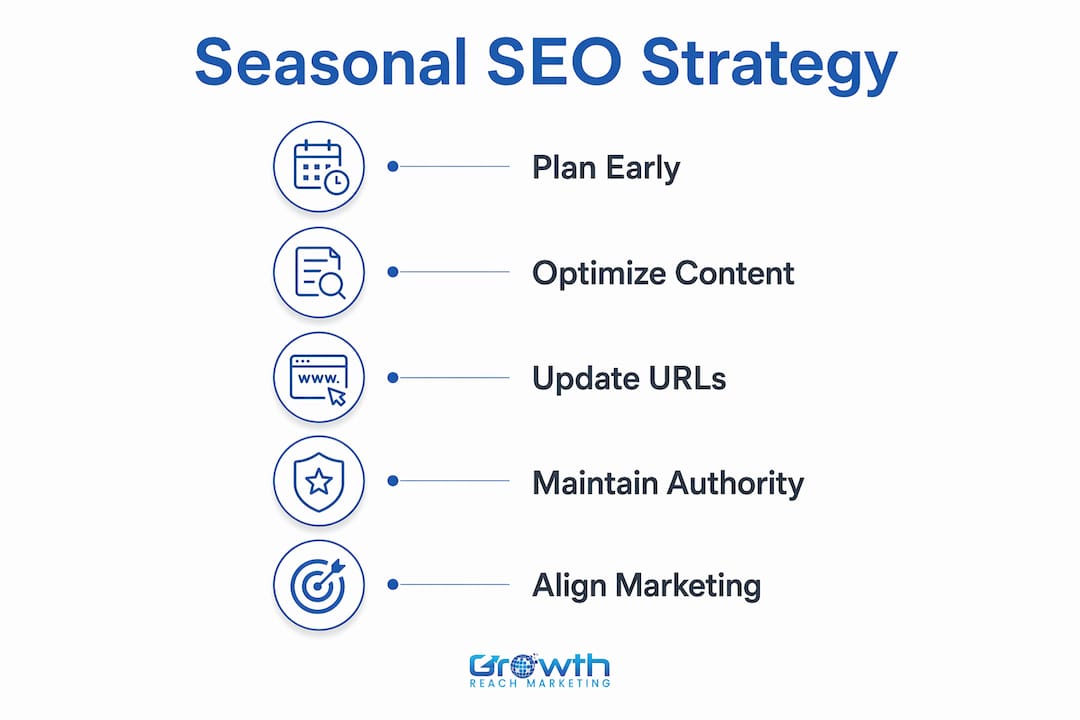
Seasonal SEO strategy is the practice of optimizing promotional content ahead of predictable rises in search demand so your beauty or wellness business captures traffic before competitors do. Most salon and clinic marketers treat seasonal promotions as a paid ads problem, pouring budget into Google Ads and Instagram the week a campaign launches. That approach leaves organic search traffic on the table entirely. The brands that win Valentine’s Day facials, summer body treatments, and holiday gift packages in search results started their SEO work months earlier, and they built pages designed to compound in authority year after year.
Why seasonal promotions need an SEO strategy to perform
Seasonal SEO is not a separate discipline from standard search optimization. It is standard SEO applied to a time-sensitive context, and the stakes are higher because the window for capturing demand is narrow. Search Engine Land defines seasonal SEO as optimizing ahead of predictable rises in search demand, with traffic patterns that vary significantly by promotion type. For a beauty brand, that means “Valentine’s Day massage deals” and “summer skin prep treatments” follow entirely different demand curves, and each requires its own preparation timeline.
The importance of SEO for promotions becomes obvious when you consider the alternative. A paid ad goes live the moment you fund it. An organic page needs weeks or months to earn ranking authority. Running both in parallel is smart. Running only paid ads means you pay full price for every click during peak demand, with no residual value after the campaign ends.

The SEO maturation problem every beauty marketer faces
LAB Open research confirms that search engines require several weeks to months to evaluate and rank seasonal content. This creates two parallel deadlines for every campaign: the date your customers start searching, and the earlier date when your content must be live for Google to index and rank it in time. Missing the second deadline means missing the first opportunity entirely.
Pro Tip: Publish your seasonal promotion page in a holding state with foundational content before the full offer is ready. Google starts the clock on indexing the moment the page goes live, not when you add the final CTA.
- Identify your three to five highest-value seasonal promotions for the year.
- Map the expected search demand peak for each (use Google Trends for beauty-specific terms).
- Count back eight to twelve weeks from that peak. That is your content publication deadline.
- Count back another two to four weeks for keyword research, content creation, and internal linking.
- Set calendar reminders and treat these deadlines as fixed, not flexible.
Does URL structure really affect seasonal promotion rankings?
URL structure is one of the most overlooked SEO decisions in seasonal marketing, and getting it wrong costs you compounding authority every single year. Search Engine Land advises against date-stamped URLs precisely because they fragment authority. A URL like "/summer-skin-treatments-2024/becomes worthless in 2026. A URL like/summer-skin-treatments/` accumulates backlinks, internal links, and ranking signals across every campaign cycle.
The contrast between these two approaches is stark when you look at the numbers over time.
| URL approach | Year 1 authority | Year 3 authority | Link equity |
|---|---|---|---|
Date-stamped (/promo-2024/) |
Starts fresh | Starts fresh again | Lost each cycle |
Evergreen (/summer-promo/) |
Builds from launch | Compounds annually | Preserved and growing |
| Redirect chain (old to new) | Partial transfer | Diluted over hops | Partially lost |
For beauty and wellness marketers running recurring campaigns, such as Mother’s Day packages, Black Friday treatment bundles, or New Year wellness resets, the evergreen URL approach means your page in year three ranks significantly faster and higher than it did in year one. Maintaining a stable URL with annual content refreshes preserves internal link pathways and strengthens cumulative SEO authority. This is the asset-based mindset that separates brands building long-term search equity from those starting from zero every season.
Pro Tip: When you refresh a seasonal page annually, update the meta title and on-page copy to reflect the current year’s offer, but keep the URL unchanged. Google reads the fresh content as a signal of relevance without losing the page’s historical authority.
Your beauty content strategy should document every seasonal URL you plan to reuse, with notes on what content to update each cycle. Treat these pages as permanent assets in your site architecture, not temporary landing pages.
What happens to your SEO when a seasonal offer expires?
Expired promotion pages are a silent SEO liability for most beauty and wellness businesses. The instinct is to delete the page or redirect it once the offer ends. Both options destroy the SEO value you spent months building. Compose.page recommends converting expired promo pages into archives with appropriate structured data, keeping them indexable and valuable long after the offer closes.
The practical approach for a salon or aesthetic clinic looks like this:
- Replace the expired offer details with a “this promotion has ended” notice plus a link to your current offers page.
- Add an FAQ section covering questions customers commonly ask about this type of treatment or package.
- Use schema markup with
priceValidUntilandavailabilityfields to signal the offer lifecycle to search engines accurately. - Include a sign-up prompt so interested visitors can be notified when the promotion returns.
- Link to related evergreen service pages to pass authority and keep users engaged.
“Treating seasonal promo pages as assets rather than disposable content improves cumulative SEO ranking and conversions over time.” — Search Engine Land
This approach means your “Black Friday facial package” page continues to rank for informational queries year-round, capturing users in the research phase months before the next campaign launches. When the promotion goes live again, the page already has authority, backlinks, and a warm audience. That is how SEO benefits sales campaigns in a way that paid advertising simply cannot replicate.
How to align your seasonal SEO calendar with your full marketing plan
Topical Map’s 2026 planning guide recommends starting SEO content planning for major holidays as early as August or September. For beauty and wellness marketers, that means your Christmas gift voucher campaign, your New Year detox package, and your Valentine’s Day couples treatment pages should all be in production before most competitors have even started thinking about Q4.
Aligning SEO with your broader marketing calendar produces measurable gains because every channel reinforces the others. Your email campaign drives traffic to a page that is already ranking. Your Instagram content links to a URL that Google has indexed for weeks. Your paid ads convert at a higher rate because the organic page has social proof, FAQs, and trust signals that a standalone ad landing page lacks.
| Season | SEO content deadline | Peak demand window | Channels to sync |
|---|---|---|---|
| Valentine’s Day | Early December | First two weeks of February | Email, Instagram, Google Ads |
| Mother’s Day | Mid-March | Last two weeks of April | Email, Pinterest, local SEO |
| Summer treatments | Early April | June through August | Blog, Instagram, Google Ads |
| Black Friday / holiday | Late August | November through December | Email, paid social, Google Ads |
Topical Map also advocates integrating SEO with broader marketing efforts for better seasonal coverage. The practical steps for beauty marketers are straightforward:
- Build an annual seasonal content calendar that maps every promotion to an SEO deadline, a content creation window, and a go-live date.
- Assign keyword research for each seasonal theme at least twelve weeks before the demand peak.
- Coordinate with your social media and email teams so campaign messaging is consistent across channels.
- Track organic traffic, ranking positions, and conversion rates for each seasonal page after every campaign cycle.
- Use that data to prioritize which pages to refresh first the following year.
Clinic calendar alignment is not just a scheduling exercise. It is the mechanism that turns individual promotions into a compounding annual growth system.
Key takeaways
Seasonal promotions without an SEO strategy capture only the paid traffic window and leave organic search revenue permanently on the table.
| Point | Details |
|---|---|
| Start SEO planning early | Begin content creation 3 to 4 months before peak demand so Google has time to index and rank your pages. |
| Use evergreen URLs | Stable URLs like /summer-treatments/ accumulate authority across years; date-stamped URLs reset to zero each cycle. |
| Preserve expired promo pages | Convert expired offer pages into resource hubs with FAQs and structured data to retain SEO value year-round. |
| Sync SEO with all channels | Aligning organic content with email, social, and paid campaigns multiplies conversion rates across every channel. |
| Treat pages as long-term assets | Pages refreshed annually outperform new pages because they carry compounding ranking signals and backlink equity. |
The SEO truth beauty marketers keep learning the hard way
I have worked with enough salons and aesthetic clinics to recognize the pattern. A clinic runs a brilliant Mother’s Day campaign in May, gets great bookings, and then deletes the page in June because “the offer is over.” By the following February, when they start thinking about Mother’s Day again, they are building from scratch. No authority. No backlinks. No indexed history. They spend twice the effort for half the result.
The brands I see pulling ahead consistently are the ones who treat their seasonal promotion pages the way a property investor treats real estate. You do not demolish a building because the tenants moved out. You renovate it, re-let it, and watch it appreciate. A “Summer Glow Package” page that has been live, indexed, and refreshed for three consecutive years will outrank a brand-new competitor page almost every time, because Google Search Central confirms that valuable, unique content remains the foundation of SEO success even as generative AI reshapes search results.
The other mistake I see constantly is treating SEO and paid ads as substitutes rather than complements. Your Google Ads campaign for a summer promotion should be driving traffic to the same URL your organic strategy has been building authority on for months. When both channels point to the same page, that page converts better, ranks better, and costs less per click over time. That is not a theory. It is what happens when you stop treating seasonal promotions as isolated events and start treating them as recurring assets in a seasonal marketing strategy built for compounding returns.
— Gerard
How Growthreachmarketing helps beauty brands win seasonal search
Growthreachmarketing works specifically with salons, aesthetic clinics, and beauty brands to build the kind of SEO infrastructure that makes seasonal promotions perform year after year. That means building evergreen URL structures, creating content calendars aligned to your promotional schedule, and ensuring your pages are technically optimized before demand peaks. If you are running seasonal campaigns without a supporting organic search strategy, you are paying full price for every customer you acquire. Growthreachmarketing’s salon SEO guide is a strong starting point for understanding how search and social work together to drive bookings at scale.
FAQ
Why do seasonal promotions need SEO strategy?
Seasonal promotions need an SEO strategy because organic rankings take weeks to months to develop, and a page that is not indexed before peak demand arrives will miss the traffic window entirely. Search Engine Land confirms that seasonal SEO requires optimizing ahead of predictable demand rises, not in response to them.
How early should beauty brands start seasonal SEO planning?
Beauty brands should start seasonal SEO planning three to four months before the expected demand peak. Topical Map’s 2026 guide recommends beginning major holiday content as early as August or September to allow adequate time for research, creation, and indexing.
Should you delete a seasonal promotion page after the offer ends?
No. Deleting an expired promotion page destroys the SEO authority it has accumulated. Compose.page recommends converting expired pages into resource archives with structured data and FAQs, keeping them indexable and positioned to rank for related queries year-round.
What URL structure works best for recurring seasonal promotions?
Evergreen URLs without year stamps, such as /christmas-gift-packages/, work best for recurring promotions. Search Engine Land advises against date-stamped URLs because they fragment link equity and force you to rebuild authority from zero each campaign cycle.
Does SEO still matter for seasonal promotions with AI-powered search in 2026?
SEO remains foundational for seasonal promotions in 2026. Google Search Central confirms that creating valuable, unique content is still the primary driver of visibility in both traditional search results and generative AI features like AI Overviews.