
Internal linking is the practice of creating hyperlinks between pages within the same clinic website to improve SEO performance and user navigation. The role of internal linking for clinic SEO goes far beyond simple navigation. It controls how Googlebot crawls your site, how PageRank flows between pages, and how strongly your content signals topical authority to search engines. Structured internal linking is the highest-leverage SEO activity for clinics because it directly influences crawl speed, authority distribution, and user engagement. Growthreachmarketing works with aesthetic clinics and beauty brands to build exactly this kind of architecture.
How does internal linking affect clinic SEO?
Internal linking serves five core functions for clinic websites: crawl facilitation, PageRank distribution, topical authority signaling, site hierarchy communication, and user navigation. Each function compounds the others. A clinic that links its service pages, condition pages, and blog posts into a coherent structure gives Google a clear map of what the site covers and which pages matter most. Without that map, even well-written content can go undiscovered.
The industry term for this practice is “link equity sculpting.” It means deliberately directing ranking power from your strongest pages toward the pages you most want to rank. For clinics, that typically means routing authority from the homepage and popular treatment pages toward newer content like provider profiles or condition-specific guides.

Pages with 40–44 internal links get four times more traffic than pages with few links. That gap exists because connectivity signals value to Google. A page with many relevant internal links pointing to it looks authoritative. A page with none looks like an afterthought.
How does Googlebot crawl clinic pages through internal links?
Googlebot discovers pages by following links. If a page has no internal links pointing to it, Googlebot may never find it. This is the orphan page problem, and it hits clinics hard because clinic websites grow fast. A new Botox page, a seasonal promotion, or a new provider bio gets published and then sits unlinked in the site structure.
Clinics frequently create orphan pages by adding new services or blog posts without linking them into the existing structure. The result is poor crawl visibility and zero ranking potential for that content. The page exists on the server but is invisible to Google and to patients searching for that service.
Crawl budget is the number of pages Googlebot will crawl on your site within a given period. Wasting it on low-value pages or failing to direct it toward important content costs you rankings. A well-linked clinic site guides Googlebot efficiently from high-authority pages to every piece of content that needs to rank.
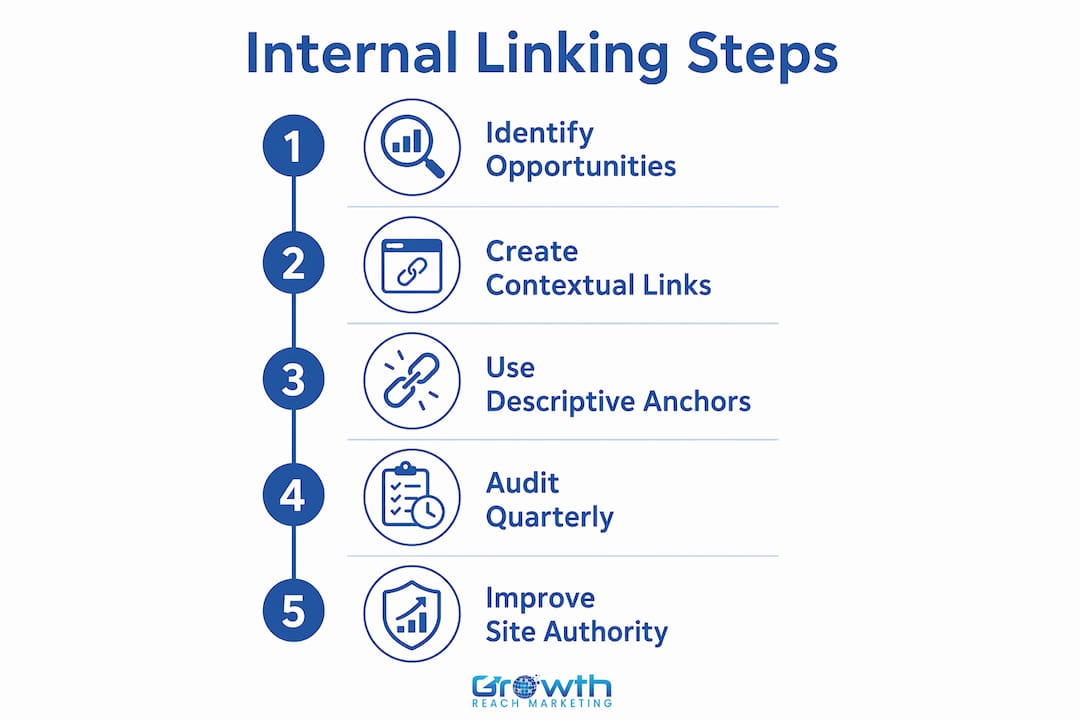
Here is a practical sequence for linking new clinic content into your site structure:
- Identify the three most relevant existing pages (a related service page, a condition page, and a blog post).
- Add a contextual link from each of those pages to the new page within the body content.
- Link the new page back to the pillar or service page it supports.
- Check that the homepage or main services page links to the section containing the new page.
- Submit the updated sitemap in Google Search Console to accelerate discovery.
Pro Tip: Every new clinic page should receive at least three contextual internal links from existing content before it goes live. Publishing without those links means Googlebot may not find the page for weeks.
How does internal linking build authority and topical relevance?
PageRank is Google’s measure of a page’s authority based on the quality and quantity of links pointing to it. Internal links pass PageRank just as external backlinks do, but you control them entirely. That control is the advantage clinics rarely use well.
The pillar-cluster model is the most effective structure for clinic websites. A pillar page covers a broad topic, such as “non-surgical facial treatments,” at a high level. Cluster pages cover specific subtopics: dermal fillers, anti-wrinkle injections, skin boosters. The pillar-cluster model creates strong topical relevance signals that increase Google ranking and AI-driven citation. Each cluster page links back to the pillar, and the pillar links out to each cluster.
The table below shows the ranking difference between connected and disconnected clinic pages.
| Page type | Internal links pointing to it | Ranking outcome |
|---|---|---|
| Pillar service page | 8–12 contextual links | Ranks for broad treatment terms |
| Cluster condition page | 4–6 contextual links | Ranks for specific condition queries |
| Blog post (linked) | 3–5 contextual links | Captures long-tail search traffic |
| Orphan page | 0 links | Rarely crawled, does not rank |
Internal linking boosts E-E-A-T signals by reinforcing topical authority through clear content clusters. When Google sees a clinic site where service pages, condition guides, and provider profiles all link to each other coherently, it reads that as expertise and trustworthiness. That matters more in healthcare than in almost any other industry.
Anchor text is the most critical factor in signaling page relevance through internal links. Vague anchors like “click here” or “read more” tell Google nothing. Specific anchors like “laser skin resurfacing” or “acne scar treatment” tell Google exactly what the linked page covers.
Pro Tip: Audit your anchor text across all internal links once per quarter. Replace any anchor that uses generic phrases with descriptive text that matches the target page’s primary keyword.
What are the best practices for internal linking on clinic websites?
Contextual links placed within body content carry more SEO value than navigational or footer links. Google weights links placed within relevant body text more heavily for ranking because they carry semantic context alongside the anchor text. A link inside a paragraph about acne treatment pointing to your acne clinic page is far more powerful than the same link sitting in a footer menu.
Clinic websites have four main content types that need to connect: service pages, condition pages, blog posts, and provider profiles. Each type should link to the others where relevant. A blog post about “what to expect after microneedling” should link to the microneedling service page, the aftercare condition page, and the provider profile of the clinician who performs the treatment. That web of connections reflects how patients actually think and search.
Reciprocal linking between related pages reinforces topical clusters. If your dermal filler page links to your lip augmentation page, the lip augmentation page should link back. This bidirectional structure tells Google both pages belong to the same topic cluster.
Common internal linking mistakes to avoid:
- Orphan pages: New service or blog pages published without any internal links pointing to them.
- Broken links: Links pointing to pages that have been deleted or moved without redirects.
- Vague anchor text: Anchors like “here,” “this page,” or “learn more” that carry no topical signal.
- Over-linking: Stuffing a single page with dozens of internal links dilutes the authority passed to each destination.
- Irrelevant links: Linking pages that share no topical relationship confuses Google’s understanding of your site structure.
Pro Tip: When a patient reads about a condition on your blog, they should be one click away from the relevant treatment page and one more click away from booking. Map that path deliberately with internal links.
What internal linking mistakes do clinics make most often?
40% of large content sites have 15% or more orphan pages that are invisible to Google and waste crawl budget. For a clinic with 80 pages, that could mean 12 or more pages that Google has never seen. Those pages cannot rank, cannot pass authority, and cannot convert patients.
Orphan pages are the single most common and most damaging internal linking failure on clinic websites. A page that Google cannot find is a page that does not exist for SEO purposes. Every new piece of clinic content must be linked into the existing structure on the day it publishes.
Broken internal links are the second major issue. When a clinic renames a service page or deletes an old blog post without setting up a redirect, every internal link pointing to that URL becomes a dead end. Googlebot hits a 404 error and stops following that path. Authority that should flow through the site disappears.
Regular automated audits are the most reliable way to find broken links and orphan pages before they damage rankings. Tools like Google Search Console, Screaming Frog, and Ahrefs all surface these issues. Manual audits work for smaller sites but become impractical once a clinic site exceeds 50 pages.
Steps for a basic internal link audit:
- Crawl the full site and export a list of all internal links and their status codes.
- Filter for 404 errors and fix each one with a redirect or a corrected link.
- Identify pages with zero inbound internal links and add at least three contextual links to each.
- Review anchor text across the site and replace generic anchors with descriptive ones.
- Check that every page published in the last 90 days appears in the crawl report.
A single well-placed contextual link from a high-authority page can improve target page rankings measurably within 2–4 weeks. That speed makes internal linking one of the fastest SEO wins available to clinics without requiring new content or backlink outreach.
Key Takeaways
Internal linking is the fastest and most controllable SEO tactic available to clinics, directly determining which pages Google finds, trusts, and ranks.
| Point | Details |
|---|---|
| Crawlability depends on links | Every clinic page needs at least three contextual internal links to be reliably found by Googlebot. |
| PageRank flows through links | Linking high-authority pages to newer content passes ranking power and accelerates indexing. |
| Pillar-cluster structure wins | Organizing service, condition, and blog pages into topic clusters builds the topical authority Google rewards. |
| Anchor text signals relevance | Descriptive anchor text tells Google what the linked page covers; generic anchors waste the opportunity. |
| Audits prevent silent damage | Regular crawl audits catch orphan pages and broken links before they erode clinic search rankings. |
What I’ve learned about internal linking after working with clinics
Most clinic owners treat internal linking as a one-time setup task. They build a site, add some navigation menus, and consider it done. That approach leaves most of the SEO value on the table.
The clinics that see the strongest organic growth treat internal linking as an ongoing editorial process. Every time a new page goes live, the team asks: which three existing pages should link here, and where should this page link to? That question takes two minutes to answer and can mean the difference between a page that ranks in six weeks and one that sits invisible for six months.
What surprises clinic owners most is how much user behavior improves alongside the SEO gains. Strong internal linking guides patients logically through healthcare topics relevant to their needs. A patient who lands on a blog post about rosacea and finds a clear link to your rosacea treatment page is far more likely to book than one who has to hunt through a menu. The SEO benefit and the patient experience benefit are the same action.
The practical lesson I keep sharing with clinic marketers is this: build the linking workflow into your content calendar, not your technical SEO checklist. When content creators, marketers, and SEO specialists all know the linking rules before a page publishes, orphan pages stop being a recurring problem. You can learn more about building that kind of content foundation in the clinic content marketing guide from Growthreachmarketing.
The clinics that monitor their internal link structure monthly, fix broken links fast, and update anchor text as their keyword strategy evolves consistently outperform those that audit once a year. It is not a complex system. It just requires consistency.
— Gerard
How Growthreachmarketing supports clinic SEO growth
Growthreachmarketing builds internal linking architecture as part of every clinic SEO engagement. The work covers full site audits, pillar-cluster content mapping, anchor text optimization, and ongoing link health monitoring so clinics never lose rankings to orphan pages or broken links.
Clinics that invest in structured SEO strategy see faster indexing, stronger topical authority, and more patient bookings from organic search. Growthreachmarketing handles the technical and content side of that work, from the first audit through to monthly performance reviews. If your clinic’s website is growing but your rankings are not, the internal link structure is almost always part of the reason.
FAQ
What is internal linking in clinic SEO?
Internal linking is the practice of connecting pages within the same clinic website using hyperlinks. It helps Googlebot crawl the site, distributes PageRank between pages, and guides patients through relevant content.
Why do orphan pages hurt clinic SEO?
Orphan pages receive no internal links, so Googlebot rarely finds or indexes them. They cannot rank in search results and contribute nothing to the site’s topical authority.
How many internal links should a clinic page have?
Pages with 40–44 internal links pointing to them receive four times more traffic than pages with few links. Aim for at least three to five contextual inbound links for every important clinic page.
What is the pillar-cluster model for clinic websites?
The pillar-cluster model links a broad service page to multiple specific condition or treatment pages. This structure signals topical authority to Google and helps the entire cluster rank for related search queries.
How often should clinics audit their internal links?
Clinics should run a full internal link audit at least once per quarter. Growing sites benefit from monthly crawl checks to catch broken links and newly created orphan pages before they affect rankings.