
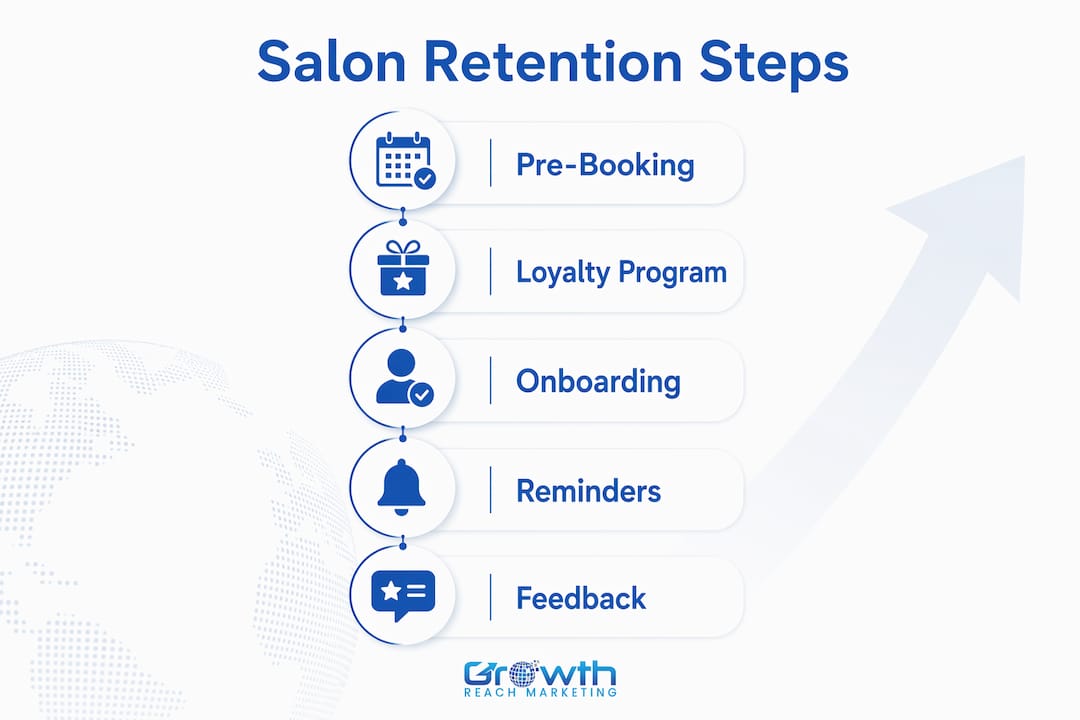
The most effective client retention strategy for a salon starts with one non-negotiable habit: rebook every client before they leave the chair. From there, a layered system of loyalty programs, personalized follow-up, and stylist-level tracking does the compounding work. Salons that build these practices into their daily operations stop running on the acquisition treadmill and start growing on a stable, recurring revenue base.
Here is what that system looks like in practice:
- Systematize pre-booking at checkout with a simple script and a small incentive, so the next appointment is confirmed while satisfaction is highest
- Launch a digital loyalty program with auto-enrollment, not a paper punch card that lives in a drawer
- Personalize every client communication by referencing the stylist’s name, the specific service, and the client’s return interval
- Track retention by stylist, share the data monthly, and coach low performers before churn compounds
- Build brand-level loyalty, not just stylist loyalty, so a resignation doesn’t take 30% of a client book with it
- Automate overdue appointment reminders triggered when a client drifts past their usual interval
- Shepherd new clients to their third visit, the point where long-term loyalty typically takes hold
Why client retention is the most important number in your salon
Retention rates tell you whether your salon is growing on solid ground or just replacing lost clients with new ones. The average salon retains a minority of new clients after their first visit, and established clients also drift annually. For salons with substantial annual revenue, client churn results in significant lost revenue that must be replaced through costly acquisition efforts every year.
The beauty industry experiences high annual staff turnover. When a stylist leaves and the salon lacks a brand-level retention system, a significant portion of that stylist’s client book can leave as well. Add the growing competition from at-home color kits and mobile stylists, and the pressure on retention has never been higher.
“New clients fuel your growth, but client retention is what actually fuels your profitability. Repeat guests typically spend more in your business than first-time clients because they have already bought into your brand.” — Kati Whitledge, owner of Be Inspired Salon
Retention also costs far less than acquisition. Acquiring a new client costs significantly more than retaining an existing one. Every percentage point you add to your retention rate preserves tens of thousands in revenue that would otherwise require a paid ad campaign to replace.
14 proven strategies to improve salon client retention
1. Systematize pre-booking at checkout
Make rebooking part of the checkout flow, not an afterthought. Train your front desk with a script that frames the next appointment as a service, not a sales pitch: “Based on your color, you’ll want to come back in about six weeks to keep it looking fresh. Want me to get that on the calendar?” Salons that systematize this achieve 35–50% pre-booking rates and see overall retention improve by 20–30%.
Pro Tip: Treat rebooking as a default client service, not an optional upsell. Remove the decision friction entirely by presenting the next appointment as the obvious next step.
2. Build a digital loyalty program with auto-enrollment
Paper punch cards get lost. Digital wallet-based programs achieve several times higher adoption because there is nothing to download, carry, or forget. The bigger operational decision is enrollment: auto-enrollment lifts participation rates from a typical 25–40% to 85–95%, which is the threshold where the program math actually starts driving behavior change.
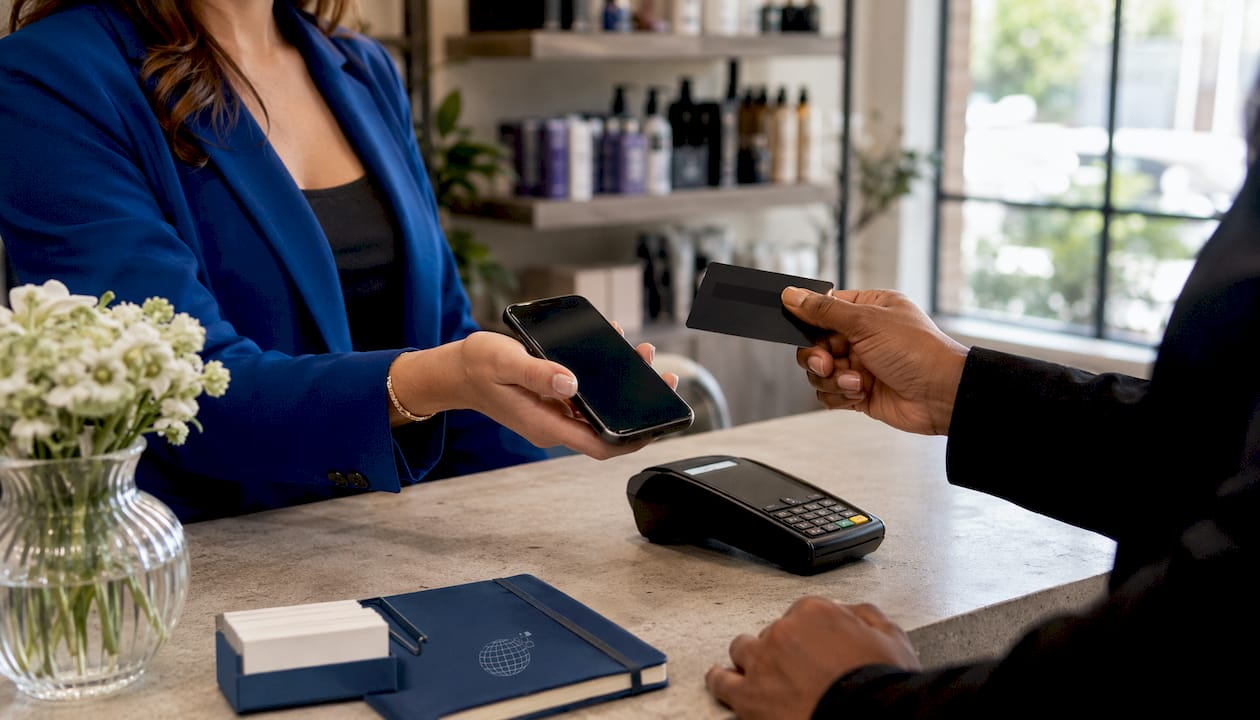
Well-designed salon loyalty programs can increase visit frequency by 15–25% and retail product sales by 20–30%. Keep the reward structure simple: a points base, a referral layer, and a birthday bonus. That combination covers the three behaviors you most want to drive.
3. Create a new client onboarding sequence
The first 90 days determine whether a new client becomes a regular or a one-time visitor. A structured three-touch sequence changes that outcome: a thank-you message within 24 hours of the first visit, a check-in with hair care tips at two weeks, and a rebooking reminder when they approach their optimal return date. Structured onboarding improves first-to-second visit conversion by 30–50%.
The third visit is the real milestone. Clients who reach it are far more likely to become long-term regulars, so focus your onboarding energy on getting them there, not just back for a second appointment.
4. Automate overdue appointment reminders
When a client drifts 1–2 weeks past their usual interval, a personalized text with a direct booking link is the single highest-ROI action you can take. Automated overdue reminders can recover 22–32% of lapsed clients. Most of them didn’t leave angry; they just got busy and forgot. A well-timed message gives them the nudge they were waiting for.
5. Track retention by stylist and act on the data
Retention is ultimately a per-stylist metric. Some stylists naturally rebook well; others need coaching on follow-up and client relationship skills. Sharing retention data with your team monthly creates accountability without blame. Salons that track stylist-level retention and act on it see a 15–25% overall retention improvement within six months. Pair low performers with high-retention mentors rather than just flagging the gap.
6. Build brand loyalty, not just stylist loyalty
When a client’s entire relationship is with one stylist, a resignation becomes a retention crisis. The fix is building salon-brand loyalty in parallel: a salon-level loyalty program, branded follow-up communication, and consistent service standards across every team member. When a stylist does leave, contact their clients immediately and personally introduce the replacement. Don’t let clients discover the change on their own.
7. Personalize every client communication
Generic booking reminders get ignored. A message that references the client’s name, their specific service, their stylist’s name, and their treatment cycle reads like a note from someone who actually knows them. That shift from transactional to personal is what makes clients feel understood rather than marketed to. Use the client notes in your booking software and make it a team habit to update them after every visit.
8. Simplify scheduling and send timely reminders
Appointment reminders reduce no-shows by 29–50% across multiple industry sources. The timing matters: send a reminder 48 hours before, then a confirmation the morning of the appointment. For hair services, a rebooking prompt at 4–6 weeks after the last visit aligns with the natural service cycle. Nail services need a shorter window of 2–3 weeks. Matching your reminder cadence to the service type is what separates a helpful nudge from noise.
9. Collect client feedback and act on it visibly
Clients who feel heard stay longer. Send a short feedback request after each visit, and when a client raises a concern, address it directly and let them know what changed. The act of following up on feedback is itself a retention signal. It tells clients the salon cares about their experience beyond the appointment.
10. Offer client appreciation gestures and VIP recognition
Birthday perks, complimentary upgrades for long-term regulars, and preferred booking times for top clients cost very little and signal genuine appreciation. The mistake most salons make is saving their best energy for new clients while coasting with regulars. Your client who has been coming every five weeks for three years deserves the same attention on visit 50 as they got on visit one.
11. Use social media and digital marketing to stay top of mind
Between appointments, clients who see your salon’s content on Instagram or receive a well-timed email with seasonal tips stay connected to the brand. This is not about posting daily. It is about showing up consistently with content that is actually relevant to their hair type, their service history, or the season. A content calendar that ties social posts, email, and in-salon messaging to the same monthly theme reinforces the brand across every touchpoint.
Pro Tip: Balance automation with authenticity. Automated reminders handle the logistics; a personal text from the stylist after a big color transformation handles the relationship. Both matter, and neither replaces the other.
12. Address complaints quickly and without defensiveness
Most churn is silent. Clients don’t leave angry; they just don’t come back. When a client does raise a concern, the response speed and tone matter more than the resolution itself. Acknowledge the issue, offer a concrete fix, and follow up afterward. A client whose complaint was handled well often becomes more loyal than one who never had a problem.
13. Re-engage inactive clients with a personal win-back message
Don’t write off clients who stopped coming. Reach out 60–90 days after their last visit with a warm, direct message. Skip the desperate discount. Something like “We’ve missed you and would love to see you again” works better than a blanket promotion, because many lapsed clients simply felt awkward returning after a long gap. Give them an easy reason to come back: a new service, a seasonal offer, or just a genuine hello.
14. Offer exclusive membership plans or prepaid packages
Memberships and prepaid packages create commitment before the client has a chance to drift. A client who has already paid for five color sessions is coming back for all five. This structure also gives you predictable cash flow and fills slower months without discounting peak demand. For salons with a high-frequency anchor service like blowouts or brow shaping, a flat monthly membership can convert occasional visitors into reliable regulars. Pair this with marketing coaching to build the right promotional structure around it.
How client experience and logistics drive loyalty
Retention is not just about programs and reminders. The day-to-day experience inside your salon either reinforces loyalty or quietly erodes it.
- Consistent service standards across all stylists build trust in the brand, not just one person. One salon group found that 85% of clients returned even after their preferred stylist left because the experience was tied to the brand.
- Simplified booking removes friction. If a client has to call during business hours, navigate a clunky website, or wait days for a confirmation, they will book somewhere easier next time.
- Genuine personal attention at the chair, remembering the vacation they mentioned or the formula that worked last time, is what clients pay premium prices for. Salon automation handles the logistics so your team can focus on that.
What the research says about salon retention best practices
The data on retention converges on a few clear patterns that separate top-performing salons from the rest.
| Strategy | Measured Impact | Source |
|---|---|---|
| Systematized pre-booking | — | PBA / Salon Today |
| Digital loyalty program (auto-enrollment) | Participation lifts from 25–40% to 85–95% | Deelo / Square |
| Automated overdue reminders | Recovers 22–32% of lapsed clients | Salon Today |
| Stylist-level retention tracking | meaningful overall improvement within six months | Salon Today |
| Structured new client onboarding | 30–50% improvement in first-to-second visit conversion | PBA |
| Loyalty program (well-designed) | visit frequency and retail product sales notably | IBISWorld |
“The biggest mistake with loyalty programs is overcomplication. Pick one simple reward structure, align your team fully, and run it consistently. A program your staff can explain in one sentence will always outperform a sophisticated one nobody understands.” — The Salon Brief
The third-visit milestone deserves special attention. Clients who reach their third visit are far more likely to become long-term regulars, which is why every new client onboarding sequence should be designed with that milestone as the explicit goal, not just the second visit.
How to communicate with clients between appointments
Effective communication between visits keeps your salon top of mind without feeling like spam. The channel mix matters: some clients respond to SMS, others prefer email, and a growing segment engages through Instagram DMs. Use both SMS and email marketing to reach clients where they actually are.
The content of those messages matters just as much as the channel. Seasonal hair care tips relevant to their service type, a heads-up about a new treatment, or a birthday message with a small perk all feel like genuine service rather than a promotional push. The goal is to make your salon the first name that comes to mind when a client thinks about their next appointment.
How to handle client complaints and turn them into loyalty
A complaint handled well is one of the strongest retention tools you have. Clients who raise a concern and receive a fast, genuine response often become more loyal than clients who never had a problem at all.
When a complaint comes in, acknowledge it the same day. Don’t get defensive, and don’t offer a discount as the first response. Ask what would make it right, then follow through. After the resolution, send a brief follow-up to confirm the client is satisfied. That final step is what most salons skip, and it is exactly what turns a frustrated client into a vocal advocate.
For clients who stop responding entirely, switch from rebooking reminders to a feedback request. A simple “We’ve missed you. Would you mind sharing any feedback about your experience?” opens a conversation that a promotional text never could.
How to win back clients who have gone quiet
Lapsed clients are not lost clients. Most of them drifted because life got busy, not because they had a bad experience. A personalized win-back message sent 60–90 days after their last visit, referencing their specific service and stylist, recovers a meaningful share of them without any discount required.
The message should feel like it came from a person, not a system. Reference something specific: “We noticed it’s been a while since your last balayage with Sarah. We’d love to get you back in.” That level of specificity signals that the salon actually tracks and values the relationship. Pair the message with a direct booking link and a gentle time frame, and you will convert a portion of lapsed clients back into regulars.
Key Takeaways
Salons that build retention into their systems, rather than relying on individual stylist relationships, consistently outperform those that treat it as a passive outcome.
| Point | Details |
|---|---|
| Pre-book at every checkout | Systematized rebooking achieves 35–50% pre-booking rates and a 20–30% retention improvement. |
| Auto-enroll in loyalty programs | Auto-enrollment lifts participation from 25–40% to 85–95%, making the program math actually work. |
| Focus on the third visit | New client onboarding should target the third visit, where long-term loyalty is established. |
| Track retention by stylist | Stylist-level tracking with coaching delivers a 15–25% overall retention improvement within six months. |
| Automate overdue reminders | Personalized overdue texts recover 22–32% of lapsed clients at the highest SMS ROI in salons. |
Retention is not a single tactic. It is a system where every touchpoint, from checkout to the follow-up text three weeks later, is designed to make coming back the easiest and most obvious choice. If you want that system to also bring in new clients while it runs, Growthreachmarketing’s salon keyword strategy guide shows how search visibility and retention work together to fill your books year-round.