Most aesthetic brands pour their budget into stunning visuals, polished branding, and paid ads, then wonder why their booking rate stays flat. The answer almost always comes down to trust. Understanding why aesthetic brands need social proof strategy is the difference between a clinic or salon that fills its calendar and one that keeps lowering prices to compete. When a potential client is deciding whether to book a $400 facial or a $1,200 injectable treatment, beautiful photos are not enough. Real people’s real experiences are what close the gap between interest and commitment.
Table of Contents
- Key takeaways
- Why aesthetic brands need social proof strategy
- Data-backed benefits for aesthetic brands
- Common social proof mistakes aesthetic brands make
- Practical strategies to build your social proof system
- Measuring and optimizing social proof over time
- My take on social proof in aesthetic marketing
- Ready to build a social proof system that fills your calendar?
- FAQ
Key takeaways
| Point | Details |
|---|---|
| Social proof drives conversions | Displaying five or more reviews can lift conversions by 270% on average, making it one of the highest-ROI tactics available. |
| Price amplifies the effect | Higher-cost aesthetic procedures benefit most from social proof, with conversion lifts reaching up to 380% for premium-priced services. |
| Placement is everything | Reviews buried on a separate testimonial page do almost nothing. Position them near booking buttons and checkout for maximum impact. |
| Systematic solicitation beats waiting | Organic review rates sit at 1 to 2%. Asking in person or via SMS and email multiplies your review volume by two to five times. |
| Authenticity outperforms perfection | A 4.2-star rating with specific, honest reviews converts better than a flawless 5-star profile that consumers distrust. |
Why aesthetic brands need social proof strategy
Aesthetic services sit in a unique category of consumer spending. The client is not buying a product they can return. They are investing in how they look and feel, often spending hundreds or thousands of dollars on a single appointment. That emotional and financial weight means hesitation is the default state for new clients.
Social proof reduces perceived risk by acting as a mental shortcut. When a potential client sees that 200 people have left five-star reviews describing their experience with a specific treatment, the brain interprets that as evidence the risk is low. It is the same reason people line up outside a busy restaurant while an empty one next door gets ignored.
The most common types of social proof in aesthetic brand marketing include:
- Customer reviews on Google, Yelp, or RealSelf
- Before-and-after testimonials with specific outcome details
- Influencer and micro-influencer mentions from trusted voices in beauty and wellness
- User-generated content shared by real clients on Instagram or TikTok
- Case studies and detailed client stories on your website
“Trust is now the gatekeeper for brand visibility, selectability, and repeatability in the wellness economy.” — NielsenIQ, 2026
Functional trust has overtaken emotional trust in the wellness and aesthetic space. Consumers no longer take a brand’s word for quality. They validate claims through peer experiences and third-party sources before they ever pick up the phone. If your brand is not actively building that third-party validation, you are invisible at the moment that matters most.
Data-backed benefits for aesthetic brands
The numbers behind social proof are not subtle. They are the kind of figures that should reshape how you think about your marketing budget.
Five or more reviews lift conversions by 270% compared to products or services with no reviews at all. That is not a marginal improvement. That is the difference between a website that generates bookings and one that generates traffic with nothing to show for it.
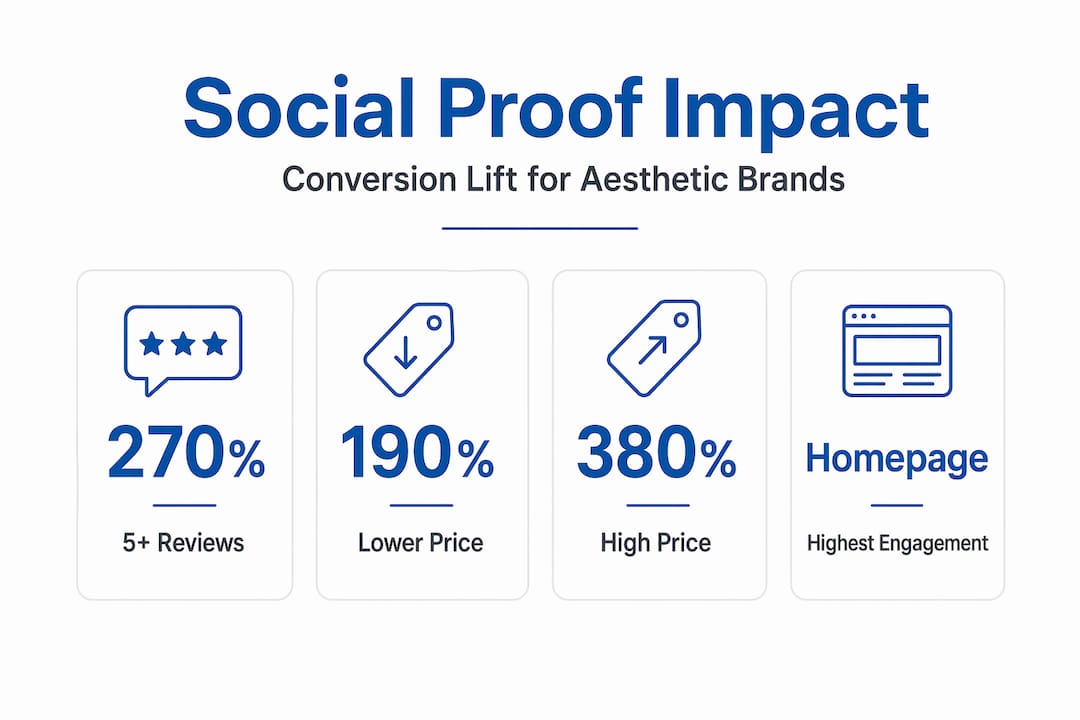
The impact scales with price. Here is how the data breaks down:
| Price point | Conversion lift from social proof |
|---|---|
| Lower-priced services | ~190% |
| Higher-priced services | ~380% |
Source: Easy Social Proof, 2024
This matters enormously for aesthetic clinics offering premium treatments. A Botox appointment, a laser resurfacing package, or a high-end facial is exactly the kind of purchase where a prospective client will spend 20 minutes reading reviews before booking. The conversion lift at higher price points reaching 380% tells you that the more expensive the service, the harder your social proof needs to work.
One more data point worth internalizing: consumer engagement with social proof is highest when it appears on homepages, service pages, and checkout flows. Homepages influence 86% of consumers, service pages influence 85%, and checkout pages influence 78%. A standalone testimonials page, by contrast, barely moves the needle. Your reviews need to be where the decisions are made, not tucked away where only the most motivated visitors will find them.
Common social proof mistakes aesthetic brands make
Most aesthetic brands are not ignoring social proof entirely. They are just doing it wrong. And doing it wrong can be almost as damaging as doing nothing.
Here are the most common mistakes and why they cost you bookings:
- Generic, overproduced testimonials. A quote like “Amazing experience, highly recommend!” tells a prospective client nothing useful. It sounds like marketing copy, not a real person’s experience. Specific testimonials that mention the treatment, the provider, and the outcome are what build actual trust.
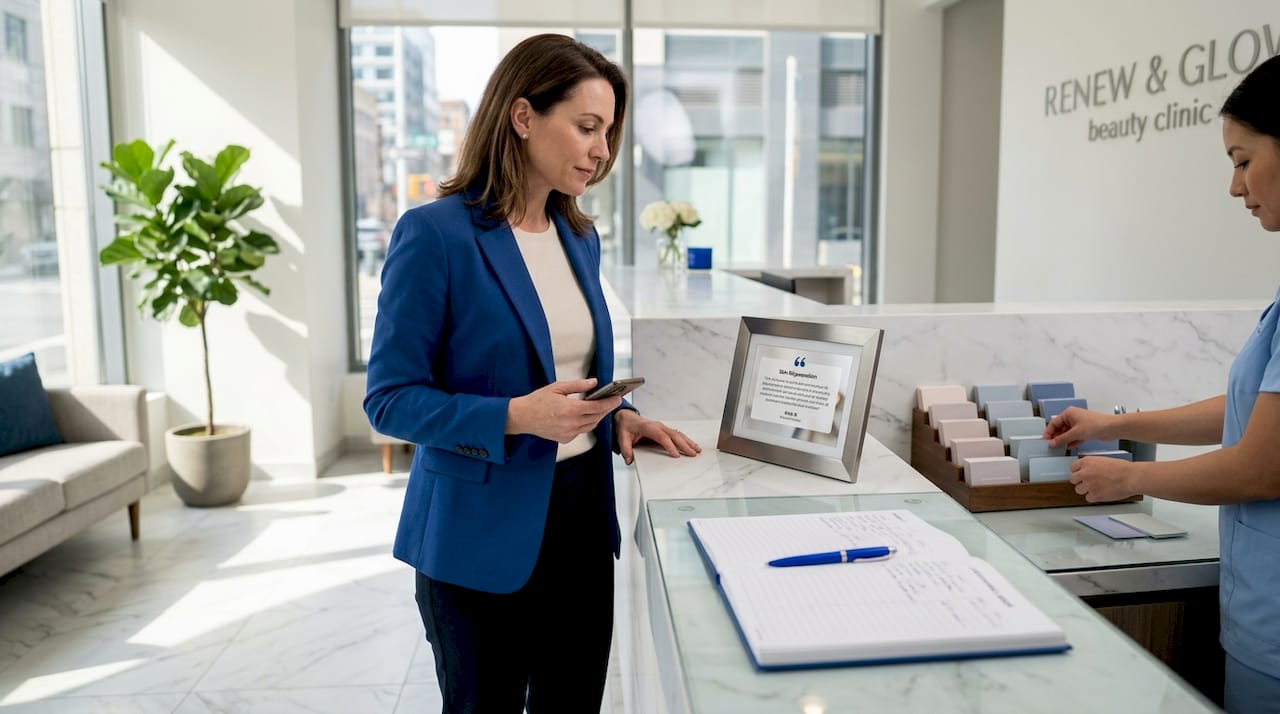
- Burying reviews on a separate page. Sending visitors to a dedicated testimonials page removes social proof from the moments that count. Most people never reach that page. Place reviews where decisions happen.
- Waiting for reviews to come in organically. Organic review rates in most service businesses sit between 1% and 2%. If you served 100 clients last month and did nothing to ask for reviews, you likely got one or two. That is not a social proof strategy. That is luck.
- Chasing a perfect 5-star rating. This one surprises most brand owners. Conversion rates peak between 4.0 and 4.7 stars, then drop as ratings approach perfection. Consumers are skeptical of a flawless score. A mix of excellent reviews with the occasional honest critique actually builds more credibility than a suspiciously perfect record.
- Ignoring review placement at checkout. Placing outcome-focused testimonials directly beneath your booking CTA is one of the highest-leverage moves you can make. Most aesthetic brands skip this entirely.
Pro Tip: When a client gives you verbal praise after a treatment, that is your best moment to ask for a written review. Train your front desk team to say something like: “We are so glad you loved it. Would you mind sharing that on Google? It takes about two minutes and helps other clients find us.”
Practical strategies to build your social proof system
Knowing you need social proof is not the same as having a system that generates it consistently. Here is how to build one that works.
1. Solicit reviews at the right moment. In-person review requests achieve a 27% response rate. Combined SMS and email follow-ups hit 26%. Compare that to the 1 to 2% you get from doing nothing, and the math is obvious. Ask in person at checkout, then follow up with a short SMS within 24 hours.
2. Place social proof where decisions happen. Your booking page, service description pages, and any page with a “Book Now” button should have reviews visible without scrolling. Testimonials placed near booking CTAs lift conversions by 15 to 25%. That is free revenue sitting on the table.
3. Use specific, outcome-focused testimonials. Pull quotes that mention the actual treatment and a measurable or emotional result. “My skin looked noticeably brighter after one HydraFacial and I had zero downtime” is worth ten generic five-star ratings. Feature these prominently on your homepage and service pages.
4. Leverage employee and founder content. Your team’s expertise is social proof too. A short video from your lead aesthetician explaining why she recommends a specific treatment builds trust in a way that no ad can replicate. This is especially powerful on Instagram Reels and TikTok, where beauty industry content marketing thrives on authentic voices.
5. Keep your social proof fresh. A review from 2021 does not carry the same weight as one from last month. Prioritize recency. Use automated follow-up tools to generate a steady stream of new reviews rather than a burst of activity followed by silence.
Here is a quick comparison of passive versus active social proof collection:
| Approach | Monthly reviews generated | Effort required |
|---|---|---|
| Passive (no solicitation) | 1 to 2 per 100 clients | None |
| Active in-person requests | 25 to 30 per 100 clients | Low (training + script) |
| Active SMS and email follow-up | 24 to 26 per 100 clients | Low (automation setup) |
Pro Tip: Use a QR code at your front desk that links directly to your Google review page. Clients who are happy in the moment can leave a review before they even leave your building.
Measuring and optimizing social proof over time
Building a social proof system is not a one-time project. It needs ongoing attention to stay effective. The good news is that the metrics are straightforward.
Track these four things consistently:
- Review volume and velocity. Are you generating new reviews every week? A sudden drop in review frequency is a signal that your solicitation process has broken down.
- Average star rating by service. If one treatment consistently generates lower ratings, that is a product or delivery problem, not a marketing problem. Fix the service first.
- Conversion rate on pages with social proof. Compare booking rates on pages before and after adding testimonials near CTAs. The lift should be measurable within 30 to 60 days.
- Engagement on social proof content. Before-and-after posts and client testimonial videos consistently outperform product-only content. Track which formats generate the most saves, shares, and profile visits.
A/B testing is your best tool here. Try two versions of a booking page, one with reviews near the CTA and one without, and let the data tell you what works. You can also test the format of social proof itself. A written quote might outperform a star rating widget for certain treatments, while video testimonials might convert better for higher-ticket procedures. Pair this with insights from your Google Ads conversion data to get a full picture of what is actually driving bookings.
My take on social proof in aesthetic marketing
I have worked with enough aesthetic brands to notice a consistent pattern. The ones struggling with client acquisition almost always have the same gap: they have invested in their brand visuals but treated social proof as an afterthought. A beautiful website with no reviews is like a stunning storefront with the lights off.
What I have found actually works is not complicated, but it does require intention. The brands that win are the ones that build review collection into their client journey the same way they build in the consultation or the aftercare call. It is not a campaign. It is a process.
The shift I keep seeing in this industry is that consumers no longer trust emotional appeals. “We care about your results” does not move people anymore. Specific, functional proof does. A testimonial that says “I had three sessions of laser hair removal and saw 90% reduction by session two” is more persuasive than any tagline you could write.
One thing I would push back on is the instinct to only showcase perfect reviews. I have seen brands suppress or ignore anything below five stars, and it backfires. The 4.0 to 4.7 star sweet spot is real. Showing that you handle criticism professionally, with a thoughtful public response, builds more trust than a suspiciously pristine record.
Treat social proof as a core pillar of your marketing, not a box to check. The brands that do this consistently are the ones that stop competing on price.
— Gerard
Ready to build a social proof system that fills your calendar?
At Growthreachmarketing, we work specifically with salons, aesthetic clinics, and beauty brands to build marketing systems that generate real bookings, not just traffic. Social proof is one of the most underused conversion tools in this industry, and we know exactly where to place it, how to collect it, and how to make it work alongside your paid and organic channels.
If you want to see how review strategy fits into a broader paid advertising approach, our salon owner’s ads guide walks through how conversion actions and social signals work together to lower your cost per booking. You can also explore our full range of aesthetic marketing services to see where social proof fits into a complete growth strategy. Reach out to Growthreachmarketing today for a personalized review of your current setup.
FAQ
Why do aesthetic brands need a social proof strategy?
Aesthetic services carry high emotional and financial stakes, which means new clients need significant reassurance before booking. A dedicated social proof strategy builds that trust systematically, rather than leaving it to chance.
How does social proof affect conversion rates for aesthetic services?
Displaying five or more reviews lifts conversions by an average of 270%, with the effect reaching up to 380% for higher-priced treatments. Placement near booking CTAs adds an additional 15 to 25% lift.
What is the best way to collect reviews for an aesthetic clinic?
In-person requests at checkout generate a 27% response rate, making them the most effective method. Following up with a short SMS or email within 24 hours captures clients who did not respond in the moment.
Does a perfect 5-star rating help or hurt an aesthetic brand?
It often hurts. Consumers tend to distrust perfect scores, and conversion rates peak between 4.0 and 4.7 stars. A mix of strong, specific reviews with the occasional honest response to criticism is more credible than a flawless record.
Where should aesthetic brands display social proof on their website?
Place reviews on your homepage, individual service pages, and directly beneath booking or payment CTAs. Consumer engagement with social proof is highest at these three locations, with standalone testimonial pages having far less impact on actual conversions.