

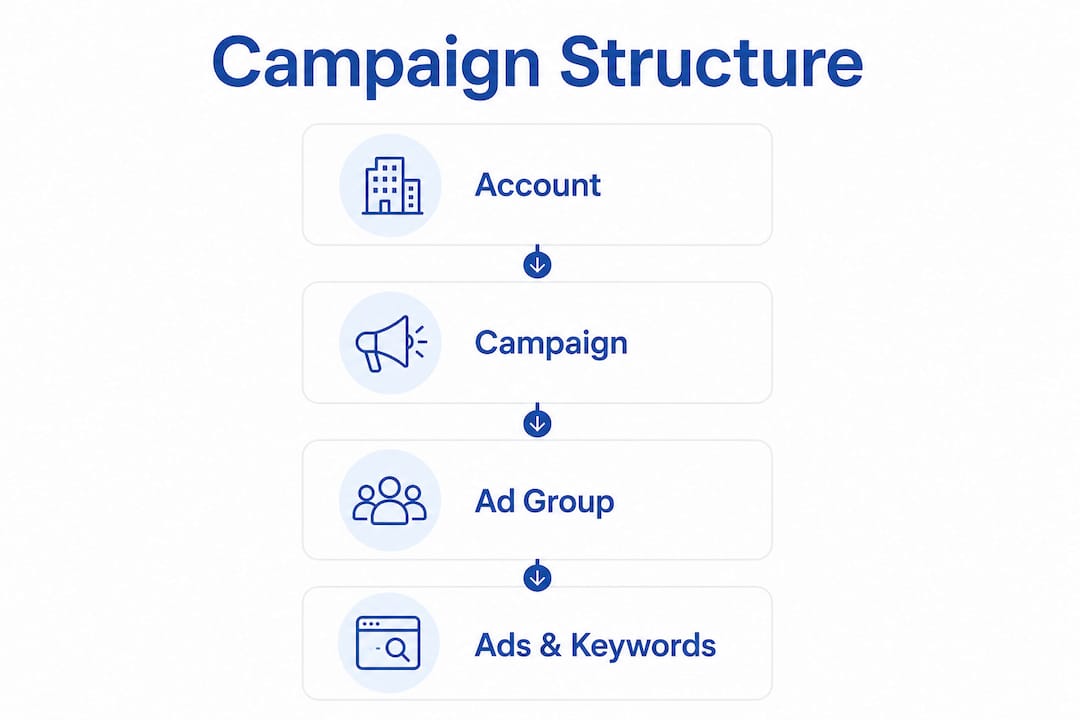
A Google Ads campaign structure is a hierarchical framework that organizes your advertising account into campaigns, ad groups, ads, and keywords to control targeting, bidding, and measurement at each level. The account hierarchy follows a fixed order: Account > Campaign > Ad Group > Ads/Keywords. Every decision you make at each level either sharpens or dilutes your ad performance. For marketing professionals and business owners running paid search, understanding this structure is not optional. It determines how efficiently your budget works, how fast Google’s machine learning optimizes, and whether your campaigns compete against themselves.
What is a Google Ads campaign structure and how does it work?
The Google Ads hierarchy has four distinct levels, and each one controls a different set of variables. Confusing these levels is the single most common reason campaigns underperform despite adequate budgets.
Account level holds all campaigns under one billing profile and login. Settings like conversion tracking, linked Google Analytics 4 properties, and payment methods live here. Changes at this level affect everything below it.

Campaign level is where you set your budget, bidding strategy, campaign type, geographic targeting, and primary conversion goal. Each campaign should represent one objective. A lead generation campaign and a brand awareness campaign should never share the same campaign container, because their bidding strategies and success metrics are fundamentally different.
Ad group level sits inside each campaign and groups together a tightly themed set of keywords and the ads that match them. Think of an ad group as a single conversation topic. A spa running Google Ads might have one ad group for “facial treatments” and a separate one for “massage bookings.” Mixing those two themes in one ad group weakens ad relevance and lowers Quality Score.
Ads and keywords are the execution layer. Keywords trigger your ads to appear; ads deliver the message and direct users to a landing page. The quality of this match between keyword, ad copy, and landing page is what Google measures when assigning Quality Score, which directly affects your cost per click.
How to choose the right campaign types for your business goals
Google Ads campaign types include Search, Display, Shopping, Performance Max, Video, Demand Gen, App, and Local. Each type serves a distinct purpose and reaches users through different placements and targeting mechanics.
The table below maps common business goals to the most appropriate campaign type.
| Business goal | Recommended campaign type | Why it fits |
|---|---|---|
| Capture high-intent search demand | Search | Text ads appear when users actively search for your service |
| Drive product sales from a catalog | Shopping or Performance Max | Product listings show price, image, and store name |
| Build brand awareness at scale | Display or Video | Visual placements reach users across millions of sites and YouTube |
| Generate leads for a local service | Search with location targeting | Targets users searching near your business |
| Maximize conversions across channels | Performance Max | Google’s AI allocates budget across all placements automatically |
Service businesses like salons, clinics, and local contractors typically start with Search campaigns targeting high-intent keywords, then layer in Performance Max once conversion data is established. E-commerce brands often run Shopping campaigns for product-specific queries alongside Search campaigns for branded terms. The key principle is that separate goals require separate campaigns. Blending a brand awareness objective with a direct response goal in one campaign forces the bidding algorithm to serve two masters, and it will serve neither well.
Pro Tip: Before selecting a campaign type, write down the single conversion action you want that campaign to drive. If you cannot name one specific action, the campaign is not ready to launch.
What are best practices for structuring ad groups and keywords?
Ad group organization is where most campaigns either gain or lose their edge. The 5 to 20 keyword rule is the most cited benchmark in the industry: keep each ad group to between 5 and 20 closely related keywords. This range keeps intent tight enough for your ads to be genuinely relevant without spreading the ad group so thin it loses statistical meaning.
Here is what strong ad group structure looks like in practice:
- One theme per ad group. A dental clinic running ads should have separate ad groups for “teeth whitening,” “dental implants,” and “emergency dentist.” Each theme gets its own headlines, descriptions, and landing page.
- Match types matter within the theme. Use a mix of exact match and broad match within the same ad group rather than creating separate ad groups for each match type. This consolidates data and helps the algorithm learn faster.
- Landing page alignment is non-negotiable. Every ad group should point to a landing page that directly addresses the keyword theme. Sending “teeth whitening” searches to a generic homepage wastes budget and drops Quality Score.
- Naming conventions save hours. Label campaigns and ad groups with a consistent format such as [Location] | [Service] | [Match Type]. This makes auditing and reporting far faster, especially when managing accounts with dozens of campaigns.
- Avoid keyword overlap between ad groups. When the same keyword appears in two ad groups within the same campaign, Google decides which ad to show, and that decision may not favor your best-performing creative.
The risk of bloated ad groups is real. When unrelated keywords share an ad group, your ad copy cannot speak to all of them with equal relevance. A user searching “laser hair removal” who sees an ad written for “waxing services” will not click. That missed click raises your effective cost per acquisition even if your bids stay constant. For local service businesses, Growthreachmarketing recommends reviewing ad copy alignment with keyword themes as a first diagnostic step in any account audit.
How does campaign structure affect Google Ads machine learning?
Campaign structure shapes machine learning by defining the auction boundaries within which Google’s bidding algorithms operate. Clean structure means clean data signals. Messy structure means the algorithm is working with noise.
When two campaigns target overlapping keywords, they compete in the same auctions. This splits impressions and conversion data across both campaigns, reducing the learning velocity of each. Google’s Smart Bidding strategies like Target CPA and Target ROAS require a minimum volume of conversions per campaign to exit the learning phase. Fragmented data delays that exit and keeps campaigns in a perpetual state of suboptimal bidding.
“Campaign structure directly influences Google Ads machine learning by shaping auction boundaries and data signal clarity, accelerating or stalling optimization.” — Improvado, Google Ads Campaign Management Guide 2026
Effective conversion tracking aligned to one goal per campaign gives the algorithm a single, unambiguous target to optimize toward. A campaign with three different conversion actions weighted equally sends mixed signals. The algorithm cannot tell whether a phone call is worth more than a form submission unless you tell it explicitly through conversion value settings.
Brands with large product catalogs should separate evergreen and seasonal campaigns to preserve historical learning. When a seasonal campaign ends and restarts, it re-enters the learning phase. Keeping it separate from your always-on campaigns protects the performance stability of your core account.
What are common mistakes in Google Ads campaign structuring?
Structural errors are the most underdiagnosed cause of poor Google Ads performance. Most advertisers look at bids and budgets first. The real problem is usually one level higher.
- Keyword overlap above 15%. More than 15% duplication across campaigns is a high-severity issue. It creates internal competition, splits conversion signals, and slows bidding optimization. Run a search term report across campaigns monthly to catch this early.
- Mixing brand and generic keywords. Brand campaigns and generic campaigns must be separated. Brand terms convert at lower cost and higher intent. When they share a campaign with generic terms, brand budget subsidizes more expensive clicks, and you lose visibility into each segment’s true performance.
- One campaign for all products or services. A single consolidated campaign covering every service you offer dilutes budget across too many themes. A salon running one campaign for haircuts, color, extensions, and bridal packages cannot optimize bids or budgets for each service independently.
- Performance Max asset groups built around audiences only. Asset groups perform best when organized by product or service themes such as bestsellers, new releases, or high-margin services. Organizing purely by audience segment gives the algorithm inconsistent creative signals.
- No geo-targeting logic at the campaign level. Running national campaigns for a local business wastes budget on irrelevant geographies. Understanding geo-targeting at the campaign level is a foundational step that many advertisers skip.
Pro Tip: Audit your account for keyword overlap before adjusting bids. A structural fix will outperform a bidding adjustment every time if the root cause is duplication.
Key takeaways
A well-designed Google Ads campaign structure requires a clear hierarchy, one conversion goal per campaign, tightly themed ad groups, and zero keyword overlap to maximize both budget efficiency and machine-learning performance.
| Point | Details |
|---|---|
| Four-level hierarchy | Account, Campaign, Ad Group, and Ads/Keywords each control distinct targeting and bidding variables. |
| One goal per campaign | Assigning a single conversion action per campaign gives Smart Bidding a clear optimization target. |
| 5 to 20 keywords per ad group | Tightly themed ad groups improve ad relevance, Quality Score, and landing page alignment. |
| Keyword overlap threshold | Keep duplication below 5% across campaigns; above 15% is a high-severity structural issue. |
| Performance Max asset groups | Organize by product or service theme, not just audience, to deliver consistent signals to Google’s AI. |
Why structure is the most underestimated lever in Google Ads
Most advertisers I audit are chasing performance through bid adjustments and creative refreshes while their campaign structure is actively working against them. I have reviewed accounts where two campaigns were bidding on identical keywords, splitting a $3,000 monthly budget between them and wondering why neither campaign had enough conversion data to exit the learning phase. The fix took 20 minutes. The performance improvement took two weeks to materialize, but it was dramatic.
The instinct to consolidate everything into one or two campaigns to “simplify management” is understandable, but it is counterproductive. Consolidation without structural logic is just chaos with fewer line items. What actually simplifies management is a clear naming convention, one goal per campaign, and a monthly overlap audit. That takes discipline, not complexity.
I also see the opposite mistake: accounts so granular that no single campaign accumulates enough conversion data to train Smart Bidding effectively. The right level of granularity depends on your monthly conversion volume. If a campaign generates fewer than 30 conversions per month, consider merging it with a closely related campaign rather than running it in isolation.
The paid media management principle that applies here is structural boundaries create optimization clarity. Every campaign boundary you draw is a signal boundary for the algorithm. Draw them with intention.
— Gerard
How Growthreachmarketing can help you build a stronger campaign structure
Growthreachmarketing works with salons, aesthetic clinics, and local service businesses to audit and rebuild Google Ads accounts from the structural level up. Poor campaign organization is the most common issue we find in new client accounts, and it is also the most fixable.
Our Google Ads service covers campaign structure audits, conversion tracking setup, ad group reorganization, and ongoing performance management. If your campaigns are spending but not converting, the problem is almost always structural before it is creative or budgetary. Explore our Google Ads conversion guide to see how proper structure connects directly to measurable results for local service businesses.
FAQ
What is the Google Ads account hierarchy?
The Google Ads hierarchy runs Account > Campaign > Ad Group > Ads/Keywords. Each level controls different settings, from billing and conversion tracking at the account level to keyword themes and creative at the ad group level.
How many keywords should be in one ad group?
Keep each ad group to between 5 and 20 closely related keywords. This range maintains tight intent alignment, improves Quality Score, and makes it easier to write ad copy that speaks directly to the search query.
Why should brand and generic keywords be in separate campaigns?
Brand keywords convert at lower cost and higher intent than generic terms. Mixing them in one campaign causes brand budget to subsidize more expensive generic clicks, and it obscures the true performance of each segment.
How does campaign structure affect Smart Bidding?
Smart Bidding strategies like Target CPA and Target ROAS require clean, sufficient conversion data per campaign to optimize effectively. Overlapping keywords and multiple conversion goals in one campaign dilute those signals and slow the algorithm’s learning phase.
What is the best structure for Performance Max campaigns?
Performance Max asset groups perform best when organized by product or service theme, such as high-margin services, seasonal offers, or bestselling products, rather than by audience segment alone. This gives Google’s AI consistent creative and economic signals to optimize spend.