
Online booking is the single biggest operational lever available to med spa owners right now. Top-performing med spas fill a substantially higher share of their appointments through online booking than the average practice. That 20-point gap translates directly into revenue, client retention, and front-desk capacity. Med spas with high digital adoption generate approximately $9,900 in incremental revenue per location per month, according to Zenoti’s 2026 Beauty and Wellness Benchmark Report. The role of online booking in med spa growth goes well beyond convenience. It determines whether a potential client books with you or clicks away to someone else.
The numbers tell a clear story. 69% of clients prefer businesses that offer online scheduling, and 50% will not book at all if they are forced to call. Automated reminders tied to online booking can significantly reduce no-shows. Platforms like PatientNow and Zenoti have built entire ecosystems around these behaviors, and tools like AestheticsPro, Vagaro, and Fresha have made online scheduling accessible at every budget level.
The growth impacts stack up across every part of the business:
- Revenue: Off-hours bookings capture demand that phone-only practices miss entirely
- Retention: One-click rebooking and membership integrations keep clients coming back
- Operations: Reduced front-desk workload and fewer scheduling errors
- Marketing: Booking widgets embedded in Google Business Profiles, Instagram, and email campaigns convert traffic directly into appointments
- No-shows: Automated SMS and email reminders cut missed appointments by up to 30%
- Data: Booking analytics reveal which services, providers, and time slots drive the most revenue
How online booking drives med spa growth
The most direct benefit is appointment volume. A booking widget that lives on your website, Google Business Profile, and social media pages captures clients at the exact moment they decide they want a service. That moment rarely falls between 9 AM and 5 PM on a weekday. 83% of med spa bookings happen on mobile devices, which means clients are browsing and booking from their couch at 9 PM. A phone line cannot compete with that.
Beyond volume, online booking changes the quality of the client relationship from the first interaction. Clients who book themselves are more committed to the appointment. Research published in PMC found that online-booked appointments had a no-show rate of 1.8% compared to 5.9% for phone-booked appointments in a medical practice setting. That difference in attendance directly affects revenue per available hour.
The operational side is just as compelling. Every appointment booked online is one fewer phone call your front desk handles, one fewer manual entry in your scheduling software, and one fewer opportunity for a double-booking error. For a busy med spa running 40 or 50 appointments a day, that adds up to real labor savings.
Core digital booking benefits for med spas include:
- 24/7 availability: Captures bookings outside business hours when demand is highest
- Reduced no-shows: Automated reminders via SMS and email cut missed appointments
- Lower front-desk load: Staff spend less time on phones and more time with clients
- New client conversion: Booking widgets on Google, Instagram, and your website turn browsers into booked appointments
- Upsell opportunities: Smart booking flows suggest add-on services at checkout
- Retention tools: Membership programs and one-click rebooking keep clients returning
What features should an effective med spa booking system have?
Not every booking system delivers the same results. The gap between a high-converting booking flow and a mediocre one comes down to a handful of specific features.
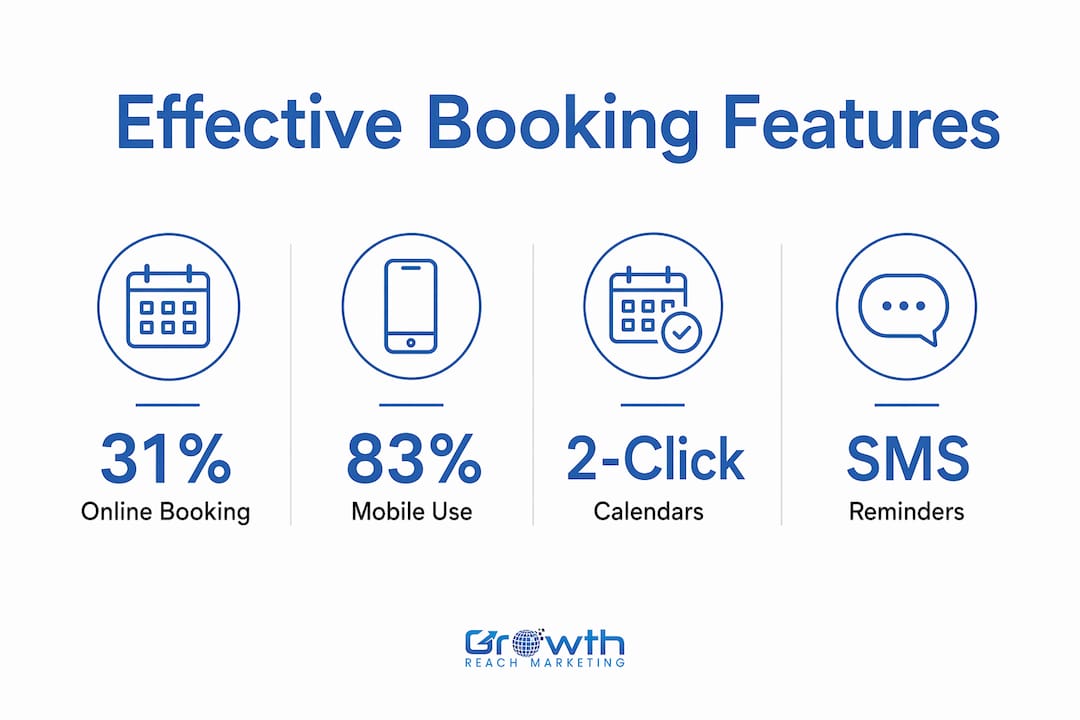
Embedded 2-click calendars are the gold standard. The client sees available times without leaving your website, selects one, confirms, and they are done. Any system that redirects clients to a third-party page or requires account creation before showing availability is bleeding bookings.
Mobile-first design is not optional given that 83% of bookings happen on mobile. Large tap targets, minimal form fields, and a flow that works identically on a phone and a laptop are baseline requirements, not premium features.
Automated reminders via SMS and email are the most direct tool for no-show reduction. PatientNow builds this into its patient management workflow. Vagaro and Fresha both include automated reminder sequences in their core plans. AestheticsPro and Workee offer customizable reminder timing so you can test what works for your client base.
AI-powered lead routing separates the advanced platforms from the basic ones. When a client books a high-value consultation, like a full-face filler assessment or a laser resurfacing package, the system should flag that inquiry and route it to a specialist rather than treating it like a standard appointment. AestheticsPro’s 2026 industry analysis highlights this as one of the most impactful features for revenue per booking.
Additional features that matter:
- Integration with practice management software: PatientNow connects booking directly to client records, treatment history, and consent forms
- Deposit collection at booking: Reduces no-shows and filters out low-intent clients
- HIPAA-compliant data handling: Any system storing client health information must meet federal privacy standards
- Membership and package redemption: Clients should be able to apply prepaid packages directly in the booking flow
- Analytics dashboard: Tracks conversion rates, drop-off points, and peak booking times
Pro Tip: Before committing to any platform, run the full booking flow yourself on a mobile device. Time how long it takes from landing on your website to receiving a confirmation. If it takes more than 90 seconds, you are losing clients.
Common booking mistakes that cost med spas clients
The most expensive mistake a med spa can make is treating the booking flow as an afterthought. Friction in the booking flow can lose up to 40% of new leads, and most of that friction is self-inflicted.
Forced account creation is the single biggest conversion killer. A new client who has never visited your spa does not want to create a password before they can see your availability. They will leave. The fix is to allow guest checkout for first-time bookings and offer account creation after the appointment is confirmed.
Multi-step flows with external redirects are nearly as damaging. If clicking “Book Now” on your website opens a new tab to a third-party scheduling page, you have introduced doubt at the worst possible moment. Clients wonder whether the page is legitimate, whether their data is safe, and whether they are even booking with the right business. Embed the calendar directly on your site.
Common booking mistakes and their fixes:
- Forced login before booking: Switch to guest checkout; offer account creation post-confirmation
- External redirect booking pages: Embed the calendar widget directly on your website
- Too many service options on one screen: Group services by category with clear descriptions
- No deposit or cancellation policy shown: Display policy before checkout to set expectations
- Missing mobile optimization: Test the flow on iOS and Android before launch
- No confirmation email or SMS: Automate confirmation messages immediately after booking
- Ignoring abandoned bookings: Set up automated follow-up for clients who started but did not finish
Pro Tip: Use Google Analytics or your booking platform’s built-in funnel report to find exactly where clients drop off. Most med spas lose the majority of abandoners at the service selection screen, not the payment screen.
How to optimize your med spa booking flow for sustained growth
Optimization is where the gap between average and top-performing med spas actually opens up. Getting online booking installed is the starting point. Turning it into a growth engine requires deliberate work on the flow itself.
Cart recovery is the fastest win most med spas are not using. When a client starts a booking and does not finish, an automated follow-up message sent within an hour can recover a meaningful share of those lost appointments. Abandoned booking recovery generates a notable amount of recovered revenue per location monthly for businesses that have it in place, according to Zenoti’s 2026 Benchmark Report.
Smart upsells at checkout work the same way they do in your treatment room. A client booking a hydrafacial sees a suggestion for an LED add-on. Someone booking a Botox consultation sees a prompt for a complimentary skin analysis. Zenoti data shows that contextual upsells at checkout achieve a 25% success rate. That is one in four clients upgrading because the system asked at the right moment.
One-click rebooking for returning clients removes the biggest barrier to repeat visits. Your regulars should not have to re-enter their information or navigate the full flow every time. Fresha and Vagaro both offer returning-client shortcuts that pull saved preferences and payment details.
Optimization tactics that move the needle:
- Cart recovery automation: Follow up with clients who abandoned the booking flow within 60 minutes
- Contextual upsells: Suggest relevant add-ons based on the service being booked
- One-click rebooking: Let returning clients rebook their last service in a single tap
- Membership integration: Allow members to apply their benefits directly in the booking flow
- Peak-hour analysis: Use booking data to identify underbooked time slots and run targeted promotions
- A/B test your booking button: Test placement, color, and copy on your website to improve click-through rates
- Google Business Profile booking link: Connect your booking system directly to your Google listing so clients can book without visiting your website
Pair your booking optimization with a broader digital presence strategy. Google Business Posts that link directly to your booking page can drive a measurable lift in appointment volume from local search.
What does the research say about AI and online booking in US med spas?
The data on AI-integrated booking tools is specific enough to act on. Med spas using AI-enabled booking tools posted higher year-over-year sales growth compared to practices still using manual scheduling systems, according to RepuClinic’s 2026 analysis. That four-point difference compounds quickly across a multi-location operation.
No-show reduction of up to 30% is achievable through automated reminders integrated with online booking systems, according to appointment scheduling research.
The mechanism matters. AI booking tools perform best when they capture lead details and route high-value consultation inquiries to the right staff member rather than trying to close the sale automatically. AestheticsPro’s 2026 industry trend report makes this point directly: the goal is to get the right human on the phone with the right client, not to replace that conversation with a chatbot. Workee’s platform applies a similar logic, using AI to qualify and sort incoming inquiries before they reach the front desk.
Key research findings on AI and digital booking in med spas:
- AI-enabled practices grew sales at 5% versus 1% for non-users in 2026
- Online-booked appointments show a 1.8% no-show rate versus 5.9% for phone-booked in clinical settings
- Average online booking penetration is 11%; top earners reach 31%
- AI tools capture leads 24/7 and route consultations without replacing human follow-up
- Automated SMS reminders are among the most effective individual tools for reducing no-shows
- High digital adoption correlates with 78% staff utilization versus 47% at average practices
For med spas investing in Google Ads for medical aesthetics, AI-powered booking tools close the loop between paid traffic and confirmed appointments, which is where most ad spend leaks.
Real-world examples of med spas winning with online booking
The benchmark data from Spa Ledger’s 2026 P&L analysis tells the story in aggregate, but the pattern shows up consistently at the practice level too. Top-earning med spas share three operational traits: a 78% staff utilization rate, a 69% same-day rebooking rate, and a 31% online booking penetration rate. Average practices hit 47%, 40%, and 11% respectively on those same metrics. The difference is not marketing spend. It is infrastructure.
Practices that have moved their booking widget from a generic third-party page to an embedded calendar on their own website consistently report lower drop-off rates. The change removes the redirect friction that costs up to 40% of new leads. Paired with a deposit requirement at booking, the same practices see no-show rates fall sharply because clients who pay something to hold a slot show up.
Vagaro users in the med spa space frequently cite the platform’s Instagram and Facebook booking integration as a direct driver of new client volume. A client who discovers a before-and-after post on Instagram can book an appointment without leaving the app. That zero-friction path from discovery to confirmed appointment is exactly what the 2026 aesthetic clinic marketing landscape identifies as the new baseline expectation for clients under 40.
Fresha’s free-tier model has allowed smaller single-location med spas to implement professional booking infrastructure without a monthly software cost, then layer in paid features like marketing automation as revenue grows. PatientNow serves the higher end of the market, integrating booking with full electronic medical records, consent form management, and before-and-after photo storage. The right platform depends on your volume and complexity, but the common thread across successful implementations is that the booking flow is treated as a client-facing product, not a back-office tool.
Training your staff to support online booking effectively
A well-configured booking system fails if the team around it does not know how to use it. Staff training on online booking falls into three areas: system management, client communication, and data review.
System management means every front-desk team member knows how to manually override the calendar, block time for walk-ins or emergencies, and process a booking that came in overnight. They should also know how to handle a client who calls to book even after you have pushed online scheduling. The answer is never to refuse the phone call. It is to complete the booking by phone and then send the client a link to manage future appointments online.
Client communication training covers how to explain the booking system to first-time visitors and how to handle complaints when the system does not work as expected. A client who tried to book online and got confused is not a lost cause. A staff member who can walk them through the process in 60 seconds and complete the booking on their behalf turns that friction into a positive interaction.
Data review is the part most teams skip. Your booking platform generates reports on conversion rates, drop-off points, peak booking times, and service popularity. Someone on your team should look at those numbers weekly. Not to generate a presentation, but to catch problems early. If your Tuesday afternoon slots are consistently going unfilled while Thursday is overbooked, that is a scheduling configuration issue, not a demand problem.
Practical staff training priorities:
- Manual override and calendar management: Every front-desk team member should handle this without help
- Client onboarding to online booking: Train staff to send booking links via text during phone calls
- Handling booking errors: Establish a clear protocol for double-bookings and system outages
- Weekly data review: Assign one person to check booking funnel reports and flag anomalies
- Deposit and cancellation policy enforcement: Staff should know exactly how to handle disputes
- Upsell prompts at check-in: When the system suggests an add-on, staff should be prepared to reinforce it in person
The med spa brand positioning work you do at the marketing level only pays off if the booking experience clients encounter matches the promise. Staff who understand the system and believe in it are the last mile of that conversion.
Key Takeaways
Online booking is the most measurable growth lever available to med spa owners in 2026, with top performers achieving 31% booking penetration and approximately $9,900 in incremental monthly revenue per location through high digital adoption.
| Point | Details |
|---|---|
| Booking penetration gap | Top earners fill 31% of appointments online versus 11% for average practices. |
| No-show reduction | Automated reminders tied to online booking cut no-shows by up to 30%. |
| AI booking advantage | AI-enabled med spas grew sales at 5% in 2026 versus 1% for manual-scheduling practices. |
| Cart recovery revenue | Abandoned booking follow-up generates approximately $800 per location per month. |
| Friction cost | Booking flow friction can eliminate up to 40% of new leads before they confirm. |
Grow your med spa bookings with Growthreachmarketing
Your booking system is only as effective as the traffic you send to it. Growthreachmarketing helps med spas and aesthetic clinics build the full digital infrastructure: SEO that ranks your services in local search, Google Ads that put you in front of high-intent clients, and conversion-focused website design that turns visitors into booked appointments. If your local SEO for beauty brands is not driving consistent traffic to your booking page, the best scheduling software in the world will not move your revenue numbers.
Get in touch with Growthreachmarketing to find out where your booking funnel is leaking and what it would take to close the gap between your current 11% and the 31% your top competitors are already hitting.
Recommended
- Med Spa Brand Positioning Steps for 2026 Growth – Growth Reach Marketing
- Med Spa Google Ads Benefits: 2026 Owner’s Guide – Growth Reach Marketing
- How Google Business Posts Help Med Spas Get Booked – Growth Reach Marketing
- 1783829821246_Med-spa-owner-reviewing-brand-strategy-notes – Growth Reach Marketing