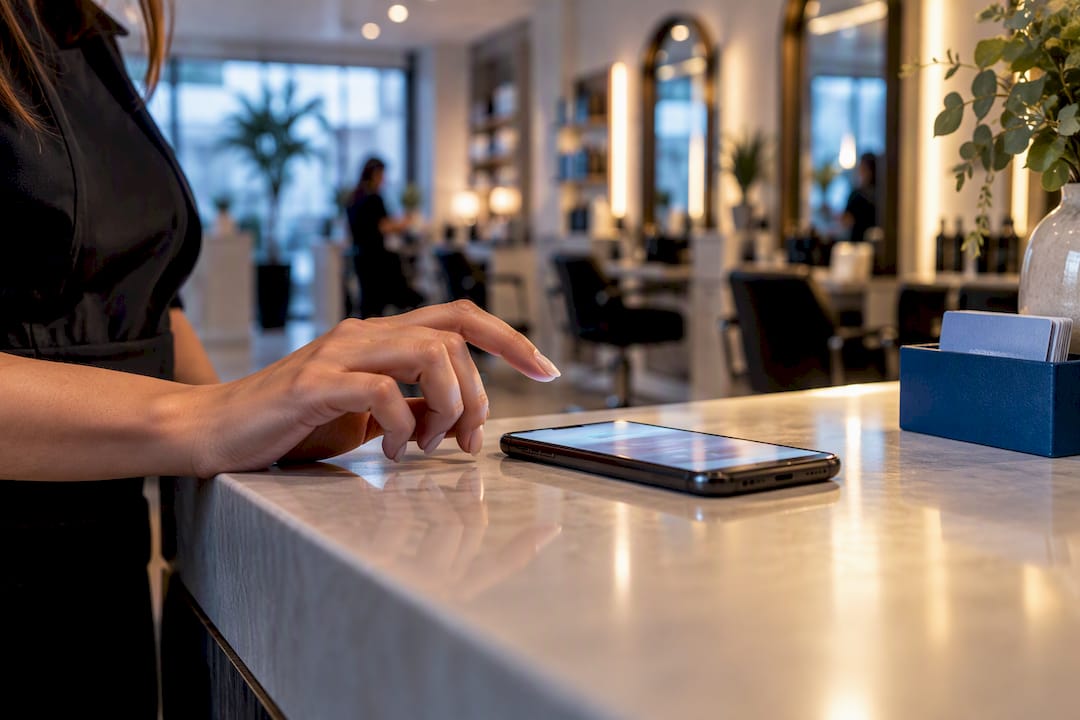

A clear call-to-action turns a site visit into a booked appointment. That single sentence captures the entire role of call-to-action in salon websites: without a visible, specific prompt, most visitors browse your portfolio, admire your work, and leave without doing anything that earns you revenue.
The highest-impact moves you can make right now:
- Place your primary “Book Now” button in the header and above the fold on every page
- Keep one primary CTA per page to avoid splitting visitor attention
- Write benefit-led copy (“Book your color consult — 20% off new clients”) instead of vague prompts like “Learn more”
- Track CTA clicks as separate events in Google Analytics so you know what’s actually converting
- Run at least one A/B test per month on button copy or color
Tools like Google Analytics and booking platforms such as Vagaro or GlossGenius give you the data to measure every one of those moves. Growthreachmarketing works with salons to build exactly this kind of conversion-focused website system.
Table of Contents
- What does a call-to-action actually mean for a salon site?
- Why CTAs matter specifically for salon websites
- What CTA types work best for salons, and when should you use each?
- Where should you place CTAs on each page of your salon site?
- What makes a salon CTA actually perform?
- How do micro and macro conversions map to the salon booking funnel?
- How do you measure CTA performance and run A/B tests that matter?
- What CTA mistakes are salons making right now?
- How Growthreachmarketing audits and optimizes CTAs for salon clients
- Key Takeaways
- The CTA gap most salons don’t see
- Growthreachmarketing’s booking funnel service for salons
- Useful sources and tools for measuring and testing your CTAs
What does a call-to-action actually mean for a salon site?
A call-to-action (CTA) is a specific, directional prompt that reduces friction and guides a visitor toward one defined next step, whether that’s booking an appointment, joining your email list, or requesting a stylist consultation. It is not a navigation menu item, a page title, or a content link. A navigation link says “here’s more information.” A CTA says “do this now, and here’s why it benefits you.”
On a salon website, CTAs split into two tiers:
Primary CTA: The booking action. “Book Now,” “Schedule Your Appointment,” “Reserve Your Spot.” This is the macro-conversion every page should point toward.
Secondary CTAs: Everything that moves a visitor closer to booking without completing it. Newsletter signup, stylist match quiz, portfolio view, promotional offer claim. These are micro-conversions that build intent.
A CTA is not decoration. It is the moment your website stops being a brochure and starts being a sales tool. Every page that lacks one is a page that earns you nothing.
The distinction matters because many salon sites treat their booking button like a navigation item, buried in a menu or placed only at the bottom of a service page. That’s a structural problem, not a design preference.
Why CTAs matter specifically for salon websites
Salons live and die by appointment volume. A website that generates traffic but no bookings is an expensive business card. The role of CTAs is to close that gap between “someone found you online” and “someone is sitting in your chair.”

Focusing each page on a single primary objective reduces cognitive friction and raises conversion likelihood. When a visitor lands on your balayage service page and sees three competing prompts (book now, read our blog, follow us on Instagram), they often choose none. One clear primary CTA removes that paralysis.
The business impact compounds across the funnel:
- Bookings: A visible, specific booking CTA converts passive browsers into paying clients
- Upsells: Service-level CTAs (“Add a deep conditioning treatment”) increase average ticket value
- Retention: Newsletter CTAs capture email addresses you can market to for months without paying for traffic again
- Reduced no-shows: Lead-qualification CTAs (consult request forms, stylist match quizzes) attract clients who are genuinely committed before they arrive
Hard-to-find booking buttons and poor imagery are among the most common reasons salon sites fail to convert leads into actual appointments. Fixing CTA visibility is often the single highest-ROI change a salon can make to its website, and it costs nothing but time.
Measurement tools to monitor: Google Analytics goals (track CTA click events), your booking software’s conversion dashboard (Vagaro, GlossGenius, Fresha), and UTM parameters on any paid or social traffic feeding the site.
What CTA types work best for salons, and when should you use each?
Not every CTA serves the same purpose. Here’s how the main types map to salon goals, with copy templates you can use immediately.

| CTA Type | Best Page(s) | Goal | Copy Example |
|---|---|---|---|
| Primary booking button | Header, hero, service pages | Macro: confirmed booking | “Book Your Appointment” |
| Service-specific CTA | Individual service pages | Macro: service booking | “Schedule Your Color Consult” |
| Stylist match quiz | Homepage, About page | Micro: lead qualification | “Find Your Perfect Stylist” |
| Promo/urgency banner | Homepage hero | Macro: immediate booking | “20% Off New Clients — Book This Week” |
| Newsletter signup | Blog, footer, exit intent | Micro: email capture | “Get Exclusive Offers + Style Tips” |
| SMS opt-in | Booking confirmation, footer | Micro: SMS list growth | “Text STYLE to 12345 for VIP Deals” |
| Chatbot/conversational | All pages | Micro: qualification + booking | “Chat With Us — We’ll Find Your Slot” |
| Portfolio/gallery CTA | Gallery, stylist profile pages | Micro: trust building | “See More of [Stylist Name]’s Work” |
Copy templates by client type:
- New client: “First Visit? Book Your Complimentary Consultation”
- Returning client: “Welcome Back — Book Your Next Appointment”
- Upsell: “Add a Gloss Treatment to Your Color Service”
- Urgency: “Only 3 Slots Left This Weekend — Reserve Yours”
- Seasonal promo: “Summer Refresh Packages — Book Before [Date]”
- Referral: “Refer a Friend, Get $20 Off Your Next Visit”
Featuring current promotions above the fold creates urgency and gives visitors an immediate reason to act. Pair that with benefit-led copy, and you’ve covered the two biggest conversion levers on any salon homepage.
Chatbot vs. direct booking button: Use a chatbot CTA when your services require consultation before booking (color corrections, extensions, treatments with a wide price range). Use a direct booking button when the service is straightforward and the visitor is ready to commit. Mixing both on the same page works only if the chatbot is positioned as a secondary option, not a competing primary prompt.
Where should you place CTAs on each page of your salon site?
Placement is where most salons leave money on the table. High-converting salon sites place the primary CTA in the header, hero section, and after key service descriptions, creating a persistent path to booking regardless of where a visitor enters the page.
Page-by-page priority:
- Header (persistent): “Book Now” button, top right. Visible on every scroll position, every page.
- Homepage hero (above the fold): Primary CTA with a benefit statement. If you’re running a promotion, this is where it lives.
- Service pages: CTA immediately after the service description and price. Don’t make visitors scroll to find it.
- Stylist profile pages: “Book with [Name]” button directly below the bio and portfolio images.
- Blog posts: Inline CTA mid-article and one at the end. Tie the CTA to the post topic (“Ready for your own balayage? Book here”).
- Footer: Secondary CTA (newsletter signup or contact form) plus a repeated booking link for visitors who scroll all the way down.
On long pages, repeat the primary CTA two to three times. Never place two competing primary CTAs in the same viewport — that recreates the decision paralysis you’re trying to eliminate.
Pro Tip: Use a heatmap tool like Hotjar or Microsoft Clarity (both free tiers available) to see exactly where visitors click and where they stop scrolling. If your booking button sits below the scroll depth of 60% of your visitors, move it up. Session recordings will show you the specific moment people abandon the booking flow.

Mobile placement rules: Sticky CTAs (a button fixed to the bottom of the screen) work well on mobile because they stay within thumb reach. Buttons should be at least 44×44 pixels to meet Apple’s Human Interface Guidelines for tappable targets. Test your booking flow on a real phone, not just a browser simulator.
What makes a salon CTA actually perform?
Design clarity and social proof outperform decorative animations every time. A flashy parallax effect does not book appointments. A high-contrast button with specific copy does.
Visual rules:
- Use a button color that contrasts sharply with your background (not a shade of the same palette)
- Keep the button large enough to read at a glance and tap without precision
- Surround the CTA with white space so it doesn’t compete visually with surrounding content
- Avoid hover effects that obscure the button text or delay the click
Copy rules:
- Start with an action verb: “Book,” “Schedule,” “Reserve,” “Claim”
- Follow with the specific benefit: what the visitor gets, not what they do
- Add supporting subtext for price or time: “From $85 · 60 minutes · No deposit required”
- Use urgency only when it’s real: “3 slots left this Saturday” beats “Book now before it’s too late” every time
“Book your color consult — 20% off new clients” consistently outperforms vague CTAs like “Learn more” or “Click here.” Specificity is the variable that moves the metric.
Accessibility: Check your button color contrast against WCAG 2.1 AA standards (a minimum contrast ratio of 4.5:1 for normal text). Use descriptive button labels rather than “Click here” — screen readers read button text aloud, and “Book your balayage consultation” is far more useful than “Submit.” Add ARIA labels when the visual context doesn’t carry into the code.
Pro Tip: Test CTA copy that references a stylist’s name or your neighborhood. “Book with Maria in Midtown” often outperforms a generic “Book Now” for returning clients or visitors who arrived via a stylist’s Instagram. Personalized CTAs increase relevance without adding complexity to the booking flow.
How do micro and macro conversions map to the salon booking funnel?
Every visitor to your salon website is somewhere on a path from “just browsing” to “appointment confirmed.” CTAs are the signposts that move them forward.
Micro-conversions are the small commitments that build intent: viewing a stylist’s portfolio, completing a hair quiz, signing up for your newsletter, saving a promotion. None of these put money in the register immediately, but they qualify the visitor and keep your salon top of mind.
Macro-conversions are the revenue events: a confirmed booking, a deposit paid, a gift card purchased.
The salon booking funnel, with the CTA that drives each stage:
- Awareness: Visitor lands on your homepage from Google or Instagram. CTA: “See Our Work” (portfolio gallery) or promo banner with an offer.
- Qualification: Visitor explores services or takes a stylist match quiz. CTA: “Find Your Perfect Stylist” or “Schedule a Free Consultation.”
- Intent: Visitor lands on a specific service page. CTA: “Book Your [Service Name]” with price and duration visible.
- Booking: Visitor enters the scheduling flow. CTA: “Choose Your Date and Time.”
- Confirmation: Booking complete. CTA: “Add to Calendar” and “Refer a Friend for $20 Off.”
Tracking distinct CTA event types separately (button clicks, form submissions, chat starts, quiz completions) in Google Analytics lets you see exactly where visitors drop out of this funnel. A high click rate on “Book Now” paired with a low booking completion rate points to a problem in the scheduling tool itself, not the CTA.
Lead-qualification CTAs (the stylist match quiz, the consult request form) serve a specific purpose beyond just capturing leads: they filter out visitors who aren’t ready to commit. Clients who complete a consultation request before booking show up. Clients who clicked “Book Now” impulsively sometimes don’t. Understanding your salon marketing funnel helps you place the right CTA at the right funnel stage.
How do you measure CTA performance and run A/B tests that matter?
Measurement without a testing plan is just data collection. Here’s what to track and how to act on it.
Core KPIs:
| Metric | What It Tells You | How to Track |
|---|---|---|
| CTA click-through rate (CTR) | % of page visitors who click the CTA | Google Analytics event tracking |
| Booking conversion rate | % of CTA clicks that result in a confirmed booking | Booking software dashboard + GA goals |
| Booking-to-attendance rate | % of bookings that show up | Booking software reports |
| Micro-conversion rate | % completing email signup, quiz, etc. | GA events per CTA type |
| Average revenue per booking | Revenue tied to CTA-driven bookings | Booking software + UTM attribution |
Set up Google Analytics 4 event tracking for every CTA: button clicks, form submissions, and chat initiations should each fire a named event. Use UTM parameters on all paid and social traffic so you can attribute bookings to their source.
Heatmaps and session recordings identify where users abandon the booking funnel and where CTAs need reinforcement — they answer the “why” behind the numbers your analytics dashboard shows.
A/B testing checklist for salons:
- Test one variable at a time: copy, color, size, or placement (never two at once)
- Run each test for a minimum of two weeks, or until you reach statistical significance
- For low-traffic salons (fewer than 500 monthly visitors), focus on the highest-traffic page only and accept longer test windows
- Document your hypothesis before you start: “Changing the CTA from ‘Book Now’ to ‘Reserve Your Spot This Week’ will increase click-through rate because it adds specificity and mild urgency”
Example hypotheses with expected impact:
- Copy specificity: “Book Your Balayage Consult” vs. “Book Now” — expected lift: 10–20% CTR improvement on the color service page
- Button color: High-contrast coral vs. muted gold on a neutral background — expected lift: measurable within 3 weeks on homepage
- Placement: CTA above vs. below the service description — expected lift: depends on scroll depth data from heatmap
Simple tests on color, copy, and button size often produce the largest early wins for salons with limited traffic. Save the heavier technical changes (booking flow redesign, multi-step form replacement) for after you have statistically significant data from the simpler tests.
What CTA mistakes are salons making right now?
Most of these take under an hour to fix.
- Burying the booking button: If “Book Now” only appears in the footer, you’ve hidden your most important conversion point. Fix: Add it to the header and hero section today. Time: 15 minutes.
- Multiple competing CTAs in the same viewport: Three buttons of equal visual weight in the same screen view split attention and reduce clicks on all of them. Fix: Designate one primary CTA per viewport section. Time: 20 minutes.
- Vague copy: “Click here” and “Learn more” tell the visitor nothing about what happens next. Fix: Rewrite every CTA button with an action verb and a specific benefit. Time: 30 minutes.
- Tiny tap targets on mobile: A button that’s easy to click on a desktop becomes frustrating on a phone. Fix: Set minimum button height to 44px and test on a real device. Time: 10 minutes.
- No event tracking: If you can’t see which CTAs are being clicked, you’re flying blind. Fix: Set up Google Analytics 4 CTA click events. Time: 45–60 minutes with a developer.
- Ignoring social proof near CTAs: A booking button surrounded by nothing converts less than one placed next to a five-star review or a before/after photo. Fix: Add one testimonial or result image adjacent to your primary CTA. Time: 20 minutes.
- Using the same CTA copy everywhere: “Book Now” on every page treats a first-time visitor the same as a returning client. Fix: Customize CTA copy by page intent and client type. Time: 45 minutes.
- No urgency on promotional CTAs: A promo banner without a deadline has no reason to be clicked today. Fix: Add a specific end date or slot count to any promotional CTA. Time: 5 minutes.
How Growthreachmarketing audits and optimizes CTAs for salon clients
Growthreachmarketing’s CTA audit process for salon clients follows a structured sequence designed to find revenue leaks fast and fix them in a defined order.
The audit process:
- Discovery: Map the salon’s current booking sources, traffic channels, and revenue goals
- Funnel mapping: Identify every page in the conversion path from landing to confirmed booking
- Heuristic audit: Evaluate each CTA against placement, copy, design, and accessibility standards
- Heatmap and session review: Use tools like Hotjar or Microsoft Clarity to identify drop-off points and missed click opportunities
- A/B roadmap: Prioritize three to five test hypotheses ranked by expected impact and implementation effort
- Implementation support: Build or brief the changes with the salon’s web team or CMS
- Measurement handoff: Configure Google Analytics events and booking software callbacks so the salon can track results independently
The salons that see the fastest booking lifts are rarely the ones with the most traffic. They’re the ones that stopped treating their website as a static brochure and started treating it as a living sales tool — iterating on the funnel, reading heatmaps, and converting social proof into CTA-driven trust signals.
Growthreachmarketing’s focus is AI-powered SEO, local search, and booking funnel optimization for salons and beauty brands across the United States. The first 30-day engagement delivers a full CTA and funnel audit, a prioritized A/B test roadmap, and implementation support so changes go live, not just into a slide deck.
Key Takeaways
Well-placed, benefit-led CTAs are the single highest-ROI change most salon websites can make, converting passive visitors into booked appointments without increasing ad spend.
| Point | Details |
|---|---|
| One primary CTA per page | Limiting each page to one primary objective reduces decision fatigue and raises conversion rates. |
| Placement drives performance | Place your booking CTA in the header, hero, and after every key service description. |
| Specificity beats vague copy | “Book your color consult — 20% off new clients” consistently outperforms generic prompts like “Learn more.” |
| Measure every CTA separately | Track button clicks, form submissions, and chat starts as distinct events in Google Analytics. |
| Growthreachmarketing accelerates results | Growthreachmarketing’s 30-day audit and A/B roadmap gives salons a prioritized, measurable path to more bookings. |
The CTA gap most salons don’t see
The conventional wisdom on salon websites says: make it pretty, show your work, and add a booking button. That advice isn’t wrong. It’s just incomplete in a way that costs salons real money.
The part most articles skip is the sequence. A booking button on a homepage hero is table stakes. What actually moves the needle is matching the CTA to where the visitor is in their decision process. A first-time visitor who found you through a Google search for “balayage salon near me” needs a different prompt than someone who’s been following your stylist on Instagram for three months. One needs trust signals and a low-commitment entry point (a consult, a quiz, a portfolio). The other is ready to book and just needs the button to be obvious.
The salons that get this right treat their website as a set of marketing strategies working together, not a single static page. They run tests, read heatmaps, and update CTA copy the way they update their service menu. That’s not a technical skill. It’s a habit.
Growthreachmarketing’s booking funnel service for salons
Salons that want more bookings from their existing website traffic don’t need a full redesign. They need a systematic audit of what’s blocking conversions and a clear plan to fix it.
Growthreachmarketing’s CTA and booking funnel service gives you exactly that: a full audit of your current CTA placement, copy, and design; a prioritized A/B test roadmap; and hands-on implementation support so changes go live within the first 30 days. The service is built specifically for salons, aesthetic clinics, and beauty brands across the United States, and it connects keyword strategy with on-site CTAs so the traffic you’re already earning converts at a higher rate. If you’re also running seasonal offers, pairing them with a proper local SEO strategy means those promotions reach the right clients at the right moment. Contact Growthreachmarketing to request your salon CTA audit and get a clear picture of what your website is leaving on the table.
Useful sources and tools for measuring and testing your CTAs
| Category | Recommended Tools | Why It Helps Salons |
|---|---|---|
| Web analytics | Google Analytics 4 | Tracks CTA click events, booking conversions, and traffic sources |
| Heatmaps and session recording | Hotjar, Microsoft Clarity | Shows where visitors click, scroll, and abandon the booking flow |
| A/B testing | Google Optimize (via GA4), VWO | Tests CTA copy, color, and placement with real visitor data |
| Booking software | Vagaro, GlossGenius, Fresha | Provides booking conversion dashboards and webhook callbacks |
| Accessibility checking | WebAIM Contrast Checker, WAVE | Verifies WCAG 2.1 AA color contrast for CTA buttons |
| Digital signage and promo CTAs | SignStream flash sale guide | Extends promo CTAs to in-salon screens for cross-channel consistency |
Configuration tips: In Google Analytics 4, create a custom event for each CTA type (e.g., cta_click_book_now, cta_click_newsletter, cta_click_quiz). Set each as a conversion event in the GA4 admin panel. In your booking software, use webhook callbacks to fire a GA4 event when a booking is confirmed, so you can close the loop between CTA click and actual appointment. Add UTM parameters to every paid ad and social link so you know which traffic source is driving your highest-converting visitors.
For deeper reading on how your website’s internal structure affects CTA discoverability, Growthreachmarketing’s salon marketing funnel guide walks through the full conversion path from first click to confirmed booking.