

Responsive Search Ads are the right format for clinic and salon search campaigns, and Google has phased out most alternatives anyway. The first move is practical: build service-specific ad groups, write one RSA per group tied to a dedicated landing page, and pin any mandatory disclaimer language before you launch. Skip the pinning step and a rotating headline can strip out a required claim without anyone noticing.
TL;DR:
- Pin all mandatory disclaimers and safety language to specific RSA headlines or descriptions to prevent them from being omitted in dynamic combinations.
- Build one campaign per service line with dedicated ad groups and landing pages to maintain relevance and control budget effectively.
- Prioritize tracking calls, form submissions, and landing page load times from day one for accurate measurement of campaign performance.
- Use diverse, well-written headlines categorized by service, benefit, trust, and call to action for optimal ad testing and quality scores.
- Pair RSAs with local Service Ads and programmatic channels for comprehensive local patient acquisition without overlap or conflicting messaging.
Table of Contents
- Getting Responsive Search Ads Clinics Can Launch This Week
- How Do Responsive Search Ads Actually Work?
- Why Does RSA Pinning Matter for Medical Ads?
- What Makes a Clinic Landing Page Actually Convert?
- How Should You Structure Campaigns and Targeting?
- How Do You Test and Improve RSA Performance?
- Where Do LSAs and Programmatic Fit Alongside RSAs?
- What Clinics Get Wrong About RSAs
- Get Your Clinic’s RSA Campaign Built Right the First Time
- Sources
- FAQ
Getting Responsive Search Ads Clinics Can Launch This Week
You don’t need a redesign to get a clinic RSA campaign live. Most of the work fits into a single afternoon if you follow the sequence in order rather than jumping between steps.
- Build one campaign per service line (injectables, laser, dermatology, dental implants) and one ad group per keyword theme inside it.
- Write an RSA with 10 to 15 varied headlines and 3 to 4 descriptions per ad group, mixing service names, benefits, and calls to action.
- Pin any required disclaimer, credential, or brand name so it never disappears in rotation.
- Point each ad to a landing page built for that specific service, not your homepage.
- Turn on call tracking and form tracking, then add negative keywords like “free,” “jobs,” or “reviews” before the ad group goes live.
Pro Tip: Write your pinned line first, then build the other 9 to 14 headlines around it. Writing them in the opposite order almost always produces a headline set that reads awkwardly once the pin locks one slot in place.
How Do Responsive Search Ads Actually Work?
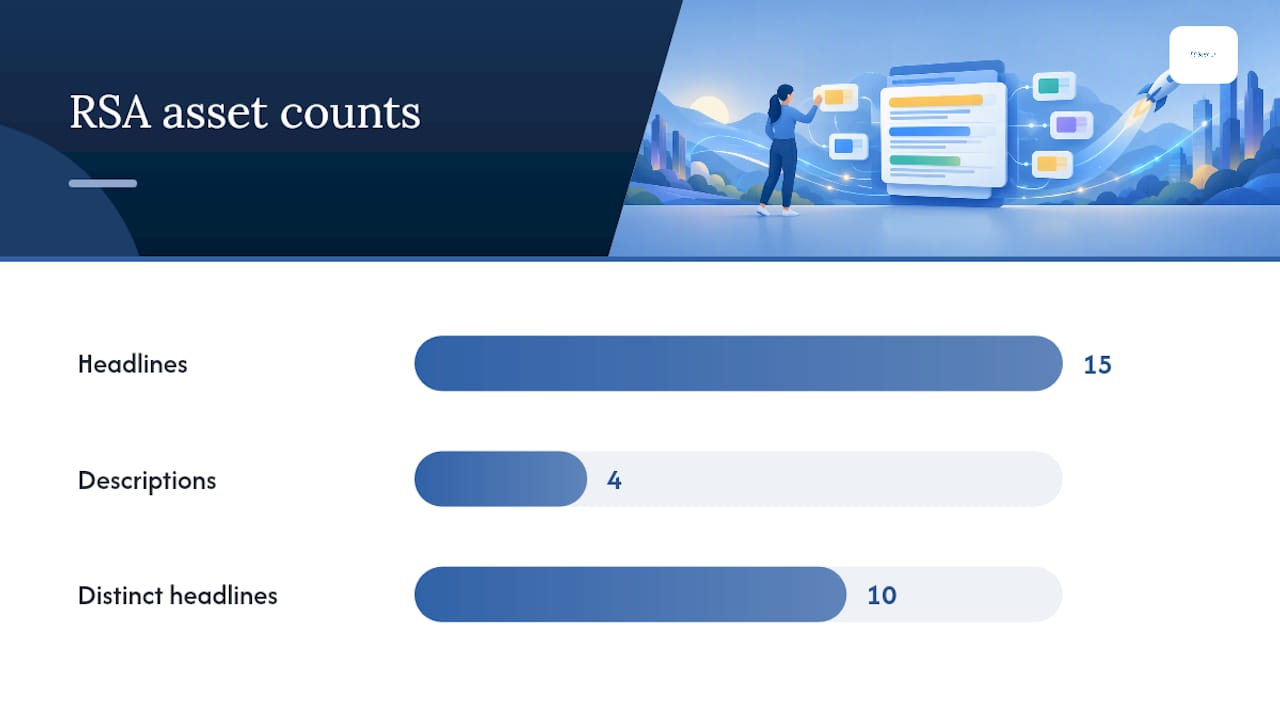
An RSA lets you submit up to 15 headlines and 4 descriptions per ad, and Google’s system tests combinations to find what earns clicks and conversions for a given search. That’s a hard ceiling, not a suggestion, and it’s Google’s own limit on the format. Google states that using RSAs instead of static ads tends to increase clicks and conversions because the ad can match a wider range of query phrasing.
For a clinic ad group, split your assets by role instead of writing 15 versions of the same sentence:
- Service headlines naming the exact procedure (“Botox in [City],” “Invisalign Consultations”)
- Benefit headlines covering outcome or convenience (“Same-Week Appointments,” “Board-Certified Providers”)
- Trust headlines referencing credentials, reviews, or years in practice
- Call-to-action headlines like “Book a Free Consult” or “Call Now”
Include your core keyword phrase in at least one headline for relevance. Ad strength (Google’s quality score for the asset mix) rewards variety, but don’t chase “Excellent” by stuffing near-duplicate phrasing. Ten distinct, well-written headlines beat fifteen padded ones, and padding is exactly what introduces the pinning mistakes covered next.
Why Does RSA Pinning Matter for Medical Ads?
RSAs create real regulatory exposure for clinics because Google’s algorithm can generate combinations that quietly drop a required phrase. Industry guidance on regulated advertisers flags this directly: dynamic permutations can omit mandated disclaimers or safety language that appeared in your original draft but never made it into every live combination.
Pinning fixes this, but only if you use it correctly:
- Pin your mandatory line (license number, required safety disclaimer, brand name) to Headline 1 or Description 1 so it appears in every version.
- Pin sparingly elsewhere. Over-pinning collapses the ad back into a static ad and defeats the point of using RSAs at all.
- Keep an upload template with your approved headline and description sets so every new ad group starts from vetted copy, not a blank page.
- Preview the actual combinations before launch and log which permutations show the required claim, a practice regulated advertisers used to build a traceable approval record for each asset set.
Pro Tip: Run every new RSA past whoever handles your clinic’s compliance review before it goes live, not after. Catching a missing disclaimer in the ad preview tool takes five minutes; catching it after a complaint takes a lot longer. Our own healthcare ads policy breakdown covers the approval categories Google applies to clinic advertisers.
What Makes a Clinic Landing Page Actually Convert?
An RSA that promises “Same-Day Botox Appointments” and sends the click to your general homepage wastes most of the budget you just spent. Clinic-focused paid search guidance is consistent on this point: match the ad’s exact promise to a dedicated landing page that loads fast on mobile and asks for one action.
Three things need to happen before you spend a dollar on RSA traffic:
- Build (or confirm) a single-purpose page per service line with one phone number and one form, not five competing offers.
- Set up call tracking on that number. Clinics routinely see phone conversions outweigh form fills, so a campaign without call tracking is flying blind on its main conversion signal.
- Route form and call data through server-side tagging rather than passing patient details straight to the ad platform, which keeps protected health information out of the ad account while still feeding Smart Bidding clean conversion data.
From day one, track cost per call, cost per booked consult, and landing page load time. Those three numbers tell you more in the first month than click-through rate ever will. A paid search funnel built around real conversion points rather than vanity clicks is the difference between a campaign that looks busy and one that fills the schedule.
How Should You Structure Campaigns and Targeting?
One campaign per service or specialty, one ad group per tightly themed keyword cluster, and one RSA per ad group. That structure keeps budget and relevance where you can actually control them, instead of one sprawling campaign trying to serve five different procedures at once.
- Geotarget by radius around each clinic location, and adjust bids down for areas outside your realistic drive-time zone.
- Layer negative keywords aggressively: “jobs,” “salary,” “training,” “free,” and any competitor names you don’t want triggering your ad.
- Use audience signals like demographics or in-market segments to refine bidding, but be careful with remarketing. Standard remarketing lists for search are restricted for patient-facing medical advertising, so your first-touch ad copy and landing page have to do most of the conversion work rather than a retargeting sequence cleaning it up later. Our breakdown of remarketing limits for aesthetic clinics covers what’s still allowed.
- Run a separate brand campaign to protect searches for your clinic’s name from competitor bidding, and keep it isolated from your service campaigns so budget doesn’t bleed between them.
How Do You Test and Improve RSA Performance?
Check asset performance under “Best,” “Good,” and “Low” ratings weekly, not the overall ad strength score alone. Ad strength tells you about variety; asset performance tells you what’s actually converting.
- If your top headlines are all benefit-driven and your service headlines rank “Low,” rewrite the service lines before touching anything else.
- If conversions are flat despite decent click volume, the landing page is usually the bottleneck, not the ad copy.
- Start bidding conservatively (maximize clicks or manual CPC) for the first two to three weeks, then switch to Smart Bidding once you have clean, verified conversion data flowing in.
- Set a weekly check on spend and call volume, and a monthly review of asset performance, cost per booking, and landing page conversion rate.
Pro Tip: Don’t rewrite headlines and swap the landing page in the same week. Change one variable at a time, or you won’t know which fix actually moved the needle.
Where Do LSAs and Programmatic Fit Alongside RSAs?
RSAs do the heavy lifting for high-intent procedure searches, but they work better paired with other channels rather than carrying every stage of the funnel alone.
- Local Services Ads build trust through the Google Screened badge and charge per lead, which pairs well with RSAs handling message control on specific procedures, a combination clinic guidance repeatedly points to as the strongest setup for local acquisition.
- Programmatic and social cover upper-funnel awareness and retargeting, but apply the same caution on patient-facing remarketing lists here as you would in search. Our programmatic guide for clinics walks through where that channel adds reach without duplicating your search spend.
- Keep messaging consistent across channels so a prospect who saw a display ad doesn’t land on a search ad promising something different, and watch for overlapping attribution between LSA leads and search conversions before you shift budget based on either number alone.
What Clinics Get Wrong About RSAs
Most clinic RSA campaigns I’ve reviewed fail for boring reasons: one generic ad group covering four procedures, a homepage doing double duty as every landing page, and no call tracking to show what’s actually working. The ad copy is rarely the real problem.
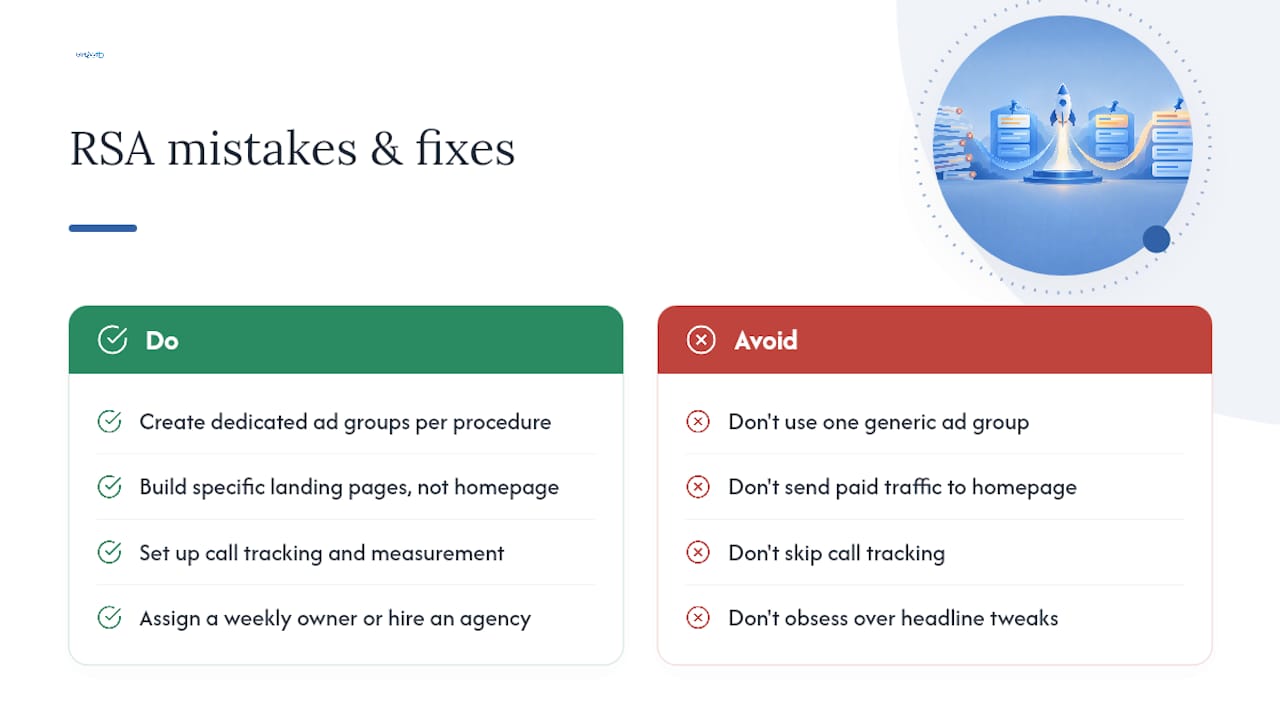
Clinics consistently under-invest in the landing page and measurement layer while polishing headlines that barely move the needle. Fixing the page and the tracking setup usually outperforms weeks of headline tweaking.
Running this in-house works fine if someone owns it weekly. If nobody has that bandwidth, an agency earns its cost fast, mostly by keeping compliance and tracking from quietly falling apart.
— Gerard
Get Your Clinic’s RSA Campaign Built Right the First Time
Our agency offers specialized services for salons, aesthetic clinics, and beauty brands, focusing on building RSA campaigns, compliant pinning workflows, and conversion tracking designed around actual patient search and booking behavior.
A typical engagement starts with an audit of your existing account (or a build from zero), followed by service-specific RSA creative, pinning for any compliance-required lines, and a call and form-tracking setup that feeds clean data into your bidding. Our Google Ads and paid media services cover the full setup along with the social and content work most clinics eventually need around it. If your current campaigns lack call tracking or dedicated landing pages, those are important aspects to address for better performance.
Sources
For deeper detail: Google’s own RSA documentation, Dentsu’s RSA compliance guidance, and our medical aesthetics clinic guide.
- About responsive search ads – Google Ads Help
- Best Practices For Marketers Developing Responsive Search Ads
- Google Ads for Medical Clinics – Ten Thousand Foot View
- Google Ads for Clinics: 4 Steps to Growth
FAQ
What Is the Headline and Description Limit for RSAs?
Responsive Search Ads accept up to 15 headlines and 4 descriptions per ad, and Google tests combinations of those assets to find what performs best for each search. You don’t have to fill every slot, but 10 to 15 varied headlines gives the system enough material to work with.
Do Clinics Need to Pin RSA Headlines?
Any legally required disclaimer, license reference, or brand name should be pinned to a fixed position, usually Headline 1 or Description 1, so it appears in every version of the ad. Unpinned mandatory text can get dropped from some combinations, which creates the compliance risk regulated advertisers are warned about.
Can Clinics Use Remarketing With Search Ads?
Standard remarketing lists for search are restricted for patient-facing medical advertising, so clinics can’t lean on retargeting the way other industries do. That makes strong first-touch ad copy and a relevant landing page the main levers for conversion.
How Much Does Growthreachmarketing Charge for Google Ads Management?
Pricing depends on account size and scope, so current rates are listed on the services page rather than a flat number here. Reach out directly for a quote based on your clinic’s specific campaign needs.
Should a Clinic Run LSAs Instead of RSAs?
Run both where budget allows. LSAs build local trust through the Google Screened badge and charge per lead, while RSAs give you control over messaging for specific procedures, and clinic guidance favors running them together rather than picking one over the other.