The highest-value local links for salons come from four sources: verified local directories with real editorial standards, local media and blogger features, wedding and vendor listings, and community sponsorship pages. Skip anything you have to pay for a placement on. Claim your Google Business Profile first, build one dedicated landing page for outreach targets, and use rel=“sponsored” tags on any paid or gifted mention.
TL;DR:
- Only verified local directories with editorial standards, stable URLs, and real human review provide valuable backlinks for salons, making bulk submissions ineffective and risky.
- Building partnerships with nearby businesses like photographers, florists, and venues through genuine collaborations often yields more sustainable, local backlinks than directory spam.
- Focus on creating high-quality, niche-relevant content such as seasonal trend reports, styling guides, or local lookbooks to earn backlinks from local media and industry sources.
- Consistent, personalized outreach with a clear value proposition and proper tracking significantly improves the chances of acquiring backlinks that lead to increased local visibility.
- Avoid low-quality directories, paid placements, and excessive reciprocal links, and remember that local relevance and authenticity outweigh sheer backlink volume for salon SEO success.
Table of Contents
- Which Local Directories Are Worth a Salon’s Time?
- How Do You Get Local Press or Blogger Features?
- Which Partnerships and Sponsorships Earn Real Editorial Links?
- How Should Salons Optimize Wedding and Vendor Listings?
- What Content Formats Actually Earn Salon Backlinks?
- What Does a Repeatable Outreach Process Look Like?
- What Link Practices Should Salons Avoid?
- How Do You Measure and Prioritize Link Opportunities?
- The Author’s Perspective and When to Bring in Help
- Turning Happy Clients Into Local Links
- Building Mutual-Link Partnerships With Nearby Businesses
- Common Local Link Building Mistakes to Avoid
- Can Social Media Groups Help You Find Local Link Opportunities?
- Why Most Salon Link Advice Misses the Point
- How Growth Reach Marketing Runs Local Link Campaigns for Salons
- Sources
- FAQ
Which Local Directories Are Worth a Salon’s Time?
Most directory submissions are a waste of an afternoon. Google’s own link spam guidance makes clear that large-scale mass-submission of low-quality, temporary listings do nothing for rankings and can flag your profile as manipulative. The directories worth your time are the ones with real editorial standards, unique content per listing, and visible human review, not an auto-approve form.
In Ireland, LocallyIrish lists many verified beauty and hair businesses across all 26 counties, with free basic listings and optional paid visibility upgrades. I Love Limerick runs a similar editorial business directory that covers beauty salons regionally. Chamber of commerce listings and trade association directories tend to carry the same weight.
Before you submit anywhere, check for:
- A crawlable profile page with a stable, permanent URL
- Editorial review rather than instant auto-publish
- Category fit for hair, beauty, or aesthetics specifically
- A live outbound link field, not just a phone number and map pin
Once you find a good fit, claim the listing, verify ownership, and fill in consistent name, address, and phone details. Link the listing to a dedicated landing page built for that traffic, not your homepage.
Pro Tip: Build one clean landing page with your services, service area, and booking button before you start submitting anywhere. Every directory link should point to the same page so Google sees a consistent, relevant destination.
How Do You Get Local Press or Blogger Features?
Local journalists and lifestyle bloggers need story ideas, not press releases about your opening hours; many salons find that seeking media coverage services can effectively complement their local outreach efforts. Salons that land features usually pitch something timely: a seasonal color trend, a stylist’s charity haircut drive, a sustainability initiative like recycling foil and hair waste, or a profile on a team member with an unusual specialty.
- Find the right contact. Look for the lifestyle or “what’s on” section of local news sites and search for bloggers who’ve covered other salons or beauty businesses in your county.
- Send a short, specific pitch. Two sentences on who you are, one line on the story angle, and a clear offer (an interview, photos, or a free styling session for a feature).
- Attach what editors actually need. High-resolution photos, a quote ready to paste in, and your availability for a quick call or visit.
- Follow up once, politely, after five to seven days. If there’s no response after that, move to the next contact rather than chasing.
- Confirm the link once published. Ask if the piece can link to your site, and check whether it landed as a live link or just a mention.
Pro Tip: Content with expert commentary and a genuinely local angle gets picked up by lifestyle blogs and wedding publications far more often than generic press releases, because editors want something their readers can’t find elsewhere.
Which Partnerships and Sponsorships Earn Real Editorial Links?
Sponsorships work as link sources because they create local, contextually relevant mentions competitors can’t easily copy, a pattern practitioners in salon link building see repeatedly. The trick is keeping every one of them compliant with Google’s rules on paid or exchanged links.
Solid partnership models for salons include:
- Sponsoring a local fashion show or charity fundraiser and getting listed on the event page
- Providing styling for a community event in exchange for a supplier or sponsor mention
- Appearing on a product brand’s “find a salon” partner page as a verified stockist
- Co-hosting a workshop with a complementary local business and cross-linking the recap pages
Negotiate the link as editorial, not conditional. If money or product changes hands, say so and ask the organizer to mark the link rel=“sponsored” or rel=“nofollow” per Google’s guidelines. Never make a sponsorship contingent on getting a dofollow link back; that crosses into paid-link territory. Offer value instead: expert content for their newsletter, a social media shoutout, or free styling for their next event.
How Should Salons Optimize Wedding and Vendor Listings?
Wedding directories combine local relevance with strong commercial intent, which makes them some of the best link targets a salon can chase. Brides search these sites specifically to book, not just to browse. WeddingPages maintains a dedicated wedding hair and beauty supplier directory for Ireland that many local brides consult before choosing a stylist, and a listing there carries both traffic and link value.
A strong listing needs:
- A curated portfolio showing bridal work specifically, not general salon photos
- Clear service area coverage so out-of-town planners know you travel
- A representative pricing range so inquiries arrive pre-qualified
- Strong, well-lit images of finished looks, not phone snaps mid-appointment
- A direct booking or inquiry call-to-action, not just a phone number
To go beyond the listing itself, pitch wedding blogs and local event planners with real styled shoots. Supplier pages on wedding-industry sites and product-brand “find a salon” pages can deliver high-value, relevant links when you’re a genuine verified partner rather than a paid placement, and those relationships often lead to repeat features season after season.
What Content Formats Actually Earn Salon Backlinks?
Directories get you listed. Content gets you cited. Salons that consistently earn links tend to publish one of four formats: a seasonal trend report, a styling how-to guide, a local lookbook, or a supplier roundup that other local businesses want to reference.
- Seasonal trend reports work because local press needs fresh seasonal content every quarter and rarely has an in-house stylist to write it.
- Styling how-to guides earn links from lifestyle sites looking to answer specific reader questions.
- Local lookbooks featuring real clients photographed around your town give local media a visual hook.
- Supplier roundups naming the brands and local vendors you work with often get linked back by those same suppliers.
Quality matters more than volume here. A piece needs an expert quote, ideally from your senior stylist, a genuinely local example or data point, and shareable visuals. Build it on one clean, linkable landing page rather than burying it in a blog archive, then send it directly to local publishers, product suppliers, and relevant social groups. A local SEO example page showing how salons structure this kind of content can save you from starting from a blank page.
Pro Tip: Pitch your trend report to suppliers before you pitch the press. If a product brand shares it, you often get a link from their site too, doubling your reach for the same piece of content.
What Does a Repeatable Outreach Process Look Like?
Outreach fails most often because it’s random: one email here, one DM there, no record of what happened. A repeatable sequence fixes that.
- Research the target: confirm they publish real content, check for an editorial process, and find the right named contact.
- Personalize the opening line with something specific to their site or recent post, not a generic greeting.
- Send a value-first pitch: two sentences of context, one line stating what’s in it for them.
- Offer an asset: a photo set, a quote, or a finished piece of content they can publish with minimal editing.
- Follow up once after five to seven days if you hear nothing.
- Confirm the link and thank them once it’s live, and note the URL for your tracker.
Template building blocks worth keeping on hand: a subject line that names the specific angle rather than “collaboration opportunity,” a two-sentence lead, one clear line on the value exchange, and one or two attached assets ready to send on request.
Log every touch in a simple spreadsheet: contact name, date, response, link status. If you’re sending fewer than ten pitches a month and getting no traction after three months, that’s usually the signal to hand the process to an agency rather than keep grinding solo.
What Link Practices Should Salons Avoid?
Google’s link spam policy is specific: don’t buy links for ranking purposes, disclose and tag sponsored placements with rel=“sponsored” or rel=“nofollow”, and stay away from low-quality directories built purely for links rather than users. A small number of high-quality, locally relevant referring domains outperforms a large volume of weak ones, so resist the urge to chase every directory that will take you.
Red flags to walk away from:
- Any offer guaranteeing a specific ranking position
- Bulk directory submission services promising “hundreds of backlinks fast”
- Excessive reciprocal link exchanges with unrelated businesses
- Automated link-building tools or “link package” upsells
If a harmful or spammy link ever appears pointing to your site, first try requesting removal or a rel=“nofollow” tag from the site owner, and document every outreach attempt. Reserve Search Console’s disavow tool for cases where removal requests genuinely fail; it’s a last resort, not a first move.
How Do You Measure and Prioritize Link Opportunities?
Track a small set of numbers rather than obsessing over every metric. Watch referring domain quality (is the site real and locally relevant?), referral traffic from each link, booking conversions tied to that traffic, and whether your Google Business Profile prominence improves, since links from other websites are one factor Google weighs alongside relevance and distance.
Prioritize opportunities using four filters:
- Local relevance: does the site actually serve your town or county?
- Editorial permanence: is the listing likely to stay live for years, not months?
- Audience fit: would your ideal client actually read this site?
- Ease and cost: how much time or money does it take to land?
Keep a one-page monthly tracker with columns for target, status, link acquired, and referral bookings. A realistic three-month benchmark is five to ten genuinely relevant, live links, each traceable to at least a small bump in direction requests or booking inquiries.
The Author’s Perspective and When to Bring in Help
Most salon link building fails for a boring reason: owners chase quantity because it feels like progress, then wonder why rankings never move. Growth Reach Marketing built its salon SEO work around the opposite instinct, prioritizing a handful of genuinely local, editorially sound placements over any bulk-submission approach. Salons running content-led outreach alongside a complete Google Business Profile setup tend to see prominence gains faster than those relying on directories alone, since the two signals reinforce each other rather than working in isolation.
Turning Happy Clients Into Local Links
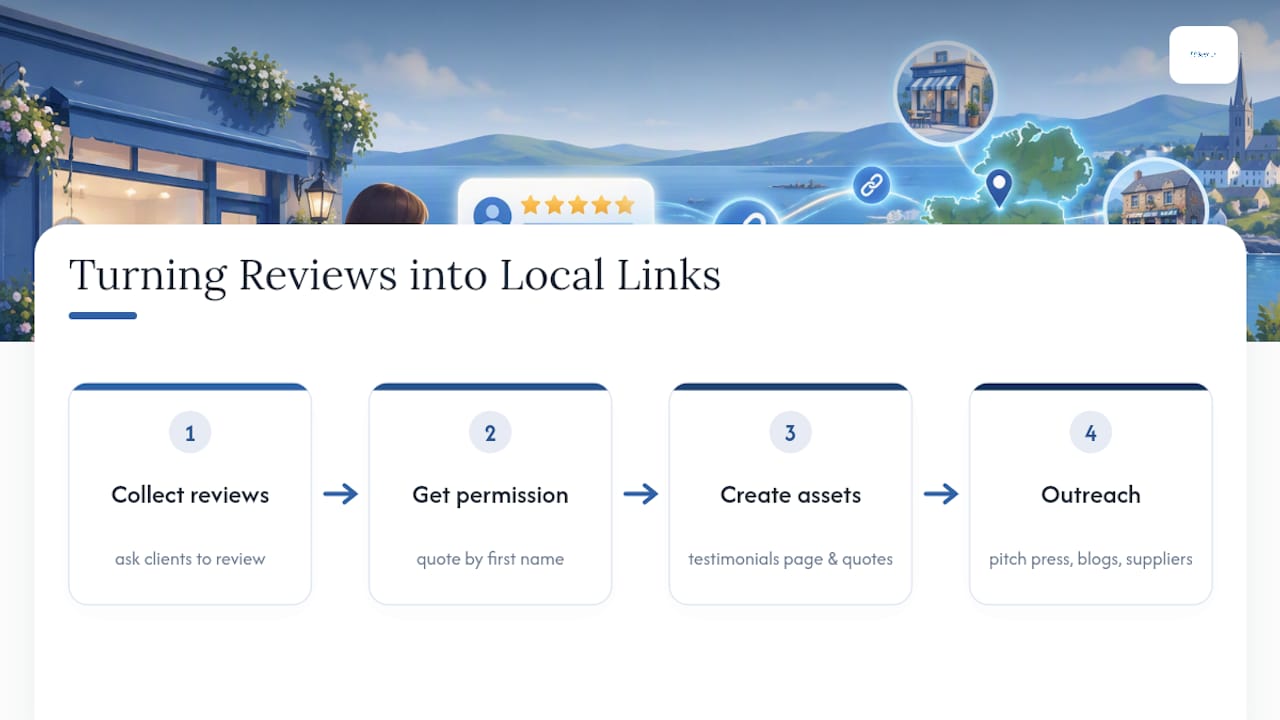
Reviews on their own don’t create backlinks, but they create the raw material for content that does. A run of five-star Google reviews mentioning your bridal styling or color correction work gives you a genuine hook for a press pitch, a supplier feature request, or a testimonial page that local blogs are willing to reference.
Ask satisfied clients if you can quote them, by first name, on a dedicated testimonials page with a short description of the service they received. That page becomes something you can point local journalists to when they ask “why should we cover this salon over another one?” It’s evidence, not a claim.
Encourage clients to leave reviews on platforms beyond Google, including any Irish beauty directory where you’re listed, since a directory profile with genuine reviews attached tends to get better placement and more organic attention than a bare listing. If a client runs a local blog or has a sizable community following, a simple thank-you note asking whether they’d be open to writing about their experience can turn one happy booking into an organic feature, without ever framing it as a transaction.
Testimonials also work as outreach ammunition. When pitching a wedding blog or local publication, including a line from a real bride about her experience gives editors something concrete to quote, which raises your odds of getting picked up over a pitch with no social proof attached at all.
Building Mutual-Link Partnerships With Nearby Businesses
The salons that build the strongest local link networks aren’t chasing strangers. They’re formalizing relationships they already have with businesses serving the same client base: bridal boutiques, florists, photographers, spas, and event venues.
Start by mapping who already refers clients to you informally. A wedding photographer who recommends your salon to brides is a natural partner for a mutual listing page. Reach out and propose something concrete: a joint “recommended vendors” page on both sites, each linking to the other with a short description of the service.
A few partnership structures worth setting up:
- Cross-referral pages listing three to five trusted local vendors, each linked and briefly described
- Co-hosted events, like a bridal styling evening with a boutique, recapped on both sites afterward
- Guest content swaps, where you write a short styling guide for a florist’s blog and they write a seasonal bouquet guide for yours
Keep these relationships genuine rather than transactional. A mutual link page only holds value if both businesses actually recommend each other in real life, since Google’s guidance treats excessive reciprocal linking with no real relationship behind it as a spam signal. The difference between a healthy partnership and a link scheme is whether the connection would exist even without the link.
Common Local Link Building Mistakes to Avoid
The biggest mistake salons make is treating link building as a numbers game instead of a relevance game. Submitting to fifty directories in a weekend feels productive, but if forty of them are auto-approve panels with no editorial oversight, you’ve spent hours building links that carry little to no local ranking value and, in the worst cases, invite scrutiny under Google’s spam guidelines.
A second common error is inconsistent business information. If your salon’s name, address, or phone number varies across directory listings, social profiles, and your website, that inconsistency undermines the local prominence signals a clean profile could otherwise provide.
Other pitfalls worth watching for:
- Paying for guaranteed placements on sites that promise a specific ranking boost, which almost always violates Google’s link spam policy
- Linking every directory to your homepage instead of a dedicated landing page built for that specific traffic source
- Ignoring niche relevance by submitting to generic national directories that have nothing to do with beauty, hair, or your local area
- Abandoning outreach after one email rather than following a structured sequence with a single, polite follow-up
- Forgetting to track results, which means you keep repeating tactics that never converted into bookings
Fix the foundation first: consistent NAP details everywhere, a verified Google Business Profile, and one clean landing page for outreach. Everything built on top of that foundation performs better than the same effort spent on a shaky one.
Can Social Media Groups Help You Find Local Link Opportunities?
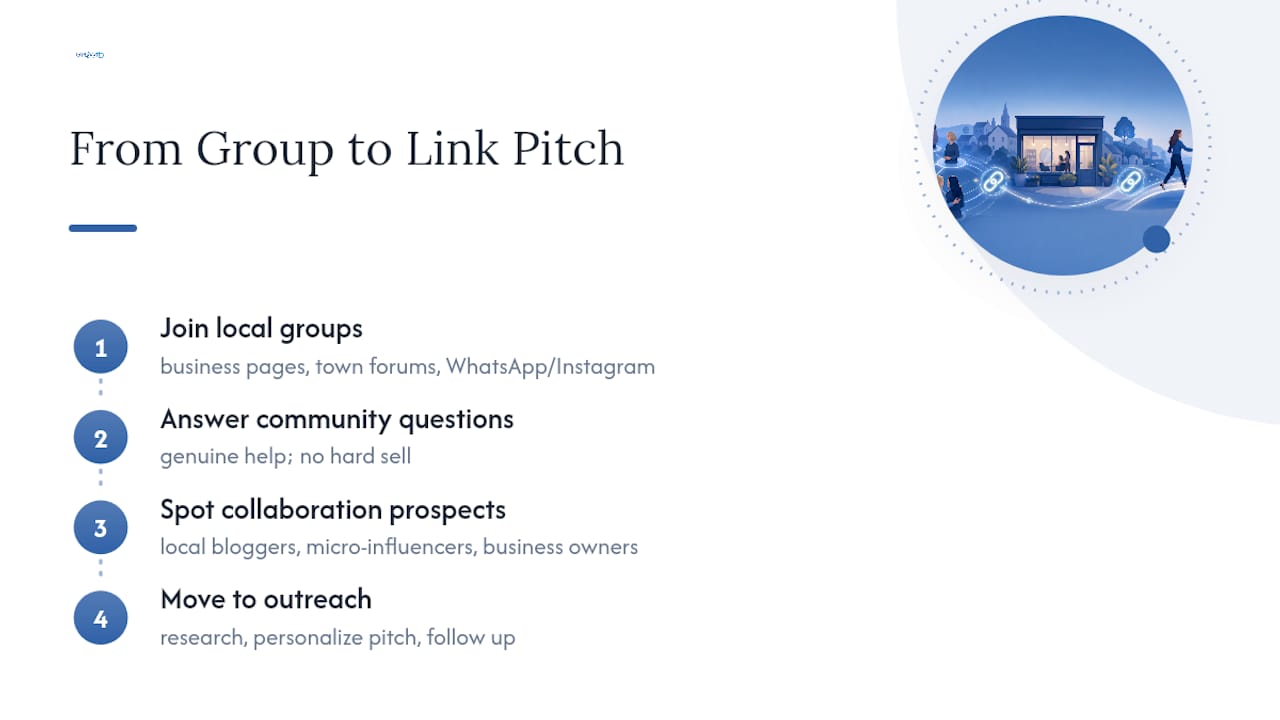
Local Facebook groups, neighborhood forums, and community WhatsApp or Instagram groups won’t hand you a backlink directly, since most social platforms use nofollow links by default. What they do offer is something more valuable for a small salon: direct access to the local bloggers, journalists, and business owners who actually control the links you want.
Join local business groups, town Facebook pages, and county-specific community forums where residents ask for salon recommendations. Answering those questions genuinely, without a hard sell, builds visibility among exactly the people who might later write about you, list you, or link to you from their own sites.
Watch for local bloggers and micro-influencers who post in these same groups asking for collaboration partners. A stylist offering a free service in exchange for an honest review is a low-cost way to land a feature on a personal blog that carries a genuine local audience and, often, a dofollow link.
Local business networking groups on Facebook and LinkedIn are also where sponsorship and cross-promotion opportunities surface first, often before they’re posted publicly anywhere else. Treat these communities as a lead source for the outreach process described earlier, not as a replacement for it. The relationship starts in the group; the actual pitch and link request still follow the same research, personalize, and follow-up sequence that works everywhere else.
Why Most Salon Link Advice Misses the Point
Most link building guides written for small businesses treat every backlink as equally valuable, which is exactly backward for a salon competing in a five-mile radius. A link from a national beauty blog with no local readers does less for your Google Business Profile prominence than one line in a county newspaper’s “best of” roundup, because local search rewards relevance and distance as heavily as raw link volume.
The conventional advice to “get as many backlinks as possible” also ignores how much risk that creates. Salons chasing volume end up in low-quality directories that Google’s own spam guidance specifically warns against, trading short-term listing counts for long-term ranking risk.
What actually moves the needle is narrower than most owners expect: a verified profile on two or three real Irish directories, one solid local press feature, a wedding directory listing that’s actually optimized for bridal search intent, and one or two genuine business partnerships. That’s a manageable list for a busy owner to execute in a quarter, not a permanent to-do list that never gets finished. Prioritize the four or five highest-relevance opportunities before you touch anything else on this list.
— Gerard
How Growth Reach Marketing Runs Local Link Campaigns for Salons
Local link campaigns typically involve local SEO audits, content-led outreach, Google Business Profile optimization, and PR support targeting relevant directories and press. A typical engagement starts with an audit of current links and profile, moves into a prioritized outreach plan targeting the highest-relevance opportunities first, then covers execution and monthly reporting so you can track which links convert into bookings.
If running outreach yourself sounds like a second full-time job on top of running a salon, that’s the gap this fills. You get a strategy built around your specific service area and client base instead of a one-size-fits-all directory blast. Check out the services page to see what a local SEO and outreach engagement looks like for a salon your size, and get in touch to start with an audit.
Sources
- Google Search Central — Link spam policies
- Tips to improve your local ranking on Google — Google Business Profile Help
- Locallyirish
FAQ
What Will Local SEO Look Like for Salons in 2026?
Local SEO for salons keeps centering on Google Business Profile completeness, genuine local links, and review volume, since Google weighs relevance, distance, and prominence when ranking local results. Expect AI-driven search summaries to pull more heavily from well-structured local content, which makes a clean, linkable landing page more important than ever.
Which Country Has the Best Hair Salons?
There’s no verified global ranking of “best” hair salons by country, since quality varies by individual salon rather than by nation. What does hold up universally is that salons with strong local reputations, verified directory listings, and genuine local press coverage tend to rank and book better than those without, regardless of where they operate.
Who Runs the Best Local Link Campaigns for Salon SEO Growth?
There’s no single certified “top” link building company for salons, but agencies specializing specifically in beauty and aesthetics tend to outperform generalist SEO firms because they understand which local directories and wedding sites actually matter. Growth Reach Marketing focuses specifically on salons, aesthetic clinics, and beauty brands, building outreach plans around Ireland-relevant directories rather than generic national link lists.
What Is the Best Booking System for Hair Salons?
The right booking system depends on your salon’s size and integrations more than any single universal answer, and no single platform is verified as best across every market. What matters for link building specifically is that your booking page loads fast, has a clear call-to-action, and is the destination you point outreach links to rather than a generic homepage.
Do Directory Submissions Still Help Salon SEO?
Yes, but only when the directory has real editorial standards, a stable URL, and genuine local traffic, since Google explicitly warns against low-quality, mass-submission directories. A handful of verified listings on sites like LocallyIrish or a chamber of commerce directory outperforms dozens of low-quality submissions.