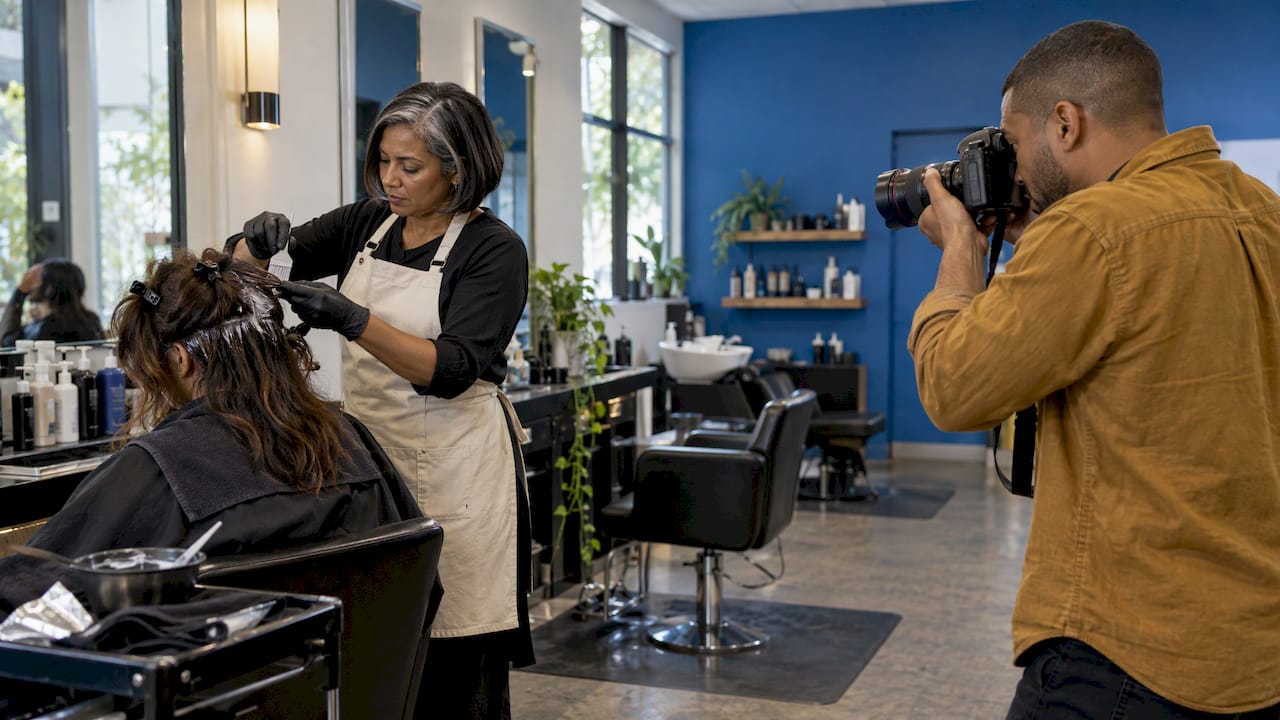
Salon branding photography is a planned set of professional images that shows your team, your space, your process and your finished work in one consistent look. Done well, it lets a stranger judge your salon or clinic before they book. This guide covers what to shoot, how to brief a photographer, what Irish rules say about client images and where each photo should go.
TL;DR
- Branding photos are a small, planned library: team, space, treatments in progress and honest results. They are not a pile of snapshots.
- Fewer, better images win. Aim for a short list of shots that show what you actually sell.
- Get written, specific consent from any client who appears, and follow Irish advertising rules on before-and-after images.
- Brief your photographer with goals, a mood board and a shot list, and agree usage rights and web-ready files up front.
- Use the images where bookings happen: your website, Google Business Profile, Instagram and your ads.
Table of Contents
- What salon branding photography is, and how it differs from ordinary photos
- Why it earns bookings
- The shot list: what to photograph
- How to plan the shoot
- Choosing a photographer
- Consent and advertising rules in Ireland
- Where to use your photos
- Our perspective
- Turn the photos into booked appointments
- FAQ
- Sources
What salon branding photography is, and how it differs from ordinary photos
Ordinary salon photography is what happens on a good Saturday: a phone shot of a blow-dry, a team selfie, a product flat lay. Each one may be fine. Together they look like six different businesses.
Branding photography works the other way round. You decide what impression you want to leave, then build a library to deliver it. One description of brand photography for hair salons frames it as a curated set that shows your work, your space, your process and your personality, so prospective clients can judge quality before they book.
That matters because of how people buy beauty services. A client cannot test a cut, a facial or an injectable treatment before paying. They look for evidence. Your images are most of that evidence, and they are often seen before a single word of your copy is read.
If you are still shaping the brand the photos will express, start with our guides on what salon branding means for your business and the salon brand identity guide. Photos work best when colors, tone and style are already decided.
Why it earns bookings
There are three jobs your images do.
They set expectations. Treatwell’s guidance for professionals says photos are what clients meet before they walk in: good photos help people imagine themselves in the chair, while weak ones make them wonder what they would actually get.
They show the experience, not just the result. Photographers who specialize in salons argue that clients buy the whole visit. Their advice is to capture the in-between moments: a client wrapped in a towel at the basin, a tea station, a stylist talking through color swatches.
They make a person feel known. A salon shoot in Northern Ireland led with a promotional video in which the owner speaks, so potential clients connect with the brand immediately. A face and a voice do what a stock image cannot.
For the wider link between visual identity and bookings, see salon branding that builds client trust.
The shot list: what to photograph
Start from what you sell, not from a Pinterest board. Treatwell’s view is that six great shots of what you actually do beat sixty mediocre ones covering everything you theoretically offer. Build the list around these groups.
Your people
Individual portraits of every stylist, therapist or clinician who will appear on your site, plus one relaxed group shot. Natural light near a window usually flatters better than overhead salon lighting. A shoot documented at a skin clinic in Newbridge, County Kildare, included staff headshots in natural light as part of its set.
Your space
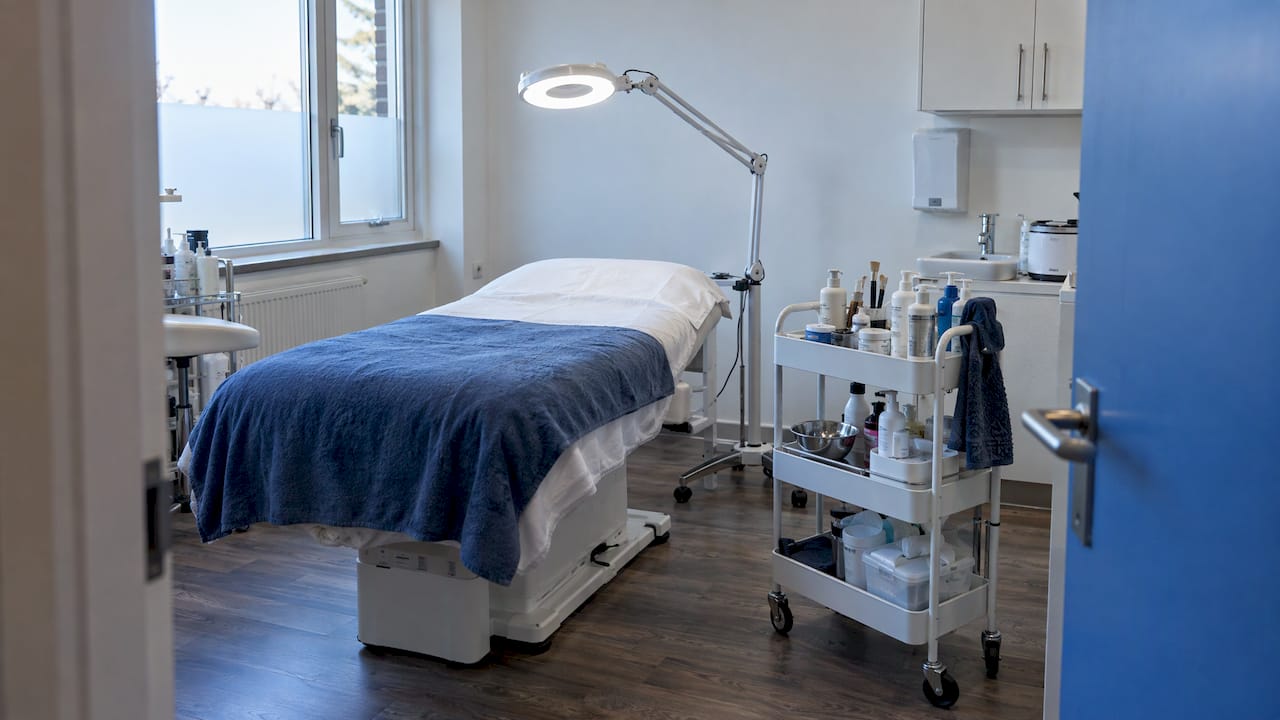
A wide shot of reception, one of the treatment room or styling floor, and tight details: product shelves, a basin, a doorway, signage. Clean first, styled second. The same Newbridge shoot included a wide-angle image of the retail area, which is a good model for showing how your space feels at a glance.
Treatments in progress
Hands at work, a consultation, a color application, a skin treatment being performed. These are the images that explain what you do better than a service menu. In the Newbridge example, the photographer captured lifestyle images of treatments in progress and had to use a tripod and slow shutter speed because of the lighting, a reminder that interiors are rarely as bright as they look to the eye.
Results
Finished hair, nails, brows or skin, shot with consistent lighting and a clean background. Keep these honest, as covered in the compliance section below.
The experience
The welcome, the drink, the towel, the mirror moment after a finish. These are the details competitors skip, and the ones that make a salon feel like a particular place.
Video and vertical cuts
Ask for portrait and landscape versions of key images, and a short video or reels if your budget allows. One full-day shoot for a hair salon in Galway City produced more than 50 images and 6 reels for social media and a future website. That is a useful benchmark for what a single day can deliver.
How to plan the shoot
Planning is where most of the value is decided. Salon business guidance says shoots that fail do so because of poor preparation, and recommends starting with clear goals and defined deliverables, considering both immediate and long-term marketing needs.
- Write down what the images must do. Fill a new website? Refresh Google Business Profile? Support an Instagram ad campaign for a new treatment? Each answer changes the shot list.
- Pick the services to feature. Choose your most profitable and most visual services, not the entire menu.
- Build a mood board. Ten to fifteen reference images that show light, color and mood. Include things you dislike too.
- Choose models carefully. Real clients who suit your target market often look more believable than agency models. They must consent in writing (see below).
- Prepare the space. Declutter, clean glass and mirrors, remove personal clutter, check that product labels and signage are current.
- Style the team. Agree what everyone wears so it matches your palette. Solid colors usually photograph better than busy patterns.
- Schedule around trading. Shoot on a closed day where you can, or early in the morning, so the photographer can work without clients in the background.
- Write the shot list and share it. Group it by location so the day runs smoothly.
Choosing a photographer
Look for relevant experience first. Guidance on choosing a business photographer recommends checking for a portfolio in your specific context, a consistent style, a clear process with shot list and mood board, clear licensing terms, web-ready delivery and real client reviews. A beauty-focused portfolio tells you the photographer already understands skin tones, mirrors, reflective surfaces and tight treatment rooms.
Use this checklist in your first conversation:
| Question | What a good answer includes |
|---|---|
| Have you shot salons, clinics or beauty before? | Examples with interiors, people and treatments |
| What is included? | Hours on site, number of edited images, video or reels if wanted |
| Who owns the images and where can I use them? | Written usage terms covering website, social, ads and print, and for how long |
| How are files delivered? | Web-ready sizes, plus portrait and landscape crops |
| How do you handle client consent? | A model release process you can both use |
| What happens if I need extra images later? | A clear price and turnaround for a follow-up session |
The usage question deserves attention. If you plan to run paid ads with the images, make sure the agreement covers advertising, not only organic use.
Consent and advertising rules in Ireland
This is the part that is easy to get wrong, and the one where a salon’s goodwill with clients is on the line.
Client and staff consent
Permission to take a photo is not permission to publish it. Irish guidance on customer photos notes that taking a picture does not cover publishing it across Instagram, websites or Google Business Profile unless the consent is specific. The same source explains that before-and-after images can reveal health information, which falls into a special category under GDPR where explicit consent is the standard. It recommends consent that is written, names the person, is specific to images and to where you plan to publish, and explains how to withdraw.
In practice, this means a simple model release for every client and team member who appears, kept on file, and a process for removing an image when someone asks. For staff, make sure there is a plan for what happens to their photos if they leave. If you are unsure about your obligations, speak to a solicitor or the Data Protection Commission’s guidance for businesses.
Before-and-after images
Treatwell advises that before-and-after posts need the same angle, distance and lighting in both shots, and that you need the client’s permission before posting either one. It also says basic adjustments like brightness, contrast and white balance are acceptable, while filters that shift color or smooth away real detail mislead people.
For clinics, the standard is formal. An Advertising Standards Authority for Ireland case summary upheld a complaint where “before” photos exaggerated the benefits by not showing the normal appearance of wrinkles, finding a breach of Section 4.1 of the Code. The lesson is to keep your baseline honest: do not shoot the “before” in worse light or at a worse angle than the “after”.
For a deeper treatment, read our guides to before-and-after photos for salon marketing and aesthetic advertising regulations in Ireland.
Where to use your photos
A shoot only pays back when the images are in the places clients look.
- Website. Use team portraits on your about and team pages, treatment images on service pages, and a hero image that shows your real space. Replace stock photography wherever you can.
- Google Business Profile. Add exterior, interior, team and work photos, and keep adding them. Fresh, accurate images help a local searcher decide.
- Instagram and Facebook. Use the portrait crops and reels for feed and Stories, and keep color and framing consistent so your grid looks like one brand.
- Paid ads. A strong treatment image or short video is often the difference between a scroll-past and an enquiry. See how this fits into our Instagram ads booking funnel.
- Email and booking pages. Use a warm, human image next to the booking button.
Export properly
Heavy files slow your pages and cost bookings. Treatwell recommends exporting JPEG rather than RAW, because nobody wants to wait for a 10MB image to load. Ask your photographer for compressed, web-ready versions, and read our guide to salon page speed before you upload a full gallery. Add short descriptive alt text to each image, for example “colorist applying balayage at the Dublin salon”, so the picture also helps people using screen readers and helps search engines understand the page.
Our perspective
We work only with salons, aesthetic clinics and beauty brands, and we see the same pattern again and again. The business has strong skills, a good team and a lovely space, but the website and profiles show stock images or mismatched phone photos. The marketing then has to work harder than it should.
Our view is that photography is the foundation of every other channel we manage. A good image library makes ads more believable, social posts easier to produce, and a website more likely to turn a visit into a booking. We design our work around that: bespoke strategies for each business, built on real data and ethical marketing.
Before a shoot, we think it is worth deciding where the images will be used. A set planned for the website, Google, Instagram and ads costs far less per use than a set shot for one purpose and then stretched.
We also treat compliance as part of the brief. Consent forms, honest results photos and advertising rules belong in the plan from day one, not as a clean-up job afterwards.
Gerard
Turn the photos into booked appointments
A photoshoot gives you assets. Our job at Growth Reach Marketing is to put them to work. We help salons, aesthetic clinics and beauty brands connect their imagery to the channels that bring in clients: Facebook and Instagram ads, social media management, SEO and AI search visibility, lead generation and booking automation.
If you have a shoot planned or a fresh set of images sitting unused, see our marketing services for salons and clinics or get in touch through Growth Reach Marketing. We are Irish-based and will tell you plainly how we would use your photos.
FAQ
How many photos does a salon need from a branding shoot?
Fewer than most owners expect, as long as each one has a job. A full-day shoot can produce 50 or more edited images and several reels, which is plenty for a website, social media and Google. Focus on team, space, treatments in progress, results and experience.
Can I post photos of clients in my salon on Instagram?
Only with their specific permission. Taking a photo does not give you the right to publish it, so get written, named consent that says where the image will appear and how the client can withdraw it. Before-and-after images can reveal health information, so be especially careful with them.
Should I shoot photos myself or hire a photographer?
Phone photos work well for everyday social posts. For your website, Google Business Profile and ads, a professional who has shot beauty interiors and people gives you consistent, high-quality images that fit your brand. Many salons use both: a professional set for the core library and phone content in between.
What should I ask a photographer about image rights?
Ask where you can use the images, for how long, and whether paid advertising is covered. Get the terms in writing. Also ask how they handle model releases for clients who appear in the shots.
How do I keep before-and-after photos compliant in Ireland?
Use the same angle, distance and lighting for both images, avoid filters that change the result, and get client consent first. Advertising rules in Ireland treat exaggerated “before” images as misleading, as one ASAI case shows. Clinics should also review our guide to aesthetic advertising regulations in Ireland.
Sources
- Brand photography for hair salons and barbershops
- Salon photography: how great photos attract more clients (Treatwell)
- Why the experience matters as much as the results
- Luxury salon brand shoot in Cookstown
- Park Skin Clinic brand shoot
- Hair salon brand photography in Galway City
- The Ultimate Guide to Salon Photoshoot Planning
- Business Photography: Complete 2026 Guide
- Customer Photos on Your Website: The Consent Rules
- ASAI Health & Beauty complaint summary