
Most Irish med spas can start with a monthly ad budget of roughly $500 to $1,500 on Meta, and move to $3,000 to $5,000 only when they run several locations or compete in a market like Dublin. Those figures come from a 2026 guide for aesthetic clinics, and they are starting points. The right number for your clinic depends on your average treatment value, how many consultations you can handle and how well you turn enquiries into bookings. This guide shows how to set the budget, split it, test it and keep it compliant.
TL;DR
- A sensible starting range for a small to mid-sized clinic is $500 to $1,500 a month on Meta ads. Larger or multi-location practices in competitive markets like Dublin may need $3,000 to $5,000.
- Work backwards from bookings: how many new clients you want, the cost of each booked consultation you can afford, and your lifetime client value.
- Keep search and referral solid before you scale paid social, and give every campaign seven to fourteen days before you change it.
- Budget for more than ad spend: creative, landing pages, follow-up and management all take money or time.
- Irish rules ban advertising prescription-only medicines to the public, so plan treatment ads around that from day one.
Table of Contents
- What an Irish med spa should expect to spend
- Work out your budget from bookings, not from a percentage
- How to split the budget across channels
- Costs that sit outside your ad spend
- Irish rules that shape what your ads can say
- How to test and adjust when bookings don’t arrive
- Metrics that tell you the budget is working
- A staged approach to scaling
- Work with us on your med spa ads
- FAQ
- Sources
What an Irish med spa should expect to spend
The published benchmarks are mostly American, so read them as a guide to proportions, not as an Irish price list. One 2026 guide to Facebook ads for aesthetics clinics puts the average cost per lead at about $51.42 in beauty and personal care and about $52 in healthcare across Meta platforms. It suggests $500 to $1,500 a month for a small to mid-sized clinic, which gives Meta’s algorithm enough data to optimise delivery. It puts larger multi-location practices in competitive cities, Dublin included, at $3,000 to $5,000 a month.
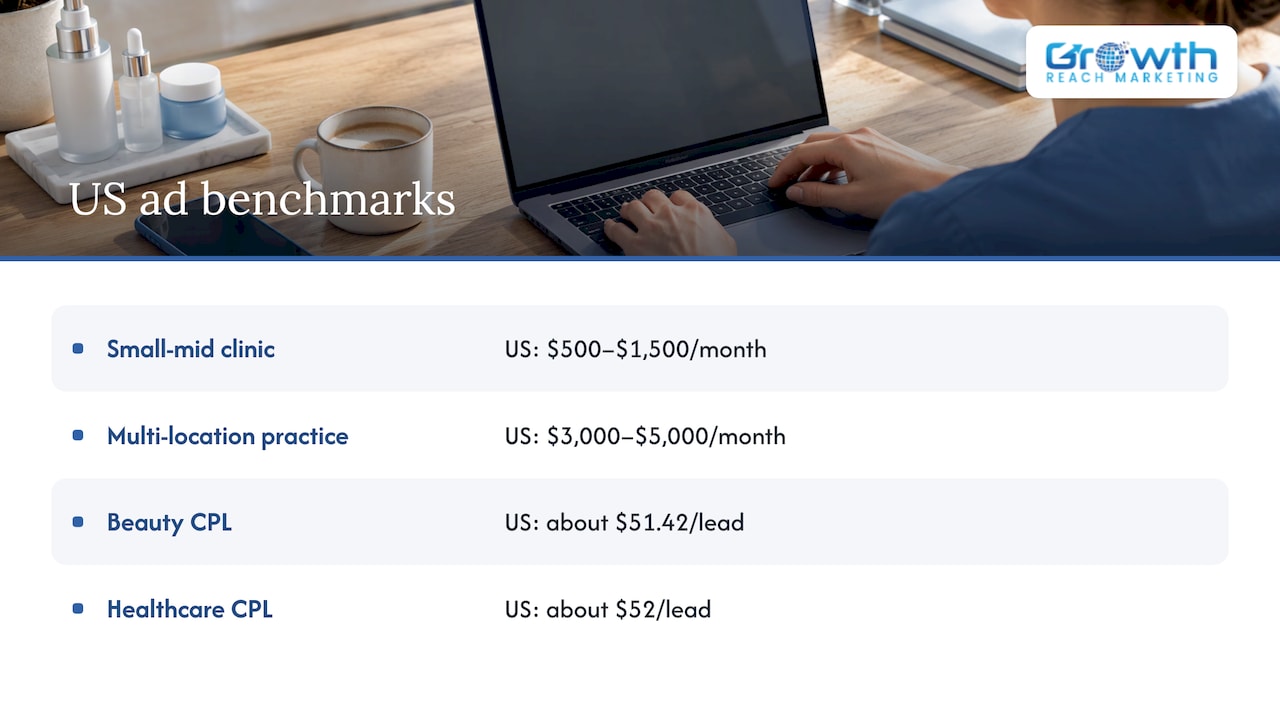
You can turn those figures into a rough lead count. At about $52 a lead, $1,000 a month buys around 19 leads. If one in three leads books a consultation and half of those buy a treatment, that is about three new clients a month. Whether that works depends on what a client is worth to you.
So the first question is not “what do other clinics spend?” It is “what can I afford to pay for one new client?”
Work out your budget from bookings, not from a percentage
A fixed percentage of revenue is a fine sanity check, but a bookings-first calculation is more useful. Use these steps.
- Set a target. Decide how many new clients you want each month, and how many your team can treat without waiting lists growing.
- Know your client value. Add up what an average new client spends over a year or more, not just the first visit. A client who starts with a skin consultation and returns for a course is worth far more than the first invoice.
- Choose a maximum acquisition cost. A common rule of thumb is to keep it at a third or less of lifetime value, which gives a healthy ratio of 1:3 or better.
- Estimate your funnel. Take your lead-to-consultation rate and consultation-to-treatment rate from your booking system. If you don’t track them yet, start this month.
- Multiply back. Target clients, divided by your conversion rates, gives the leads you need. Leads times cost per lead gives the ad spend.
Here is an example. You want eight new clients a month. Your leads book a consultation 35% of the time, and 55% of consultations become treatments. That means you need about 42 leads (8 ÷ 0.55 ÷ 0.35). At roughly $52 a lead, the spend is around $2,200. If that is more than you want to spend, improve the conversion steps before you raise the budget. Faster replies to enquiries are the usual first fix.
Our guide to booking conversion optimization for salons and clinics covers the stages between a click and a confirmed appointment.
How to split the budget across channels
No single split fits every clinic, but the logic is consistent. Practices with strong referral and loyalty flow can afford to spend more on growth channels. Practices that retain few clients should fix search visibility and referrals before scaling paid social. As a working rule, keep paid social to a minority share of acquisition spend until you have a creative approach that produces leads repeatedly.
A practical split for a clinic starting out looks like this.
| Channel | What it does | Typical role in the budget |
|---|---|---|
| Google Ads (search) | Catches people already searching for a treatment near them | The largest paid share for most clinics, because intent is high |
| Meta ads (Facebook and Instagram) | Builds demand and fills consultation slots with visual proof | A steady but smaller share until your creative is proven |
| Local SEO and Google Business Profile | Keeps you visible without paying per click | Mostly time and content, with a low ongoing cost |
| Email, SMS and reactivation | Brings past clients back and converts quiet leads | A small spend with a high return |
| Referral and loyalty | Turns happy clients into new ones | Incentives, not media spend |
Start with search because it meets demand that already exists. Our guide to the benefits of Google Ads for med spas explains how search campaigns work for treatment-led clinics. When the search campaign is stable, add Meta to reach people who haven’t searched yet. Our Facebook lead ads guide covers setup, budget and follow-up in more detail.
Don’t forget the free or low-cost channels. A well-kept Google Business Profile does a lot of work, and Google Business Posts can help get people booked. Our overview of local SEO for beauty brands shows how that visibility builds.
Costs that sit outside your ad spend
The number you put into Google or Meta is only part of the real cost. Plan for these items too.
- Creative. Photos, short videos and copy that meet the advertising rules. Treatment ads depend on images that show a real, calm clinic environment and a believable team. The creative industry photo standards are a useful checklist when you brief a photographer.
- Landing page and booking flow. A fast page that explains one treatment and leads to one clear booking action. Poor pages waste ad spend.
- Enquiry handling. Someone, or something, must answer leads within minutes. Slow replies are one of the most common reasons paid leads don’t convert.
- Management. Either your time, a staff member’s time or an agency fee.
- Tracking and reporting. Call tracking, form tracking and a way to link a booking to the ad that produced it.
- Compliance review. Time to check each ad against the rules below.
We don’t publish a fixed price for management, because scope varies with the number of treatments, locations and channels. We scope it after looking at your clinic.
Irish rules that shape what your ads can say
Advertising budgets are wasted when ads get rejected or complaints follow. In Ireland, two layers matter.
The first is the law on medicines. S.I. No. 541/2007 prohibits advertising prescription-only medicines to the general public, and the HPRA’s guidance confirms this covers all media, including websites and social media. It applies to services involving prescription-only medicines such as botulinum toxin. An International Bar Association article says the same: social media can promote authorised prescription-only medicines only to people qualified to prescribe or supply them.
The second is the ASAI code. The ASAI Health & Beauty code also prohibits advertising prescription-only medicines to the public. It requires that marketing for individual treatments takes care not to minimise, trivialise or create unrealistic expectations, particularly in the use of photographs.
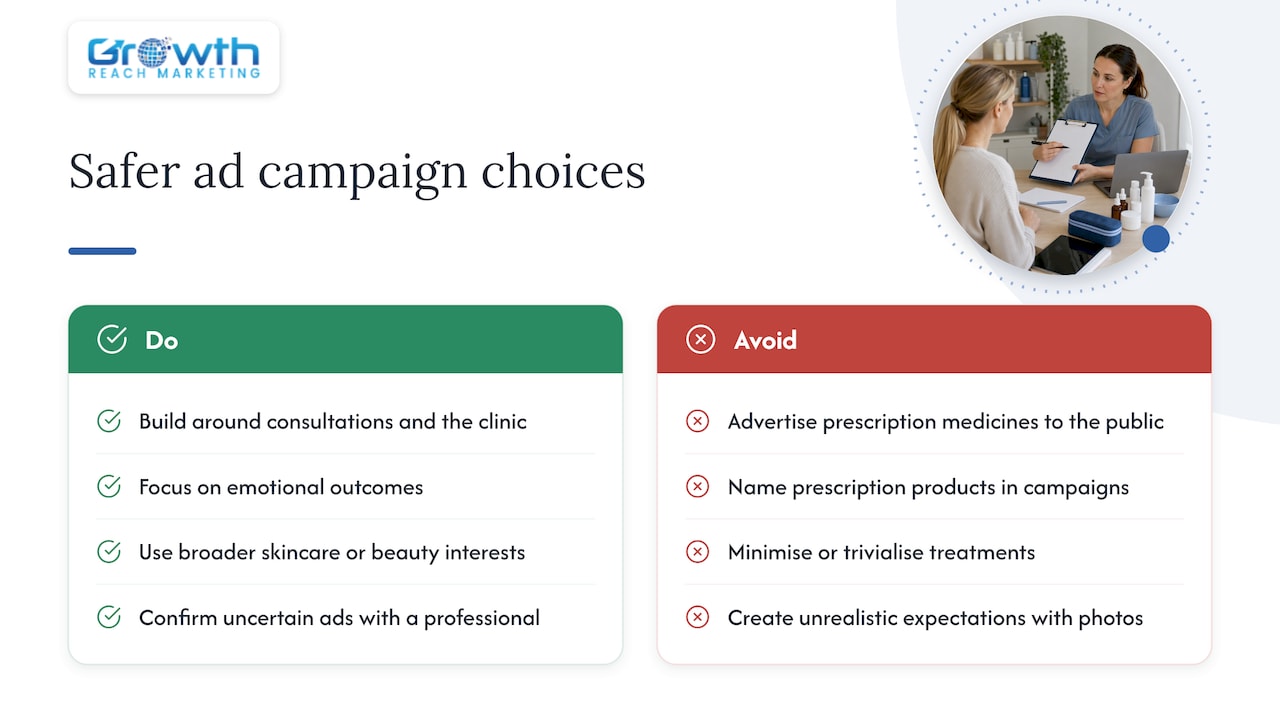
For your budget, this means building campaigns around consultations, the clinic, the practitioner and the client’s goals, not around naming a prescription product. Consentz’s guide also recommends focusing ad copy on the emotional outcome rather than the physical change, and using broader interests such as skincare or beauty instead of sensitive health interests.
For the detail, see our guides to aesthetic advertising regulations in Ireland and before and after rules in Ireland. Confirm any specific ad with a qualified professional if you are unsure.
Our view: budget for the whole journey
We work only with salons, aesthetic clinics and beauty brands, and the pattern we see most is simple. Clinics treat the ad budget as the whole plan. They put money into clicks, then lose the booking in a slow reply, a weak page or an unclear offer.
Our approach is to build the system around the ad: search and AI visibility so people find you, paid campaigns that bring consultations, and automated enquiry handling and follow-up so a lead is answered quickly and not left waiting. We design for data you can read, so every euro is traceable to a booking.
Start modestly, measure honestly and increase spend only when bookings follow. We prefer a clinic that grows steadily over one that spends big in month one and stops in month three.
Gerard
How to test and adjust when bookings don’t arrive
When a campaign starts, resist the urge to change it daily. The same Consentz guide suggests allowing seven to fourteen days for Meta’s learning phase before making adjustments. In that time, watch cost per lead, click-through rate (it suggests aiming for above 1%) and lead quality.
After that window, use this order.
- Check lead quality first. Are people booking consultations, or only filling in forms? Cheap leads that never answer the phone cost more than dearer ones that do.
- Pause weak ad sets. Stop those with high cost per lead and low click-through.
- Scale winners gradually. The guide suggests raising a winning budget by 20% every three to five days, which avoids resetting delivery with a big jump.
- Fix the page and follow-up before adding money. If clicks are fine but bookings aren’t, the problem is after the ad.
- Test one variable at a time. Change the offer, the image or the audience, not all three.
Metrics that tell you the budget is working
Track these monthly, per channel.
| Metric | What it tells you |
|---|---|
| Cost per lead | How efficiently ads produce enquiries |
| Cost per booked consultation | The number that matters most for budget decisions |
| Consultation-to-treatment rate | How well your team converts |
| Blended acquisition cost | Total marketing spend divided by new clients |
| Client lifetime value | What a client is worth over time |
| Ratio of acquisition cost to lifetime value | Whether growth is affordable; 1:3 or better is a common aim |
Pick one number as your anchor: cost per booked consultation. Leads can be inflated and clicks can be misleading, but a booked slot is real. Our med spa lead generation types playbook helps you compare which sources produce them.
A staged approach to scaling
Months one to three: prove it. Run one search campaign and one Meta campaign at the lower end of the range. Fix tracking. Read results weekly, change little.
Months four to six: improve it. Cut what isn’t booking, add email and reactivation to the clients you already have, and refine the page.
Month seven onwards: scale it. Raise spend where cost per booked consultation stays inside your limit. Add treatments or a second location only when the first is steady.
Work with us on your med spa ads
If you’d rather not build this yourself, we manage Facebook and Instagram ads, SEO and AI search visibility, enquiry handling and booking automation, lead generation and conversion optimisation, and email reactivation for Irish clinics. We are an Irish-based agency that works only in beauty and aesthetics.
See our services or get in touch and we’ll help you set a budget that matches your goals.
FAQ
How much should a med spa spend on ads each month?
A small to mid-sized clinic can start with about $500 to $1,500 a month on Meta, according to one 2026 clinic guide. Larger practices in competitive areas like Dublin may need $3,000 to $5,000. Work back from the number of new clients you want and what each is worth.
Should I start with Google Ads or Facebook and Instagram ads?
Most clinics should start with Google search, because it reaches people already looking for a treatment. Add Meta once search is stable and you have photos and videos that fit the advertising rules.
How long before I know if ads are working?
Give a Meta campaign seven to fourteen days to learn before making changes. Judge results over a full month using cost per booked consultation, not clicks alone.
Can I advertise Botox in Ireland?
No. Irish law prohibits advertising prescription-only medicines to the public, and the HPRA says this applies to websites and social media. Promote consultations and the clinic instead, and check your wording against the ASAI code.
Sources
- Facebook Ads for Aesthetics Clinics: Complete Guide 2026
- Promoting medicines to the public on social media (HPRA)
- Health & Beauty, Advertising Code (ASAI)
- Advertising and labelling of medicinal products on social media (IBA)