The fastest way to cut missed appointments is to automate reminders timed to each booking’s lead time, add one-tap reschedule links to every message, require deposits only for higher-risk bookings, and publish a clear cancellation policy before clients ever reach checkout. Track every no-show so cancellations become refillable slots instead of lost revenue.
TL;DR:
- A Kaiser Permanente study found that a second text reminder reduced missed appointments by 7% for primary care and 11% for mental health visits.
- Use deposits and staff calls selectively for first time clients, appointments over 90 minutes, peak time slots, and clients with prior missed appointments.
- Publish a 24 or 48 hour cancellation window, explain deposit refunds or forfeiture and emergency exceptions, and repeat the policy in booking confirmations.
- A waitlist can offer newly opened appointments to clients for 15 to 30 minutes before sending the slot to the next person.
- Test reminder wording, cadence, and deposit rules for four to six weeks, while tracking missed appointments, late cancellations, booking conversion, and revenue per available slot.
Table of Contents
- Quick Checklist: Prioritized Steps to Implement This Week
- Reminders and Confirmations: Evidence-Backed Cadence and Wording
- Cancellation Policy and Deposits: How to Deter No Shows Fairly and Legally
- Booking UX and Rescheduling: Turn Friction into a Booking Flow Advantage
- Incentives, Waitlists and Overbooking: Filling Canceled Slots Without Harming Client Experience
- Segmentation, Targeting, and Analytics: Measure What You Change
- Agency Implementation Checklist: How We Automate No-Show Reductions
- Using AI and Automation Tools to Predict and Prevent No Shows
- Integrating No-Show Reduction with Local Social Media Ad Campaigns
- Author Perspective: Trade-Offs and Practical Priorities
- How We Help Salons Reduce No Shows
- FAQ
- Sources
Quick Checklist: Prioritized Steps to Implement This Week
Most salons see measurable improvement within two to three weeks of tightening reminder timing and adding reschedule links, before touching deposits at all. Start with the lowest-friction fixes, since they cost nothing to implement and rarely upset clients.
- Turn on an automated booking confirmation sent immediately after checkout.
- Add a 48 to 72 hour reminder with a one-tap reschedule or cancel link.
- Send a second reminder 24 hours before the appointment, especially for new clients.
- Apply deposit or card-authorization rules only to first-time clients, long services, and peak-time slots.
- Set up a waitlist so canceled slots get offered automatically.
- Train front-desk staff on a short script for calling high-risk bookings.
- Review your cancellation policy wording and display it at booking and in every confirmation.
- Pull a basic no-show report weekly to spot repeat offenders.
Apply the deposit and phone-call steps first to new clients, bookings over 90 minutes, and Friday or Saturday afternoon slots, since those carry the highest no-show risk in most salons. Everything else, confirmations, reminders, and reschedule links, should apply to every booking from day one.
Reminders and Confirmations: Evidence-Backed Cadence and Wording
Reminders work, but the details of timing and wording decide how much they actually move the needle. A systematic review and meta-analysis of electronic notifications found that text notifications meaningfully reduce no-shows compared with sending no reminder at all, and that sending more than one notification produced a larger effect than a single message.
Reminders that ask for action outperform reminders that merely inform. A text that only states the date and time gets ignored. A text that asks the client to confirm, cancel, or reschedule in one tap gets a response, because it converts a passive notice into a small decision the client has to make.
A practical cadence for most salons looks like this:
- Send an instant confirmation the moment the booking is made, with the date, time, and service listed.
- Send a reminder 48 to 72 hours out with a reschedule link, giving clients enough runway to free the slot for someone else.
- Send a second reminder 24 hours before for new clients or long appointments, since a randomized quality-improvement study at Kaiser Permanente found that adding a second text reminder cut no-shows by 7% for primary-care visits and 11% for mental-health visits.
- Call clients directly only for your highest-risk bookings, since phone outreach costs staff time that doesn’t scale across every appointment.
Wording matters as much as timing. Two randomized trials published in PLOS ONE found that SMS reminders stating a specific cost or concrete consequence reduced missed appointments more than vague or softly worded messages. A line like “a missed appointment without 24 hours’ notice forfeits your deposit” outperforms “we hope to see you soon.” Keep the message short: the appointment detail, the consequence if it’s missed, and a single link to confirm, cancel, or reschedule.
One sourced figure worth planning around: the electronic notifications meta-analysis reports that multiple reminders produce a larger attendance improvement than a single reminder, which is the evidence behind recommending a two-touch sequence rather than one message and hoping for the best.
Use SMS as your default channel since it reaches clients fastest and gets read within minutes. Email works well for the initial confirmation and for sending calendar attachments, but it’s too easy to miss for a same-day nudge. For email marketing content that pairs well with your reminder sequence, confirmations and appointment recaps are a natural fit.
Cancellation Policy and Deposits: How to Deter No Shows Fairly and Legally
A cancellation policy only works if clients see it before they book, not buried in an email they never open. State the notice period required to cancel without penalty, what happens to a deposit if that window is missed, how refunds are handled, and any exceptions for emergencies.
- State the notice period clearly: 24 or 48 hours is standard for most salon services.
- Explain deposit treatment: whether it’s forfeited, credited to a future visit, or partially refunded.
- List exceptions: illness, emergencies, or salon-caused delays should have a clear, human process.
- Repeat the policy in every confirmation and reminder, not just at the original booking.
Refundable deposits work well for first-time clients, since they lower the barrier to booking while still creating a reason to show up. Non-refundable deposits or card pre-authorizations suit higher-value services, like color corrections or multi-hour packages, where a no-show costs you real chair time. A small, proportional amount, often a fraction of the service price, is usually enough to change behavior without discouraging bookings altogether.
Pro Tip: Require deposits only for the bookings most likely to no-show, first-time clients, long appointments, peak slots, rather than applying them across every service.
The Competition and Consumer Protection Commission advises that cancellation and deposit terms must be clear and should not create unreasonable barriers for consumers trying to cancel. In practice, that means publishing your policy on your booking page, repeating it in confirmations, and giving clients an obvious way to raise a complaint or request an exception. Our cancellation confirmation guide has message examples that keep this transparent without sounding punitive.
Booking UX and Rescheduling: Turn Friction into a Booking Flow Advantage
Plenty of no-shows aren’t deliberate. A client forgets, loses track of the date, or simply doesn’t want the hassle of calling to reschedule and lets the appointment slide instead. Reducing that friction often recovers more bookings than any deterrent policy.
- Include a one-tap reschedule link in every confirmation and reminder, not just a phone number to call.
- Attach a calendar invite to the confirmation message so the appointment lands directly on the client’s phone.
- Collect accurate mobile numbers and explicit SMS consent at the point of booking, since a bad number breaks the entire reminder sequence.
- Insist your booking software supports reschedule links, waitlist automation, calendar sync, and two-way SMS before you commit to it.
A client who can reschedule in ten seconds from a text message is far less likely to simply not show up. The goal is making the easy path and the right path the same path.
Incentives, Waitlists and Overbooking: Filling Canceled Slots Without Harming Client Experience
A cancellation isn’t automatically a loss if you have a system to refill it fast. Waitlists built into your booking software can text waiting clients the moment a slot opens, often with a short window to claim it before it’s offered to the next person in line.
- Offer canceled slots to waitlisted clients with a 15 to 30 minute claim window before moving to the next person.
- Use cautious overbooking only for time slots with a known, consistent no-show pattern, and only by one appointment at a time.
- Reward on-time attendance with small loyalty credits or discounts rather than only punishing absences.
- Promote last-minute openings to your existing client list before advertising them more broadly, since they already know and trust you.
Overbooking without data behind it creates double-booked chairs and frustrated clients, so only apply it to slots with a documented history of no-shows. Our retention strategy guide covers pre-booking incentives that work alongside waitlist automation.
Segmentation, Targeting, and Analytics: Measure What You Change
Blanket policies waste effort on clients who were never going to miss their appointment anyway. Segment your extra reminders and deposit rules toward the bookings that actually carry risk: new clients, people with a prior no-show, long or high-value services, and peak-demand time slots.
- Flag repeat no-show clients in your booking system and require a deposit on their next booking.
- Reserve phone-call reminders for your highest-value or highest-risk appointments only.
- Track no-show rate, same-day cancellation rate, booking conversion rate, and revenue per available slot every month.
- Run simple A/B tests on message wording, reminder cadence, and deposit versus no-deposit over a four to six week window before changing policy salon-wide.
| Metric | What it tells you | How often to check |
|---|---|---|
| No-show rate | Share of booked appointments missed without notice | Weekly |
| Same-day cancellation rate | How often clients cancel too late to refill the slot | Weekly |
| Booking conversion rate | Whether deposit or policy changes are scaring off bookings | Monthly |
| Revenue per available slot | Whether changes are protecting or costing you revenue | Monthly |
Rule-based segmentation, flagging new clients and repeat offenders, gets most salons most of the benefit without any extra software. Predictive targeting, where a tool scores every booking’s no-show risk automatically, is worth the investment once you’re managing enough appointment volume that manual flagging becomes unreliable. A review of predictive-model interventions found that targeting reminders toward higher-risk visits improved efficiency compared with sending extra reminders to everyone.
Agency Implementation Checklist: How We Automate No-Show Reductions
We build out a standard automation sequence for salon and clinic clients: booking confirmation sent instantly, a calendar invite attached, a first reminder 48 to 72 hours out with a reschedule link, a second reminder 24 hours before with an explicit cancellation window, and a waitlist trigger that fires when a cancellation comes in.
- We prioritize confirmation and first-reminder automation first, since it delivers the fastest measurable drop in no-shows.
- We set up deposit and card-authorization rules next, once the booking data shows which segments actually need them.
- We layer in waitlist automation and two-way SMS once the reminder sequence is stable.
- We track attribution from reminder sent to appointment kept, so you can see which message and timing combination is actually working.
Pro Tip: Run a short pilot on one location or one service line before rolling automation out across your whole booking calendar, it makes the before-and-after comparison much cleaner.
A typical audit starts by reviewing your current confirmation and reminder setup, then maps the fastest wins against what your booking software can already do. Our salon automation guide walks through the full sequence in more depth.
Using AI and Automation Tools to Predict and Prevent No Shows
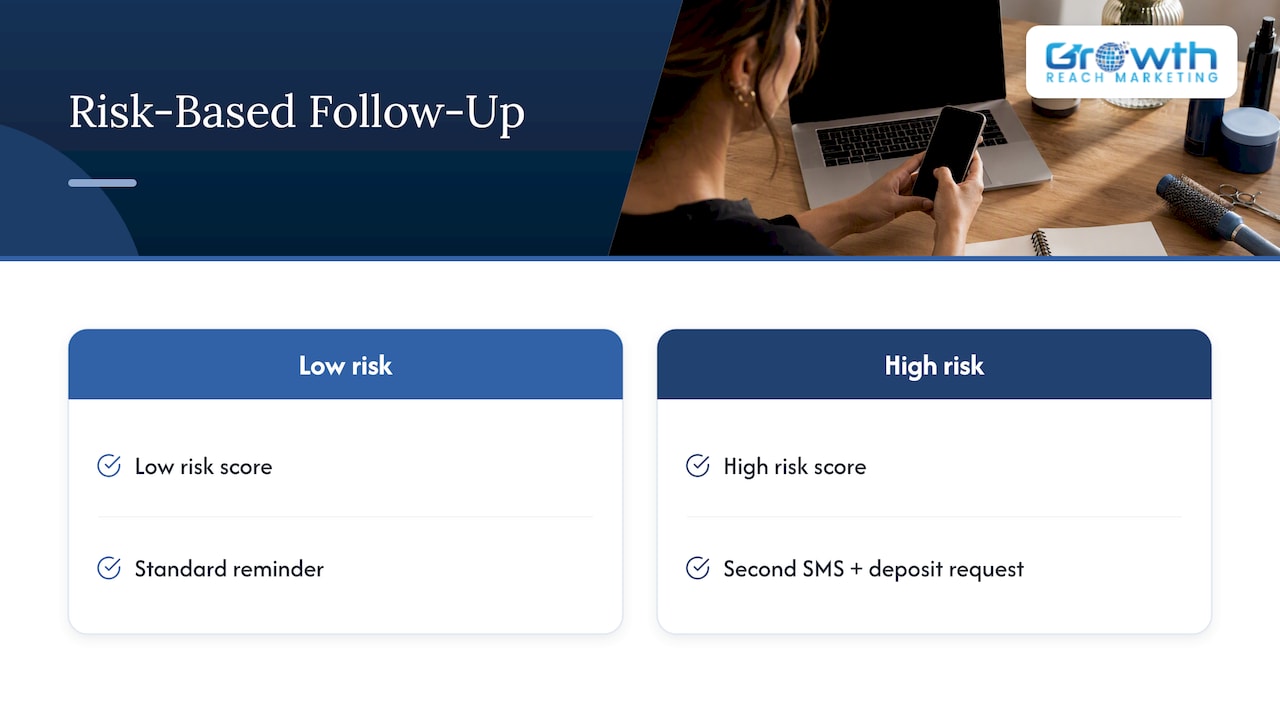
Modern booking platforms increasingly score each appointment’s no-show risk automatically, using signals like booking lead time, service length, time of day, and the client’s own appointment history. That score can then trigger the right level of follow-up: a standard reminder for low-risk bookings, a second SMS plus a deposit request for high-risk ones.
Automation tools also handle the repetitive parts of the reminder sequence that are easy to skip when a front desk gets busy: sending the confirmation the instant a booking lands, firing the 48 to 72 hour reminder without anyone remembering to do it, and triggering a waitlist text the second a slot opens up. None of this requires a large team. Most booking and scheduling platforms built for salons already include basic rules-based automation, and the step up to predictive scoring is usually a software setting rather than a rebuild.
The practical test for whether AI-driven prediction is worth adopting is volume: a salon booking a few dozen appointments a week gets most of the benefit from simple rule-based segmentation, new clients, long services, repeat no-show history, without needing a predictive model at all. Once appointment volume and staff count grow past what one manager can track manually, a system that scores risk automatically starts paying for itself in staff time saved, not just in no-shows avoided.
Integrating No-Show Reduction with Local Social Media Ad Campaigns
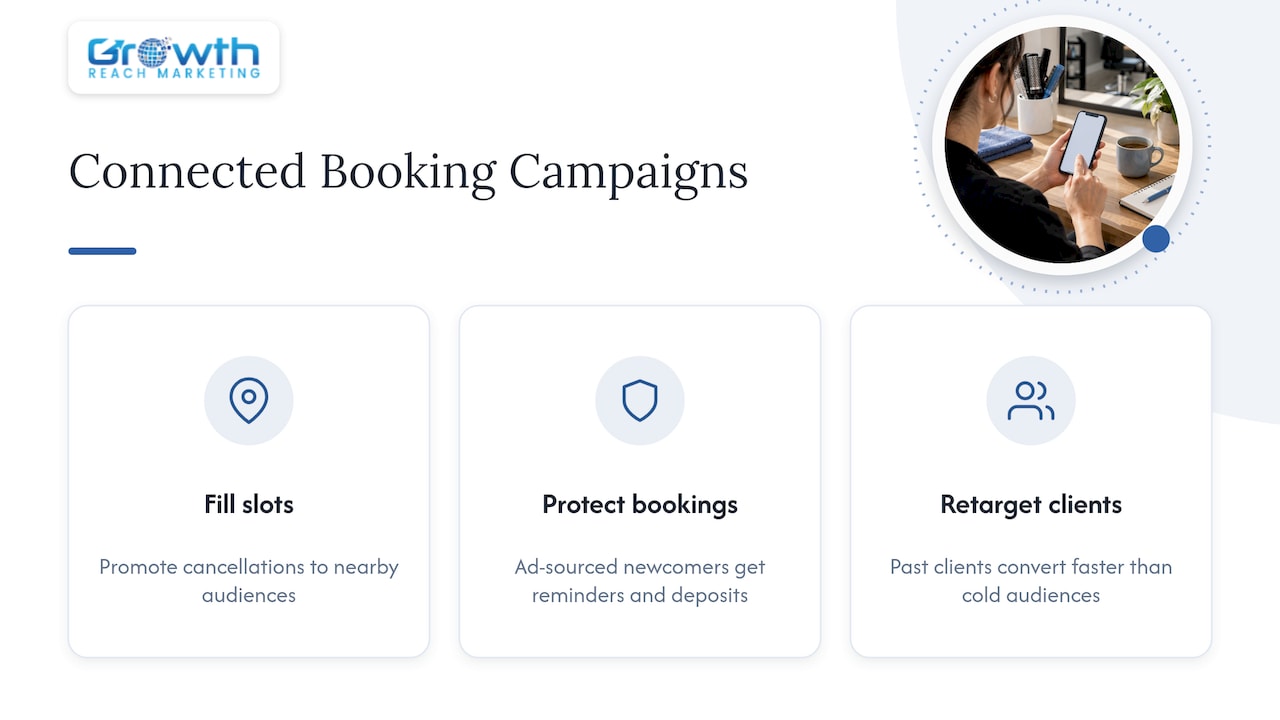
No-show reduction and local advertising solve different problems, but they share the same booking funnel, and treating them separately wastes the data each one generates. A canceled slot is inventory you’ve already paid to fill once. Promoting it directly to a local Facebook or Instagram audience, rather than letting it sit empty, turns a missed appointment into a same-day booking opportunity for someone nearby who’s ready to come in quickly.
The reverse connection matters too: ad campaigns that drive new clients to book should feed those bookings straight into your strictest reminder and deposit rules, since first-time clients sourced from a paid ad carry a higher no-show risk than regulars who’ve been with you for years. Segmenting new-from-ads clients into a two-reminder, deposit-required flow protects the revenue you just paid to generate.
Retargeting audiences built from your client list are also useful for filling last-minute cancellations: a short-notice promotion shown only to people who’ve booked with you before tends to convert faster than a cold local audience, since they already trust your salon. Running these as small, targeted campaigns rather than broad local ads keeps the cost per filled slot reasonable.
Author Perspective: Trade-Offs and Practical Priorities
Most salons reach for deposits first because they feel like control. I’d flip that order. Reminders and reschedule links cost nothing to try and fix the majority of no-shows, which are forgetfulness, not bad faith.
Blanket deposit rules punish loyal clients for the sins of a few repeat offenders. Segment first: flag the clients and time slots with real risk, then test your changes on them before rolling anything out salon-wide. An early cancellation is salvageable inventory, not a loss, if your waitlist is ready to catch it.
— Gerard
How We Help Salons Reduce No Shows
Fixing reminder timing and policy wording gets you most of the way there, but the ongoing work of running SMS and email flows, measuring which messages actually move attendance, and feeding ad-driven bookings into the right reminder sequence is where most salons run out of time. That’s the gap we close for salon and aesthetics clinic clients.
- We design and manage SMS and email reminder flows, including the cadence and wording that research shows gets replies.
- We set up measurement and attribution so you can see which reminder sequence and deposit rule actually reduce no-shows.
- We run Facebook and Instagram advertising that feeds new local clients into your booking funnel with the right follow-up built in from the start.
A quick audit looks at your current confirmation, reminder, and cancellation setup, then flags the fastest fixes before any bigger rebuild. Visit our services page to see how we can set this up for your salon.
FAQ
What is the cancellation policy for hairdressing salons?
Most salon cancellation policies ask for 24 to 48 hours’ notice before canceling or rescheduling without penalty. Policies typically state what happens to a deposit if that window is missed, along with exceptions for emergencies, and should be visible at booking rather than only mentioned afterward.
How do I say no to an appointment?
Declining a booking request is clearest when stated plainly: explain the reason, whether it’s a full schedule, a policy requirement like an unpaid deposit from a prior no-show, or a service you don’t offer, and suggest an alternative time or provider when possible. Keeping the message short and direct avoids confusion without sounding harsh.
What is a reasonable cancellation policy?
A reasonable policy requires a short notice period, often 24 to 48 hours, states clearly what happens to any deposit if that notice isn’t given, and includes a fair exception process for genuine emergencies. Irish consumer protection guidance notes that cancellation terms should be transparent and should not create unreasonable barriers for clients trying to cancel.
What is your process to reduce no shows?
An effective process combines automated confirmations and reminders timed 48 to 72 hours and 24 hours before the appointment, selective deposits for higher-risk bookings, a clear published cancellation policy, and a waitlist that refills canceled slots automatically. Tracking no-show rate and same-day cancellations monthly shows whether the combination is actually working.
Sources
- Kaiser Permanente randomized study on extra text reminders
- PLOS ONE: Stating appointment costs in SMS reminders reduces missed hospital appointments
- Systematic review/meta-analysis of electronic notifications to improve attendance
- Competition and Consumer Protection Commission (CCPC) — guidance for businesses