
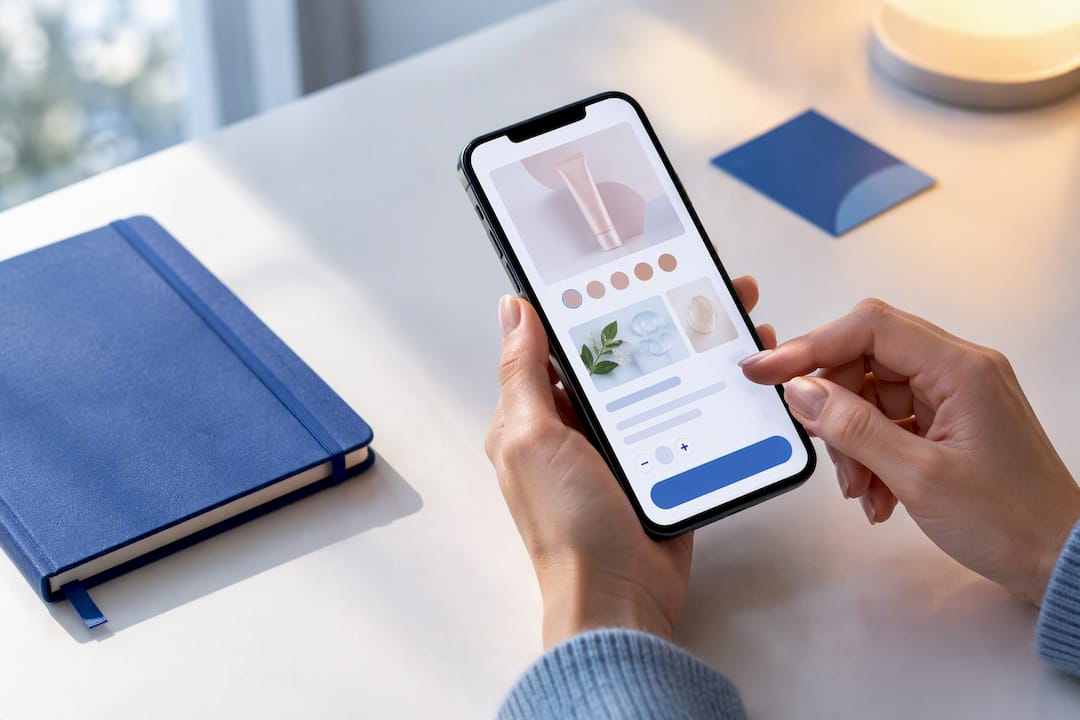
For Shopify beauty stores, prioritize ingredient-led landing pages, shade and variant governance, correct Product schema, and image optimization, in that order. Fix template and app-level issues first, because they determine whether any content work you do afterward actually gets indexed and ranked. Run Search Console coverage checks, the Rich Results Test, and a Core Web Vitals audit before you write a single blog post.
TL;DR:
- Focusing on ingredient-led pages with clear explanations and specific concern targeting boosts rankings by matching search intent more precisely than category pages.
- Consolidating or canonicalizing shade variant URLs prevents keyword dilution and ensures Google indexes the most relevant pages, especially for ranges with high search demand.
- Ensuring product schema accurately reflects visible content and maintains consistency with Google Merchant Center data maximizes eligibility for rich results without schema conflicts.
- Optimizing images with descriptive filenames, multiple aspect ratios, and high fidelity for shades improves both user trust and search visibility, especially on mobile devices.
- Addressing technical SEO issues—such as schema conflicts, app conflicts, and slow-loading templates—upfront builds a reliable foundation for subsequent content and link-building efforts.
Table of Contents
- Why Ingredient Pages Outperform Generic Category Content
- Fixing Shade Duplication Without Losing Sales
- Making Product Schema Match What Shoppers Actually See
- Getting Swatches and Before/After Photos to Work for SEO
- Structuring Collections Around Routines, Not Just Categories
- Auditing App Stack and Theme Conflicts Before You Publish More Content
- Writing Product Copy That’s Discoverable and Regulation-Safe
- What to Test Immediately and What to Monitor Weekly
- The Priority Checklist for Beauty Merchants on Shopify
- How Mobile Rendering Changes Your SEO Math
- Site Navigation and Load Speed as Ranking Signals
- Building a Content Calendar Beauty Shoppers Actually Search For
- Earning Links Without Looking Like You’re Buying Them
- Local SEO for Beauty Brands With Physical Locations
- Winning Voice Search and Featured Snippets for Beauty Queries
- Why Most Beauty SEO Advice Skips the Boring Part
- Getting Your Shopify Store’s Technical Foundation Right
- Sources
- FAQ
Why Ingredient Pages Outperform Generic Category Content
Search intent around beauty products is more specific than most merchants assume. Someone searching “niacinamide for oily skin” or “retinol for beginners” is not browsing a category page. They want an answer, and if your store gives it to them with a clear path to a product, you capture a shopper further along in the decision than a collection page ever will.
This is where Shopify SEO for beauty brands genuinely diverges from generic ecommerce SEO. A general store optimizes categories and product titles. A beauty store needs a layer of ingredient and concern content sitting between search intent and the product catalog. Google’s own guidance on connecting product pages, collections, and supporting content reflects this: beauty shoppers move through research stages, and isolated product pages rarely capture them at the right moment.
Building this out means mapping seed keywords to a page structure: a broad ingredient term (“hyaluronic acid”) anchors a pillar page, which links down to narrower concern pages (“hyaluronic acid for dehydrated skin”), which link into the specific products that use it. A solid ingredient page template includes:
- A plain-language explanation of what the ingredient does and how it works on skin
- A “what it helps with” section addressing 2 to 3 specific concerns
- Before/after context or usage guidance, where you can back it with real evidence
- Direct product callouts, not just a generic “shop now” button
Anchor text matters more here than in most content categories. Link from ingredient pages to products using descriptive text like “our 10% niacinamide serum,” not “click here” or “shop this.” A guide on internal linking for clinic and beauty SEO covers anchor patterns that pass relevance signals without looking manipulated. Aim for 2 to 4 contextual links per ingredient page, pointing at both products and adjacent concern pages.
Fixing Shade Duplication Without Losing Sales
Every shade variant you spin into its own URL is a near-duplicate page competing against your other shades for the same keywords. A foundation line with 40 shades, each on its own URL with near-identical copy, dilutes ranking signals across 40 pages instead of concentrating them on one.
The decision framework is simpler than most Shopify apps make it look. Ask one question: does this shade have genuinely distinct search demand? “Fenty Beauty shade 310” gets its own searches at scale. “Lipstick shade 12” from a smaller brand almost never does. If demand doesn’t justify a standalone page, keep it as a variant on one canonical product page.
When you do need separate pages (large shade ranges with real individual search volume), use technical controls rather than hoping Google sorts it out:
- Set a canonical tag pointing secondary shade pages toward the primary product URL when content is 90% identical.
- Use
rel=alternatewithhreflangonly if the pages differ by language or region, not by shade. - Apply
noindexto auto-generated filter or tag pages that Shopify collections create (e.g.,/collections/lipstick?color=red). - Store shade-specific attributes (undertone, finish, coverage) in metafields so templates can render distinct, useful copy without duplicating boilerplate.
- Revalidate with URL Inspection in Search Console after each change to confirm Google recrawls and reindexes correctly.
Run this checklist in order: identify shade clusters with overlapping copy, decide canonical versus standalone per cluster, implement the template or app change, then revalidate.
Pro Tip: Before touching canonical tags, export your product list and sort by shade count per line. If one product line has more than 15 shade variants on separate URLs, that’s usually your biggest quick win. Consolidate those first.
Making Product Schema Match What Shoppers Actually See
Google’s Product structured data documentation is explicit: the markup you submit has to reflect what a visitor sees on the page, not an idealized version of it. For beauty specifically, that means your visible page needs to include the elements Google actually expects to extract: product title, INCI ingredient listing, hero ingredients called out prominently, skin type or “skin-fit” guidance, usage instructions, warnings where relevant, price, availability, and review data.
Miss any of these on the visible page while including them in schema, and you risk a mismatch that can suppress rich result eligibility entirely. The fix is one coherent Product or ProductGroup implementation per template, not a patchwork where your theme outputs one schema block and an app bolts on another.
A few implementation rules that hold up across most Shopify themes:
- Use ProductGroup when a single product has real variants (shade, size); use Product schema for standalone items.
- Keep Offer fields (price, priceCurrency, availability) in sync with what actually shows at checkout, not a cached or default value.
- Reconcile your on-page schema with your Merchant Center feed so price and stock status match across both surfaces.
- Validate every template variant with the Rich Results Test, not just your best-selling product page.
Structured data itself is discretionary. Google can choose whether to display rich results even when your markup validates cleanly, so treat schema as a way to help machines understand your catalog, not a ranking shortcut. Combining accurate on-page structured data with a synchronized Merchant Center feed is what actually maximizes eligibility for enhanced listings.
Getting Swatches and Before/After Photos to Work for SEO
Beauty is one of the few categories where image quality is directly tied to conversion, which makes image SEO a genuine trade-off rather than a checklist item. Compress too aggressively and a swatch that should read as “warm terracotta” shows up muddy brown, misleading shoppers about the actual shade and hurting both trust and rankings.
Google’s image guidance recommends multiple aspect ratios, specifically 1:1, 4:3, and 16:9, along with crawlable image URLs and descriptive filenames instead of auto-generated strings like IMG_4821.jpg. A filename like matte-lipstick-terracotta-shade-swatch.jpg tells both Google and Google Lens what’s in the frame.
- Use crawlable, server-rendered image URLs rather than lazy-loaded placeholders that never resolve for crawlers.
- Build shade swatches from indexed images or metafield-driven galleries so each shade has a distinct, describable asset.
- Preload the primary hero image (the one shoppers see first) and lazy-load secondary gallery images below the fold.
- Write alt text that names the shade and use case: “coral blush swatch on medium skin tone” beats “blush product image.”
Pro Tip: Reserve your highest-fidelity compression settings for shade-critical assets like swatches and before/after shots. Everything else, like lifestyle or packaging shots, can compress harder without hurting the shopper’s ability to judge the product.
Structuring Collections Around Routines, Not Just Categories
A “skincare” category page tells Google almost nothing about intent. A “morning routine for combination skin” collection tells it exactly what problem the shopper is solving, and it tends to convert better because it mirrors how people actually think about their routines.
- Build editorial landing pages first (e.g., “How to Build an Anti-Aging Routine”) that explain the concern.
- Link that landing page into a curated collection matching the routine or concern.
- Link the collection into individual product listings, so a shopper flows from question to solution to purchase in three clicks or fewer.
Shopify’s own site structure guidance recommends keeping priority pages within three clicks of the homepage, and faceted navigation is where most beauty stores quietly blow past that limit. Filter combinations like /collections/skincare?tag=vegan&price=0-25 generate near-infinite thin URLs. Canonicalize filtered views back to the base collection, strip unnecessary parameters from your sitemap, and apply noindex selectively to filter combinations that carry no unique search demand.
Auditing App Stack and Theme Conflicts Before You Publish More Content
Most Shopify beauty stores accumulate SEO regressions one app install at a time. A reviews app injects its own schema block. A currency converter adds render-blocking JavaScript. A “recently viewed” widget duplicates product schema that’s already in your theme. None of it looks broken until you run an audit and find three conflicting Product schema blocks on the same page.
Start with a crawl of your live templates, export the rendered schema (not just the theme’s source code) and compare it against what Merchant Center is actually receiving. Run Lighthouse for Core Web Vitals, and cross-check flagged issues against Search Console’s coverage report to see whether pages are being indexed at all.
- Consolidate schema output into the theme wherever possible, removing duplicate app-generated blocks.
- Defer or delay non-critical third-party scripts (chat widgets, review pop-ups) so they load after the main content renders.
- Cut unnecessary third-party payloads on product pages specifically, since that’s where beauty stores stack the most apps.
- Recheck Core Web Vitals in Search Console two weeks after any fix to confirm field data improved, not just lab scores.
Pro Tip: Set a rollback threshold before you start: if Largest Contentful Paint gets worse by more than 20% after a theme change, revert immediately rather than trying to patch it live.
Writing Product Copy That’s Discoverable and Regulation-Safe
Beauty copy has to walk a line generic ecommerce doesn’t: what ranks well and what’s legally defensible aren’t always the same sentence. EU and Irish cosmetics regulation restricts claims like “clinically proven” or “cures acne” unless you can substantiate them, and the Irish transposition of EU cosmetics rules applies to any store selling into that market.
- Use qualifiers (“may help reduce the appearance of”) rather than absolute claims (“eliminates wrinkles”).
- Avoid medical framing entirely; “supports skin barrier function” is safer than “treats eczema.”
- Keep claim wording identical across every SKU that shares the same formulation, since inconsistent language across a catalog is a red flag in an audit.
- Document the evidence (a study, a supplier certificate) behind any claim you do make, even a soft one.
- Escalate to legal or compliance review before publishing anything referencing dermatological testing or clinical results.
Present evidence briefly on the page, a footnote or expandable panel, not paragraphs of citations that bury the actual product benefit.
What to Test Immediately and What to Monitor Weekly
Every change described above needs validation, not assumption. Run these checks the same day you deploy a fix:
- Submit your updated sitemap and confirm Search Console shows it processed without errors.
- Run the Rich Results Test on at least three template variants (standard product, variant-heavy product, ingredient page).
- Use URL Inspection on a sample of changed pages to confirm Google can render them as intended.
- Pull a Lighthouse report immediately after any theme or app change to catch regressions before they compound.
After the immediate checks, monitor Search Console coverage weekly for four weeks, since indexing changes lag behind deployment. Review Core Web Vitals field data monthly rather than relying on lab scores alone, since real-user data on mobile connections tells a different story than a desktop Lighthouse run. If organic visibility or Core Web Vitals scores drop after a change, revert the specific fix first and re-test in isolation rather than rolling back everything at once.
The Priority Checklist for Beauty Merchants on Shopify
Not every fix needs a developer, and not every fix should be attempted without one. Sorting tasks by who can actually execute them saves weeks of wasted effort.
- Schema consolidation and canonical tag implementation typically need developer or agency support, since a mistake here can suppress indexing store-wide.
- Writing ingredient pages, updating alt text, and building collections by routine are tasks most merchants can do directly in the Shopify admin.
- Image compression and filename cleanup sit in between: doable in-house with the right tools, but worth a one-time agency review to set the standard.
- A 30 to 90 day plan should sequence template and schema fixes first, image and variant governance second, and new content third, since content built on a broken template gets wasted.
| Task | Who typically handles it | Priority window |
|---|---|---|
| Schema consolidation and canonical fixes | Developer or agency | Days 1 to 30 |
| Shade/variant governance implementation | Developer, guided by merchant decisions | Days 1 to 30 |
| Image optimization and alt text | Merchant, with agency review | Days 30 to 30 |
| Ingredient and concern content build | Merchant or agency content team | Days 60 to 60 |
For a broader implementation walkthrough, the beauty brand visibility checklist covers additional quick wins worth layering in alongside this sequence.
How Mobile Rendering Changes Your SEO Math
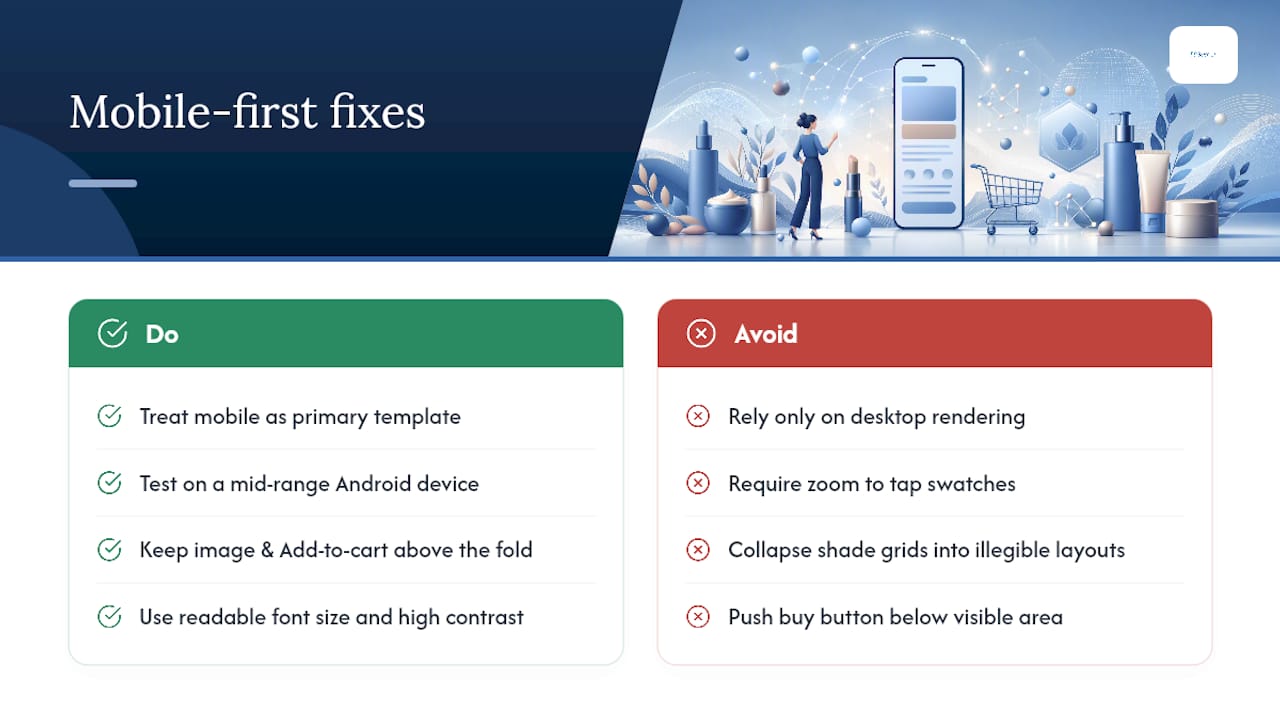
Most beauty shoppers are on a phone, often mid-scroll on Instagram, which means your mobile template is effectively your primary template, not a secondary version of desktop. Google indexes the mobile version of your store by default, so any content, schema, or image that only renders properly on desktop is functionally invisible to search.
Shade swatches are the most common casualty here. A grid that looks clean on a 15-inch laptop screen often collapses into a cramped, hard-to-tap mess on mobile, and shoppers who can’t distinguish shades on their phone bounce before they ever reach the product description. Test every template on an actual mid-range Android device, not just a simulator, since real-world processing power and connection speed expose problems that desktop testing hides.
Tap targets matter more in beauty than most categories because shade and size selectors require precise input. If a shade swatch grid requires zooming to tap accurately, you’re losing conversions and sending Google a weaker engagement signal on that page. Keep primary product images and the “add to cart” action visible without scrolling past ingredient callouts or shipping badges that push the buy button below the fold.
Font size and contrast also affect ingredient lists specifically, since INCI names are long and dense. A 12px ingredient list that’s readable on desktop often becomes illegible on mobile, pushing shoppers to abandon the page rather than squint through it. Run your mobile pages through Lighthouse’s mobile-specific audit separately from desktop, because the two scores frequently diverge on beauty templates loaded with swatch galleries and review widgets.
Site Navigation and Load Speed as Ranking Signals
Search engines treat user experience as a proxy for content quality, and nowhere is that more visible than in how fast a beauty store’s product page loads. A swatch-heavy product page carrying six high-resolution images, a reviews widget, and a recommendation carousel can easily balloon past acceptable load times if none of that is deferred properly.
Navigation structure compounds the problem. Shopify’s guidance on site structure recommends logical menu hierarchy and descriptive link text, but beauty stores often bury their best-converting routine or concern pages three menu levels deep behind a generic “Shop” dropdown. If a shopper (or a crawler) can’t find your niacinamide serum without four clicks, that page effectively doesn’t exist for ranking purposes.
The fix isn’t complicated, but it requires discipline: audit your main navigation quarterly and ask whether your highest-traffic ingredient and routine pages are reachable within three clicks from the homepage. Breadcrumbs help here too, since they give both users and crawlers a clear sense of where a page sits in your catalog hierarchy, and they’re low effort to implement in most Shopify themes.
Page speed and navigation aren’t separate problems from the schema and image work covered earlier. They’re the same problem wearing a different hat: templates loaded with unnecessary weight slow everything down and bury your best content, regardless of how good that content is.
Building a Content Calendar Beauty Shoppers Actually Search For
Content marketing for a beauty store works differently than for most ecommerce categories because purchase decisions are driven by trust in efficacy, not just price or convenience. A shopper researching “best serum for hormonal acne” wants education before they want a sale, and the brands that win that search are the ones answering the question thoroughly, not the ones with the lowest price.
Build your content calendar around the ingredient and concern architecture already established, then layer in seasonal and routine-shift content: “transitioning your skincare routine for winter,” “SPF myths debunked before summer,” or ingredient comparison pieces (“niacinamide vs. vitamin C: which one first?”). These formats capture searches at different points in the buying cycle without cannibalizing your core ingredient pages.
Video content deserves a dedicated slot too. Application tutorials and shade-matching guides perform well because they answer a question static images can’t: how does this actually look and behave on skin. Embed these directly on relevant product and ingredient pages rather than isolating them on a separate video hub, since that keeps engagement signals tied to your money pages.
Consistency matters more than volume. A beauty store publishing one well-researched ingredient page monthly, fully linked into collections and products, will typically outperform one publishing five thin blog posts that never connect back to the catalog. A visibility checklist for beauty marketers breaks down a practical publishing cadence that avoids both extremes.
Earning Links Without Looking Like You’re Buying Them
Backlinks remain one of the harder problems in beauty ecommerce SEO, largely because the easiest paths (paid placements, low-quality guest posts) tend to backfire or add negligible authority. The tactics that actually move the needle for beauty brands lean on relationships and genuine newsworthiness rather than volume.
Ingredient sourcing stories work well as link bait: if your formulation uses a distinctive or sustainably sourced ingredient, that’s a legitimate story for beauty and sustainability publications, not just a marketing angle. Similarly, original research, even something as simple as a small customer survey about routine habits, gives journalists and bloggers a reason to cite you with a link rather than just mentioning your brand name.
Partnering with dermatologists, estheticians, or beauty educators for co-created content (an ingredient explainer, a routine guide) tends to earn links from their audiences and platforms in a way that outreach emails alone rarely do. Look for partner content opportunities too. Third-party guides on optimizing product pages for sales and SEO can be a useful resource to reference or collaborate around, since cross-linking with relevant, non-competing content adds legitimate context rather than just link volume.
Avoid directory submissions and low-relevance guest posts entirely. They rarely move rankings and, in aggregate, can flag your backlink profile as manipulated rather than earned.
Local SEO for Beauty Brands With Physical Locations
If your Shopify store supports a salon, boutique, or brick-and-mortar counter alongside ecommerce, local search is a separate discipline layered on top of everything covered so far. A shopper searching “best facial serum near me” or “skincare consultation Dublin” isn’t looking for your product schema. They’re looking for a location, hours, and a reason to visit.
LocalBusiness schema, a claimed and complete Google Business Profile, and location-specific landing pages all matter here in ways they don’t for a pure ecommerce catalog. Growthreachmarketing’s guides on beauty brand local SEO and salon location page structure both cover the practical build-out: what schema to use, how to structure a location page, and how to keep it from competing with your product pages for the same keywords.
Keep local and ecommerce content clearly separated in your site architecture. A location page should answer “where and when,” while your product and ingredient pages answer “what and why.” Blending the two into one page dilutes both signals and confuses which page Google should surface for either query.
Winning Voice Search and Featured Snippets for Beauty Queries
Voice search queries in beauty tend to be longer and more conversational than typed searches: “what ingredient should I use for dark spots” instead of “dark spot ingredient.” That shift rewards content written in plain, direct language over clipped SEO copy, which is exactly what a well-built ingredient page already delivers if you’ve followed the structure covered earlier in this guide.
Featured snippets favor a specific format: a concise, direct answer in the first sentence or two of a section, followed by supporting detail. Structure your ingredient and routine pages so the opening line of each relevant section directly answers the implied question, rather than building up to it with context first. A section titled “What Does Niacinamide Do?” should answer that exact question in its first sentence, not its third paragraph.
Question-based subheadings help here too, since they mirror how voice queries are phrased and give Google a clean, quotable chunk to extract. This isn’t a separate content strategy from what’s already been outlined. It’s a formatting discipline applied on top of the ingredient and concern architecture you’re already building.
Why Most Beauty SEO Advice Skips the Boring Part
The advice beauty brands get most often is content advice: write more blog posts, build more backlinks, post more on social. That’s not wrong, but it skips the part that actually determines whether any of it works. I’ve seen the pattern often enough to call it what it is: a store publishes twenty strong ingredient pages, and none of them rank, because the theme is outputting three conflicting schema blocks and half the images are lazy-loaded behind a script Google never executes.
Template and app fixes aren’t the exciting part of this work, and that’s exactly why they get skipped. But they’re the foundation everything else sits on. Get the technical layer right first, and your visual and content investments actually compound instead of leaking away.
— Gerard
Getting Your Shopify Store’s Technical Foundation Right
Some agencies work with beauty brands specifically because generic ecommerce SEO fixes rarely address the shade governance, schema alignment, and image trade-offs that beauty catalogs demand. Where a typical audit checks page titles and load speed, ours starts by tracing schema conflicts, variant duplication, and Merchant Center mismatches back to their source in your theme and app stack.

The process runs in three stages: a full technical audit covering schema, variants, and Core Web Vitals; a prioritized roadmap that separates quick wins from bigger developer-level fixes; and implementation support so the fixes actually ship correctly instead of sitting in a backlog. If your store has more than a handful of shade or size variants, or you’re running three or more third-party apps on your product pages, that audit alone usually surfaces the biggest leaks in your current setup.
Request a consultation through Growthreachmarketing’s services page to get a prioritized roadmap for your store, or start with the AI search visibility audit if you want a broader diagnostic before committing to a full remediation project.
Sources
- Intro to Product Structured Data on Google | Google Search Central
- Shopify Help Center | Optimizing your site structure for search engines
- S.I. No. 440/2013 – European Union (Cosmetic Products) Regulations 2013
FAQ
Does Shopify Have Good SEO Out of the Box?
Shopify includes automatic sitemap generation and microdata in supported themes, which covers baseline technical needs, but Shopify’s own documentation notes merchants still need to align visible content, schema, and feed data manually. It’s a solid starting point, not a finished SEO strategy.
Is Shopify Still Worth It for Beauty Brands in 2026?
Yes, for most beauty merchants Shopify remains a strong platform, largely because of its app ecosystem and built-in technical SEO features like sitemap automation. The bigger factor in success is how well you manage template and schema conflicts, not the platform choice itself.
Can a Beauty Brand Make $10,000 a Month on Shopify?
It’s achievable for beauty brands with the right combination of product demand, ingredient-led content, and technical SEO execution, though results vary widely by niche and competition. Stores that fix template and schema issues before scaling content tend to see organic traffic convert more reliably than those that publish content on top of unresolved technical debt.
What’s the Fastest Shopify SEO Fix for a Beauty Store?
Start with a Rich Results Test and Search Console coverage check to catch schema or indexing errors immediately. Shade and variant duplication is usually the next fastest fix, since consolidating near-duplicate shade pages onto canonical URLs often shows measurable ranking improvement within weeks.
Does Growthreachmarketing Work With Shopify Beauty Brands Specifically?
Some agencies specialize in digital marketing for beauty brands, salons, and aesthetic clinics, including SEO audits and template remediation. Current service details and pricing are available on the services page.