

Ad relevance in Google Ads is defined as how closely your ad copy matches the intent behind a user’s search query. It is one of three components that make up Quality Score, alongside expected click-through rate and landing page experience. Google rates ad relevance as Above Average, Average, or Below Average at the keyword level. That rating directly shapes your Ad Rank, your cost per click, and whether your ad appears at all in a given auction.
What does ad relevance mean in Google Ads campaigns?
Ad relevance measures the alignment between what a user types into Google and what your ad actually says. When someone searches “laser hair removal near me” and your ad headline reads “Book Laser Hair Removal Today,” that is strong relevance. When your ad reads “Affordable Beauty Treatments,” Google sees a weaker match and penalizes you for it.

Ad relevance is the only Quality Score component fully within your direct control as an advertiser. Expected CTR depends partly on historical data, and landing page experience requires technical and content work. Ad relevance, by contrast, lives entirely in how you write and structure your ads. That makes it the fastest lever you can pull to improve Google Ads ad quality.
Quality Score combines expected CTR, ad relevance, and landing page experience, each rated on a three-point scale. A below-average ad relevance score drags down your overall Quality Score even if your landing page is excellent. Google evaluates this rating at the keyword level, meaning each keyword in your account carries its own relevance signal.
How does ad relevance affect your campaign performance?
Ad relevance feeds directly into Ad Rank, which is the score Google calculates every time a user triggers an auction. Google recalculates Ad Rank in real time based on your bid, ad quality signals, and contextual factors like device and location. A higher Ad Rank wins better positions and can reduce what you pay per click.
The cost implication is significant. Low ad relevance drives high CPCs more often than low bids do, because Quality Score directly influences the price you pay at auction. Advertisers who assume they need to raise bids to compete are often solving the wrong problem. Fixing relevance is cheaper and more sustainable.
Here is what poor ad relevance costs you in practice:
- Higher cost per click. Google charges more when your ad quality is weak, because the system compensates for lower relevance with a higher price floor.
- Lower ad positions. Even a large bid cannot fully offset a below-average Quality Score, so your ads appear lower on the page or not at all.
- Reduced impression share. High Quality Score components like ad relevance increase your share of impressions in premium positions, meaning poor relevance costs you visibility as well as money.
- Wasted budget. Ads that appear for mismatched queries generate clicks from users who were never going to convert, burning spend without results.
Strong ad relevance is not just a quality metric. It is a cost control mechanism. Every point of improvement in your Quality Score translates to a lower effective CPC at the same bid level.
What factors determine ad relevance in Google Ads?
Google evaluates ad relevance using several signals, and understanding each one helps you write ads that score well consistently.
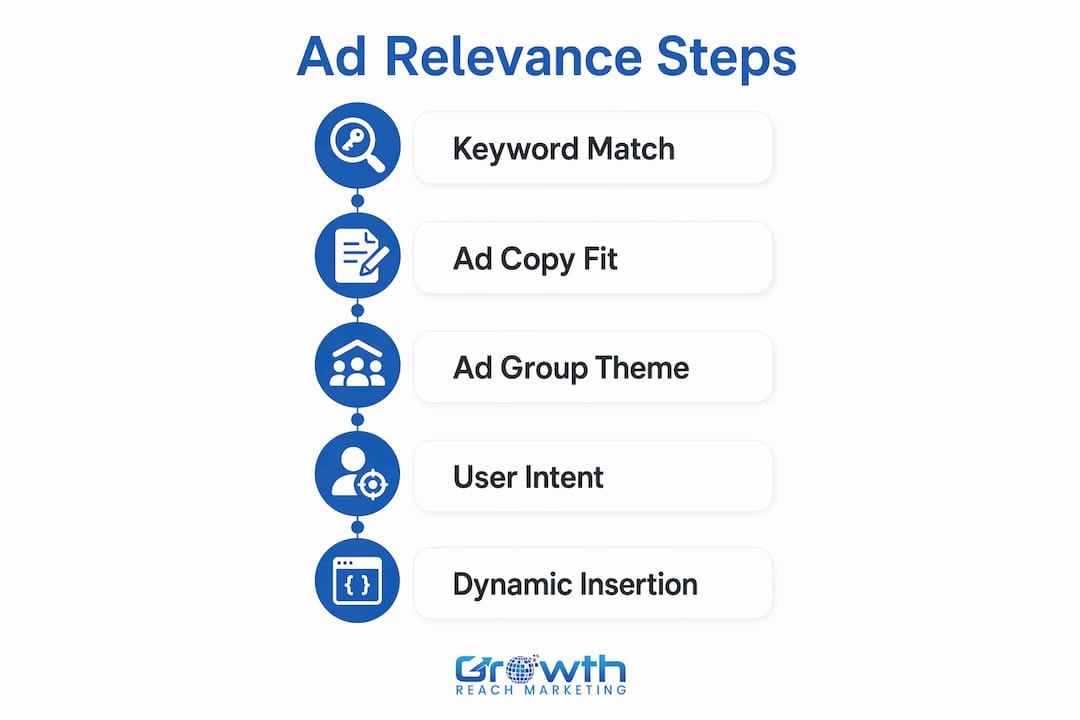
Keyword-to-ad copy alignment is the most direct factor. The words in your ad headline and description should reflect the keyword that triggered the ad. If your keyword is “Botox consultation London” and your headline says “Book a Skin Treatment,” Google reads that as a mismatch. The closer the language match, the stronger the relevance signal.
Ad group structure shapes relevance at scale. Each ad group should contain keywords that share a single, tight theme. When you mix “facial treatments,” “chemical peels,” and “microneedling” into one ad group with generic copy, no single ad can speak accurately to all three intents. Tightly themed ad groups make it possible to write copy that genuinely matches every keyword inside them.
User search intent goes beyond literal keyword matching. Google’s system reads whether a user is in research mode, comparison mode, or ready to buy. An ad that matches the keyword but misses the intent still scores poorly. A user searching “how much does Botox cost” wants pricing information, not a “Book Now” headline.
Dynamic Keyword Insertion can improve relevance by automatically pulling the search query into your ad copy. It is useful for large ad groups where writing individual ads for every keyword is not practical. However, DKI carries risk. If your keyword themes are too broad, the inserted text can produce ads that read awkwardly or feel irrelevant despite technically matching the query.
Here is how ad relevance compares to the other two Quality Score components:
| Quality Score component | What Google measures | Who controls it |
|---|---|---|
| Ad relevance | Match between ad copy and search intent | Advertiser (direct control) |
| Expected CTR | Predicted likelihood a user clicks the ad | Advertiser and historical data |
| Landing page experience | Relevance and usability of the destination page | Advertiser and web developer |
Pro Tip: Write your ad headlines first, then check whether each headline could serve every keyword in that ad group. If even one keyword feels like a stretch, split it into its own ad group.
Common reasons your ads have low ad relevance
Low ad relevance is almost always a structural problem, not a writing problem. The copy is often fine. The issue is that the wrong keywords are triggering the wrong ads.
-
Loosely themed ad groups. Poorly themed ad groups with loosely related keywords are the most common cause of low relevance ratings. When one ad must serve ten different keyword intents, it cannot match any of them precisely.
-
Broad match triggering irrelevant queries. Broad match keywords expand your reach but also pull in searches that have nothing to do with your offer. An ad for “salon appointments” can appear for “salon software reviews” if match types are not managed carefully.
-
Generic ad copy. Copy written to appeal to everyone ends up resonating with no one. Phrases like “Quality Service at Great Prices” carry no keyword signal and score poorly against specific search queries.
-
No negative keyword list. Without negatives, your ads appear for searches that are clearly outside your offer. Each irrelevant impression and click signals to Google that your ad is a poor match for those queries.
-
Misaligned landing pages. Mismatch between ad copy and landing page content) weakens relevance signals across the board. Google reads the destination page as part of the overall quality picture.
The fastest diagnostic tool is the Search Terms report inside Google Ads. Reviewing the Search Terms report shows you exactly which queries triggered your ads and whether those queries match your ad copy. Mismatches found here are the clearest signal that your ad group structure or match types need work.
Pro Tip: Run the Search Terms report weekly during the first 60 days of any new campaign. Add irrelevant queries as negative keywords immediately. This single habit prevents most low-relevance problems before they compound.
How to improve ad relevance in your Google Ads campaigns
Improving ad relevance is a structural exercise as much as a creative one. These are the practices that produce consistent, measurable results.
-
Build tightly themed ad groups. Group keywords by a single, specific intent. Single Keyword Ad Groups (SKAGs) take this to the extreme by placing one keyword per ad group, which makes it possible to write ad copy that is a near-perfect match every time. SKAGs require more maintenance but deliver stronger relevance scores and higher CTR.
-
Write copy that mirrors keyword language. Use the exact phrasing from your keyword in at least one headline. If your keyword is “teeth whitening London,” your first headline should contain those words or a direct variant. This is not about stuffing keywords. It is about confirming to the user and to Google that your ad is the right answer.
-
Match the intent, not just the keyword. Improvements in ad relevance) that prioritize intent matching over keyword insertion produce better campaign outcomes. A user searching “best Botox clinic near me” wants social proof and proximity signals, not a generic treatment description. Your copy should reflect that.
-
Align your landing page with your ad. The page a user lands on should continue the exact conversation your ad started. If your ad promises a free consultation, the landing page should lead with that offer. Disconnects here hurt both landing page experience scores and the overall relevance picture. Understanding what ad copy means in the broader context of Google Ads helps you see how copy, relevance, and landing pages work as a system.
-
Monitor and iterate continuously. Ad relevance ratings update as Google collects more data on how users interact with your ads. Check Quality Score components monthly, identify keywords rated Below Average for ad relevance, and rewrite or restructure those ad groups first. Prioritize by spend volume so your budget goes to the best-performing, most relevant ads.
Key takeaways
Ad relevance is the single Quality Score component fully within your control, making it the highest-leverage area for reducing CPCs and improving ad placement.
| Point | Details |
|---|---|
| Ad relevance defined | It measures how closely your ad copy matches the intent behind a user’s search query. |
| Impact on cost and position | Low ad relevance raises CPCs and lowers Ad Rank, regardless of how high your bid is. |
| Primary control lever | Of the three Quality Score components, ad relevance is the only one advertisers control directly. |
| Structural fix first | Most relevance problems come from loosely themed ad groups, not weak copywriting. |
| Diagnosis tool | The Search Terms report is the fastest way to find query-to-ad mismatches and fix them. |
Why intent beats keyword matching every time
I have audited hundreds of Google Ads accounts across salons, clinics, and local service businesses, and the pattern is almost always the same. Advertisers obsess over bid strategy and ignore ad group structure. They assume that if the keyword is in the ad, relevance is covered. It is not.
The accounts that consistently achieve Above Average ad relevance ratings are not the ones with the cleverest copy. They are the ones with the tightest structure. One theme per ad group. Headlines that speak directly to what the keyword promises. Landing pages that pick up exactly where the ad left off. That discipline is unglamorous, but it is what separates a 6/10 Quality Score from a 9/10.
The other thing I have noticed is that intent alignment matters far more than keyword density in the ad text. A user searching “how much does lip filler cost” is in research mode. An ad that leads with a price range or a “see our pricing” call to action will outperform one that just says “Book Lip Filler Today,” even if both contain the keyword. Google’s system is sophisticated enough to read that signal, and so is the user.
Landing page relevance is also growing in influence. Accounts that fix ad copy but leave a generic homepage as the destination still struggle. The full chain matters: keyword to ad to page. Break any link in that chain and your relevance score reflects it.
My advice for anyone starting an optimization workflow is to fix structure before copy, fix copy before bids, and never touch bids until the first two are solid. That sequence saves money and produces results that actually hold.
— Gerard
How Growthreachmarketing can improve your Google Ads results
Growthreachmarketing works with salons, aesthetic clinics, and local service businesses to build Google Ads campaigns where every element, from keyword grouping to ad copy to landing page, is aligned for maximum relevance and minimum wasted spend.
If your campaigns are producing high CPCs, low click-through rates, or below-average Quality Scores, the problem is almost always structural. Growthreachmarketing audits your account, restructures ad groups around tight keyword themes, rewrites copy to match search intent, and aligns landing pages to complete the relevance chain. You can explore our Google Ads optimization guide to see how we approach campaign performance for service businesses, or visit Growthreachmarketing.com to get started.
FAQ
What does ad relevance mean in Google Ads?
Ad relevance is Google’s rating of how closely your ad copy matches the intent behind the keyword that triggered it. Google rates it as Above Average, Average, or Below Average, and it forms one of three components in your Quality Score.
How does ad relevance affect my cost per click?
Low ad relevance increases CPC because Quality Score directly influences what you pay at auction. Poor relevance lowers your Ad Rank, which forces you to bid higher to maintain the same position.
What is the difference between ad relevance and landing page experience?
Ad relevance measures the match between your ad copy and the search query. Landing page experience measures the relevance and usability of the page users reach after clicking. Both are Quality Score components, but they are evaluated separately and require different fixes.
How do I check my ad relevance score in Google Ads?
Open Google Ads, go to the Keywords tab, and add the Quality Score columns to your view. You will see individual ratings for expected CTR, ad relevance, and landing page experience at the keyword level. Below Average ratings on ad relevance indicate which keywords need attention first.
Can Dynamic Keyword Insertion fix low ad relevance?
DKI can improve relevance by inserting the search query directly into your ad copy, but it is not a reliable fix on its own. If your keyword themes are too broad, DKI produces ads that read awkwardly and may still score poorly. Tighter ad group structure is the more reliable solution.