
Beauty industry content marketing is not about posting pretty pictures and hoping someone buys. It is a deliberate system for building brand trust, driving organic discovery, and converting curious browsers into loyal customers. The global beauty market exceeds $580 billion by 2027, and with over 80% of consumers researching beauty products online before purchasing, the brands winning right now are the ones treating content as a growth engine, not a decoration. This article breaks down what beauty industry content marketing actually means, which platforms and formats move the needle, and how to build a strategy that compounds over time.
Table of Contents
- Key takeaways
- What beauty industry content marketing really means
- Platforms that drive beauty engagement
- Effective beauty marketing strategies that actually compound
- Real campaigns that show content marketing in action
- How to measure and optimize your content marketing
- My honest take on beauty content marketing in 2026
- Ready to build a content strategy that actually grows your beauty brand?
- FAQ
Key takeaways
| Point | Details |
|---|---|
| Content marketing is strategic, not decorative | It drives brand discovery, trust, and conversions far beyond aesthetics or follower counts. |
| Platform choice shapes content format | TikTok rewards raw authenticity while YouTube builds authority through depth and education. |
| UGC outperforms polished production | Real customer content builds trust more effectively than any brand-produced ad campaign. |
| Dual strategy wins long-term | Combining SEO for intent capture with paid social for reach creates compounding growth. |
| Measurement separates good from great | Tracking engagement, conversions, and repeat purchases tells you what to scale and what to cut. |
What beauty industry content marketing really means
At its core, beauty industry content marketing is the practice of using digital content to promote products, communicate brand values, and build lasting relationships with consumers across multiple platforms. It is not a single campaign or a viral moment. It is an ongoing system that earns attention rather than buying it.
The types of content that fall under this umbrella are broader than most people assume:
- Blog posts and articles that answer ingredient questions, explain routines, and rank in Google search
- Video tutorials on TikTok, Instagram Reels, and YouTube that demonstrate real results
- User-generated content (UGC) from customers sharing honest reviews and before-and-afters
- Email sequences that nurture leads from first purchase to loyal repeat buyer
- Influencer collaborations that blend the creator’s voice with the brand’s message
- Stories, polls, and interactive posts that build community and gather real-time feedback
The business objectives behind all of this are specific: increase brand awareness, drive organic search traffic, build consumer trust, and convert that trust into sales. What separates content marketing from traditional advertising is that it gives value first. A 60-second tutorial on how to layer serums teaches something useful. A banner ad just interrupts.
Authenticity and community engagement are what distinguish top beauty marketers from everyone else. Consumers can detect when a brand is performing versus when it is actually connecting. The polish of a produced ad campaign can actually work against you when your audience has been trained by TikTok to trust the unfiltered version.
Pro Tip: Before you plan any content, write down the three questions your ideal customer types into Google before buying your product. Build your first three blog posts around those exact questions.
Platforms that drive beauty engagement
Knowing what content marketing is means nothing without knowing where to deploy it. Each platform has its own culture, algorithm, and audience expectation. Treating them all the same is one of the fastest ways to waste your budget.
TikTok is where beauty trends are born. Approximately 70% of beauty purchases in the U.S. are influenced by content seen on TikTok and Instagram. Short-form, unpolished videos that show real application, real skin, and real reactions perform far better than anything that looks like an ad. The algorithm rewards watch time and shares, so hooks matter enormously. A video that opens with “I tried this $12 drugstore serum for 30 days” will outperform a slick brand video almost every time.
Instagram still plays a critical role, but its function has shifted. It is now where brands build their visual identity, showcase community, and activate shopping features. Instagram’s strength is in curated aesthetics combined with social proof. Reels drive discovery while Stories and carousels deepen engagement with existing followers.

YouTube is where beauty authority lives. Long-form video content allows brands to create in-depth tutorials, ingredient education, and Q&A sessions that build genuine expertise. A 15-minute video on retinol layering does something no 30-second ad can: it answers every objection, builds trust, and keeps the viewer in your world for the full duration.
Pinterest functions as a visual search engine. Users on Pinterest are actively planning, which means they are closer to a purchase decision than a casual scroller. Boards organized around skin concerns, seasonal looks, or product routines capture high-intent traffic that is easy to convert.
Email marketing is the most underrated channel in beauty. Once someone gives you their email, you have a direct line that no algorithm can interrupt. Sequences built around skin type quizzes, product education, and exclusive offers consistently drive repeat purchases and higher lifetime value.
Avoiding common social media mistakes on each platform, from posting inconsistently to ignoring comments, is just as important as the content itself.
Effective beauty marketing strategies that actually compound
The brands growing fastest in 2026 are not picking one channel and hoping for the best. They are running a dual strategy: SEO for long-term intent capture and paid social for immediate reach. Here is how the key strategic pillars work together.
| Strategy | Strength | Best for |
|---|---|---|
| SEO content (blogs, FAQs) | Long-term organic traffic from high-intent searches | Building brand authority and capturing research-phase buyers |
| Paid social ads | Fast reach and precise audience targeting | Product launches, promotions, and retargeting |
| User-generated content | Authentic social proof at scale | Building trust and improving product page conversions |
| Micro-influencer marketing | Niche credibility and high engagement rates | Reaching specific communities with genuine recommendations |
| Email marketing | Direct, algorithm-free communication | Retention, upsells, and loyalty programs |
SEO-driven blog content is one of the most underused assets in beauty marketing. A post titled “Best moisturizer for dry skin over 40” targets a specific, purchase-ready searcher. That post works for you 24 hours a day without ad spend. Pair it with a retargeting campaign for readers who visited but did not convert, and you have a system that feeds itself.
User-generated content builds trust more effectively than any polished production. Integrating UGC directly on product pages, not just on social media, gives shoppers social proof exactly where they need it most: at the point of purchase. Brands that archive and display real customer photos and reviews on product pages see measurable lifts in conversion rates.
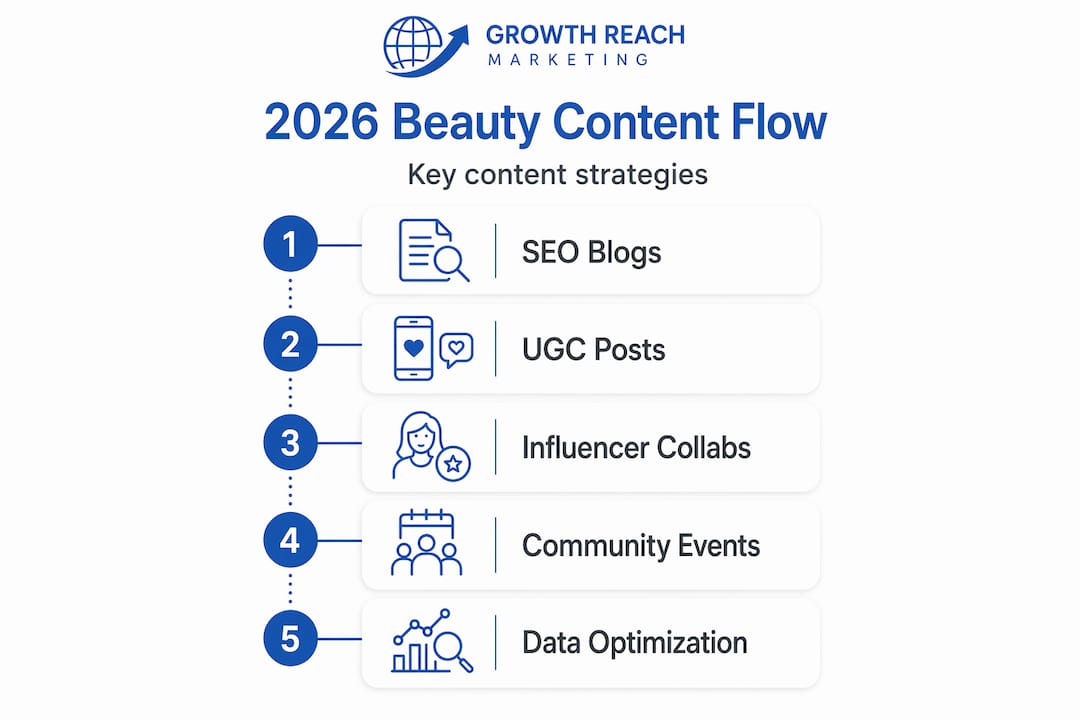
The influencer marketing model has shifted significantly. Moving away from scripted content toward creator experiences, where brands give creators genuine access without posting mandates, produces far more authentic and engaging content. This approach requires more trust from the brand side, but the results justify it.
Pro Tip: If you are running local salon ads alongside your content strategy, make sure your ad landing pages reflect the same tone and messaging as your organic content. Consistency between paid and organic dramatically improves conversion rates.
Real campaigns that show content marketing in action
Theory is useful. Real examples are better. These three campaigns illustrate what effective beauty content marketing looks like when it is executed with intent.
Makeup by Mario and Sephora launched a collaborative TikTok content series that blended education with entertainment. Rather than running separate campaigns, they co-created content that served both audiences simultaneously. The result was a format that felt native to TikTok while carrying the credibility of two recognized names. The lesson: co-branded content works when both parties bring genuine value to the collaboration, not just reach.
Jergens took a different approach entirely. Instead of briefing influencers with scripts and posting requirements, they invited creators to an experience. The Joy Club Miami trip had no content mandates. Creators were simply placed in a camera-ready environment and allowed to share what they wanted. The outcome was 31 million impressions and $3.5 million in media value from entirely organic content. That is what happens when you trust creators to do what they are actually good at.
Rhode built social engagement around a product and accessory combination that was designed to be photographed and shared. The campaign worked because it understood that the product itself was the content. It gave consumers something worth posting about.
The common thread across all three campaigns is that none of them felt like advertising. They felt like content people wanted to watch, share, and participate in.
The lesson for your brand is this: stop asking how to make your ads look less like ads. Start asking how to make your content worth consuming on its own terms.
How to measure and optimize your content marketing
Knowing what to track is the difference between a strategy that grows and one that stalls. These are the metrics that actually tell you whether your content is working:
- Organic traffic growth from blog and SEO content, tracked monthly with tools like Google Search Console or Google Analytics 4
- Engagement rate on social content, including saves and shares, which signal genuine interest rather than passive scrolling
- Conversion rate from content-driven traffic, meaning what percentage of blog readers or video viewers actually buy or book
- Social mentions and UGC volume, which measure whether your audience is creating content about you without being asked
- Email open rates and click-through rates, which tell you whether your nurture sequences are actually resonating
- Repeat purchase rate, which is the clearest signal that your content is building loyalty, not just one-time transactions
Shortening the distance between consumer insight and action is one of the most underrated competitive advantages in beauty marketing. Brands that can read their analytics, spot what is working, and adjust within days rather than quarters consistently outperform slower competitors.
Pro Tip: Set up Google Ads conversion tracking alongside your organic content analytics. Seeing both data streams together reveals which content types are warming up your paid audience and reducing your cost per acquisition.
My honest take on beauty content marketing in 2026
I have worked with beauty brands and service businesses long enough to see the same mistake repeat itself. The brand invests in beautiful photography, hires a content agency, publishes consistently for three months, and then wonders why nothing is converting. The content looks great. The strategy is missing.
What I have seen actually work is deceptively simple. You need content that serves a real question your customer is already asking. You need to show up on the platforms where they are already spending time. And you need to give up the idea that every piece of content needs to look like it belongs in a magazine.
The brands I watch most closely are the ones willing to let go of control. The Jergens campaign is a perfect example. No scripts. No mandates. Just trust in the creator and the environment. That kind of restraint is genuinely hard for most marketing teams, but it produces content that audiences actually believe.
Micro-influencers are still massively underused. A creator with 8,000 highly engaged followers in a specific niche will outperform a celebrity post nine times out of ten for actual conversion. The numbers are smaller. The trust is not.
My strongest advice: pick one platform, go deep, and build a content system before you expand. Spreading thin across every channel is how brands end up with mediocre presence everywhere and authority nowhere.
— Gerard
Ready to build a content strategy that actually grows your beauty brand?
If you have read this far, you already understand that content marketing for beauty brands is more than posting and hoping. It requires a real system built around search intent, platform behavior, and consumer trust.
At Growthreachmarketing, we work specifically with salons, aesthetic clinics, and beauty brands to build content marketing systems that drive real visibility and real bookings. From SEO content creation and Google Ads management to influencer strategy and local search optimization, every service is built around one goal: getting your brand in front of the right people at the right moment. If you are ready to stop guessing and start growing, explore our full marketing services or get started with a consultation today.
FAQ
What is beauty industry content marketing?
Beauty industry content marketing is the practice of using digital content, including blogs, videos, social posts, and email, to build brand awareness, earn consumer trust, and drive product sales without relying solely on paid advertising.
Which platforms work best for beauty content marketing?
TikTok and Instagram drive discovery and impulse purchases, YouTube builds long-term authority through tutorials and education, and Pinterest captures high-intent shoppers who are actively planning a purchase.
How does UGC help beauty brands?
User-generated content provides authentic social proof that polished brand content cannot replicate. Displaying real customer results directly on product pages has been shown to improve conversion rates at the point of purchase.
What is the best beauty marketing strategy for small brands?
Start with SEO-driven blog content to capture high-intent organic search traffic, build an email list from day one, and invest in micro-influencer relationships rather than expensive celebrity partnerships for higher engagement and trust.
How do I measure whether my beauty content marketing is working?
Track organic traffic growth, social engagement rates (especially saves and shares), content-driven conversion rates, and repeat purchase rates. These metrics together show whether your content is building real brand equity or just generating impressions.