

Most marketers treat geo-targeting as a simple filter. You pick a city, check a box, and assume your ads reach the right people. That misses the actual power behind what does geo-targeting mean in practice. Geo-targeting is a location-based delivery system that connects your message to prospects based on where they live, work, and move. When you understand how it works at a technical and strategic level, you unlock a way to make every advertising dollar work harder for your local market.
Table of Contents
- Key takeaways
- What geo-targeting means and how it works
- Types of geo-targeting in marketing campaigns
- Benefits of geo-targeting for businesses
- Real-world geo-targeting examples
- Common mistakes in geo-targeting campaigns
- My take on using geo-targeting effectively
- Reach more local clients with Growthreachmarketing
- FAQ
Key takeaways
| Point | Details |
|---|---|
| Geo-targeting delivers by location | Ads and content reach users based on country, city, ZIP code, or radius from a specific point. |
| Multiple signals power targeting | IP addresses, GPS, and Wi-Fi all feed location data, each with different accuracy and reach. |
| Geo-targeting differs from geo-fencing | Geo-targeting is state-driven content delivery; geo-fencing triggers actions when users cross a boundary. |
| Wasted spend drops significantly | Limiting delivery to relevant geographic areas removes budget spent on audiences that cannot convert. |
| Testing validates accuracy | Running test traffic before scaling confirms your targeting is landing where you expect it to. |
What geo-targeting means and how it works
The geo-targeting definition that actually matters for your campaigns: it is the practice of delivering ads or content to users based on their geographic location, whether that is a country, a state, a city, a ZIP code, or a custom radius around a point on a map. It is not a passive filter. The system actively detects where a user is and then decides in milliseconds whether to serve them your content.
Three core technical methods drive how geo-targeting works in practice:
- IP address mapping identifies a device’s approximate location by looking up the network address assigned to it. This method requires no user permission, works across almost all devices, and resolves location in milliseconds. The tradeoff is accuracy. IP-based targeting can place a user in the right city but occasionally miss by several miles.
- GPS signals pull from the device’s physical location hardware and deliver the most precise coordinates available. This method works best on mobile devices and requires explicit permission from the user, which makes it more intrusive but far more accurate.
- Wi-Fi and cellular signals fall between IP and GPS in terms of accuracy. They work well in dense urban areas where signal infrastructure is rich and are commonly used inside apps and mobile browsers.
One distinction every marketer needs to understand is the difference between geo-targeting and geo-fencing. They are not interchangeable terms. Geo-targeting is state-driven meaning it continuously delivers content based on a user’s current location. Geo-fencing is event-driven. It triggers a specific action when a user physically crosses a defined virtual boundary. Geo-targeting is common across websites and search ads. Geo-fencing lives mostly in mobile apps. Using the wrong one for your campaign objective is a guaranteed path to disappointing results.
Pro Tip: When setting up a new geo-targeted campaign, start with city-level targeting before narrowing to ZIP codes. This gives you enough volume to read performance data accurately before tightening the radius.
Types of geo-targeting in marketing campaigns
Not all geographic targeting works at the same granularity. The level you choose directly affects how relevant your ads feel and how large an audience you can reach. The table below maps out the most common targeting layers.
| Targeting level | Geographic scope | Best use case | Accuracy level |
|---|---|---|---|
| Country | National | Brand awareness, broad promotions | Low |
| State or region | Multi-city area | Regional service businesses | Low to medium |
| City | Single metro area | Location-specific offers, events | Medium |
| ZIP or postal code | Neighborhood level | Hyper-local retail, service areas | High |
| Radius | Custom distance from point | In-store traffic, service radius | Very high |
Broad targeting at the country or state level reaches more people but requires messaging that resonates across diverse populations with different contexts and needs. Narrow targeting at the ZIP code or radius level reaches fewer people but lets you write ads that speak directly to a neighborhood. A message referencing a specific area of your city feels far more personal than a generic offer.
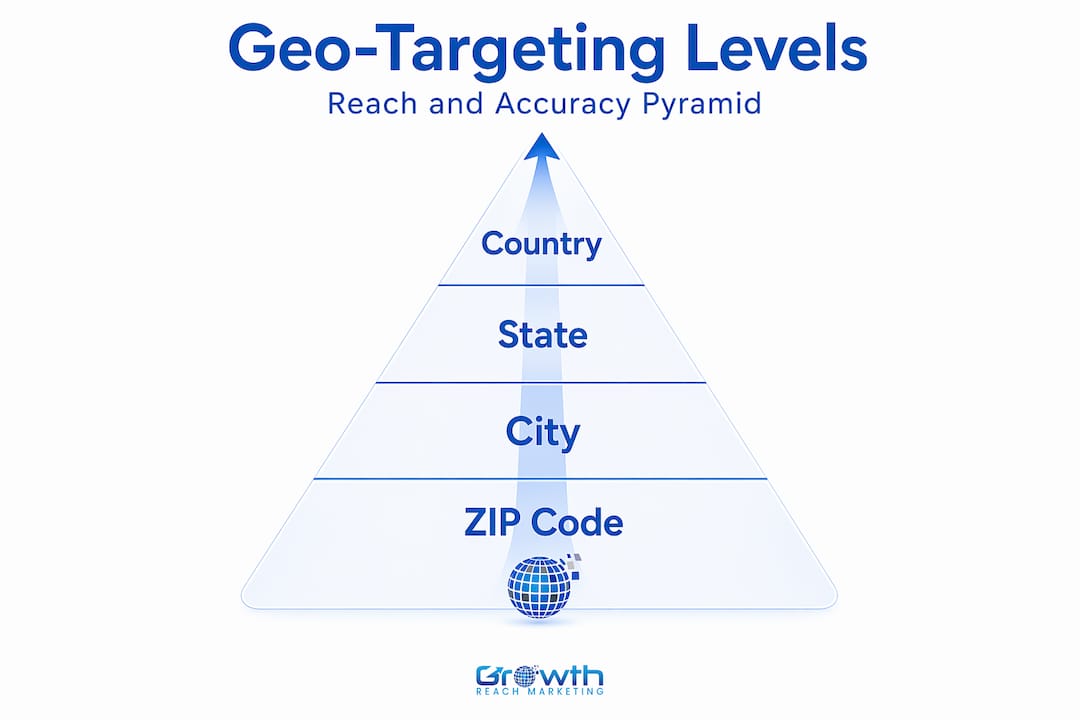
The most effective campaigns layer geographic targeting with demographic and behavioral filters. You are not just finding people in the right place. You are finding people in the right place who also match your customer profile. A salon in a specific neighborhood benefits from combining ZIP code targeting with audience data that prioritizes women in a relevant age bracket who have recently searched for beauty services.
For local service businesses like aesthetic clinics, understanding targeting local clients through layered location plus audience data is often the difference between a campaign that breaks even and one that books appointments consistently.

Benefits of geo-targeting for businesses
The core reason to use geo-targeting in marketing is simple. Relevant ads perform better. When someone in your actual service area sees your ad, they are far more likely to take action than someone three states away who stumbled into your campaign.
The specific benefits that matter most for local advertisers include:
- Higher ad relevance: Location-based targeting aligns messaging with the specific needs and context of people in that area. A dermatology clinic offering a seasonal promotion can reference local weather conditions, local events, or neighborhood-specific language that immediately signals “this is for you.”
- Better conversion rates: When the offer, the location, and the user intent align, people convert. A prospect who sees an ad for a clinic two miles from their home is dealing with zero friction between interest and action.
- Reduced wasted ad spend: Advertisers who limit delivery to specific cities, ZIPs, or radii stop paying to reach people who will never visit their location. That recaptured budget can then shift to audiences that actually convert.
- Smarter budget allocation: When you can see which neighborhoods or cities drive the most conversions, you reallocate spend toward those areas rather than spreading budget evenly across regions that deliver inconsistently.
The financial logic of geo-targeting is hard to argue against. Budget directed at unqualified geographic audiences is simply lost. Even modest improvements in audience precision compound over a campaign’s lifetime.
Pro Tip: Run separate ad groups for each geographic segment rather than grouping multiple locations in one campaign. This lets you write location-specific copy and measure performance independently, which makes optimization far easier.
Google Ads supports this kind of granular geographic setup natively. Understanding Google Ads conversion actions in parallel with geo-targeting gives you a full picture of where your spend is generating real outcomes.
Real-world geo-targeting examples
Understanding the theory is one thing. Seeing how businesses deploy geo-targeting in practice makes the strategy concrete and repeatable.
-
Retail and in-store promotions: A boutique with two locations in different ZIP codes runs separate campaigns for each. Each ad uses the neighborhood name, references local landmarks, and links to a landing page specific to that store. The result is a message that feels local rather than corporate, and foot traffic from each campaign is tracked independently.
-
Service businesses targeting by city boundary: A plumbing company serves three cities within a metro area. Rather than one broad campaign, they build city-specific ad groups with messaging like “serving [City Name] homeowners since 2010.” Each city campaign uses a landing page that mentions the city name, reinforcing relevance to both the user and Google’s ad quality scoring.
-
Event marketing with radius targeting: A medspa hosting a client appreciation evening targets a five-mile radius around their clinic. The ad copy references the event by name and includes a call-to-action to reserve a spot. Radius targeting keeps spend focused on people who can realistically attend.
-
Geo-targeted keywords in local SEO: Beyond paid ads, geo-targeting logic applies to organic search content. Pages that target phrases like “facial treatment in [Neighborhood]” attract users with high purchase intent. Growthreachmarketing builds this approach into programmatic advertising for clinics and local SEO strategies for exactly this reason.
-
Competitor proximity targeting: Some businesses target users near a competitor’s physical location. A new salon opening within a mile of an established competitor can run radius-based ads specifically in that zone to capture prospects who are already interested in that category of service.
Common mistakes in geo-targeting campaigns
Knowing the benefits of geo-targeting does not automatically protect you from the mistakes that erode campaign performance. Most errors come down to flawed assumptions about how location data behaves.
- Confusing geo-targeting with geo-fencing. Marketers who expect geo-fencing results from a geo-targeted campaign will be disappointed. If your goal is to trigger a push notification when someone walks past your store, geo-targeting is the wrong tool. Get clear on the mechanic before building the campaign.
- Trusting location data without validation. VPNs and proxies shift apparent user locations, which means a user in your target city can appear to be in another country. This creates ghost traffic in your reports. Testing with real traffic before scaling is not optional.
- Ignoring user intent variability by location. Different local contexts require different messaging and sometimes separate campaigns entirely. Assuming people in different cities share the same purchase intent leads to generic copy that underperforms everywhere.
- Overlooking device and platform differences. Desktop IP targeting and mobile GPS targeting behave differently. A campaign that performs well on desktop may show inaccurate location data on mobile if permissions are not enabled on the device.
Pro Tip: Always run a small test budget against a known location using a device you control before scaling a new geo-targeted campaign. This simple check confirms that delivery is landing in the right area.
Effective geo-targeting requires alignment of signal quality, identity resolution, and available media inventory. A weakness in any one of these three areas can stall performance even when everything else looks correct.
My take on using geo-targeting effectively
I’ve worked on enough local advertising campaigns to know that geo-targeting is consistently underestimated on both ends. Some marketers treat it as a magic switch that fixes irrelevant traffic overnight. Others overcomplicate it with so many layered filters that the audience shrinks to the point where the algorithm cannot learn.
What I’ve found actually works is starting wider than feels comfortable. Set city-level targeting, gather real performance data, then tighten by ZIP code or radius based on where conversions are clustering. This approach respects the algorithm’s need for learning volume while giving you the directional data to refine intelligently.
The most impactful thing I’ve seen businesses get wrong is building a geo-targeted campaign with brilliant location settings and then running generic ad copy. The location precision means nothing if the message does not reflect that the business understands who lives there. Combine your location signal with copy that speaks directly to that neighborhood’s reality.
And validate everything. I’ve seen campaigns running for weeks with confident location settings, only to discover VPN-skewed data was inflating impressions from outside the target area. Test before you scale, and check your geographic performance reports weekly, not monthly.
— Gerard
Reach more local clients with Growthreachmarketing
If you’ve read this far, you understand that geo-targeting done right is not just about choosing a city on a dropdown. It requires the right signal selection, clean audience layering, copy that speaks to local context, and ongoing validation to keep performance honest.
Growthreachmarketing helps salons, aesthetic clinics, and local service businesses build Google Ads campaigns that combine precise geographic targeting with conversion-focused copy and proper tracking. Whether you want to drive foot traffic to a specific location or book appointments across multiple service areas, the local advertising guide for salons is a strong starting point. To explore the full range of services tailored for local businesses, visit the Growthreachmarketing services page.
FAQ
What does geo-targeting mean in digital advertising?
Geo-targeting means delivering ads or content to users based on their geographic location, such as a country, city, ZIP code, or custom radius. Platforms detect location through IP addresses, GPS, or Wi-Fi signals and serve relevant content accordingly.
How is geo-targeting different from geo-fencing?
Geo-targeting is state-driven, meaning it delivers content based on where a user currently is. Geo-fencing is event-driven and triggers a specific action when a user physically crosses a predefined virtual boundary, which is common in mobile apps.
What are the main benefits of geo-targeting for local businesses?
Geo-targeting increases ad relevance, improves conversion rates, and reduces wasted spend by limiting delivery to audiences in your actual service area. It also lets you write location-specific copy that resonates more strongly with local prospects.
Why might geo-targeting show inaccurate location data?
VPNs and proxies can shift a user’s apparent location, making someone in your target city appear to be elsewhere. Marketers should validate targeting with test traffic before scaling to catch these discrepancies early.
What types of geo-targeting work best for service businesses?
City-level and ZIP code targeting work well for most service businesses. Radius targeting around a physical location is ideal for driving in-store visits or promoting events to people within a realistic travel distance.