

Most med spas run on some combination of six pricing models: memberships, packages, per-service (à la carte), tiered pricing, value-based pricing, and dynamic or promotional pricing. If your priority is steady, predictable cash flow, start testing memberships. If you want a bigger cash-upfront ticket and higher per-visit spend, test packages or value bundles first. Either way, don’t guess. Run a 90-day pilot on one model, track contribution margin and repurchase rate side by side, and let the math pick the winner.
- Memberships: best for cash-flow stability and recurring revenue.
- Packages/bundles: best for lifting average ticket and upfront cash.
- Per-service and tiered pricing: best for flexibility and testing price sensitivity by service line.
- Dynamic/promotional pricing: best for filling slow periods without permanently discounting your core menu.
Key Takeaways
Contribution margin, not top-line revenue, determines whether a membership or a package produces more owner income over a full year.
| Point | Details |
|---|---|
| Start with a pilot | Test one pricing model on a single cohort for 60 to 90 days before rolling it out clinic-wide. |
| Track margin, not revenue | Measure contribution margin, repurchase rate, and average ticket, not just cash collected upfront. |
| Cap package discounts | Keep package discounts near 10 to 15% and pair them with a clear upsell plan. |
| Price memberships on real cost | Load in product cost and provider time before setting a monthly membership fee. |
| Pair pricing with tracking | Growth Reach Marketing builds the funnel tracking and campaigns that reveal whether a pricing pilot is actually converting. |
Table of Contents
- Types of Med Spa Pricing Strategies and When Each One Fits
- How Do You Choose the Right Pricing Strategy for Your Med Spa?
- Running a Pricing Test Without Betting the Business
- A Worked Example: Membership vs. Package Math
- Pricing Mistakes That Quietly Destroy Margin
- Packaging and Communication Tips That Prevent Client Confusion
- How Pricing Shapes Who You Attract and Retain
- Aligning Offers With Marketing Campaigns and Seasonal Demand
- Sources
Types of Med Spa Pricing Strategies and When Each One Fits
Every pricing model on this list solves a different business problem. None of them is universally “best” — the right choice depends on your service mix, your utilization, and how much cash you need moving through the business each month.
Per-service (à la carte) pricing charges a set price for each individual treatment, no bundling. It’s still the right default for one-off services like a single laser session or a first-time consult, where a client hasn’t committed to a course of care yet. Cash-flow effect: immediate, one-time revenue per visit. Implementation complexity: low.
Membership/subscription models charge a recurring monthly fee for a set of included services, credits, or discounts. They work best when you need predictable, recurring cash flow and have the retention infrastructure to keep members engaged. Cash-flow effect: strong and recurring, but only if pricing accounts for the real cost of included services. Implementation complexity: moderate to high.
Packages and course-of-care bundles sell multiple sessions upfront, often at a discount, for treatments that require a series (think six laser sessions or a quarterly neurotoxin plan). Best for lifting average order value and locking in repeat visits. Cash-flow effect: large upfront payment, but revenue is technically already “spent” once delivered.
Tiered pricing (good, better, best) lets clients self-select their spend level for the same service category. It’s excellent for capturing both price-sensitive and premium clients without running two separate brands. Implementation complexity: low to moderate.

Value-based pricing ties price to the outcome or experience, not the cost of delivering it. It only works if your positioning and marketing back up the premium claim. Best for injectables and results-driven procedures where clients are already comparing outcomes, not commodities.
Dynamic and promotional pricing adjusts price by season, day, or demand. Best for smoothing out slow Tuesdays or winter lulls, but it’s the model most sensitive to margin erosion if discounts aren’t capped.
How Do You Choose the Right Pricing Strategy for Your Med Spa?
Start with three numbers before you pick anything: contribution margin by service line, average ticket, and repeat cadence. Contribution margin tells you what’s actually left after direct costs. Average ticket tells you how much cash moves per visit. Repeat cadence tells you whether a membership or package even makes sense for that service, since a treatment clients only need once a year is a poor membership candidate.
- Identify your primary objective: revenue growth, cash-flow stability, or lifetime value.
- Map your service mix. Injectables, lasers, and IV therapy carry different margins and different repeat cycles.
- Check staff utilization. A membership only pays off if providers have open capacity to deliver included services.
- Confirm marketing capacity. Packages need a bigger acquisition push than recurring memberships do.
Before committing, pull this from your point-of-sale or practice management system:
- Rebooking rate by service line over the last 90 days.
- Current average ticket, broken out by new versus returning clients.
- Provider utilization percentage by day of week.
Watch for these red flags, which usually mean the model you picked is quietly losing money:
- A membership priced so low it gives away more value than a member ever redeems.
- Package discounts deeper than 10 to 15 percent with no clear plan to upsell add-ons, a range Zenoti’s pricing guide treats as the sensible ceiling.
- Low utilization that makes subscription math unprofitable even at full member capacity.
Pro Tip: Tie provider compensation to per-service contribution margin, not just gross revenue booked. Providers will naturally start protecting the margins you’re trying to grow.
Running a Pricing Test Without Betting the Business
You don’t need a full relaunch to know if a pricing model works. You need a contained pilot, a control group, and a short list of numbers you’re willing to act on.
Track these metrics throughout any pricing pilot:
- Contribution margin per service (revenue minus direct product cost minus direct provider time).
- Lifetime value and repurchase or rebooking rate for the pilot cohort.
- Average ticket and customer acquisition cost for anyone who entered through the new offer.
- Break-even member count for any subscription tier, plus monthly churn.
Statistic callout: Whether a package or a membership wins in your practice comes down to two thresholds: the repurchase rate on your packages and the contribution margin per member on your subscriptions. Neither model wins by default. It’s decided by which one clears its own break-even math faster in your specific mix of services.
Structure the test like this:
- Pick one pilot cohort (new patients only, or a single service category), and hold everyone else on your current pricing as the control.
- Run it for a full billing or treatment cycle, typically 60 to 90 days, so you capture at least one repurchase cycle.
- Set a minimum signal threshold before you scale: don’t roll out a membership chain-wide off 15 sign-ups.
This is where the Ward Advisory framing earns its place: memberships stabilize recurring cash flow, but packages can produce higher owner income when repurchase rates and contribution margins are both strong. Treat that as a testable hypothesis, not a rule. Measure contribution-margin lift in your pilot, not just which model brings in more top-line revenue that quarter.
Pro Tip: Run new pricing on new-patient cohorts first. Existing clients have pricing expectations already baked in, and testing on them muddies your read on true demand.
A Worked Example: Membership vs. Package Math
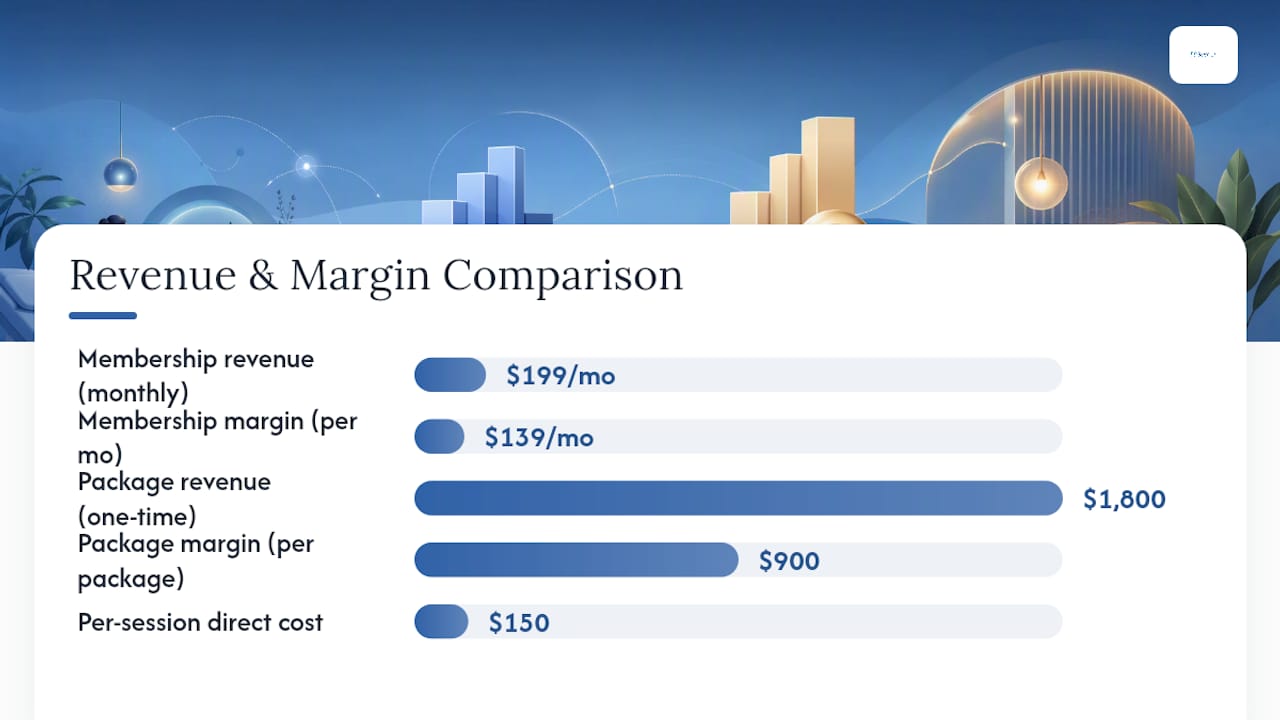
Here’s a simplified comparison. Say a med spa runs a $199/month membership including one facial credit and a 15% discount on add-ons. Product cost and provider time for that facial run roughly $60. Contribution margin per member, per month, lands near $139 before overhead. At 80 active members, that’s over $11,000 in monthly contribution margin, assuming redemption stays predictable.
Now compare a six-session laser package sold for $1,800 upfront, with per-session direct cost (device time, consumables, provider) around $150. Contribution margin per package is roughly $900, delivered over several months rather than every 30 days.
The formula behind both: contribution margin = revenue minus direct product cost minus direct provider cost.
| Dimension | Memberships | Packages |
|---|---|---|
| Best for | Cash-flow stability | Higher upfront ticket |
| Cash-flow effect | Recurring, monthly | Lump sum, upfront |
| Impact on retention | Strong if redemption is managed | Depends on repurchase at renewal |
| Typical margin potential | Moderate, compounds with scale | Higher per unit if repurchase holds |
| Implementation complexity | Moderate to high | Low to moderate |
| Sensitivity to discounts | High, margin erodes fast if underpriced | Moderate, capped near 10 to 15% discount |
Pricing Mistakes That Quietly Destroy Margin
Undercosted memberships are the most common margin killer in the industry. Owners set an attractive monthly price without fully loading in product cost, provider time, and average redemption, then wonder why the subscription line loses money even at full capacity. Untracked injectable waste is the second. A few units lost per week across several providers adds up to real dollars nobody notices until year-end.
Verify your state’s scope-of-practice and advertising rules before launching any bundled or subscription pricing involving prescription treatments. Requirements around good faith exams, telehealth workflows, and who can legally administer or prescribe vary by jurisdiction, so confirm with your medical director or legal counsel rather than assuming your model is compliant because a competitor runs something similar.
- Require a documented good faith exam or telehealth workflow before any prescription-based membership tier activates.
- Set clear scheduling rules for member benefits so front desk staff don’t double-book credits or waive expiration dates inconsistently.
- Run monthly inventory counts on injectables and tie variance directly back to provider accountability.
- Disclose bundled and subscription terms clearly, including cancellation policy and what happens to unused package sessions, to avoid deceptive-discount complaints.
Packaging and Communication Tips That Prevent Client Confusion
How you name and present a price matters almost as much as the number itself. A package called “Six-Session Laser Series” reads as a commitment with a clear end point. A membership called “VIP Glow Membership” reads as ongoing value, which sets different expectations for cancellation and rollover credits.
The most common operational failure isn’t pricing at all. It’s front-desk staff quoting different terms than what’s on the website, or booking software that doesn’t track membership credits accurately, so clients show up expecting a benefit that expired last month. Put your pricing terms in writing, in the same language, everywhere a client encounters them: the booking page, the intake form, and the receptionist’s script.
Second most common failure: bundling too many services into one package without a clear hierarchy. If a client can’t explain in one sentence what they bought, you’ll spend more staff time on billing disputes than you saved on the discount. Keep package names descriptive, keep the included sessions countable, and keep the fine print (expiration, transferability, add-on pricing) visible before checkout, not buried in a follow-up email.
Clear packaging also protects your margin conversations internally. When providers and front-desk staff understand exactly what a $1,800 package includes and excludes, they stop improvising discounts on the fly to smooth over confusion, which is one of the quieter ways bundled pricing bleeds margin over time.
How Pricing Shapes Who You Attract and Retain
Every price point you set is also a filter. A $79 introductory facial attracts a different client than a $2,400 annual membership, and that’s not a bad thing. It’s a segmentation tool if you use it deliberately.
Tiered pricing is the cleanest way to serve multiple client segments without diluting your brand. A “good, better, best” structure for a service category lets budget-conscious clients enter at a lower tier while premium clients self-select into the higher one, all under the same roof. Value-based pricing works the opposite direction: it signals to a narrower, higher-intent segment that you’re positioned above commodity pricing, which only works if your brand positioning actually supports that claim before the price does.
Memberships tend to attract and retain a segment that values convenience and habit over one-off deals. That’s the client who books monthly regardless of promotions, which is exactly the profile you want anchoring recurring revenue. Packages attract commitment-minded clients willing to pay upfront for a result, but they can also attract deal-seekers if your discount is too aggressive. The deeper the package discount, the more likely you’re pulling in clients who churn once the price returns to normal.
Segment your marketing spend accordingly. Promote your entry-tier or à la carte services to cold traffic that hasn’t converted yet, and reserve membership and value-based offers for warmer segments, past clients, referrals, and email subscribers, who already trust your outcomes enough to commit.
Aligning Offers With Marketing Campaigns and Seasonal Demand
Pricing strategy and marketing strategy aren’t two separate projects. A membership launch needs a different campaign than a seasonal package promotion, and running them with identical messaging usually flattens results for both.
Seasonal and demand-based adjustments make the most sense for services with predictable slow periods. Body contouring and laser hair removal, for instance, often see softer demand in colder months, which makes a bounded, time-limited promotion more effective than a permanent price cut. Cap any promotional discount and set an expiration date before you launch it. An open-ended sale trains clients to wait for the next one.
When you launch a package or membership, the offer needs its own funnel, not just a mention on your homepage. That means a dedicated landing page, a booking flow that doesn’t lose people between “interested” and “paid,” and a follow-up email sequence for anyone who clicks but doesn’t convert immediately. Membership offers in particular benefit from nurture sequences that remind lapsed leads what they’re missing, since subscription decisions rarely happen on the first visit to a page.
Paid social and search campaigns should be built around the specific offer, not your general brand. A campaign promoting a six-session package needs different ad creative, different landing copy, and a different budget cadence than one promoting an ongoing membership, because the buying decision timeline is completely different for each.
A Note on Testing Offers, Not Just Pricing Them
Pricing decisions don’t hold up in isolation. We’ve found that a membership or package only proves itself once it’s tested inside the actual booking funnel, alongside the messaging and ads that drive traffic to it. Measure offer performance the way you’d measure any campaign: by conversion rate and contribution margin in the funnel, not by how good the price looks on a spreadsheet.
How Growth Reach Marketing Supports Your Pricing Tests
Testing a new membership or package price only tells you the truth if the traffic behind it is measured properly. Growth Reach Marketing is the alternative to guessing at conversion rates: we build the tracking, landing pages, and paid or organic traffic experiments that let you see whether a pricing pilot is actually working, not just whether it feels busier.
That means setting up conversion tracking on your booking funnel before you launch a membership tier, building a dedicated landing page for a package promotion instead of burying it on your homepage, and running paid social or search campaigns that isolate one offer at a time so you know which price point is pulling its weight. Med spas that pair a pricing pilot with a structured lead-generation approach get a cleaner read on repurchase rate and contribution margin, because the traffic and the offer are being measured together instead of guessed at separately. If you’re about to test a new membership or package price, start by getting your Google Ads campaign structure set up to isolate that offer, then reach out to Growth Reach Marketing to map out the tracking before you launch.
Sources
- Med Spa Operating Costs 2026: Where the Margin Leaks | Sorso
- Med Spa Profit Margins for 2026 | Spakinect
- How to Price Med Spa Services: Complete Strategy Guide + Calculator | The Check-In by Zenoti
This article is general information, not a substitute for advice from a qualified financial advisor. Consult a qualified financial professional about your own circumstances before acting on anything here.
Recommended
- 1783829821246_Med-spa-owner-reviewing-brand-strategy-notes – Growth Reach Marketing
- Med Spa Google Ads Benefits: 2026 Owner’s Guide – Growth Reach Marketing
- Track Med Spa Campaign ROI: A Clinic Owner’s Playbook – Growth Reach Marketing
- 1784883737114_Med-spa-owner-analyzing-campaign-data-at-desk – Growth Reach Marketing