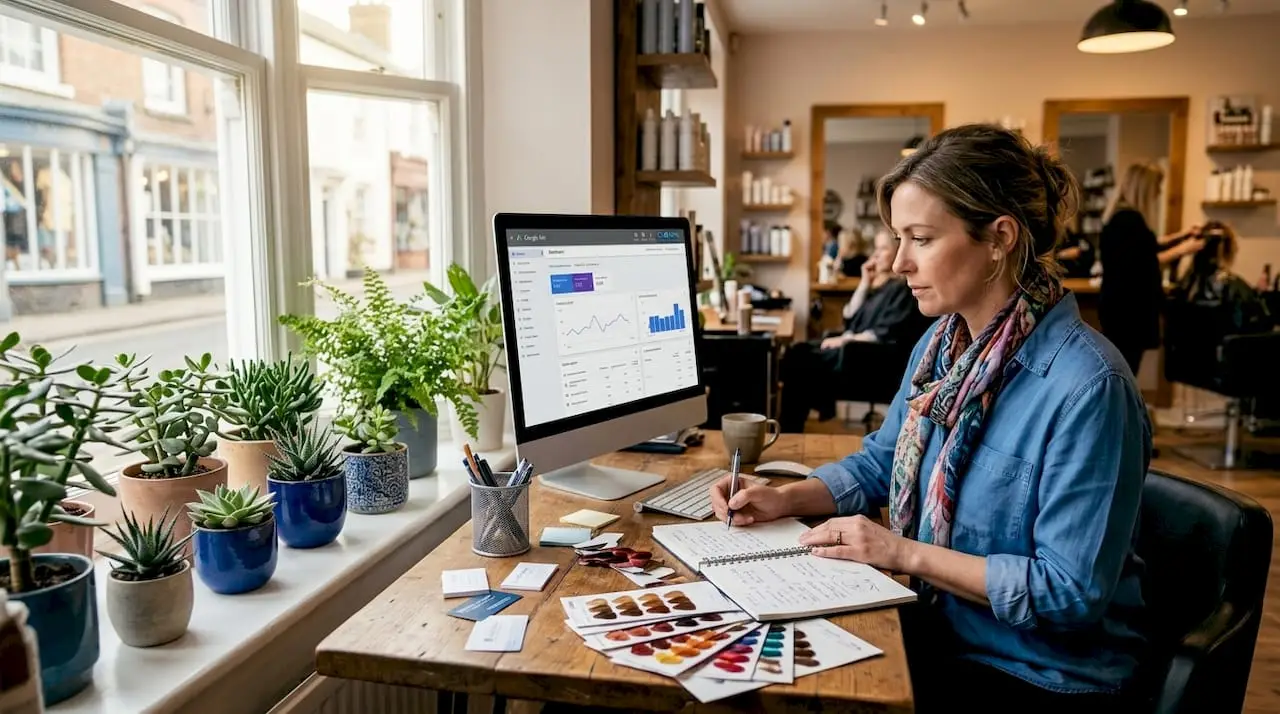
Most salon owners running Google Ads share the same frustration: money goes out, clicks come in, but the appointment calendar stays half-empty. The problem is rarely the budget. It’s execution. Applying the right salon google ads best practices means targeting people who are actively searching for your specific service in your specific neighborhood, writing ad copy that removes friction, and tracking what actually matters. This guide covers everything from keyword selection and ad copy to smart bidding and campaign structure, so your ads stop burning money and start filling chairs.
Table of Contents
- Key takeaways
- 1. Salon Google Ads best practices start with hyper-local targeting
- 2. Build your keyword list around service specificity and booking intent
- 3. Write ad copy that converts, not just clicks
- 4. Use ad extensions to build trust and reduce booking friction
- 5. Set up conversion tracking that reflects actual bookings
- 6. Send paid traffic to dedicated service landing pages
- 7. Avoid the most common mistakes in salon Google Ads campaigns
- 8. Structure campaigns for smart bidding to work effectively
- 9. Know when to use remarketing and competitor bidding
- My honest take on what actually moves the needle
- Let Growthreachmarketing handle the hard part
- FAQ
Key takeaways
| Point | Details |
|---|---|
| Local intent drives bookings | Service-specific keywords with city or neighborhood modifiers outperform broad terms dramatically. |
| Track real bookings, not clicks | Set up conversion actions for online bookings, calls, and form submissions to measure what matters. |
| Landing pages determine results | Sending paid traffic to a dedicated service page instead of your homepage lifts conversion rates significantly. |
| Smart Bidding needs patience | Allow 30 to 90 days and at least 30 to 50 conversions before tightening targets or changing strategy. |
| Separate campaigns by goal | Keep appointment booking campaigns separate from product sales campaigns to prevent bidding conflicts. |
1. Salon Google Ads best practices start with hyper-local targeting
Before a single dollar goes to clicks, your location settings need to match the reality of how people choose a salon. Most clients will not travel more than a few miles. Targeting a 25-mile radius around your salon sounds like more opportunity, but it actually dilutes your budget across people who will never book.
Set your campaigns to target by radius around your specific address, not just your city. Use the “Presence” setting, not “Presence or interest,” to avoid showing ads to people who searched for your city but live elsewhere. If you have multiple locations, build separate campaigns for each one.
Highly localized keywords like “balayage salon Chicago” consistently outperform generic terms like “salon” or “beauty” for booking intent and cost per acquisition. Pair that with location-specific ad copy that mentions your neighborhood, and you signal immediately to a searcher that you are the right result.
Pro Tip: Add “near me” as a keyword phrase in broad match modifier or phrase match. Google treats “near me” searches as high-intent local signals, and local intent searches like these convert at a higher rate for service-based businesses.
2. Build your keyword list around service specificity and booking intent
Generic keywords waste money. “Haircut” and “salon” pull in researchers, students, people looking for jobs, and everyone except someone ready to book today. Your keyword strategy should reflect the actual services you want to sell, combined with location and booking intent signals.
Think in terms of what a client types when they have decided they want the service and just need to find the right place. Phrases like “keratin treatment near me,” “lash extensions [city name],” or “men’s fade haircut [neighborhood]” carry high intent. These are the searches worth paying for.
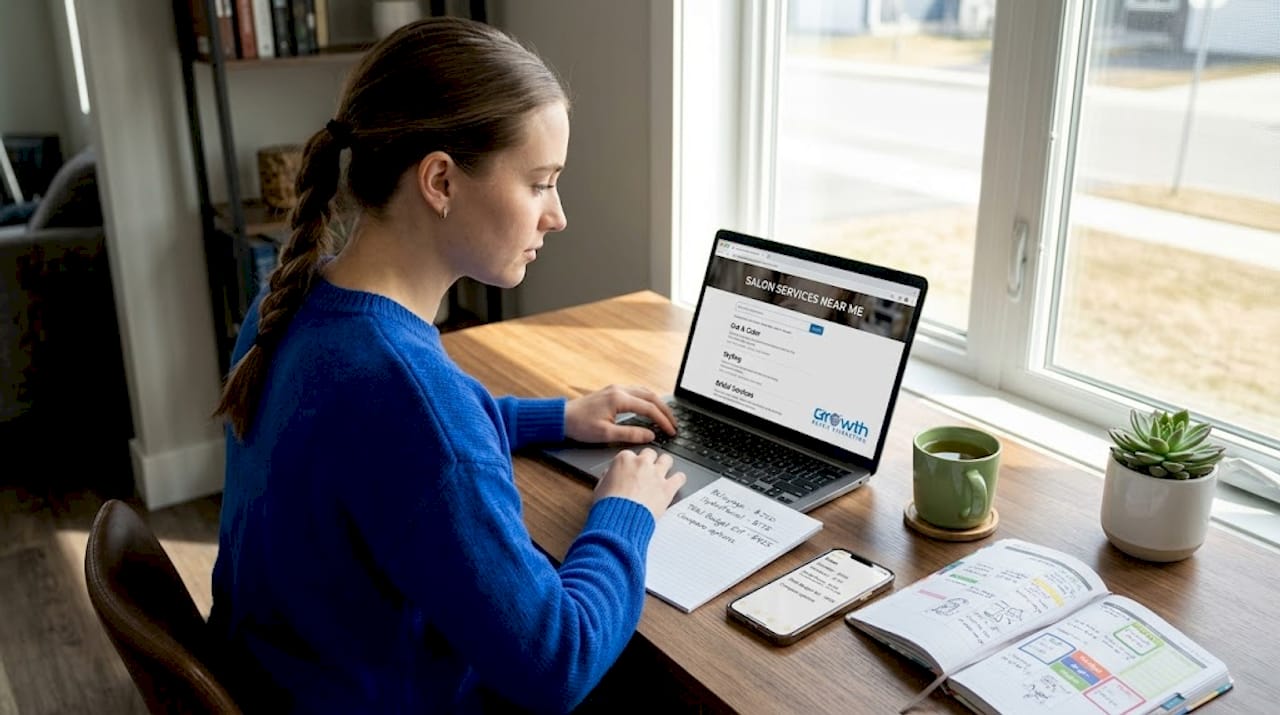
Organize your ad groups so each one maps to a single service category. One ad group for balayage, one for cuts, one for extensions. This lets you write ad copy that speaks precisely to each service, which improves your Quality Score and lowers cost per click.
3. Write ad copy that converts, not just clicks
Every character in a Google search ad is selling your salon. The headline is not a branding exercise. It is a direct response to what someone just typed. If they searched “highlights salon downtown Austin,” your headline should say exactly that, with a booking cue attached.
Strong salon ad copy follows a clear structure:
- Headline 1: Service name plus location (“Highlights Salon Downtown Austin”)
- Headline 2: Trust signal or differentiator (“15+ Years, 500+ Happy Clients”)
- Headline 3: Booking cue with urgency (“Book Online Today, Same-Week Slots”)
- Description 1: Reduce friction (“Easy online booking, free parking on Main St, results guaranteed”)
- Description 2: Social proof or offer (“Rated 4.9 stars on Google. First-time client special available.”)
Effective salon ad copy always addresses the unspoken questions a new client has: Is this place reputable? Can I get in soon? Will it be worth the price? Answer those questions in the ad itself.
Pro Tip: Match your ad copy language exactly to the headline on your landing page. If your ad says “Balayage Specialist in Denver,” your landing page headline should echo that phrase. Mismatches between ad and page reduce conversion rates and lower your Quality Score.
4. Use ad extensions to build trust and reduce booking friction
Ad extensions are free to add and they expand the real estate your ad takes up on the search results page. More importantly, they give searchers the information they need to take action without extra clicks.
For salons, the most valuable extensions are:
- Call assets: Show your phone number directly in the ad. Use a local area code number rather than toll-free. Local numbers increase trust and call conversion rates.
- Location assets: Display your address and link to Google Maps. This is especially powerful for mobile searchers who are close by and deciding in real time.
- Sitelink assets: Link to specific service pages (balayage, extensions, men’s cuts) so searchers can go directly to what they want.
- Promotion assets: Show limited-time offers or first-visit specials to create urgency.
Extensions do not cost extra per impression. They improve click-through rate and give Google more signals to serve your ads in relevant placements.
5. Set up conversion tracking that reflects actual bookings
This is where most salons run campaigns for months without realizing they are measuring the wrong thing. Click volume and impressions are not conversions. A conversion is a booked appointment.
Set up conversion actions in Google Ads for three specific events: online booking confirmation pages, phone calls from ads, and contact form submissions. For call tracking, configure call reporting with a minimum call duration of 60 seconds to filter out misdials and hang-ups. A two-second call is not a booking lead.
Improper call conversion configuration is the top reason salons cannot see call bookings in their data. Common culprits are auto-tagging being disabled, forwarding numbers not set up correctly, or the conversion action linked to the wrong account. Check each setting before launching any campaign. You can find a full walkthrough in this conversion actions guide from Growthreachmarketing.
6. Send paid traffic to dedicated service landing pages
This is the single most impactful fix for salons that are already running ads. If someone clicks an ad for “eyelash extensions near me” and lands on your homepage, you have made them do the work. Most will leave. Sending traffic to a homepage instead of a specific service booking page is one of the most common and costly mistakes in salon PPC advertising.
Each service campaign needs its own landing page. That page should include the service name in the headline, three to five photos of real client results, pricing or a pricing range, a visible booking button above the fold, and a handful of five-star reviews. Nothing else on the page should compete for the visitor’s attention.
Think of it this way: you paid to get someone to the door. The landing page is the door. Make it easy to walk through.
7. Avoid the most common mistakes in salon Google Ads campaigns
Even well-funded campaigns underperform when these errors go uncorrected.
- Ignoring negative keywords. Review your Search Terms report multiple times weekly when a campaign is new. Add negatives for anything that signals no booking intent: “DIY,” “how to,” “training,” “free,” “course,” “product,” “jobs.” Left unchecked, broad match keywords will eat your budget serving ads to people who have no intention of booking.
- Mixing appointment and product campaigns. Running retail product ads in the same campaign as appointment booking ads creates conflicting bidding signals. Google’s algorithm cannot optimize for two different goals at once. Separate these campaigns so each one uses the right bidding strategy, Target CPA for bookings and Target ROAS for products.
- Changing campaigns too often. Every time you significantly alter bids, budgets, or targeting, you reset the learning phase. Let campaigns run for at least two to four weeks between changes.
- Tracking clicks as success. High click volume with zero bookings means something is broken downstream. Check landing pages, booking flows, and conversion tracking before increasing budget.
- Setting unrealistic Target CPA goals from day one. Starting too low forces Google to restrict who sees your ads, starving the campaign of data before it has a chance to learn.
8. Structure campaigns for smart bidding to work effectively
Smart Bidding is powerful, but it requires the right conditions to perform. Google Ads needs around 30 to 50 conversions during the learning phase, typically spread over 30 to 90 days, before the algorithm can reliably predict and optimize for your target cost.
Here is how to set up your campaign structure for success:
- Start with a Target CPA set at 20 to 30% above your current actual cost per booking. Setting an aggressive CPA too early forces Google to restrict impressions and the campaign never gathers enough data to improve.
- Build campaigns by service category, not by match type. One campaign for cuts, one for color, one for extensions. Assign budgets based on the revenue value of each service.
- Use portfolio bid strategies when you have multiple smaller campaigns. Pooling campaigns with similar conversion goals helps them exit the learning phase faster by aggregating conversion data.
- For Performance Max campaigns, load diverse creative assets. PMax campaigns underperform when headlines and images are duplicated. Use multiple angles: a social proof headline, a benefit headline, a booking-urgency headline. Include real photos and short video clips.
| Strategy | Best for | Trade-offs |
|---|---|---|
| Target CPA | Established campaigns with booking data | Needs 30+ conversions to stabilize |
| Maximize Conversions | New campaigns without CPA data yet | Can overspend early without a cap |
| Target ROAS | Product sales campaigns | Wrong choice for appointment bookings |
| Manual CPC | Tight budget control, early testing | Time-intensive, no AI optimization |
Pro Tip: Set a call duration minimum of 60 seconds in your call conversion action settings. A call that lasts under a minute is almost never a booking. Including misdials in your conversion data teaches Google to optimize for the wrong behavior.
9. Know when to use remarketing and competitor bidding
Two strategies often overlooked in salon advertising deserve a place in mature campaigns.
Remarketing shows ads to people who visited your site but did not book. This audience is warm. They know you exist. A remarketing ad offering a first-visit discount or a “spots still available this week” message can recover a meaningful percentage of lost traffic. Run these on Display and YouTube at a lower CPM budget.
Competitor keyword bidding (bidding on another salon’s brand name) is a gray area. It can generate clicks, but the conversion rate tends to be lower because the searcher was looking for someone specific. It also inflates your CPC and can trigger retaliatory bidding. Use it selectively and only when your offer is clearly differentiated.
For most salons with limited budgets, the priority order is: local service search campaigns first, remarketing second, and competitor campaigns only if you have budget left over after the first two are profitable.
My honest take on what actually moves the needle
I’ve watched salon owners launch campaigns with solid budgets and walk away frustrated after 60 days because bookings never materialized. Almost every time, one of three things went wrong: the landing page was the homepage, call tracking was broken, or the learning phase was disrupted by constant changes.
What I’ve found is that patience during the learning phase feels counterintuitive. You’re spending money and the results look modest. The instinct is to change something. That instinct usually makes things worse. The campaigns that perform best are the ones where the owner committed to a properly structured setup, left it alone for 30 to 60 days, and then made precise, data-informed adjustments.
I’ve also seen salon owners underestimate how much the landing page matters. You can have flawless targeting and brilliant ad copy, and a slow, generic, mobile-unfriendly landing page will still kill your conversion rate. The ad gets someone to the door. The landing page closes the deal.
Local intent targeting is not glamorous, but it is what fills calendars. A tightly targeted campaign for “balayage [your city]” with a clean landing page and real booking conversion tracking will outperform a broad, creative-heavy campaign almost every time.
— Gerard
Let Growthreachmarketing handle the hard part
Running Google Ads profitably requires ongoing attention to conversion tracking, keyword refinement, landing pages, and bidding strategy. Most salon owners have a full book of clients to manage. The last thing you need is a second job managing an ad account.
Growthreachmarketing specializes in Google Ads for salons and beauty businesses. We handle conversion action setup, campaign structure, local targeting, ad copy, and monthly optimization so you get more bookings without the guesswork. Whether you’re starting from scratch or fixing a campaign that isn’t converting, explore our salon Google Ads services or visit our full services page to see how we can build a campaign that actually fills your calendar.
FAQ
What keywords work best for salon Google Ads?
Service-specific keywords with location modifiers perform best. Phrases like “balayage salon [city]” or “lash extensions near me” attract searchers with clear booking intent and lower wasted spend than broad terms.
How long before my salon Google Ads start converting?
Allow 30 to 90 days for Smart Bidding campaigns to stabilize. Google needs 30 to 50 conversions in the learning phase to optimize effectively, so avoid major changes during that period.
Why are my salon ads getting clicks but no bookings?
The most common causes are sending traffic to a homepage instead of a service-specific booking page, broken call tracking configuration, or poor mobile landing page experience. Audit all three before adjusting your bids.
Should salons use Performance Max or Search campaigns?
Start with Search campaigns targeted by specific services and locations. Add Performance Max once you have conversion data and diverse creative assets ready. Running both together works well for established campaigns.
How do I track phone call bookings in Google Ads?
Set up a call conversion action in Google Ads with a minimum call duration of 60 seconds. Use a local area code forwarding number in your call asset, and verify that auto-tagging is enabled in your account settings.