
A beauty product page ranks and sells when it answers the shopper’s real questions in plain, structured form: what the product is, what is in it, how to use it, who it suits and why they can trust it. Then you add the technical layer: a clear title and H1, descriptive images, honest reviews, Product structured data and fast loading. This guide covers each piece in order, including the Irish and EU rules on cosmetic claims that most generic SEO advice skips.
It is written for owners and managers of beauty brands, salons and clinics that sell products online, whether that is a skincare line, a retail shelf in your booking site or a full shop.
TL;DR
- Give every product page a unique description that links ingredients and texture to a benefit and a use case, not a copy of the supplier’s text.
- Put the main keyword in the title tag, meta description and H1, then use it naturally in the copy.
- Show the full ingredient list, descriptive image alt text and real reviews, and add Product structured data.
- Check every claim against Irish rules before you publish: substantiation, labelling and the Responsible Person requirement.
- Track clicks, rankings and conversion in Google Search Console and fix one template at a time.
Table of Contents
- What a beauty product page has to do
- Choose keywords shoppers actually type
- Title, H1, URL and meta description
- Write copy that explains the product
- Claims: what you can say in Ireland
- Images, video and alt text
- Reviews and social proof
- Technical checks: structured data and speed
- Measure what is working
- A starting checklist per product page
- Perspective
- Get help with your product pages
- FAQ
- Sources
What a beauty product page has to do
A product page has two readers. The shopper wants to know whether this serum, shade or shampoo suits their skin or hair. The search engine, including AI assistants, wants to understand the same thing from the page’s text and data. Pages that serve the first reader well usually serve the second.
Research from beauty ecommerce practitioners points the same way: a strong page combines a clear product name and benefit, ingredient information, directions, texture notes, reviews and claim-safe proof. Another view of the category is that beauty search success comes from clinical clarity paired with commercial utility: structured product data, educational content, visual proof and a page that removes friction.
A useful way to plan is to treat the page as a stack of layers:
- Findability: keyword, title, URL, internal links.
- Understanding: copy, ingredients, directions, structured data.
- Trust: images, reviews, compliant claims.
- Experience: speed, mobile layout, a clear add-to-basket path.
- Measurement: the data that tells you what to change next.
The rest of this article follows that stack.
Choose keywords shoppers actually type
Start with the product, not a tool. For each product, write down the ways a customer would describe it before they know your brand name. A vitamin C serum might be searched by ingredient, by concern (“dull skin”), by product type, or by comparison with another type of product. A shade-led product might be searched by shade, finish or skin tone.
Work through these steps for each page:
- List the product’s attributes: type, key active ingredient, skin or hair type, texture, finish, size and the problem it addresses.
- Match one primary search phrase per page. One product page should target one main intent. If two products share a phrase, one of them should target a more specific variation, such as a different skin type or format.
- Collect supporting phrases from how customers describe the product in reviews, emails and the questions your front desk or clinic team hears. These are the natural-language terms that belong in the copy and the FAQ.
- Check the search results. Search the phrase in Google as a shopper in Ireland would. If the results are mostly category pages, the phrase suits a collection page, not a single product. If they are product pages, you are in the right place.
- Check what is realistic. Large retailers dominate broad product terms. Specific combinations (ingredient plus skin type plus format) are where smaller brands win first, and they convert better because the shopper knows what they want.
Keep a simple sheet with the product URL, primary phrase, supporting phrases and the date you last reviewed it. It becomes the brief every time you add a product.
Title, H1, URL and meta description
The basics still matter. Guidance from a major SEO platform is to include the primary keyword in the title, meta description and H1 and use it naturally in the copy. For beauty, that translates into a pattern like this:
| Element | What to do | Example pattern |
|---|---|---|
| Title tag | Brand, product name and the main descriptor, written for a human | Brand + product name + type or key active |
| H1 | The full product name with the key descriptor, one per page | Same wording as the title, without the extras |
| URL | Short, readable, no codes or parameters | /products/product-name |
| Meta description | One benefit, one differentiator, a reason to click | Who it is for, what it does, delivery or size detail |
| Internal links | Link to the parent collection and related products | “Pairs with” and “Also suits” blocks |
A few beauty-specific points:
- Keep the full brand and product name together in the H1 and title so shoppers who search the exact name find you.
- Separate variants sensibly. If shades or sizes share one page, make sure the page still describes the product as a whole and the variants are easy to pick.
- Link from guides to products. If you publish routines or how-to content, link the products they mention. Our guide to a beauty content strategy shows how that content supports the pages that sell.
- Write the meta description as a promise. It will not change rankings directly, but it influences who clicks.
Write copy that explains the product
Supplier copy is the most common weakness on beauty product pages. If twenty shops paste the same paragraph, none has a reason to outrank the others. Aim for descriptions that are unique and connect concrete attributes, such as ingredients and texture, to buyer benefits and use cases.
A structure that works on most beauty pages:
- Opening line: what it is, who it is for and the main benefit, in one or two sentences.
- Key actives or features: three to five, each with a plain-English line on what it is there for.
- Texture and feel: gel, cream, oil, how it absorbs, scent or finish. Shoppers cannot touch it, so you have to describe it.
- How to use: step, amount, frequency, where it sits in a routine.
- Who it suits: skin types, hair types, concerns, and who should check with a professional first.
- Size and details: volume, shades, packaging.
- Full ingredients list.
Write the way your best consultant speaks to a client at the counter. That is also the kind of language AI assistants pick up: they interpret natural-language questions by drawing on structured content, ingredient lists and high-authority sources, so factual and well-organised product information helps visibility there. If you want to go further on that side, see our guide to AI SEO for salons and our playbook for Google AI Overviews.
Ingredients as content
Ingredients are one of the strongest search and trust signals in beauty. Publish the complete INCI list as real text on the page, not inside an image, and add a short, readable breakdown of the key actives with a plain-English interpretation, as ingredient-transparency guidance recommends.
The text must also match the pack. In Ireland, labelling must be in English or Irish and English, and ingredients are listed in descending order of weight using INCI names. Copying the label exactly into the page avoids mismatches and keeps your online listing consistent with what arrives in the box.
Short answers inside the page
Add a small question-and-answer block to each important product: “Can I use this with retinol?” “Is it suitable for sensitive skin?” “How long does a bottle last?” Keep answers short and factual. Where a question touches a medical condition, pregnancy or a prescription treatment, say that a pharmacist, GP or dermatologist is the right person to ask, and keep your own answer to what the product is and how it is used. Short, direct answers also suit the 40 to 100 word format we describe in our guide to generative engine optimization.
Claims: what you can say in Ireland
Beauty copy is full of promises, and in Ireland those promises are regulated. This is where good SEO and good compliance meet: pages that make clear, supportable claims are also the ones you can keep live without having to rewrite them later.
The points to check before you publish:
- Substantiation. The Advertising Standards Authority’s code says claims about health and beauty products and treatments should be substantiated, and where relevant that should include robust and reputable trials on human subjects.
- Composition versus application. The same code says cosmetic claims should separate what the product’s composition does from effects caused by how it is applied, such as massage. A claim that a product can prevent or reverse hair loss needs substantiation.
- Responsible Person. Cosmetic products placed on the Irish market need a Responsible Person established in the EEA or Northern Ireland, whose name and address appear on the packaging, as set out in the HPRA guide for responsible persons. If you sell your own line, confirm who holds that role before you list anything.
- Labelling. Match the language and ingredient rules above on the page as well as on the pack.
If your business also advertises treatments, such as injectables, the rules are stricter again. Our guide to aesthetic advertising regulations in Ireland covers that side for clinics.
A practical rule for copywriters: describe what the product contains, how it feels and how to use it, then state a benefit only where you can show the evidence behind it. Keep a document with the proof for each claim, next to the keyword sheet.
Images, video and alt text
Beauty is visual, and images affect both conversion and search. Use multiple high-quality product images with descriptive alt text, and add user-generated content such as videos and reviews to build trust.
A checklist for each product:
- Hero image on a clean background, plus pack back, label and size-in-hand shots.
- Texture image or swatch showing the product on skin, in the shades you sell.
- Descriptive filenames such as brand-product-name-50ml.jpg, not IMG_4021.jpg.
- Alt text that describes the image in a sentence: what the product is and what is shown. Do not stuff keywords.
- Compressed files. Modern formats such as WebP are worth considering, as the visual guidance for beauty brands suggests, because image weight is a common cause of slow pages.
- Short video of application or texture, where you can produce it.
Only use before-and-after images you have the rights and consent to publish, and make sure they are not edited or presented in a way that misleads. The Irish code above applies to images as well as words.
Reviews and social proof
Reviews do two jobs. They persuade, and they add fresh text written in your customers’ own words. Verified, skin-type-specific reviews work as social proof for conversion and indexable long-tail content that matches niche searches such as “moisturizer for dry, sensitive skin”.
To make reviews work harder:
- Ask after delivery, when the customer has used the product long enough to judge it. Include a prompt for skin or hair type.
- Publish them on the page as text, not only in a widget that hides them from search engines. Check with your platform or developer how the reviews are rendered.
- Reply to reviews, including the critical ones, calmly and in your brand voice.
- Collect honestly. Do not write or buy reviews, and do not filter out negative ones in a way that misleads shoppers.
- Reuse the language. The phrases customers use are the best source for your FAQ and supporting keywords.
Proof matters on the trade side as well: brands that sell to retailers and stockists use the same principle, and growing a beauty brand through wholesale buyers leans on visible customer evidence just as a consumer page does.
Technical checks: structured data and speed
Once the page reads well, make sure machines can read it too.
Product structured data
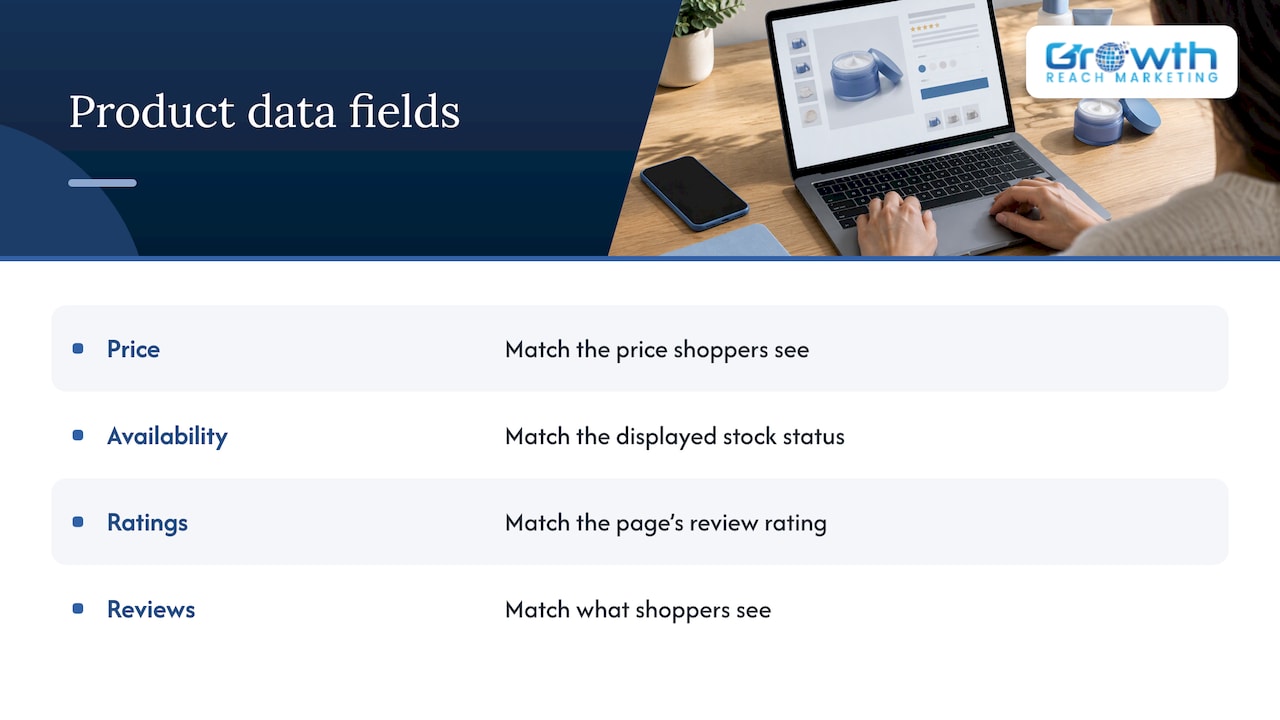
Add Product structured data so Google can understand the attributes of the item and potentially surface richer search results. The markup can carry price, availability, ratings and reviews, which supports rich-result eligibility. Most ecommerce platforms generate a basic version, so check what yours outputs and confirm it matches what shoppers see: the price, stock status and review rating in the markup should be the same as on the page.
If you also run a salon or clinic, the same discipline applies to your business pages. Our guides to salon schema markup and clinic schema markup explain what to add and how to test it.
Page speed
Beauty pages are image-heavy, so speed needs attention. The targets to monitor are Largest Contentful Paint within 2.5 seconds, Interaction to Next Paint below 200 milliseconds and Cumulative Layout Shift below 0.1. Check them in PageSpeed Insights on your top products, on mobile first, because that is where most shoppers browse.
Common beauty-page fixes:
- Compress and correctly size hero images, and do not lazy-load the main one.
- Reserve space for images and review widgets so the layout does not jump.
- Remove unused apps and scripts that load on every product page.
If your shop runs on Shopify, our 30 to 90 day Shopify SEO plan for beauty brands starts from templates, because one template fix applies to every product at once.
Measure what is working
Track search visibility through organic traffic, clicks and rankings, and watch product conversion, add-to-basket, checkout and return rates. The principle is to test changes against user behavior and conversion data rather than guess.
A simple monthly routine:
- Open Google Search Console and PageSpeed Insights, the free tools for tracking page rankings, visitors and load speed.
- List your top 20 product pages by impressions. Note clicks and average position.
- Pick pages with many impressions and few clicks. Improve the title and meta description first.
- Pick pages with many visits and few add-to-baskets. Improve images, copy, reviews and the delivery information.
- Change one thing at a time, note the date and compare after a few weeks.
If a product page feeds bookings rather than baskets, for example a retail range promoted alongside appointments, the same logic applies. Our guide to booking conversion optimization covers the path from visit to booking.
A starting checklist per product page
| Area | Check |
|---|---|
| Keyword | One primary phrase, supporting phrases listed |
| Title and H1 | Full name plus main descriptor, keyword used naturally |
| Copy | Unique, benefit tied to ingredient or texture, directions included |
| Ingredients | Full INCI list as text, key actives explained |
| Claims | Each one supported, composition separated from application |
| Images | Several angles, descriptive filenames and alt text |
| Reviews | Verified, visible as text, skin or hair type included |
| Schema | Product markup matching the visible price and stock |
| Speed | LCP, INP and CLS within targets on mobile |
| Measurement | Search Console and conversion data reviewed monthly |
Perspective
Most beauty brands we speak to treat product pages as a catalog task: upload the photo, paste the supplier text, move on. We see it differently. A product page is the one place where a search, a claim, a review and a sale meet, and it deserves the same care as a treatment menu or a consultation.
Our approach at Growth Reach Marketing is built specifically for beauty and aesthetics. We start with how your customers actually search, including on AI platforms like ChatGPT, then build pages and systems that answer those questions clearly, use data to show what is working, and keep the claims ethical. As an Irish-based team, we work closely with clients, so the advice you get reflects Irish rules and the way Irish shoppers buy.
Fixing one product page helps one product. Fixing the template, the content process and the tracking helps every product you add afterwards. That is where we put our effort.
Gerard
Get help with your product pages
If you would rather have a specialist team build this into your site, we offer SEO and AI search visibility work (including AEO and GEO), lead generation and conversion optimization, and email marketing and customer reactivation for beauty brands, salons and clinics. We can review your key pages, set up the tracking and plan the content around the products that matter most. See our services or get in touch through our home page.
Published prices are not listed for these services, so the best next step is to tell us what you sell and where you want to grow.
FAQ
How long should a beauty product description be?
Long enough to answer the shopper’s questions, and no longer. For most products that means a short opening summary, a few key actives with their purpose, texture, directions and the full ingredient list. Focus on being unique and specific rather than hitting a word count.
Should I list the full ingredients on every product page?
Yes. Publish the complete INCI list as text and add a plain-English explanation of the key actives. In Ireland, labelling uses INCI names in descending order of weight, so match your page to the pack exactly.
Do reviews really help product page SEO?
They help in two ways. They build trust that supports conversion, and verified reviews that mention skin type or hair type add indexable, long-tail wording that matches niche searches. Make sure they appear as text on the page, and only publish genuine reviews.
What claims can I make on a beauty product page in Ireland?
Claims need to be substantiated, and for some, robust trials on human subjects are expected. Separate what the product’s composition does from effects caused by application, such as massage. Check the Advertising Standards Authority code and the HPRA guidance before you publish.
Sources
- Beauty Product Page Copywriting That Builds Trust
- SEO for Skincare, Beauty & Cosmetic Brands
- Optimising Skincare Product Descriptions
- Product description examples: 10 patterns to use
- A Deep Dive into SEO for Ecommerce Product Pages
- How To Improve Your Ecommerce Product Page SEO
- Ecommerce Product Page Optimization: 11 Elements
- HPRA: Cosmetic products labelling
- HPRA: Guide to cosmetic products for responsible persons
- Advertising Standards Authority: Health & Beauty code