To rank a salon on Google Maps, you need to do three things well: match what clients search for, be close to where they search, and look more trusted than the salon next door. Google calls these relevance, distance and prominence. You can’t pay for a better position, but you control a surprising amount of all three. This guide shows what to change in your Google Business Profile, how to get reviews without breaking the rules, and what a realistic plan looks like for a salon, aesthetic clinic or med spa in Ireland.
TL;DR
- Google ranks local results on relevance, distance and prominence, and no business can pay for a higher ranking.
- Fix the basics first: the right primary category, complete services, accurate hours, and a booking link that points to a specific page.
- Reviews matter to clients and to visibility. Ask every client in a way that is easy, never in exchange for a reward.
- The “Book Online” button only appears if your booking software is an approved Google partner, so check that before you pay for anything else.
- Expect to work at it for weeks, not days. Our own 60 to 90 day weekly plan breaks it into small tasks.
Table of Contents
- What Google actually looks at
- Why it’s worth the effort in Ireland
- Step 1: Choose your categories with care
- Step 2: Fill in the profile like a shop window
- Step 3: Make booking effortless
- Step 4: Build a steady flow of genuine reviews
- Step 5: Strengthen prominence beyond the profile
- A 90-day order of work
- Our perspective: where salons lose ground
- When to get help
- FAQ
- Sources
What Google actually looks at
When someone searches “hair salon near me” or “lip filler Cork”, Google shows local results on Maps and Search. Google’s own guidance says local results are based mainly on relevance, distance and prominence.
- Relevance is how well your profile matches the search. A profile with a vague category and no services listed gives Google little to match.
- Distance is how far the searcher is from your business, or from the location they named. You can’t change where you are, but you can be clear about where you operate.
- Prominence is how well known you are. Reviews, links from other sites and your overall presence on the web all feed into it.
This explains something owners often notice: the top result for “salon Dublin” isn’t always the best salon. It’s often the one with the clearest profile, the most recent reviews and a website that agrees with the listing.
It also explains why a search such as “best hair salons near Artane” returns directory pages as well as individual salons. Directories have strong prominence. Your job is to make your own profile strong enough to sit beside them.
Why it’s worth the effort in Ireland
Irish clients are online before they walk in. In a Phorest survey of 716 clients in Ireland and the UK, 45% said they prefer to book appointments digitally whenever possible, mainly for convenience and the ability to see available slots. The same coverage notes that 61% of clients still rely on word of mouth, so Maps doesn’t replace recommendations. It’s where those recommendations get checked.
Reviews play a part too. Earlier Phorest research found that 37% of Irish consumers were influenced by online reviews when choosing their current hair salon. That figure dates from 2022, so treat it as a floor rather than a current reading.
Step 1: Choose your categories with care
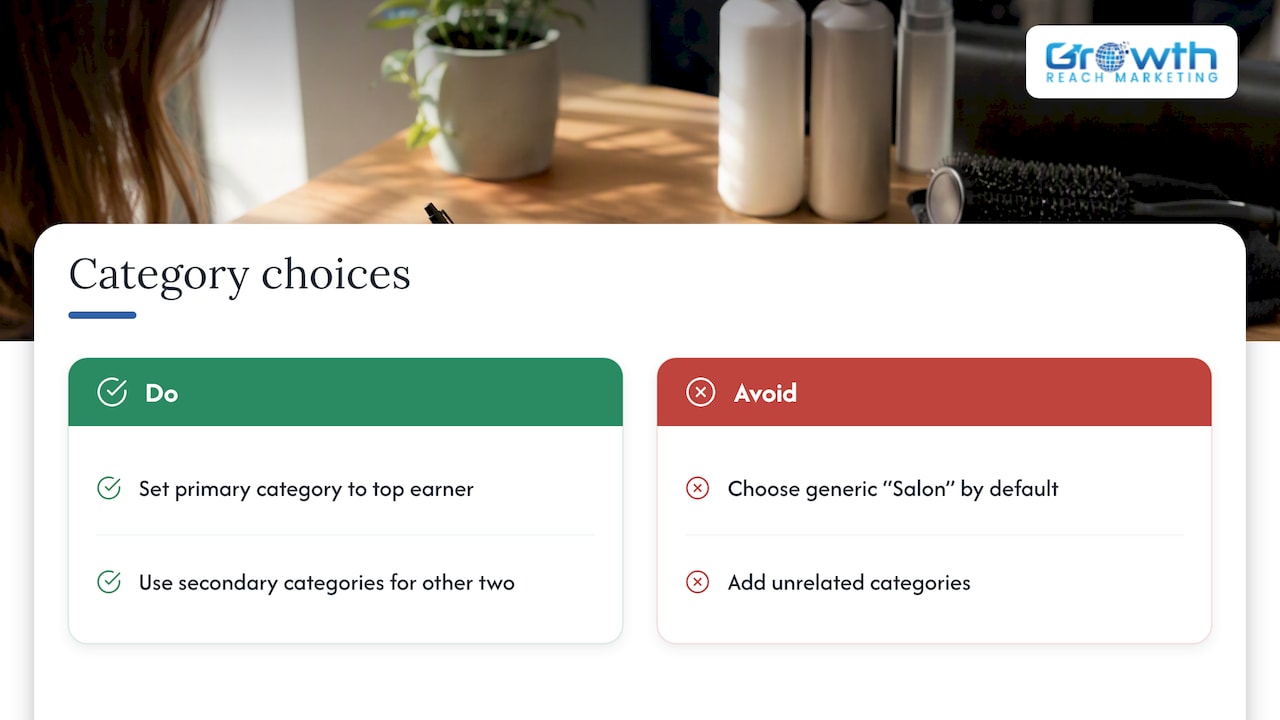
Your primary category is one of the strongest signals you send. Google’s guidance is to set it to match your core service, such as Hair Salon, Aesthetic Clinic or Med Spa, and not a loose label.
A common mistake is picking the generic “Salon” because it feels safe. If most of your income comes from colour, say so with a hair-specific category. If you are a clinic, choose the clinical category and add the others as secondary. We cover this in detail in our piece on fixing the “Salon” category mistake.
A quick test: write down the three services that bring in the most money. Your primary category should describe the first. Secondary categories should cover the other two, and nothing else.
Step 2: Fill in the profile like a shop window
Google describes the Business Profile as the box that helps customers discover and contact your business. Treat every field as part of that shop window.
- Name: your real trading name, exactly as it appears on your signage. Adding keywords or a town name to the name field is the sort of thing that gets profiles suspended.
- Address and service area: if you also travel to clients, for example a mobile bridal stylist, define your service area so Google knows where you operate.
- Hours: keep them right, including bank holidays. Nothing loses trust faster than arriving at a closed door.
- Services and prices: list each treatment with a short plain description. “Balayage” and “Skin consultation” are what people type.
- Photos: real ones of your space, your team and your work, added regularly. Skip stock images.
- Description: two or three honest sentences on who you serve and where, written for people, not for an algorithm.
Don’t create a profile for each stylist. Google’s guidelines say you should keep one main profile for the location and, where needed, practitioner profiles linked to it. Duplicate profiles for the same person can lead to suspension.
Step 3: Make booking effortless
A profile that ranks but doesn’t convert is a waste. Two details matter here.
First, the “Book Online” button. It isn’t a link you paste in. According to Google’s Business Profile best practices playbook, it only appears if you use an approved booking partner. Check your booking software against Google’s list before you assume the button is coming.
Second, the links you do add. Google’s business links policy says booking links should lead to direct, specific pages for that location, not a generic homepage or a social media profile. If you run two salons, each profile needs its own landing page. Our location page checklist shows what each page should contain.
Step 4: Build a steady flow of genuine reviews
Reviews are where most salons are either strong or stuck. The goal is a steady, recent flow, not a burst.
Make leaving a review easy
Don’t just say “please leave us a review”. Generate the short link or QR code from your Business Profile dashboard and put it where clients already are: on appointment cards, receipts, at the front desk, or in a follow-up text after the visit. Google’s own small business story from a Carlow barber shop is a useful local reminder that this is a routine, not a campaign.
The best moment to ask is right after a client has said something nice. Train your team to say, “That means a lot, would you mind putting it in a review? I’ll text you the link.”
Never pay for them
Reviews must be genuine. Google’s business links and review guidance in our research notes that offering incentives, discounts or cash in exchange for reviews is prohibited and can lead to policy violations or removal of your profile. That includes the “free blow-dry for a five-star review” idea. Don’t.
Reply to every review, including the bad ones
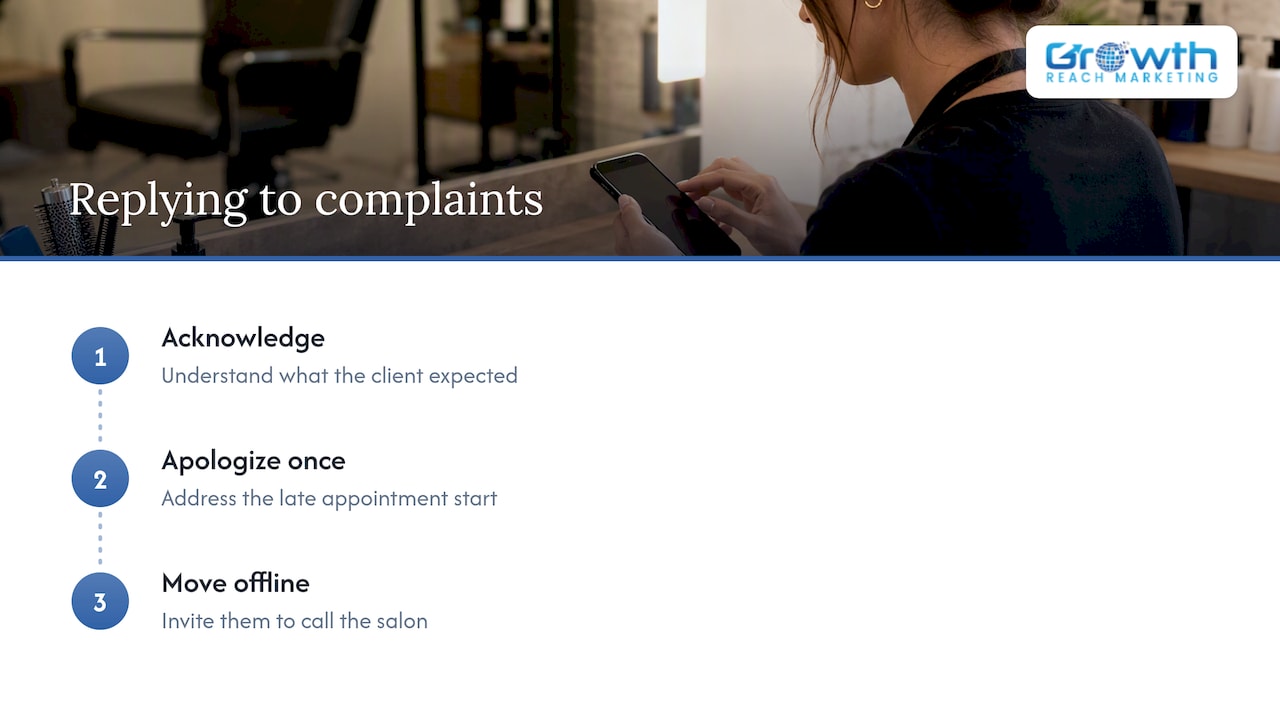
Google’s guidance on responding to reviews says negative reviews aren’t necessarily harmful when handled professionally, and that a balanced mix can look more trustworthy. Reply in a conversational, professional tone, focus on understanding what the client expected, and don’t use the reply as an advert.
A sample reply to a complaint about a long wait:
Thank you for telling us, and I’m sorry your appointment started late. That isn’t the experience we want you to have. Please call the salon on the number on our profile so we can make it right.
It acknowledges, apologizes once, and moves the conversation offline. Our article on salon review strategy examples has more templates.
Step 5: Strengthen prominence beyond the profile
Past the profile itself, Google looks at how well known you are on the wider web. Three things help:
- A website that matches your listing. Same name, address and phone number, and pages for your main services. A keyword-led structure helps; see why salons need a keyword strategy.
- Local links. Mentions from Irish business groups, suppliers, local press and community events show you’re a real part of the area. We explain the safe ones in local links Irish salons need.
- Fresh activity. Regular updates show the business is open and active. For clinics, Google Business posts are a simple way to promote a seasonal treatment or a new service.
For a wider view of how this fits with the rest of your online presence, our guide to beauty brand local SEO is a good next read.
A 90-day order of work
Here is a sensible sequence for a salon starting from a half-finished profile.
| Weeks | Focus | What you do |
|---|---|---|
| 1 to 2 | Foundations | Fix the primary category, hours, services, description and photos. Check that your booking software is a Google-approved partner. |
| 3 to 4 | Booking and website | Point booking links to specific pages. Make sure your site’s address and phone match the profile exactly. |
| 5 to 8 | Reviews | Add QR codes and text follow-ups. Reply to every existing review. |
| 9 to 12 | Prominence | Earn a few genuine local links and post updates regularly. |
Results vary by area. A salon in a crowded part of Dublin 2 competes with far more profiles than one in a small town, so judge progress against your own starting point, not a neighbour’s.
Our perspective: where salons lose ground
We work with salons, aesthetic clinics and med spas, and the pattern is consistent. Most owners think they have a ranking problem when they actually have a clarity problem. The profile says “Salon”, the website says something else, the booking link goes to a homepage, and reviews stop in the spring.
Our view is that Maps work should be boring and steady. There are no tricks worth the risk of a suspended profile, because a suspension costs you the one channel that sends walk-in and phone bookings every day. We would always rather fix three basics and keep them fixed than chase a clever tactic.
We also think owners should measure bookings, not positions. A salon that ranks fourth but has a clear booking button and recent reviews will often beat a salon ranked second with neither. Track calls, direction requests and booked appointments from the profile, and ask new clients how they found you.
— Gerard
When to get help
Many owners can handle the steps above in a few hours a week. If you don’t have those hours, or if you run several locations, a specialist can take over. At Growth Reach Marketing we work specifically with salons, aesthetic clinics and beauty brands in Ireland, combining local SEO with paid social and content. You can see what we offer on our services page, where our Facebook and Instagram ads management, social media management and LinkedIn management are listed. If you’d like to start with a conversation about your profile, get in touch through our website.
FAQ
Can I pay to rank higher on Google Maps?
No. Google states that no business can pay for a higher local ranking. You can run Google Ads alongside your profile, which is a separate paid placement, but your organic Maps position comes from relevance, distance and prominence.
How many reviews does my salon need?
Google doesn’t publish a number. What matters is that your reviews are genuine, recent and answered. Look at the profiles ranking above you in your own area and aim to close that gap steadily, rather than chasing an arbitrary total.
Why doesn’t my profile show a Book Online button?
The button only appears when you use a booking provider that Google has approved. Check whether your software is on that list. If it isn’t, add a direct booking link to a specific page for your location instead.
Should each stylist have their own Google profile?
Keep one main profile for the salon. Practitioner profiles linked to that location are allowed where needed, but duplicate profiles for the same person can lead to suspension.
Sources
- Tips to improve your local ranking on Google, Google Business Profile Help
- Your business information in your Business Profile, Google Business Profile Help
- Guidelines for representing your business on Google, Google Business Profile Help
- Business links policies and guidelines, Google Business Profile Help
- Respond to reviews, Google Business Profile Help
- GBP Best Practices Playbook 2026, Google
- Growth Story: The Baba’s, Grow with Google
- Survey finds half of clients in Ireland favour personalised salon experience, Professional Beauty
- Over a third influenced by online hair salon reviews, Professional Beauty