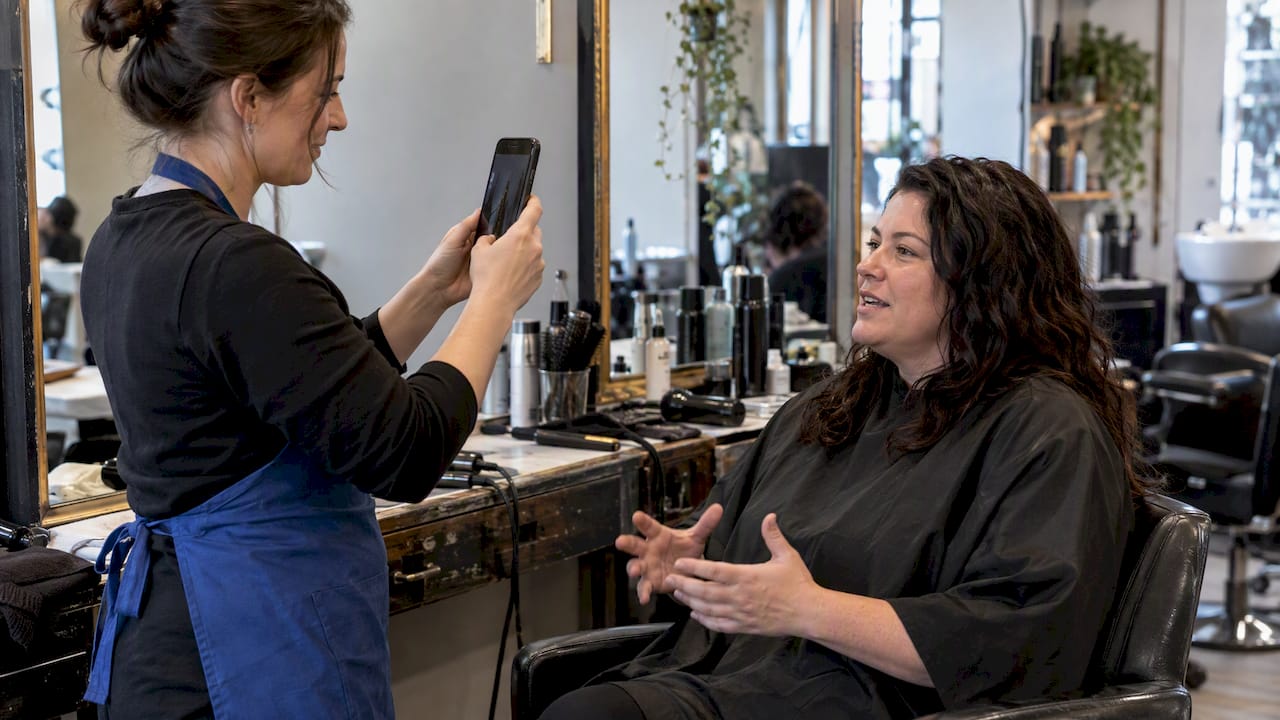
User-generated content (UGC) works in salon ads because it looks like a real client talking, not a brand selling. The workable route in Ireland is simple: get written permission from clients or creators, run their content through Meta’s Partnership Ads (branded content) tools, label it as an ad where there is any commercial relationship, and send the traffic to a booking page that is ready for it. This guide covers each step, with the Irish rules and what to film.
TL;DR
- UGC for salon ads means real client or creator content, such as a reaction, a walkthrough or a before-and-after story, used as the creative in paid Facebook and Instagram campaigns.
- Irish consumers punish fakery: 54% name inauthentic content as their biggest annoyance, so rough and real beats polished and filtered.
- If you pay a creator or give a free treatment, the ad must carry a clear label such as #Ad or Paid partnership, at the start of the content, under ASAI guidance.
- Use Meta’s official partnership label rather than boosting someone’s post from your own account. It keeps you compliant and gives you performance data.
- Test three or four short videos against each other, measure bookings rather than likes, and keep a consent record for every clip.
Table of Contents
- What UGC means for a salon ad
- Why it suits Irish salons and clinics
- Authenticity is the whole point
- Which UGC formats work for salon ads
- Before and after photos: handle with care
- The rules: labelling and consent in Ireland
- How to run UGC as an ad on Facebook and Instagram
- Where to find UGC creators in Ireland
- Common mistakes
- Our perspective
- Want help running UGC ads?
- FAQ
- Sources
What UGC means for a salon ad
UGC is content made by someone other than your marketing team: a client filming her blow-dry reveal, a creator trying your balayage consultation, a bride posting her trial. In an ad, it replaces the studio shot with something closer to a recommendation from a friend.
There are three kinds, and they need different handling:
- Organic client content. A client tags the salon in a Story or reel with no deal in place. You can ask permission to reuse it.
- Gifted content. You give a free service or product and the client or creator posts about it. This counts as a commercial relationship.
- Paid creator content. You commission a local creator for a fee, a set number of videos and agreed usage rights. This is closest to what agencies call a UGC ad.
Most salons start with the first, move to the second, and only pay for the third once they know which message sells.
Why it suits Irish salons and clinics
The case rests on trust. The ASAI’s 2025 influencer research found that 58% of Irish consumers check influencers’ posts before making personal shopping decisions, and 23% trust influencer posts more than direct promotion from a brand. Online advertising is also trusted more than it used to be: 19% now rate it above TV or radio, up from 9% in 2022.
Salons sell something people cannot judge from a website: how it feels to sit in your chair, whether the colorist listens, whether the result lasts. A client saying so on camera answers that in a way a service menu cannot. If you want the wider picture on proof, our guides to salon social proof examples and the role of testimonials in salon marketing go deeper.
There is a performance angle too. Meta reports that campaigns using Partnership Ads averaged a 19% lower cost per acquisition and a 13% higher click-through rate than brand-owned ad campaigns, according to figures from late 2025. That is Meta’s own aggregate data, not a promise for a single-chair salon in Cork, so treat it as a reason to test, not a forecast.
Authenticity is the whole point
The same ASAI research found that 54% of Irish consumers see inauthentic content as their biggest annoyance, for example influencers misrepresenting real life. For a salon, that has a practical meaning: a heavily filtered, over-lit clip can do more harm than having no clip at all.
Irish research on millennial consumers points the same way. A National College of Ireland study of beauty influencers found that trust comes from relatability more than attractiveness, and that a sponsored post that reads like a forced sales pitch weakens purchase intent. It is an older, small-scale study, so use it as direction rather than proof.
What this means when you brief or select content:
- Let the person use her own words. Give her three points to cover, not a script.
- Show attainable results: normal lighting, normal hair, real texture.
- Keep the imperfect moments in: the nervous laugh, the “I almost didn’t book” line.
- Avoid filters that change hair color, skin or lashes. If the ad promises a result the chair cannot deliver, the first comment will say so.
Which UGC formats work for salon ads
Short vertical video is the default for Reels and Stories placements. These formats suit salons well:
| Format | What it shows | Best for | Length |
|---|---|---|---|
| Reveal reaction | Client seeing the finished result in the mirror | Colour, cuts, brows, lashes | 10 to 20 seconds |
| First-visit story | Why she booked, what she was worried about, what happened | New-client acquisition | 20 to 30 seconds |
| Process walkthrough | A creator filming the consultation and the treatment | Treatments that feel unfamiliar, such as keratin or lash lifts | 30 to 45 seconds |
| Objection answer | “I was scared it would damage my hair, here is what happened” | Retargeting people who visited your booking page | 15 to 25 seconds |
| Occasion content | Bridal trial, graduation, Debs prep | Seasonal pushes | 15 to 30 seconds |
The first two seconds decide whether anyone watches. Open on the face or the result, put a caption on screen for people watching on mute, and say the service and the town early. A clip that opens with “Just had my balayage in Galway” tells the right person it is for her.
For how video also helps your visibility beyond ads, see our guide to video content for salon SEO.

Before and after photos: handle with care
Before-and-after images are the most persuasive UGC a salon has, and the one most likely to cause trouble. You need the client’s written consent for each image, and the result must be typical enough that the ad does not mislead. Our salon before and after photos guide covers how to shoot and present them.
Aesthetic clinics have extra care to take. The Irish Medical Council’s guidance, discussed in this Medical Independent piece on promoting medical services, notes that people seeking advice on treatment can be vulnerable to persuasive influence. If you offer injectables or other medical treatments, check the rules for your profession and the product before you turn any patient content into an ad. The regulator and your own professional body are the right places to confirm what is allowed.
The rules: labelling and consent in Ireland
Two things matter before any UGC goes live as an ad: whether the content must be labelled, and whether you have the right to use it.
Labelling under ASAI guidance
The ASAI’s influencer guidance says commercial content must be clearly labelled as advertising. In practice, if you paid a fee or gave a free gift, treat the post as an ad. A clear primary label, such as #Ad, Paid partnership or #Gifted, should appear at the very start of the content, not tucked behind a “Show More” or placed at the end of a caption. Labels like #Collaboration or #BrandAmbassador can be added only alongside a primary label, never instead of one.
The ASAI also publishes recent complaint decisions, and businesses that fail to comply can be named publicly. For a local salon whose reputation is the business, that is a bigger cost than any ad fee. Awareness is rising as well: more than 63% of users now recognize #ad as an advertising label, up from 46% in 2022, according to the ASAI’s survey. Hiding the label is both risky and pointless.
More generally, the CCPC’s advertising guide for businesses sets out that ads must be legal, honest, decent and truthful. A testimonial that overstates what a treatment does breaks that rule even if the client said it sincerely.

Consent and usage rights
This is our recommended practice, not a legal checklist, so ask your solicitor to approve your template. For every clip, keep a short written record covering:
- who owns the content and who is granting permission;
- where it can run (organic, paid ads, website) and for how long;
- whether the person’s face, name and handle may be used;
- whether she can withdraw consent and how you will take the ad down if she does;
- whether any payment or gift was involved, so you know the label to apply.
A message saying “love it, feel free” in a DM is thin evidence. A simple form signed at the chair is better.
How to run UGC as an ad on Facebook and Instagram
The most common mistake is boosting a creator’s post from her own profile, or reposting her video from your account and promoting that, with no partnership tag. Creator IQ’s breakdown of Instagram’s tools explains that the Branded Content tool lets a brand grant permission for a creator’s post to be used as an ad. Using it keeps the content properly labelled and lets you track performance in your ad account. A paid post boosted without the label is a compliance red flag.
Meta has also expanded its Partnership Ads tools. A December 2025 report says the Partnership Ads Hub now includes UGC and affiliate posts from Instagram creators, making them easier to find and monitor. Menus change often, so check the current steps in Meta’s own help pages when you set up.
A workable sequence:
- Collect. Ask clients at checkout, and in a follow-up message, to post and tag you. Save every tagged Story and reel.
- Ask. Message the ones that fit your best-selling service, and get permission and usage rights in writing.
- Set up the partnership. Ask the creator to add your business as a paid partner on her post, and approve it from your side, so the ad runs with the official label.
- Build the ad. Use the original video. Add a clear call to action: Book now, with a link to a page that shows the same service, the price range and online booking.
- Target locally. Keep the radius tight around your salon, such as the town and the commuting area, and exclude existing clients if you can.
- Test. Run three or four clips with the same budget and audience for at least a week or two. Cut the weakest, keep the best.
- Refresh. Content fatigue arrives fast on small local audiences. Plan a new clip every three to four weeks.
Measure bookings, not views
A reel with 30,000 views and no bookings has failed. Track clicks to the booking page, completed bookings and cost per booked appointment, then compare to your average first-visit value. If you use lead forms, our piece on Facebook lead ads for Irish clinics shows how to track bookings rather than just form fills. For the wider system behind this, see our beauty clinic lead generation playbook and the overview of salon lead generation channels.
Where to find UGC creators in Ireland
You do not need a famous influencer. A micro-creator with a few thousand local followers, or a regular client who posts well, often performs better because her audience lives near you. Look at:
- clients already tagging you (the cheapest and most credible source);
- local hair, beauty and lifestyle creators in your county whose audience matches your clients;
- brides, students and staff from nearby businesses you already serve;
- your own team, filmed as themselves, which is not UGC strictly but behaves like it.
Agree the fee, the number of videos, the usage period and the labelling before anyone films. Offer a free service only if you are comfortable with it being labelled as gifted.
Common mistakes
- Boosting without the partnership label. Covered above, and the easiest to avoid.
- Over-editing. Polishing takes away the reason UGC works.
- Sending traffic to the homepage. The ad promised a balayage; the click should land on the balayage page with booking.
- Claiming results no one can promise. Keep the client’s statement about her experience, not guarantees.
- No consent trail. If a client asks you to remove her clip, you need to be able to find and stop it quickly.
- Running one clip forever. Fatigue is real in small audiences.
Our article on common salon social media mistakes covers the organic side of the same problems.
Our perspective
We work with salons, aesthetic clinics and beauty brands, and the pattern is consistent: the best-performing ad is rarely the best-looking one. It is the one where a real client says something specific, such as “I’d been going to the same place for years and nobody ever asked what I wanted.”
The mistake we see most is treating UGC as a creative trick instead of a system. A salon posts one great reel, boosts it, gets a few clicks and sees no bookings, because the landing page, the booking flow and the follow-up were never built for it. The content gets the blame when the funnel was the issue.
Our advice is to start small and keep it honest. Collect consent from day one. Label everything that has a commercial relationship attached, because Irish audiences notice and the ASAI publishes. Pick one service you want to fill, test a few clips against it and judge the result by booked appointments. Once you know what a booking costs, you can decide how much to put behind it, and whether to bring in a creator or just keep filming your own clients.
We would rather you run three honest, labelled clips well than twenty rushed ones.
— Gerard
Want help running UGC ads?
If you would rather have this set up and managed for you, our Facebook and Instagram ads management and social media management are built for salons, aesthetic clinics and med spas. We build the creative plan, the consent process, the partnership set-up and the booking path, and report on appointments, not vanity numbers. Pricing is not published, so get in touch for a conversation about your salon.
FAQ
What does UGC stand for in salon ads?
UGC stands for user-generated content: content made by customers or creators rather than by the business. In a salon ad, that usually means a client video, a creator’s walkthrough or a tagged reel used as the ad creative with permission.
Do I have to label UGC when I use it in an ad?
If there is a commercial relationship, such as a fee or a free treatment, yes. The ASAI guidance calls for a clear primary label like #Ad, Paid partnership or #Gifted at the start of the content. If in doubt, label it.
Can I just boost a client’s post that tags my salon?
Not safely. Get her permission first, and use Meta’s partnership tools so the post is properly tagged and runs with the right label. That also lets you see results in your ad account.
How many UGC videos does a salon need?
Start with three or four short clips for one service, so you can compare them. Plan to replace the weakest after a couple of weeks and add fresh content every few weeks, since small local audiences tire of the same clip quickly.
Is UGC suitable for aesthetic clinics?
It can be, but the rules are tighter for medical treatments. Check the guidance from your professional regulator and the ASAI before using patient content, and avoid any claim about outcomes.
Sources
- ASAI: Influencer survey results 2025
- ASAI: Social media influencer guidance
- ASAI: Recent complaint decisions
- CCPC: Advertising standards for businesses in Ireland
- E-Commerce Brasil: Meta expands tools for turning creator content into ads
- MediaMarketing: New Meta tools boost creator partnerships
- CreatorIQ: How Instagram’s ad innovation unlocks reach
- National College of Ireland: Social media influencers and the beauty industry
- Medical Independent: Promoting your medical services