Facebook Lead Ads let a salon collect a name, phone number and service request inside Facebook or Instagram, without sending anyone to a website. They work best when the offer is specific, the form is short, consent is handled properly under Irish rules, and someone replies within minutes. Get those four things right and a small daily budget can start filling quiet slots. Get them wrong and you collect a spreadsheet of names nobody answers.
This guide covers how the format works, how to set it up for an Irish salon, what to put on the form, what to spend, and how to turn leads into bookings.
TL;DR
- Lead Ads use an Instant Form that opens inside the app, so the client never has to load a landing page.
- Keep the form short, add a privacy policy link, and never pre-tick a marketing consent box: Irish law requires clear, affirmative consent.
- A sensible starting test is €5 to €10 a day for 3 to 4 days, then a couple of weeks of data before you judge it.
- Speed of reply decides lead quality. Set up an automatic text or email and assign every enquiry to a named person.
- Measure booked appointments, not form fills.
Table of Contents
- How Facebook Lead Ads work for a salon
- When lead ads beat a website booking link
- Setting up a lead ad campaign for an Irish salon
- What to ask on the instant form
- Consent and privacy: what applies in Ireland
- How much to spend and how long to run it
- Follow-up: where bookings are won
- Testing, retargeting and measuring
- Our perspective
- Want us to run it for you?
- FAQ
- Sources
How Facebook Lead Ads work for a salon
A normal Facebook ad sends people to a landing page. A lead ad does not. When someone taps it, a form opens inside the app, and their contact details such as name, email and phone number are pre-filled and submitted without leaving Facebook or Instagram. That removes the step where most mobile visitors give up: a slow page, a clumsy booking widget, a form they have to type into with one thumb.
For a salon or aesthetic clinic this suits impulse-friendly services. Think a colour consultation, a skin analysis, a bridal trial, a first-time facial or a patch-test slot. The person is scrolling in the evening, sees an offer that fits, and enquires in ten seconds. You call or message the next morning.
The trade-off is intent. A lead ad is quick, so it can attract casual taps. Most of the work in this guide is about filtering for people who genuinely want an appointment, and about replying fast enough to catch them while they still do.

When lead ads beat a website booking link
Use lead ads when:
- You sell services that need a short conversation first, such as aesthetic treatments, hair extensions, colour corrections or bridal packages.
- Your booking page is slow, hard to use on a phone, or not tied to your calendar.
- You want a list of local people you can follow up with by phone or email, within consent rules.
Use a direct booking link when the service is simple, priced online and bookable in two taps, such as a standard cut. Many salons run both: a lead form for consultations and a booking link for retargeting people who already know them. Our guide on the booking funnel for Instagram ads shows how the two fit together.
Setting up a lead ad campaign for an Irish salon
The mechanics are simple. In Ads Manager you choose the Lead Generation objective, create a form, set the ad details, budget and audience, and include a privacy policy in the form. The decisions that matter come inside those steps.
1. Pick one offer per campaign
One campaign, one service, one reason to act now. “Book a skin consultation” outperforms “Our services” because the reader knows exactly what they get. Good salon offers are specific and low-risk:
- A consultation or patch test slot for a higher-value service.
- A first-visit treatment at a clearly stated price.
- A seasonal slot: communion and wedding season hair trials, pre-Christmas party styling, back-to-school cuts.
- A limited number of quiet-day appointments, for example Tuesday mornings.
State the price or the saving in the ad if you can. Price-blind leads are the most likely to disappear when you call.
2. Choose creative that shows the real place and result
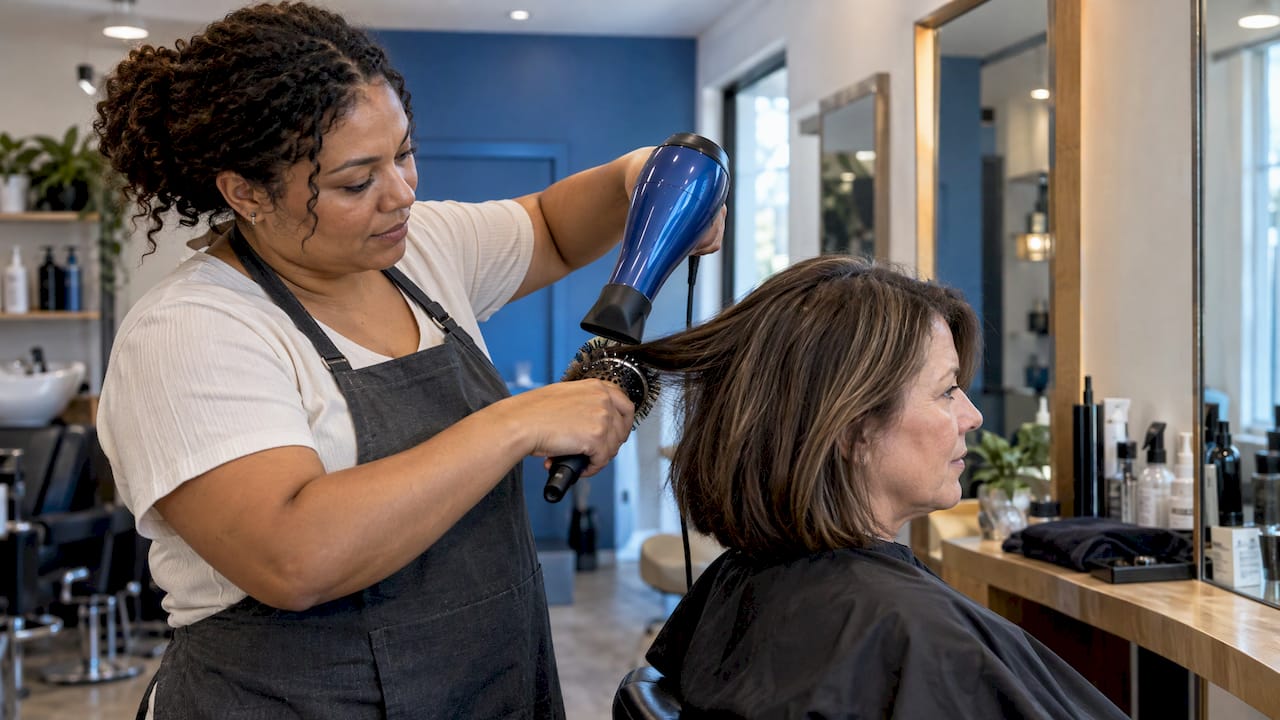
People book a person and a room. Use real photos of your stylists, your chairs and finished work, with client permission. Short video of a blow-dry or a treatment room tour usually feels more honest than stock imagery. If you plan to use client content, our piece on using client content in salon ads in Ireland covers the permission side.
For aesthetic clinics, be careful with before and after imagery and with claims about results. Keep the copy factual and describe the consultation, not a guaranteed outcome.
3. Write copy that qualifies
A short structure works well:
- A headline naming the service and the area: “Balayage consultations in Galway city”.
- One line on what happens next: “Tell us what you’d like and we’ll text you available times.”
- A price or offer detail.
- A button that matches the action, such as “Book now” or “Get quote”.
Writing the price into the ad is a filter. It costs you a few curious clicks and saves your team a lot of dead calls.
4. Target a realistic local radius
Salons live and die by travel time. An Irish booking-software guide suggests that an urban barber might use a radius of 3 to 5 kilometres, while a rural groomer might use 15 to 25 kilometres. Use that as a starting frame and adjust to where your current clients actually come from. A Dublin city salon and a salon in rural Mayo have very different catchments.
If you have followers, past clients or website visitors, start with those warm audiences. Training material from a Local Enterprise Office programme in Tipperary stresses that warm audiences should be prioritised when a business has followers or website visitors. We go deeper on radius and audience choices in our guide to targeting local clients with salon ads.
What to ask on the instant form
Every extra field cuts the number of leads and raises their quality. Aim for the shortest form that lets you decide whether to call.
| Field | Why it earns its place |
|---|---|
| First name and mobile number | You need a way to reply fast. Prefilled by Meta in most cases. |
| Service wanted (dropdown) | Lets you route the lead and prepare the right slot. |
| Preferred day or time of day | Makes your first message specific: “We have Thursday at 11”. |
| Prior experience, e.g. first visit or returning | Helps you tailor the call for aesthetic services. |
| Email (optional) | Only if you will actually use it, and only with consent. |
Appointment-focused guidance from a lead generation firm recommends collecting contact details plus qualifying information such as the service wanted and the preferred day, adding a privacy disclaimer, and saying clearly what happens next. Following that advice, end the form with a thank-you screen that says who will contact the person and when, for example “A member of our team will text you within 30 minutes during opening hours.” A higher-intent review screen before submission can also reduce accidental taps.
If your CRM supports it, you can go a step further. Aesthetix CRM documentation notes that it syncs leads from Instant Forms and that supported campaigns can offer calendar booking on the form’s Thank You page. That lets an enthusiastic lead pick a slot immediately instead of waiting for your call.
Consent and privacy: what applies in Ireland
A lead form is data collection, so GDPR applies from the first field. A separate set of rules covers marketing messages. Under the ePrivacy Regulations (S.I. 336/2011), electronic direct marketing generally requires prior, clear, affirmative consent, with a limited exception for existing customers and similar services. The Data Protection Commission also says that each marketing message must include a valid way to opt out.
For your form, that means:
- Add a privacy policy link that says who you are, what you collect and why.
- Keep marketing consent separate from the enquiry. A person asking for a consultation slot has agreed to be contacted about that slot, not necessarily to receive your newsletter.
- Never pre-tick a box. The DPC’s guidance states that silence, pre-ticked boxes or inactivity do not constitute valid consent.
- Honour objections. People have a right to object to direct marketing at any time, and you must stop when they do.
- Record consent. Keep the form version, timestamp and wording so you can show what the person agreed to.
If you plan to text or email leads after the first reply, read our guides on GDPR email soft opt-in tests in Ireland and SMS consent for salons and clinics. Clinics handling health-related details should also review what they ask on the form, and our Facebook lead ads guide for Irish clinics goes into that. For any specific doubt about your data or forms, ask a data protection adviser or solicitor.
How much to spend and how long to run it
You do not need a large budget to learn something. The Local Enterprise Office Tipperary training summary recommends €5 to €10 per day over 3 to 4 days as a sensible initial test, with at least €10 a day generally advised for cold audiences using AI targeting. The same material says €5 a day may reach about 3,000 people and €10 a day about 5,000 to 6,000, depending on audience size.
A practical plan:
- Days 1 to 4: run one offer at €10 a day to a local radius. Do not touch it. Meta’s delivery system needs time and spend to learn.
- Week 2: let it keep running. Do not judge a local campaign on a few days of data.
- Week 3: compare cost per lead, but more importantly count how many leads answered and how many booked.
- Then: keep the winner, replace the weakest creative, and add a second offer.
A cheap lead that never books is more expensive than a pricier lead who turns up. Always divide spend by appointments, not by form fills.
Follow-up: where bookings are won
Speed matters more than any ad setting. Someone who submitted a form on a Saturday night has probably also enquired elsewhere. Appointment-business guidance recommends an automated text or email within minutes, assigning each enquiry to a responsible team member, and measuring response time. A simple routine looks like this:
- Instant auto-reply (within a minute): “Thanks, Aoife. We’ve got your request for a colour consultation. We’ll text you times shortly.”
- Human message within 30 minutes during opening hours, offering two specific slots.
- Phone call if there is no reply in a few hours.
- Reminder the day before the booked appointment.
- Two or three follow-ups over a week for leads that go quiet, each one with a clear opt-out.
Your front desk should know who owns the lead inbox. If nobody does, a shared inbox is where leads go to die. If you want to automate the first reply or move the conversation to chat, see our notes on WhatsApp booking automation for salons and clinics.
Testing, retargeting and measuring
Treat the first month as a test, not a verdict.
Test one thing at a time. Change the image or the offer, not both. Run two creatives against each other for the same period and budget.
Retarget the warm. People who watched your video, visited your site or engaged with your page are the cheapest leads you will get. Put your best offer in front of them rather than a broad audience.
Track what counts. Record for every lead: source campaign, time received, time of first reply, whether they booked, whether they attended and what they spent. That is the only way to see which ad pays. If your website also takes bookings, set up GA4 booking events so both routes are measured in one place, and look at conversion improvements on your booking flow.
Common problems and fixes:
| Symptom | Likely cause | Fix |
|---|---|---|
| Many leads, few answer | Form too easy, offer too vague | Add a service dropdown and a price in the ad |
| Leads answer but do not book | Slow reply or no clear slots | Reply in minutes with two specific times |
| Leads book but do not attend | No reminder | Send a confirmation and a day-before reminder |
| Leads from far away | Radius too wide | Narrow to your real catchment |
Our perspective
We see the same pattern in salons and clinics again and again: the ad is rarely the problem. The problem is what happens in the ten minutes after someone taps it.
That is why we build lead ads as part of a booking system, not as a stand-alone campaign. The form, the consent wording, the automatic reply, the calendar and the reporting are designed together, so that you can see how many leads became appointments, not just how many forms were filled.
We work only with beauty, aesthetics and local service businesses, and we are based in Ireland, so consent rules and local catchments are part of the brief from day one. Our aim is simple: fewer wasted euros, a front desk that knows exactly who to call, and a campaign you can explain to your own accountant.
Gerard
Want us to run it for you?
If you would rather spend your time with clients than in Ads Manager, we manage Facebook and Instagram ads for salons, aesthetic clinics and med spas, alongside AI enquiry handling, follow-ups and booking automation. That covers the campaign, the form, the consent wording and the reply routine, so that every lead is handled quickly. See our services or get in touch to talk through your salon.
If you are comparing channels first, our overview of 12 salon lead generation channels to test is a good place to start, and Google Ads for salons catches people who are already searching.
FAQ
Are Facebook Lead Ads worth it for a small salon?
They can be, if you can reply to leads quickly and you measure bookings rather than form fills. A small starting test of €5 to €10 a day is enough to learn whether your offer and area work. If nobody can answer enquiries within the hour, fix that first.
What should I offer in a salon lead ad?
Offer one specific service with a clear next step, such as a consultation, a patch test slot, a first-visit treatment or a seasonal package. Mention the price or saving in the ad, and show real photos of your team and work. Avoid vague “book with us” messages.
Do I need consent to message people who fill in my form?
You can contact someone about the enquiry they made. For ongoing marketing by email or text, Irish rules generally require clear, affirmative consent, and pre-ticked boxes do not count. Keep marketing consent as a separate, unticked choice and include an opt-out in every message. For specific cases, check with a data protection adviser.
How long before I know if it is working?
Run the first test for 3 to 4 days at a steady budget, then give a local campaign a couple of weeks of data before judging it. Look at appointments booked and attended, not just cost per lead.
Should I use Facebook or Google Ads?
They do different jobs. Facebook and Instagram reach people who were not searching but may be interested, while Google catches people already looking for a service. Many salons start with one and add the other once bookings are steady.
Sources
- How to Advertise Across Meta Platforms and Generate More Leads, HubSpot
- Getting Started: Facebook and Instagram Lead Ads, Aesthetix CRM
- Facebook Lead Ads Booking, Aesthetix CRM
- Facebook Advertising for Salons and Barbers, reservations.ie
- Electronic Direct Marketing FAQ, Data Protection Commission, April 2020
- Data Protection Basics, Data Protection Commission, 2019
- Facebook and Instagram Ads Part 2 training summary, Local Enterprise Office Tipperary