
Med spa brand positioning is defined as the strategic space your practice occupies in a patient’s mind, answering one question: why should they choose you over every other option nearby. The aesthetic industry is crowded, and owners who skip this foundation compete on price alone. The med spa brand positioning steps covered here give you a repeatable framework to attract the right patients, charge what you’re worth, and build a practice people return to. Growthreachmarketing works with aesthetic clinics daily, and the difference between a busy book and an empty one almost always traces back to positioning clarity.
What are the core med spa brand positioning steps?
Brand positioning in a med spa context is not just a logo or a color palette. Positioning is built from expertise, point of view, patient promise, service focus, and communication style. That combination is what makes one practice feel premium and another feel generic, even when both offer identical treatments.
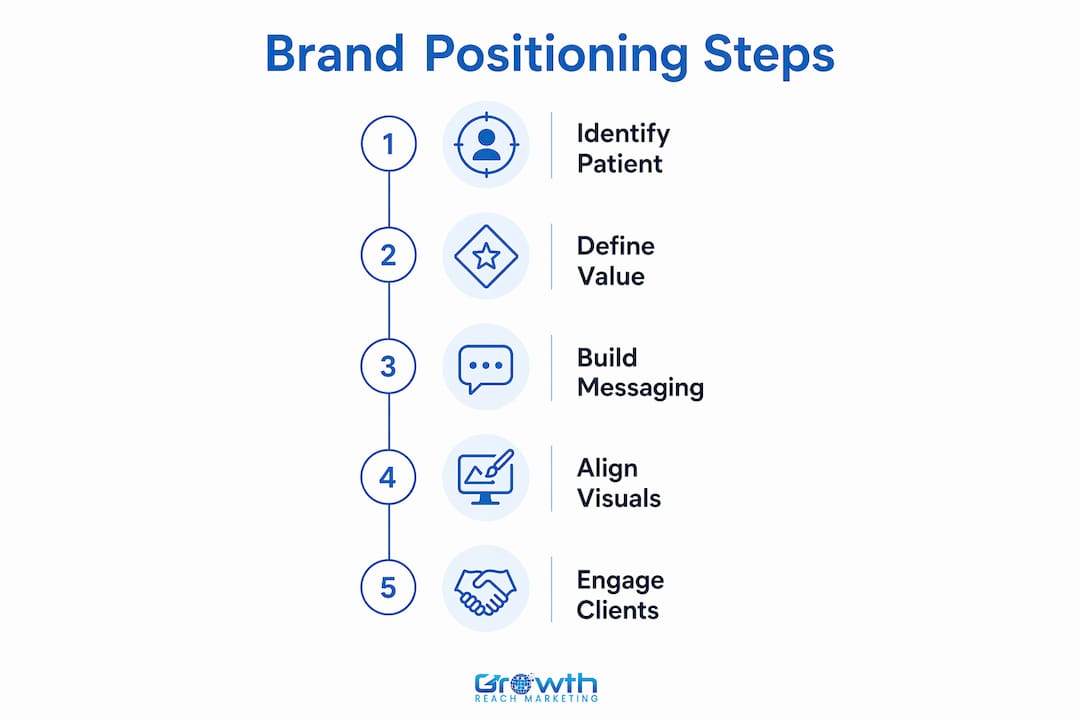
The full process breaks into five connected steps: identifying your ideal patient, defining your unique value, building your brand identity, aligning your messaging, and executing through client touchpoints. Each step feeds the next. Skipping one creates gaps that patients notice, even if they cannot name what feels off.

Med spa owners who treat positioning as a one-time task miss the point. Positioning is a living framework you test, refine, and protect as your market shifts.
How do you identify your ideal med spa target patient?
Knowing your ideal patient is the foundation of every other positioning decision. Without it, your messaging tries to speak to everyone and resonates with no one.
Start with these four steps:
-
Go beyond demographics. Age and income matter, but psychographics drive bookings. Med spa target patients are typically self-care oriented, comfortable in spa environments, and seeking maintenance and enhancement treatments. Many are newer to aesthetics. That mindset shapes how you write copy, design your space, and train your front desk.
-
Map treatment adherence and retention potential. A patient who books Botox every three months is worth far more than one who tries a single laser session and disappears. Build your ideal patient profile around who returns, not just who converts once.
-
Pull data from your existing patient base. Survey your top 20% of patients. Ask what brought them in, what keeps them coming back, and how they describe your practice to friends. Their words become your positioning language.
-
Segment by treatment category. Patients seeking body contouring have different motivations than those booking skin rejuvenation. Each segment may need a slightly different message, even within the same brand.
-
Assess profitability per patient type. Some treatments attract high-volume, low-margin patients. Others attract lower volume but higher lifetime value. Build your positioning around the segment that makes your business sustainable.
Pro Tip: Run a simple 3-question survey at checkout: “What made you choose us?”, “What do you love most about your experience here?”, and “How would you describe us to a friend?” The answers will rewrite your homepage.
How do you build a unique value proposition for your med spa?
Your unique value proposition (UVP) is the single clearest reason a patient should book with you. Most med spas either skip this step or write something vague like “results-driven care.” That phrase means nothing to a patient scrolling Instagram at 9 PM.
A strong UVP starts with your anchor expertise. Pick the one or two treatments your team delivers better than anyone in your market. Build your identity around those, not around a 40-item service menu. Depth beats breadth in positioning.
Next, develop a treatment philosophy. A philosophy built around subtle enhancement, staged treatment plans, patient education, and realistic expectations attracts better-fit patients. It also communicates how your practice thinks, which is a genuine differentiator.
Med spas that compete with dermatology practices make a common mistake: they try to match clinical authority. Med spas win on experience, ambiance, accessibility, and welcoming newcomers, not on clinical credentials. Lean into what you actually do better. A warm, approachable environment with a clear aesthetic point of view beats a cold clinical tone every time for your target patient.
Key differentiators to build into your UVP:
- Ambiance and environment: Does your space feel like a retreat or a waiting room?
- Accessibility: Do you offer flexible booking, transparent pricing, and clear treatment explanations?
- Client experience: From the first phone call to the follow-up text, is every touchpoint intentional?
- Provider personality: Are your injectors and aestheticians visible, relatable, and trusted by name?
Pro Tip: Write your UVP as one sentence a 16-year-old could understand. If you need three sentences to explain what makes you different, you are not clear enough yet.
Understanding aesthetic brand differentiation is worth studying before you finalize your UVP. The gap between a generic practice and a booked-out one is almost always a positioning gap, not a treatment gap.
How do you align messaging and visual identity across channels?
Consistent messaging is what turns a positioning idea into a brand patients recognize and trust. Consistent messaging across your website, email, and in-person interactions reinforces trust and shapes patient perception over time.
Messaging tone
Your tone should reflect your positioning directly. An expert-led, results-focused practice uses clear, confident, and aspirational language. A wellness-first, relaxation-oriented practice uses warmer, softer language. Neither is wrong. Mixing both creates confusion.
Visual identity
Med spa visual branding favors spa-like, luxurious designs with soft, inviting colors and aspirational imagery. This contrasts sharply with clinical dermatology branding, which uses white space, medical fonts, and credential-heavy layouts. Your visual choices signal your positioning before a patient reads a single word.
Apply your visual identity consistently across these touchpoints:
- Website: Hero images, font choices, and color palette should match your in-spa experience.
- Social media: Instagram grid, Stories, and Reels should feel like one cohesive brand, not a mix of stock photos and personal phone shots.
- Email marketing: Templates, tone, and imagery should match your website, not feel like a different business.
- In-spa experience: Signage, packaging, music, and scent all reinforce or undermine your brand positioning.
| Channel | Positioning signal | Common mistake |
|---|---|---|
| Website | First impression, trust builder | Stock photos that feel generic |
| Visual proof of results and culture | Inconsistent grid, no brand voice | |
| Retention and relationship tool | Promotional-only, no personality | |
| In-spa environment | Emotional confirmation of brand promise | Decor that contradicts digital branding |
Provider bios and patient testimonials are underused positioning tools. A bio that shows personality and expertise builds trust faster than a credential list. A testimonial that describes the experience, not just the result, speaks directly to your ideal patient’s motivations.
How do you communicate your positioning through campaigns and client interactions?
Positioning only works when patients experience it consistently, from the first ad they see to the follow-up message after their appointment.
Here is how to execute it across every touchpoint:
-
Design consultations around your philosophy. Every consultation is a brand interaction. Train your team to use the same language your marketing uses. If your brand promises “natural results,” your injectors should use that phrase and explain what it means to them personally.
-
Run Instagram content that reflects your positioning. Instagram drives 40% more new patient inquiries when used with before-and-after photos and provider spotlights. That number reflects how much patients rely on visual proof before booking. Post content that shows your culture, not just your results.
-
Build Google Ads campaigns around your anchor treatments. Targeted Google Ads let you reach patients searching for specific treatments in your area. Your ad copy should reflect your positioning, not just list services. “Natural Botox results in Austin” outperforms “Botox near me” for a practice positioned around subtle enhancement.
-
Structure a referral program that rewards loyalty. Referral programs with incentives like discounts and complimentary services generate 20–30% of new patient volume for med spas. The key is making the program easy to share and publicly acknowledging referring patients when appropriate.
-
Track and refine. Review which campaigns attract patients who book again. If your highest-converting ad brings in one-time patients, your positioning message may be attracting the wrong segment. Adjust the message before you increase the budget.
“Your brand is not what you say it is. It is what your patients say it is when they describe you to a friend. Every touchpoint either confirms or contradicts that description.”
For video content that reinforces your brand story, aesthetic video marketing offers a practical framework for med spas building patient trust through authentic content. Pairing video with a structured marketing workshop approach can sharpen how you present your brand across paid and organic channels.
What I’ve learned from positioning med spas that actually grow
The most common mistake I see med spa owners make is confusing decoration with positioning. They invest in a beautiful logo, a soft color palette, and a well-designed website, then wonder why their booking rate does not improve. Decoration is not positioning. Positioning is the answer to “why you, why now, why not the place down the street.”
The practices I have seen grow fastest share one trait: they are ruthlessly clear about who they are not for. A practice positioned around accessible luxury for first-time aesthetics patients should not run promotions that attract bargain hunters. Every discount that contradicts your positioning erodes the trust you spent months building.
Balancing medical credibility with a welcoming atmosphere is genuinely hard. Lean too clinical and you lose the patients who want to feel comfortable. Lean too spa-like and you lose the patients who need to trust your medical expertise. The answer is not a compromise. It is a clear hierarchy: lead with warmth, back it with credentials, and let your results speak last.
The practices that invest two or three months in this foundation before spending a dollar on ads almost always outperform those who run campaigns first and figure out positioning later. Positioning is not a marketing task. It is a business decision.
— Gerard
How Growthreachmarketing helps med spas build and grow their brand
Med spa owners who have clear positioning still need the right channels to reach their ideal patients at scale. Growthreachmarketing specializes in helping aesthetic clinics translate their brand identity into search visibility, paid campaigns, and local authority that fills appointment books.
From local SEO for beauty brands that puts your practice in front of nearby patients to Google Ads for medical aesthetics that targets by treatment and location, the team at Growthreachmarketing builds systems designed for long-term growth. If your positioning is solid but your visibility is not, that is the gap worth closing first. Reach out to Growthreachmarketing to see how a focused digital strategy can turn your brand positioning into a full appointment calendar.
Key Takeaways
Effective med spa brand positioning requires a clear patient profile, a defined unique value proposition, and consistent execution across every client touchpoint.
| Point | Details |
|---|---|
| Define positioning first | Positioning answers why a patient chooses you, built from expertise, promise, and communication style. |
| Profile your ideal patient | Go beyond demographics to include psychographics, treatment adherence, and lifetime value potential. |
| Build a real UVP | Anchor your identity to specific treatments and a treatment philosophy, not a generic service list. |
| Align visuals and messaging | Every channel, from Instagram to in-spa signage, should reinforce the same brand promise. |
| Execute through touchpoints | Consultations, ads, and referral programs must all reflect your positioning to attract the right patients. |
FAQ
What is med spa brand positioning?
Med spa brand positioning is the strategic place your practice holds in a patient’s mind, defined by your expertise, service focus, patient promise, and communication style. It answers why a patient should choose your practice over every other option in your market.
How do med spas differ from dermatology practices in branding?
Med spas win on experience, ambiance, accessibility, and welcoming newcomers rather than competing on clinical credentials. Dermatology branding emphasizes medical authority, while med spa branding favors accessible luxury and a welcoming environment.
How long does it take to build a med spa brand identity?
Building a clear brand identity typically takes two to three months of focused work before you invest in paid advertising. Rushing this step leads to campaigns that attract the wrong patients and messaging that feels inconsistent.
Which marketing channels work best for med spa brand positioning?
Instagram is the most powerful visual platform for med spas, while Google Ads targets patients actively searching for specific treatments. Both channels work best when your messaging directly reflects your positioning, not just your service list.
How do referral programs support med spa brand positioning?
Referral programs with structured incentives can generate 20–30% of new patient volume and reinforce your brand by attracting patients who already trust your existing clients. The program works best when it rewards loyalty publicly and aligns with your brand values.