
Pay-per-click advertising is a digital ad model where you pay only per click, meaning your budget goes directly toward people who showed enough interest to act. Platforms like Google Ads and Meta Ads Manager run the world’s largest PPC ecosystems, giving businesses of every size access to audiences that traditional media never could. The model rewards relevance over raw spending, which is why a well-optimized campaign from a local aesthetic clinic can outrank a national brand with a bigger budget. Understanding how pay-per-click advertising works is the difference between burning ad spend and building a predictable lead machine.
How does the PPC auction process work?
Every time a user types a search query or loads a page with ad inventory, an auction runs in real time to determine which ads appear and in what order. This happens billions of times daily across Google Search, Google Display Network, and Meta platforms. The speed is invisible to users, but the mechanics behind it directly control your costs and visibility.
Google Ads determines placement using a metric called Ad Rank. Ad Rank is not simply the highest bid. It is calculated by multiplying your Quality Score by your maximum bid, and the advertiser with the highest Ad Rank wins the top position. This means a business with a Quality Score of 8 and a $2 bid can outrank a competitor bidding $5 with a Quality Score of 3.

The actual cost per click you pay is also lower than your maximum bid in most cases. The actual CPC formula works like this: take the Ad Rank of the competitor directly below you, divide it by your Quality Score, and add $0.01. That means quality improvements directly reduce what you pay per click, not just where you rank.
Google also enforces minimum Ad Rank thresholds that exclude low-quality ads from top positions regardless of bid. These thresholds factor in query competitiveness, user signals, and advertiser history. An ad with a poor Quality Score may not appear at all, even if the bid is high. This is the mechanism that keeps search results useful and forces advertisers to earn their placement.
Key factors that influence your Ad Rank in every auction:
- Maximum CPC bid: The ceiling you set for what you will pay per click
- Quality Score: Google’s 1-10 rating based on expected CTR, ad relevance, and landing page experience
- Ad Rank thresholds: Minimum quality bars that must be cleared for any placement
- Context of the search: Device, location, time of day, and search query intent
- Ad extensions: Sitelinks, callouts, and structured snippets that expand your ad and improve CTR
Pro Tip: Never raise your bid as the first response to poor performance. Check your Quality Score first. A low score means you are paying a penalty on every click, and no bid increase will fix that.
What are the main strategies for setting budgets and bids?
Budget and bidding decisions shape the entire performance of a PPC ad campaign. The two primary approaches are manual bidding and automated bidding, and each serves a different stage of campaign maturity.
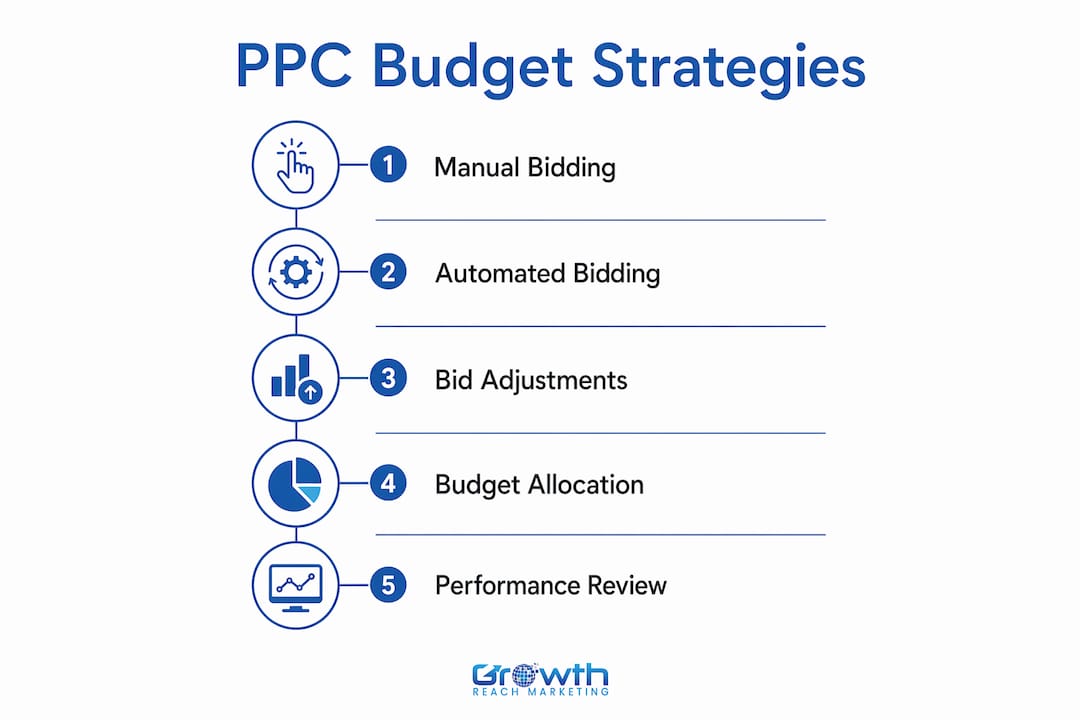
Manual bidding gives you direct control over the maximum CPC for each keyword or ad group. This works well when you have limited data and want to test the market without handing control to an algorithm. The tradeoff is time. Managing bids manually across hundreds of keywords requires constant attention and expertise.
Automated bidding uses Google’s machine learning to adjust bids in real time based on the likelihood of a conversion. Strategies like Maximize Clicks, Target CPA, and Target ROAS each optimize toward a different goal. Target CPA tells Google to find conversions at or below a cost you set. Target ROAS tells it to prioritize revenue efficiency. These strategies work best once your account has sufficient conversion data, typically at least 30 to 50 conversions per month.
Here is a practical framework for choosing your bidding approach based on campaign stage:
- New campaign with no data: Start with manual CPC or Maximize Clicks to build impression and click history without overspending.
- Campaign with 30+ conversions per month: Switch to Target CPA or Target ROAS to let Smart Bidding optimize toward business outcomes.
- Brand awareness goal: Use Target Impression Share to control how often your ad appears for branded or competitive terms.
- Limited budget: Use manual CPC with bid adjustments for device, location, and time to concentrate spend where it converts best.
- Scaling a proven campaign: Increase Target ROAS targets gradually rather than in large jumps to avoid destabilizing the algorithm.
Pro Tip: When switching from manual to automated bidding, give the campaign a two-week learning period before judging performance. Cutting it short based on early data is one of the most common and costly mistakes in pay-per-click strategy.
How do quality factors and relevance influence PPC success?
Quality Score is Google’s shorthand for how relevant and useful your ad is to the person searching. It is scored from 1 to 10 and built from three components: expected click-through rate, ad relevance to the keyword, and landing page experience. Each component is rated below average, average, or above average, and the combination produces your score.
Higher Quality Score directly reduces your actual CPC and improves your Ad Rank without requiring a higher bid. An advertiser with a score of 9 can pay significantly less per click than a competitor with a score of 4, even while appearing above them in the results. This is the single most underused ROI lever in PPC advertising.
The table below shows how Quality Score components affect campaign outcomes:
| Quality Score component | Low performance impact | High performance impact |
|---|---|---|
| Expected CTR | Higher CPC, lower Ad Rank | Lower CPC, stronger placement |
| Ad relevance | Ad may not show for target keywords | Ad matches intent, improves conversion rate |
| Landing page experience | Google penalizes with lower scores | Supports Smart Bidding and reduces bounce |
Poor landing page experience is the most overlooked quality factor. An ad can have a strong CTR and relevant copy, but if the landing page loads slowly, lacks the promised offer, or fails on mobile, Google penalizes the entire ad group. For salons and local service businesses, this often means sending traffic to a generic homepage instead of a dedicated booking page, which tanks both Quality Score and conversion rate. Improving your ad copy relevance and aligning it tightly with the landing page is one of the fastest ways to improve Quality Score without touching your bid.
How to measure and optimize PPC campaigns for business outcomes
Clicks are not the goal. Conversions are. Conversion tracking is the foundation of any PPC campaign that connects ad spend to real business results like booked appointments, form submissions, or purchases. Without it, you are flying blind on which keywords, ads, and audiences actually drive revenue.
Setting up conversion tracking in Google Ads requires placing a conversion tag on the confirmation page or action that signals a completed goal. Integrating Google Ads with GA4 gives you a richer view of the customer journey, but it also introduces a common problem: double counting. If both GA4 and a native Google Ads tag fire on the same conversion event, your reported conversions inflate and Smart Bidding learns from bad data.
Selecting a single conversion source is the most important tracking decision you will make. Either import goals from GA4 into Google Ads or use native Google Ads tags, but not both for the same action. Mixing sources creates discrepancies that mislead the algorithm and make performance reporting unreliable.
Key steps for building a reliable measurement setup:
- Define your primary conversion action before launching any campaign, whether that is a phone call, form fill, or online booking.
- Audit your tags using Google Tag Assistant or GA4 DebugView to confirm tags fire once and only once per conversion.
- Check for GA4 and Google Ads discrepancies regularly. Attribution differences between the two platforms are common and can mislead budget decisions if left unaddressed.
- Use conversion data to inform Smart Bidding only after you have at least 30 clean conversions in a 30-day window.
Pro Tip: On Meta Ads Manager, each ad set needs approximately 50 optimization events within 7 days to exit the learning phase. Splitting budget across too many ad sets starves each one of data and prevents stable delivery.
Key takeaways
PPC advertising rewards relevance and measurement precision far more than raw budget size, making Quality Score and conversion tracking the two highest-leverage variables in any campaign.
| Point | Details |
|---|---|
| Auction mechanics | Ad Rank combines Quality Score and bid; the highest bidder does not always win. |
| Actual CPC formula | Your real cost per click depends on competitor Ad Rank and your Quality Score, not just your max bid. |
| Bidding strategy selection | Match your bidding approach to campaign maturity; use manual CPC early, then shift to Smart Bidding with data. |
| Quality Score impact | Improving Quality Score lowers CPC and raises Ad Rank without increasing spend. |
| Conversion tracking accuracy | Use a single conversion source to prevent double counting and protect Smart Bidding performance. |
Why PPC is more than a bidding game
I have audited dozens of PPC accounts for salons, clinics, and local service businesses, and the pattern is almost always the same. The owner or their previous agency focused entirely on bids and keywords while ignoring the three things that actually determine profitability: message matching, landing page alignment, and clean conversion data.
A well-structured campaign is not just organized for tidiness. It exists so that the keyword, the ad, and the landing page all say the same thing to the same person at the same moment. When those three elements align, Quality Score rises, CPC drops, and conversion rates climb. When they do not, you pay a premium for every click and wonder why the budget disappears without results.
The other thing most guides skip is the multi-layer nature of PPC strategy. Demand capture through search is one layer. Retargeting people who visited but did not convert is another. Audience-based campaigns on Meta that build awareness before someone searches are a third. Treating PPC as a single channel with a single tactic is what keeps most businesses stuck at mediocre results.
My honest advice: before you increase your budget, fix your Quality Score and verify your conversion tracking. Those two actions will do more for your return on ad spend than any bid adjustment.
— Gerard
Ready to get more from your Google Ads campaigns?
Growthreachmarketing works with salons, aesthetic clinics, and local service businesses to build Google Ads campaigns that generate real bookings, not just clicks. From keyword strategy and ad copy to Quality Score optimization and conversion tracking, the team handles every layer of your PPC setup.
If your current campaigns are spending without delivering consistent leads, the issue is almost always structural. Growthreachmarketing’s Google Ads campaign setup process starts with a full audit of your existing account before a single dollar of budget is adjusted. The goal is a campaign that pays for itself. Reach out to Growthreachmarketing to find out what is holding your current ads back.
FAQ
What is pay-per-click advertising in simple terms?
Pay-per-click advertising is a model where advertisers pay per click rather than per impression, meaning you only spend money when someone actively engages with your ad. Google Ads and Meta Ads Manager are the two dominant platforms for running PPC campaigns.
How does Google decide which PPC ads to show?
Google uses Ad Rank, calculated from your Quality Score and maximum bid, to determine ad placement in every auction. Ad Rank thresholds also filter out low-quality ads regardless of bid amount.
What is a good Quality Score in Google Ads?
A Quality Score of 7 or above is considered strong and typically results in lower CPC and better ad placement. Scores below 5 indicate problems with CTR, ad relevance, or landing page experience that are costing you money on every click.
How do I track conversions in a PPC campaign?
Set up a conversion tag in Google Ads on the page or action that confirms a completed goal, such as a booking confirmation or thank-you page. Use a single tracking source to avoid double counting, which distorts Smart Bidding and inflates reported results.
When should I switch from manual to automated bidding?
Switch to automated bidding strategies like Target CPA or Target ROAS once your campaign has at least 30 conversions per month. Before that threshold, manual CPC gives you more control without risking the algorithm optimizing toward insufficient data.