

E-E-A-T stands for Experience, Expertise, Authoritativeness and Trustworthiness. For a med spa, it means every treatment page should show who performed or reviewed the work, what they are qualified to do, what the risks are, and where your claims come from. Google does not score E-E-A-T as a single ranking factor, but it uses signals of it, and treatments that affect health get the closest scrutiny. In Ireland, those same signals overlap with what the ASA and the Medical Council already expect of you.
This guide covers what E-E-A-T means for a clinic website, what to put on each page, who should write and review content, and how to keep it current.
TL;DR
- E-E-A-T is a framework from Google’s quality rater guidelines, not a switch you turn on. Google says its systems give extra weight to strong E-E-A-T on health topics.
- Name the practitioner, their registration, their training and their hands-on experience on every treatment page.
- Cover risks, downtime, suitability and realistic results, and substantiate every claim in line with ASA rules.
- Never advertise prescription-only medicines such as botulinum toxin to the public. Describe the consultation, not the product.
- Review treatment pages on a schedule and show the review date and the reviewer.
Table of Contents
- What E-E-A-T means and how Google uses it
- Why Irish rules make E-E-A-T more than an SEO exercise
- How to show Experience
- How to show Expertise
- How to show Authoritativeness
- What trustworthy treatment content includes
- Trust signals your site should carry
- Keeping content current
- Common mistakes that weaken E-E-A-T
- Perspective
- How Growth Reach Marketing can help
- A practical starting plan
- FAQ
- Sources
What E-E-A-T means and how Google uses it
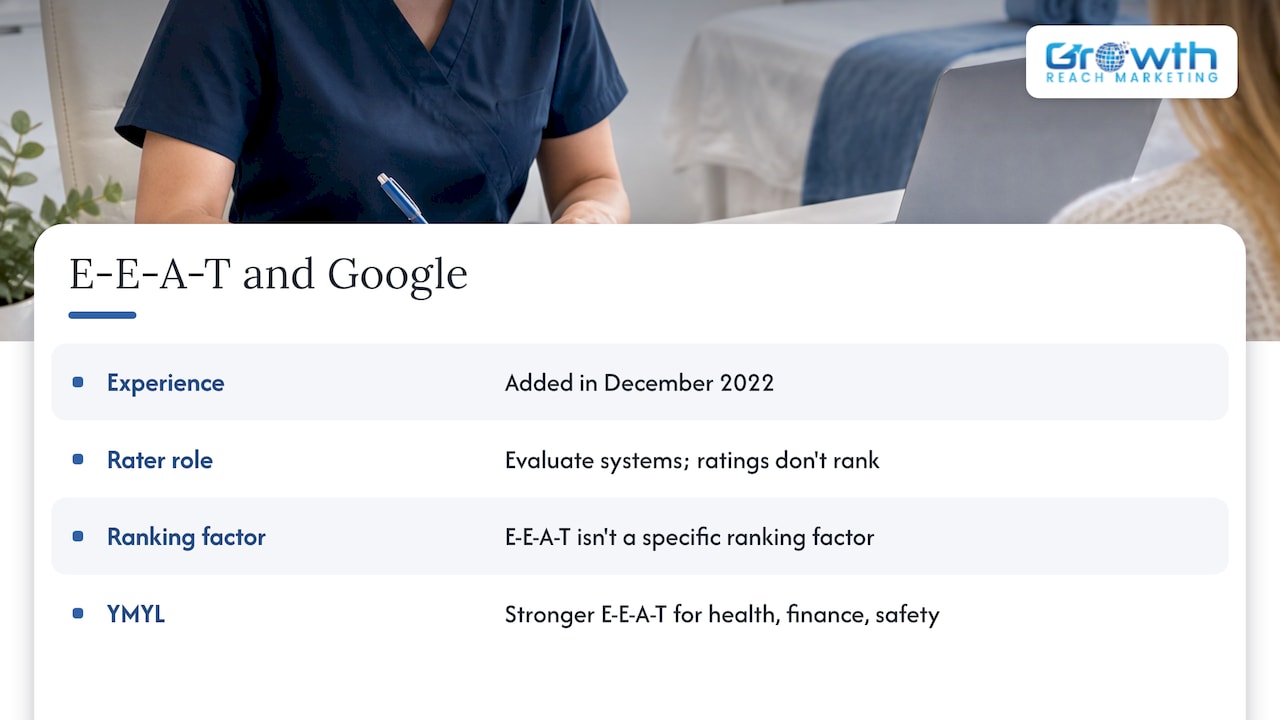
Google added the extra E (Experience) to its framework in December 2022. The same post explains that search raters use the Search Quality Rater Guidelines to evaluate how well Google’s ranking systems perform, and that their ratings do not directly influence ranking.
So what does the framework do for you? Google’s helpful content guidance says E-E-A-T is not itself a specific ranking factor, but that a mix of factors can identify content with good E-E-A-T. It also says its systems give even more weight to strong E-E-A-T for topics that could significantly affect health, financial stability or safety. Google calls these Your Money or Your Life (YMYL) topics. Injectables, laser, skin treatments and anything clinical sit squarely in that group.
The practical reading: Google wants helpful, reliable content written for people, not content built to manipulate rankings. A treatment page that reads like a brochure with keywords added is weak on every one of the four letters.
The four letters, applied to a clinic
| Signal | What it means on a clinic site | Where to show it |
|---|---|---|
| Experience | First-hand work: real consultations, real procedures, real patient questions | Practitioner bios, case notes written with consent, how-we-work pages |
| Expertise | Qualifications and registration relevant to the treatment | Author and reviewer boxes, credentials, training history |
| Authoritativeness | Others recognize you: professional bodies, press, referrals, citations | Memberships, speaking, trade or local media, links from reputable sites |
| Trustworthiness | Accuracy, transparency, safety, honest claims, easy contact | Risk sections, pricing clarity, review dates, address, complaints process |
Google’s own guidance treats trust as the centre of the framework. The other three feed it. If a reader cannot tell who is behind the page or whether the information is safe, nothing else rescues it.
Why Irish rules make E-E-A-T more than an SEO exercise
Most E-E-A-T articles are written for the US. In Ireland the same habits are partly a legal requirement, and that is an advantage if you handle it well.
Advertising rules
The ASA’s health and beauty code requires that claims about treatments and products are substantiated, including robust and reputable human trials where relevant. It also prohibits implying that a medical consultation or surgical operation is unnecessary. The same page notes that S.I. No. 541/2007 prohibits advertising prescription-only medicines to the public.
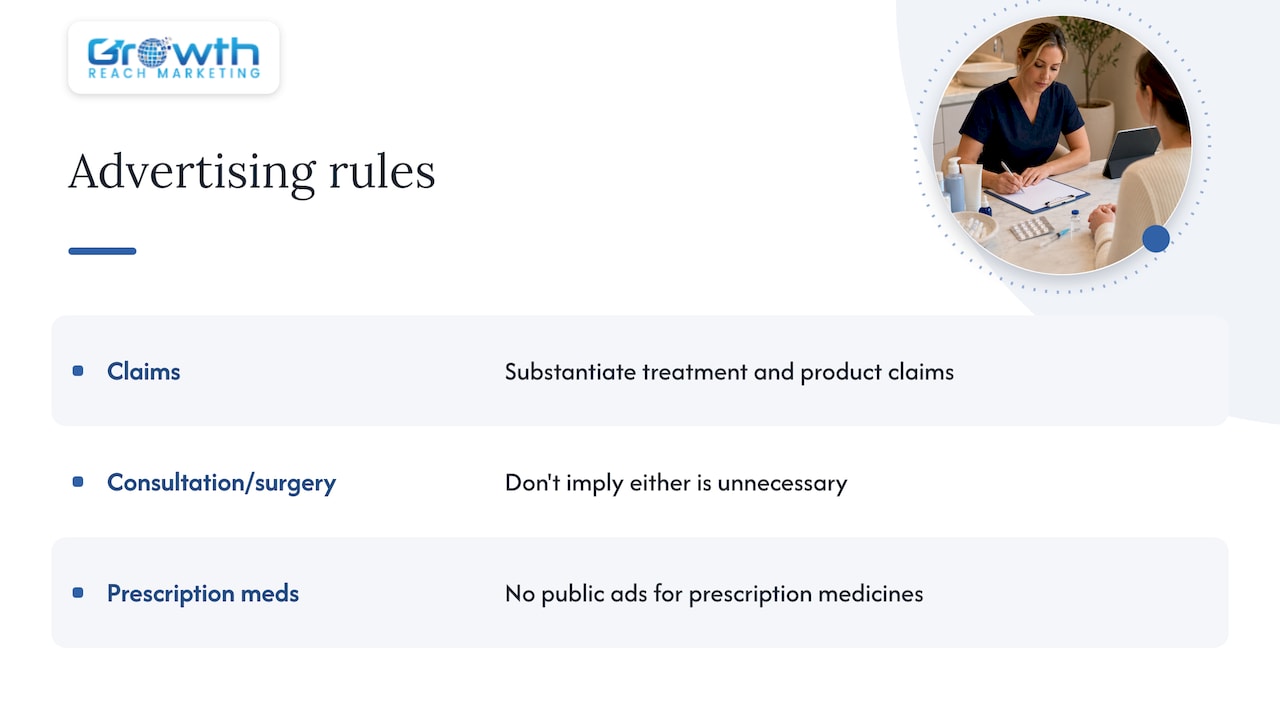
For your website, that means a before-and-after gallery, a result promise or a headline claim all need evidence behind them. It also means a page titled with a prescription product name and a price is a problem, however well it ranks.
Medical Council expectations
If doctors work in your clinic, the Medical Council’s Guide to Professional Conduct and Ethics (2024) applies. It says doctors must ensure information given to the public is accurate, valid and substantiated. It also says doctors must identify themselves by name when giving clinical advice online and keep personal and professional social media separate.
That is almost a checklist for the Expertise and Trust signals Google looks for: a named clinician, accurate information, a clear professional presence.
Botulinum toxin
The Medical Council states that botulinum toxin is a prescription-only medicine that must not be advertised to the public, and that prescribing or administering it is a clinical decision made responsibly. The HPRA has also warned that some people offering aesthetic services may supply prescription medicines illegally, which can pose significant risks to public health.
For E-E-A-T, this shapes your content. Build pages around the concern (for example, lines on the forehead or facial ageing), the consultation with a qualified prescriber, and the assessment process. Do not name the product in headlines, offers or promotional copy. Our guide to aesthetic advertising regulations in Ireland goes through the wording in more detail.
How to show Experience
Experience is the newest letter and the hardest to fake. It is also where a clinic has the biggest natural advantage over a generic health site, because you do the work every day.
- Describe the consultation as it actually happens. What do you ask, what do you check, when do you decline to treat? A paragraph in a practitioner’s own voice beats three paragraphs of general description.
- Use your own images with consent. Original photographs of your treatment room, equipment and team show a real operation. If you show results, follow ASA substantiation rules and be clear about the conditions of the photo, such as lighting and time since treatment.
- Answer questions you actually hear. Reception and clinical staff know what patients ask: how long does swelling last, can I treat before a wedding, what if I am on certain medication. Turn those into content, and have the clinician answer them.
- Show years and volume only if true and verifiable. Say how long the practitioner has performed a treatment. Avoid inflated numbers you cannot back up.
Our YMYL content playbook for aesthetics covers the editorial and visual side of this in depth.
How to show Expertise
Expertise is about the person behind each page, not just the clinic brand.
- Put a named author or reviewer on every treatment page. A line such as “Reviewed by Dr Name, registered medical practitioner” with a link to their bio does more than an anonymous “Team” byline.
- State registration and let readers verify it. The Medical Council runs a public register you can search by name or registration number, and says registration number is often listed on clinic websites. Include yours. The same logic applies to nurses and other regulated professionals: name the relevant body and number where one exists.
- List training that matches the treatment. Do not list a general qualification on a page about a technique it does not cover.
- Match the writer to the topic. A content writer can draft, but a qualified clinician should review any page covering suitability, contraindications, aftercare or risk.
Who should write and who should review?
A workable model for a small clinic:
| Role | Does | Shown on page as |
|---|---|---|
| Marketing writer or agency | Researches, drafts in plain language, structures the page | Editor or content team |
| Treating practitioner | Supplies first-hand detail, checks technical accuracy | Author or contributor |
| Medical reviewer (doctor or nurse as relevant to the treatment) | Signs off on risks, suitability and aftercare | Reviewed by, with date |
| Compliance check | Checks wording against ASA code and Medical Council guidance | Internal, not displayed |
This keeps the workload realistic. The practitioner spends fifteen minutes on a page rather than writing it from scratch, and the page still carries a real clinical voice.
How to show Authoritativeness
Authority is built outside your own site as much as on it. It is slower, but it compounds.
- Professional memberships and affiliations you actually hold. List them and link to the body.
- Earned coverage. Quotes from your clinicians in Irish media, trade publications or local business press send a signal that others see you as a source. Our piece on compliance-first digital PR for Irish clinics explains how clinics approach this without breaking advertising rules.
- Consistent business identity. Your name, address and phone number should match across your site, your Google Business Profile and directories. Google Business posts are one way to keep the profile active and informative.
- A coherent topic footprint. A site with deep, accurate coverage of the treatments you offer reads as more authoritative than a site that touches a hundred topics lightly.
What trustworthy treatment content includes
A useful test: could a cautious patient read the page and walk into the consultation better informed, not just more excited? A strong treatment page covers:
- What the treatment is and who it suits. Plain language, no jargon without explanation.
- Who it does not suit. Suitability criteria and situations where you would refer the patient on or decline. This is framed as safe practice and it builds trust.
- What the process looks like. Consultation, assessment, procedure, aftercare, follow-up.
- Risks and side effects. Common and rare ones, written by or reviewed by a clinician, with guidance on when to contact you.
- Realistic results and timescales. Avoid guarantees. ASA rules require claims to be substantiated, so say what you can support.
- Evidence. Link to published research or official guidance where you make a general claim about how a treatment works.
- Pricing approach. If you publish prices, make them clear. If pricing is set after consultation, say so and explain why.
- How to book and who you will meet. Name, role and a clear route to contact the clinic.
Handling results and testimonials
Results are the most scrutinized content on any aesthetics site. Keep each result claim tied to something you can show. Present before-and-after images with context, avoid retouching, and do not imply a result is typical unless you can substantiate that. Reviews on third-party platforms carry more weight than testimonials you host yourself, so make it easy for happy patients to leave one. Our guide to a social proof strategy for aesthetic brands is worth a read here.
Trust signals your site should carry
Google’s guidance talks about people-first content, but readers decide on trust within seconds. Check your site against this list:
- Full business name, registered address, phone and email on every page footer or a contact page
- Named clinicians with photos, credentials and registration details
- Clear privacy policy and cookie notice that match what the site actually does
- Secure site (HTTPS) and a booking process that does not collect more data than needed
- Visible review date and reviewer on treatment pages
- Honest pricing information or a clear explanation of how quotes work
- Consent and aftercare information accessible before booking
- A real complaints route
Design matters too. A page that loads slowly or hides the booking button undermines the trust the content builds. See our notes on med spa website design for layout points that support both trust and bookings.
Keeping content current
Health content ages. Guidance changes, products change, and your own practice evolves. A reasonable routine:
| Content type | Suggested check | Why |
|---|---|---|
| Treatment pages | Every six to twelve months, and whenever a protocol changes | Accuracy of risks, suitability and aftercare |
| Pages mentioning regulation | Whenever the ASA, HPRA or Medical Council publishes relevant updates | Compliance wording can go out of date |
| Practitioner bios | When someone joins, leaves or gains a qualification | Names and credentials must be accurate |
| Pricing and offers | Each time prices change | Out-of-date prices damage trust quickly |
| Blog and news posts | Annual audit: update, merge or remove | Thin or stale posts weigh down the site |
The schedule is a suggestion based on how fast clinic information tends to change, not an official standard. Whatever interval you choose, record it and stick to it, and show a last reviewed date on the page.
Common mistakes that weaken E-E-A-T
- Anonymous content. Pages with no named author or reviewer on clinical topics.
- Product names in promotions. Naming prescription-only medicines in headlines or offers.
- Unsubstantiated claims. Superlatives and result promises with nothing behind them.
- Copied manufacturer copy. Generic descriptions that tell the reader nothing about your clinic’s approach.
- Fake or inflated social proof. Anything a reader or regulator could not verify.
- No risk information. Pages that only describe benefits.
- Orphaned old posts. Outdated content that still ranks and contradicts your current practice.
Perspective
E-E-A-T is often sold as an SEO trick. We see it differently: it is simply what a good clinic already does, written down where patients and search engines can find it.
The clinics we work with in Ireland usually have the raw material. They have clinicians with real training, a careful consultation process and patients who are happy to talk. What is missing is the translation onto the website: a named reviewer, a risk section, a clear explanation of who is and is not suitable, and wording that respects ASA and Medical Council expectations.
Our approach is to build that translation with you. We draft in plain language, your clinician adds the first-hand detail and signs off on the clinical content, and we check the wording against Irish advertising rules before it goes live. That makes the content stronger for Google and for AI search tools, and safer for your clinic. We think ethical, data-driven marketing is the only kind worth doing in a field where patients are making decisions about their health and appearance.
Gerard
How Growth Reach Marketing can help
We are an Irish-based agency that works specifically with salons, aesthetic clinics and med spas. For clinics that want their treatment content to earn trust and visibility, we offer SEO and AI search visibility work (AEO and GEO), lead generation and conversion optimisation, and ad and social management, with a bespoke strategy for each client.
If you would like to see how this could work for your clinic, have a look at our services or get in touch through the Growth Reach Marketing homepage. For the search side, our article on why aesthetic clinics need an SEO strategy is a good starting point.
A practical starting plan
If you do nothing else this month, do these five things in order:
- Pick your three highest-value treatment pages.
- Add a named author or reviewer, with credentials and, where relevant, a registration number readers can look up.
- Add a section on suitability, risks and aftercare, reviewed by the clinician.
- Audit every claim and image against the ASA health and beauty code, and remove any prescription-only product names from promotional copy.
- Add a last reviewed date and put the next review in the calendar.
Then repeat for the rest of the site, starting with the pages that bring in the most enquiries. Paid ads sit under the same trust logic, so if you run them, read about why aesthetic clinic ads need compliance too.
FAQ
Is E-E-A-T a Google ranking factor?
Not as a single score. Google says E-E-A-T itself is not a specific ranking factor, but it uses a mix of factors that can identify content with good E-E-A-T. It also says its systems give extra weight to those signals on health-related topics, which includes clinic content.
Do I need a doctor to write my treatment pages?
Not necessarily to draft them, but a qualified clinician should review any page covering suitability, risks or aftercare. Show their name, role and credentials on the page. If a doctor gives clinical advice online, the Medical Council expects them to identify themselves by name.
Can I mention botulinum toxin on my website?
It is a prescription-only medicine, and the Medical Council says it must not be advertised to the public. Focus your content on the concern, the consultation and the assessment by a qualified prescriber. Check the ASA code and speak to your regulator or legal adviser about specific wording.
How often should I update treatment pages?
A review every six to twelve months works for most clinics, plus an update whenever a protocol, product or regulation changes. Show the last reviewed date and the reviewer on the page so patients and search engines can see the content is maintained.
What is the quickest E-E-A-T improvement for a small clinic?
Add named clinician bios with credentials and a reviewer line on your top treatment pages. Then add a clear risks and suitability section. These two changes address Expertise and Trust directly and take little time.
Sources
- Google Search Central: Our latest update to the quality rater guidelines
- Google Search Central: Creating helpful, reliable, people-first content
- Advertising Standards Authority for Ireland: Health and Beauty code
- Medical Council: Guide to Professional Conduct and Ethics, 9th edition (2024)
- Medical Council: Statement on the prescribing and administration of Botox
- HPRA statement on the unauthorised supply of botulinum toxin
- Medical Council: Check the Register