
A clinic prequalification form is a pre-appointment screening and consent workflow that must be completed before booking higher-risk aesthetic treatments. It captures medical history, allergies, and contraindications so staff can catch red flags before a client sits in the treatment chair. Any procedure carrying real risk, from injectables to laser resurfacing, needs one completed and clinically reviewed before that first appointment, in line with the informed consent and competence obligations that govern aesthetic practice in Ireland.
TL;DR:
- Prequalification forms should include medical history, medication interactions, allergy screening, and psychological assessment to identify red flags before treatment.
- Separate layers for intake, general consent, and treatment-specific addenda improve clarity and compliance, with electronic signature tools ensuring proper documentation.
- Digital workflows that trigger automated form delivery, hold appointments until review, and store answers in structured data reduce last-minute cancellations and improve safety.
- Irish regulatory standards require documented informed consent, product batch details, and clinician competence verification for aesthetic procedures.
- Staff review is divided: front desk handles completeness, while clinicians analyze medical flags and contraindications, with escalation protocols in place for unsafe conditions.
Table of Contents
- What to Include: Core Fields Every Clinic Prequalification Form Needs
- Template Checklist and Form Structure: Intake, Consent, and Treatment Addenda
- Digital Workflow: Collecting Forms Before the Appointment
- Legal, Regulatory, and Professional Essentials for Irish Clinics
- Staff Workflow and Red Flags: Who Reviews What
- Timing, Retention, and Version Control
- A Growth Marketer’s View on Prequalification Workflow
- How Growth Reach Marketing Automates the Form-to-Booking Gap
- Sources
- FAQ
What to Include: Core Fields Every Clinic Prequalification Form Needs
A prequalification questionnaire for clinics only works if it asks the right questions in the right order. Skip a field and you find out the hard way, usually mid-treatment.
Start with identity basics: full name, date of birth for age verification, and an emergency contact. From there, the form needs to dig into clinical territory that a general clinic registration form never touches.
- Medical history flags: autoimmune conditions, clotting disorders, diabetes, and cardiovascular issues all change treatment suitability.
- Medications and supplements: anticoagulants, isotretinoin, and certain antibiotics interact badly with lasers, peels, and injectables.
- Allergy and sensitivity screening: lidocaine, latex, and common skincare ingredients (retinoids, fragrance, preservatives) belong on every form, not just injectable intake.
- Pregnancy or breastfeeding status, plus recent sun exposure, which matters for laser and peel candidacy.
- Prior aesthetic treatments and any adverse reactions, including who performed them and when.
- Fitzpatrick skin type, the six-category scale clinicians use to predict how skin reacts to light-based treatments and to gauge photosensitivity risk.
- A short psychological screening question, ideally drawing on the BDDQ framework, plus a simple motivation question (“What result are you hoping for?”).
That last item catches more than people expect. A brief BDD screener flags clients whose expectations sit outside what any treatment can realistically deliver, and it gives staff a documented reason to pause or refer rather than book.
Template Checklist and Form Structure: Intake, Consent, and Treatment Addenda
Split the paperwork into three layers instead of one long document. A single mega-form that tries to cover intake, general consent, and every treatment variation in one pass gets skimmed, not read.
- Core intake (one-time, updated periodically): medical history, allergies, Fitzpatrick type, medications, past reactions.
- General consent: procedure overview, common and rare risks, alternatives considered, aftercare instructions, photography opt-in, financial and cancellation policy, signature, and date.
- Treatment-specific addenda: a short form attached to each modality, injectables, lasers, chemical peels, microneedling, or waxing, that names the exact risks and aftercare for that service.
Separating these layers matches what practitioners already recommend: per-treatment consent addenda read more clearly than one form trying to cover every service a clinic offers.
Every consent document needs a version number and date stamped on it. When a protocol changes or a new product gets added, the old version becomes obsolete, and you want a paper trail showing which version the client actually signed. Electronic signature tools that timestamp and lock the document at submission solve this automatically.
Pro Tip: Keep addenda short, one page per treatment type. A four-page consent form for a 20-minute lip filler appointment gets rubber-stamped, not read.
Digital Workflow: Collecting Forms Before the Appointment
Paper clipboards in a waiting room do not qualify as patient intake prequalification. By the time a client fills one out, they are already seated, already committed emotionally, and staff have almost no time to review flagged answers before treatment starts.
The better model sends the form digitally at the moment of booking, then locks the appointment in a pending state until someone actually reviews it.
- Trigger the form automatically at booking, with conditional logic that skips irrelevant questions (a waxing client doesn’t need an injectable-specific allergy screen).
- Hold the appointment as “pending” in the calendar until a clinician clears the responses, not just “scheduled.”
- Store answers as structured data in the client’s profile instead of a scanned PDF buried in a folder, which makes triage flags searchable later.
- Send reminders 24 to 72 hours before the visit and block final confirmation if the form is incomplete, a pattern that measurably improves completion rates versus day-of paperwork.
- Connect booking software to a CRM and appointment dashboard so front desk and clinical staff see the same flagged answers in real time.
A booking platform paired with automated reminders, the kind covered in appointment scheduling and follow-up systems, closes most of the gap between “form sent” and “form actually reviewed before treatment day.”
Legal, Regulatory, and Professional Essentials for Irish Clinics
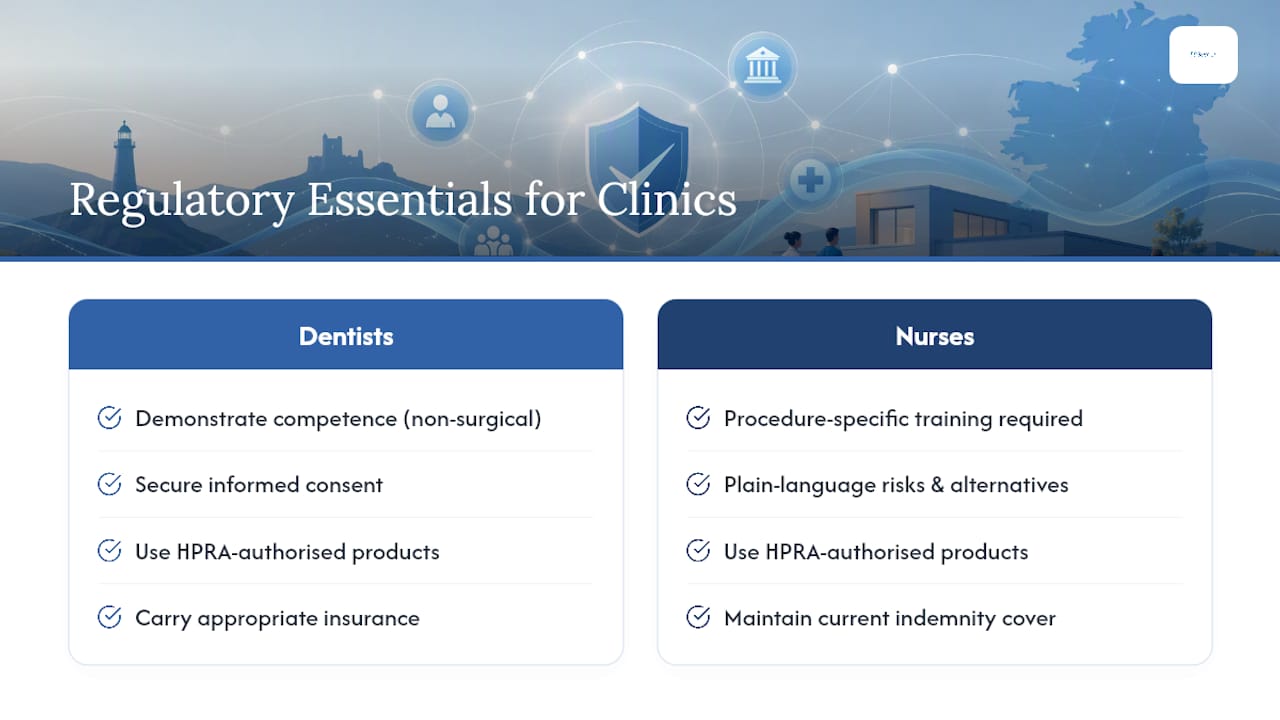
Form design in Ireland isn’t just a best-practice exercise, it sits inside binding professional obligations. The Dental Council’s Code of Practice requires dentists offering non-surgical cosmetic procedures to demonstrate competence, secure informed consent, use only HPRA-authorised products, and carry appropriate insurance.
Nurses face a parallel standard. NMBI guidance requires procedure-specific training, plain-language explanation of risks and alternatives, and current indemnity cover before performing aesthetic treatments. Both frameworks lean on the Health Products Regulatory Authority (HPRA) to define which products are authorized for use, meaning your form should capture product names and batch details, not just “filler was administered.”
None of this replaces clinical judgment. A signed consent form documents that a discussion happened; it does not shield a clinic from a negligence claim if the underlying care fell short. Retention and version control matter here too, dated and archived forms become the evidence that governance was actually followed, not just paperwork filed away.
Staff Workflow and Red Flags: Who Reviews What
Front desk staff check that a form is complete and legible. They flag obvious gaps, but they don’t make clinical calls. That job belongs to the treating clinician, who reviews medical history, medication conflicts, and BDD screener responses before signing off on the booking.
Some answers demand an automatic refusal: active isotretinoin use before laser treatment, uncontrolled bleeding disorders before injectables, current pregnancy for most energy-based devices. Others are relative risks, controlled diabetes or a mild latex sensitivity, that need clinician review rather than outright refusal.
- Front desk: completeness, legibility, missing signatures.
- Clinician: medical flags, medication interactions, BDD responses, final sign-off.
- Escalation: postpone with a clear written reason, never book “to be safe.”
Pro Tip: Train staff with real flagged examples, not just the policy document. Consistent interpretation across shifts prevents one team member waving through what another would have stopped.
Timing, Retention, and Version Control
Collect the full intake before the first treatment, then reconfirm at least every 12 months or whenever something material changes: new medication, surgery, pregnancy, or a new treatment category the client hasn’t tried before. Each of those triggers a fresh full intake rather than a quick update.
Date and version every form, and store signature metadata alongside the appointment record rather than as a separate file. That link between consent version and specific visit is what makes an audit trail defensible months or years later.
A Growth Marketer’s View on Prequalification Workflow
Clinics that automate pre-visit forms consistently see fewer last-minute cancellations and a tighter match between ad clicks and people who actually show up ready for consultation. That connection between ad-to-consult conversion and structured intake gets overlooked because it sits in the operations gap between marketing and the front desk. Deferred bookings caused by missing paperwork are a preventable cost, not a fact of clinic life, and the clinics that fix it convert more of the leads they’re already paying to generate.
— Gerard
How Growth Reach Marketing Automates the Form-to-Booking Gap
Some marketing agencies offer automation layers around booking systems to send prequalification forms automatically and help manage flagged answers before appointment day. We build the automation layer around your existing booking system, so prequalification forms send automatically, incomplete submissions block confirmation, and flagged answers reach the right clinician before appointment day.
This is a paid service, distinct from downloading a free template and configuring it yourself, and it fits clinics that want ad spend and intake to actually connect rather than run as separate systems. That includes aligning Google Ads for medical aesthetics campaigns with the same conditional logic your forms use, so the leads coming in already match your eligibility criteria before they ever book. If your clinic is losing time chasing incomplete forms or losing bookings to no-shows, visit the Growth Reach Marketing services page and request a short workflow audit.
This article is general information, not a substitute for advice from a qualified doctor. Consult a qualified healthcare professional about your own circumstances before acting on anything here.
Sources
- Code of Practice regarding Non-Surgical Cosmetic Procedures — Dental Council
- Guidance for Registered General Nurses Who Perform Non-Surgical Aesthetic and Cosmetic Procedures — NMBI
- Aesthetic injectables in Ireland — DWF (legal insight)
- Med Spa Intake and Consent Forms: What to Include and How to Collect Online | DaySpark Blog
FAQ
What Is a Clinic Prequalification Form?
It’s a pre-appointment screening document that captures medical history, allergies, and contraindications so staff can confirm a client is safe to book before treatment day. It typically pairs a one-time intake with treatment-specific consent addenda, following the structure recommended in med spa intake guidance.
What Fields Are Legally Required on a Clinic Registration Form?
There’s no single universal legal template, but Irish professional bodies expect documented informed consent, product authorization details, and practitioner competence records for every aesthetic procedure. The Dental Council’s Code of Practice and NMBI guidance set the baseline for what that documentation should contain.
Does a Signed Consent Form Protect a Clinic From Liability?
No. A signed form documents that a consent discussion took place, but it doesn’t substitute for sound clinical judgment or eliminate exposure to a negligence claim. Legal commentary on aesthetic injectables in Ireland makes clear that the consultation itself, not the paperwork, remains the primary safeguard.
How Often Should Clients Redo Their Intake Form?
Reconfirm at minimum every 12 months, and require a full new intake sooner if medications, health status, or pregnancy status change. Any new treatment category the client hasn’t had before should also trigger a fresh review rather than relying on an older form.
Can Growth Reach Marketing Help Automate This Process?
Yes. Some marketing providers build booking and CRM integrations that auto-send prequalification forms, block confirmation on incomplete submissions, and route flagged answers to clinicians before appointment day. Details on that service are available on the Growth Reach Marketing services page.