Booking conversion optimization means getting more of the people who open your booking page to finish an appointment. You measure the share who book, find the step where they leave, fix that step, and test the change. For a salon or aesthetic clinic, the biggest gains usually come from five places: clear services with prices, visible availability, a short form, a fast mobile page, and a confirmation and reminder sequence that protects the booking once it is made.
This guide walks through each of those in order, with a worked example, a measurement set-up you can do this week, and the points where Irish businesses have extra rules to respect.
TL;DR
- Booking conversion rate is people who booked divided by people who reached the booking page, multiplied by 100. Track it by step, not as one number.
- Most losses happen at a few predictable points: service choice, availability, the details form, payment or deposit, and slow mobile loading.
- Show prices, durations and real availability early, and ask only for the details you need to hold the slot.
- Reminders and clear cancellation terms protect the booking after it converts.
- Change one thing at a time, compare like for like, and judge success by completed appointments, not clicks.
Table of Contents
- What booking conversion actually measures
- Find where clients drop off before you change anything
- Present services, prices and practitioners so choosing is easy
- Show real availability, not a request form
- Shorten the flow and ask for less
- Fix speed and mobile first
- Make price, deposit and trust clear before the last click
- Protect the booking with confirmations and reminders
- How to test changes without fooling yourself
- Where traffic quality fits in
- Our perspective
- Get help turning clicks into bookings
- A 30-day plan you can start this week
- FAQ
- Sources
What booking conversion actually measures
Appointment booking conversion rate is the share of people who visit your booking page and then book. You divide the number who booked by the number who visited the booking page in the same period, then multiply by 100, as one scheduling guide explains. A booking software glossary gives a simple example: 130 confirmed bookings from 1,000 booking-page visits is a 13% conversion rate.
Two details matter more than the formula.
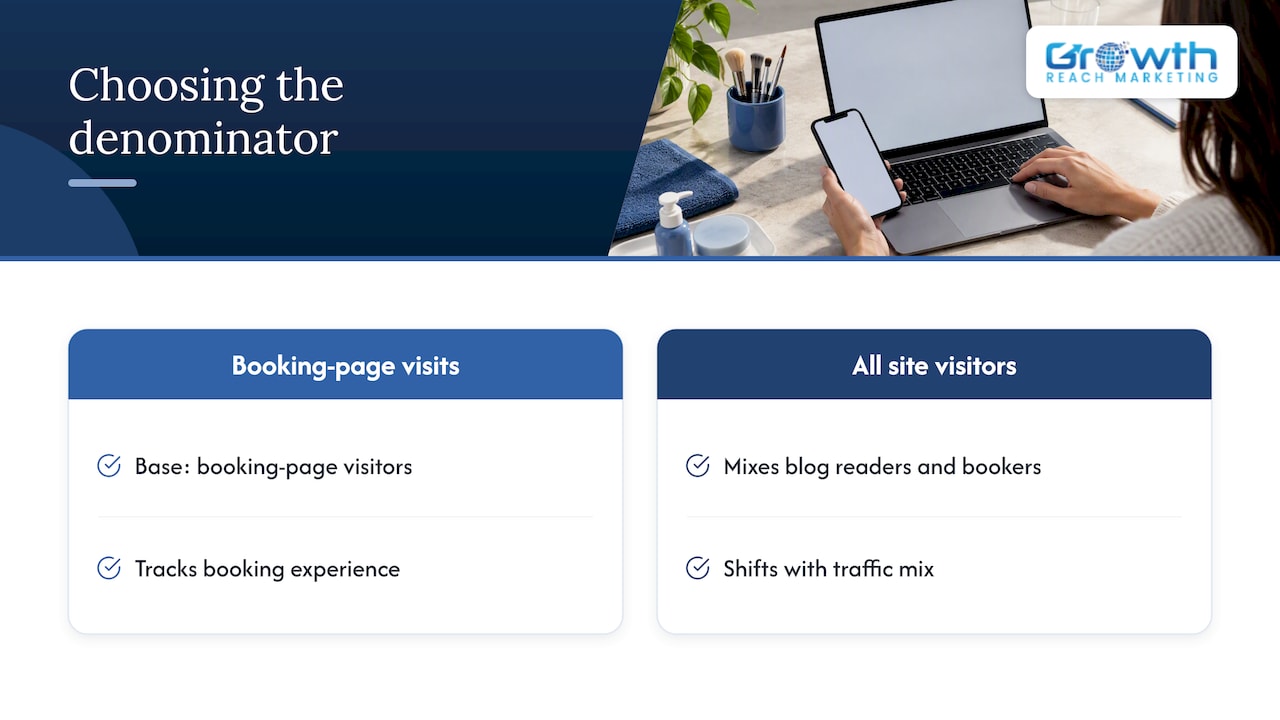
Pick the right denominator. If you divide bookings by all website visitors, you mix people who came to read your blog with people who were ready to book. That figure moves whenever your traffic mix moves, and tells you little about the booking experience. Use booking-page visits (or booking starts) as the base.
Count people once per step. The hard part of funnel maths is counting the same person at each stage, because one client may visit three times before booking. Pick one unit (sessions or users) and stay with it across every step.
The search results for this topic are dominated by general conversion rate optimization guides. They are useful for the principles, but a salon or clinic has a narrower job: turn an intention (“I want a balayage” or “I’m thinking about skin booster treatment”) into a diary entry. That is what the rest of this article is about.
What counts as a good rate?
People often ask whether 2.5% or 12% is a good conversion rate. There is no single answer, because the base matters. A sitewide rate of 2.5% across all visitors can be healthy for a brand-new visitor from a social ad. A rate of 2.5% among people who already opened your booking calendar would be poor. Compare yourself with your own previous months first, then with the same traffic source. A figure from another industry or another country’s travel sites is a poor yardstick for a Dublin hair salon.
Find where clients drop off before you change anything
Changing the page before you know where people leave is guesswork. Start by splitting your booking journey into steps and counting how many people reach each one.
A typical beauty or clinic journey looks like this:
- Land on a service page or the booking page.
- Choose a service.
- Choose a practitioner or time.
- Enter contact details.
- Pay a deposit or accept terms (if you take one).
- See the confirmation.
Set up the events in GA4
Google Analytics can track page views at each booking step, from viewing services to confirming an appointment, so you can see where prospective clients abandon the flow. One booking-software help article suggests defining the rate as appointment_booked divided by booking_started, and tracking events such as reached_payment to diagnose payment or landing-page friction.
GA4 itself has recommended event names for this kind of journey, such as begin_checkout, which you can reuse for a booking that has started. Using standard names keeps your reports easier to read later. If you want a step-by-step version, we cover the setup in our guide to GA4 booking events.
A minimal event set for a salon:
| Event | Fires when | What it tells you |
|---|---|---|
| booking_started | Client picks a service or clicks “Book” | Intent, the base for your rate |
| time_selected | Client chooses a slot | Whether availability is the problem |
| details_entered | Form is submitted | Whether the form is too long |
| reached_payment | Deposit page loads | Whether the price or terms surprise people |
| appointment_booked | Confirmation page loads | The conversion you are paid on |
Read the drop-off, then diagnose
Once a few weeks of data are in, look for the biggest percentage fall between two steps. A few common patterns:
- Big loss between booking_started and time_selected: availability is hard to see, looks empty, or the service choice is confusing.
- Big loss between details_entered and reached_payment: a technical fault or an error message after submission.
- Big loss at reached_payment: the deposit or the price was a surprise.
- Good desktop numbers but poor mobile numbers: a speed or layout problem on phones.
Segment by device and by source. Clients arriving from an Instagram ad behave differently from those who found you on Google Maps, and mixing them hides the problem.
Present services, prices and practitioners so choosing is easy
The first decision a client makes on your booking page is what to book. If that is hard, nothing downstream matters.
Booking-software guidance suggests grouping services by outcomes people recognize, such as colour, treatments or styling, with clear pricing and a duration on each. In practice:
- Use client language, not menu language. “Grey blending” is clearer than “Demi-permanent tonal service”. “Anti-wrinkle consultation” is clearer than a product name.
- Put the price and the time on every service. Where the price depends on length or a consultation, show a range and say what decides it.
- Limit the first screen. Six to eight categories beat a scrolling list of forty items. Let people open a category.
- Offer a consultation route for clinical treatments. In an aesthetic clinic, many people are not ready to book a specific injectable treatment. A bookable consultation converts the unsure visitor without pressure. Our piece on med spa landing pages and A/B tests covers how to frame that offer within Irish advertising rules.
Practitioners and “any available”
Clients who have a favourite stylist want to pick them. Clients who do not care want the soonest slot. The same guidance says letting clients choose a named staff member or “any available” makes the decision faster. Default the selector to “any available” so that a first-time visitor is not forced into a choice they cannot make.
Show real availability, not a request form
There is a large difference between “Request an appointment and we’ll get back to you” and a calendar with live slots. The first asks the client to wait, perhaps for hours, and in that time they may book elsewhere. Live availability, as the same booking guidance puts it, replaces request-and-wait models and makes the decision immediate.
Some practical points for your calendar:
- Show the next available slot up front. If the earliest opening is in three weeks, say so honestly and offer a waitlist. An empty-looking calendar with no explanation reads as “closed”.
- Do not hide evenings and Saturdays. If a slot exists, show it. Many working clients can only book after hours.
- Keep buffers inside the system. Cleaning time, patch tests and consultation overruns belong in your booking software settings, so clients only see slots you can actually serve.
- Show times in a way that fits one screen on a phone. Seven days of slots in a scrolling list is easier than a month grid on a small screen.
If you want to understand how this fits in the bigger commercial picture, see the role of online booking in med spa growth.
Shorten the flow and ask for less
Every step and every field is a chance to lose someone. The advice that recurs across booking-software publishers is to aim for page loads under 2 seconds and a flow of three to five steps, keep forms to essentials, and offer guest booking without forcing account creation. These come from software vendors, so treat the numbers as sensible targets to test, not laws.
The form: name, contact, service
For a standard hair or beauty appointment you need a name, a mobile number or email, and the service and slot. Everything else (how they heard about you, date of birth, a long free-text box) can be collected later or not at all.
Ireland adds a legal reason to stay lean. GDPR’s principles include data minimisation, which means collecting only what you need for the purpose. Asking for less personal data is both better conversion practice and better compliance.
Clinics are a special case. Health-related answers, such as medical history, are sensitive and should be gathered after the booking is secured, in a consultation form sent to the client, not on the public booking page. If you are unsure what your clinic can collect and when, check with your data protection adviser or the Data Protection Commission’s guidance.
A worked example
Suppose a salon in Cork gets 600 booking-page visits in a month and 54 bookings. That is a 9% conversion rate. Tracking shows that 300 people select a service, 210 pick a time, 120 submit details, and 54 complete the booking. The largest proportional drop is between the time and the details form (210 to 120), and a second one from details to booking (120 to 54).
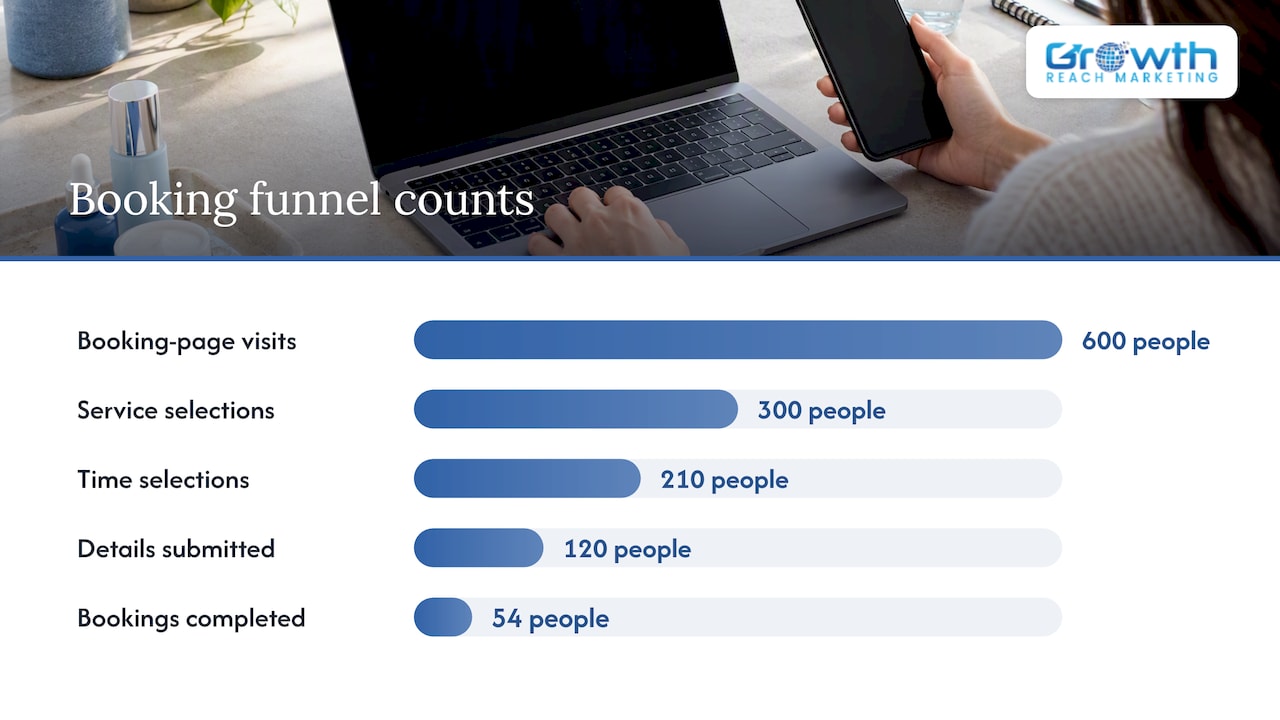
The second drop is suspicious, because someone who has already entered their details is committed. The salon checks and finds that the deposit page asks for a card payment with no price shown until the last click. After showing the deposit amount and what it covers one step earlier, the salon can run the new version for a few weeks and compare. The numbers here are illustrative, not a result we have achieved, but the logic is the one to follow: find the biggest unexplained drop, form a specific hypothesis, change one thing.
Fix speed and mobile first
Most beauty bookings start on a phone, often from an Instagram profile or a Google Business Profile. If the booking page is slow on mobile data, the rest of your optimization is wasted.
Testing booking flows on cellular data and on several real devices matters, because performance can differ sharply from Wi-Fi desktop testing. Do this yourself: switch off Wi-Fi, open your booking link from your Instagram bio, and try to book a service. Note every pause, pop-up and tap that feels awkward.
For the technical side, compressing images, limiting scripts and choosing hosting that responds quickly all help. These website speed optimization tips are a useful checklist to hand to whoever manages your site. Embedded booking widgets load from another provider’s servers, so check whether the widget itself is the slow part before blaming your own site.
Quick mobile checks:
- Buttons large enough to tap without zooming.
- The “Book” button visible without scrolling on service pages.
- Phone number fields that bring up a numeric keypad.
- No pop-ups covering the calendar.
- Apple Pay or Google Pay if your provider supports them, so nobody types card numbers on a small screen.
Make price, deposit and trust clear before the last click
The final screen is where hesitation peaks. The client is about to commit money or a calendar slot, and any surprise sends them away.
Guidance on booking pages recommends showing the price or range before asking for personal information, making the payment button state the amount and what it covers, and putting cancellation terms and trust signals such as reviews, certifications or a clear policy where clients can see them before confirming.
For an Irish salon or clinic that translates to:
- Price in euro, tax included, on the service and again at the last step. Keep the amount identical throughout.
- A one-line deposit explanation: how much, whether it is deducted from the final bill, and when it is refunded.
- A short cancellation policy in plain words, for example the notice you require, shown beside the confirm button, not buried in terms.
- Genuine reviews and credentials near the button. A Google rating, a named practitioner and the qualifications of the person doing the treatment all help. Only show what is true and current.
On deposits, be fair. A deposit protects your diary, but a high deposit on a low-value service can push people away. Test by service type: you may want one for colour or injectables and none for a 30-minute blow-dry.
Protect the booking with confirmations and reminders
Conversion does not end at the confirmation page. A booking that becomes a no-show earns nothing, and the slot cannot be resold.
A good confirmation shows the service, practitioner, date, time, address, price or deposit paid, cancellation terms, and a one-tap way to add it to a calendar or reschedule. Send it immediately by email and text.
On reminders, one trial from Imperial College London researchers into text message reminders in healthcare, as reported by a practice-communications company, found a reduction in no-shows of around 38%. That was in medical appointments, so do not expect the same effect in a hair salon, but the direction is encouraging. Test your own: send a reminder 48 hours before, with a one-tap confirm or reschedule link, and compare no-show rates over a couple of months.
If you message clients for marketing as well as for the appointment itself, keep the two separate. A reminder about a booking is a service message. A promotion needs its own consent.
How to test changes without fooling yourself
Optimization only works if you can tell whether a change helped. Some rules that keep you honest:
- Change one thing at a time. If you alter the form, the button colour and the deposit in the same week, you cannot say which mattered.
- Write the hypothesis first. For example: “Showing the deposit amount on the time-selection step will increase the share who reach payment and complete.”
- Compare like with like. Same traffic source, same device split, similar season. Bridal season, back-to-school and the run-up to Christmas distort everything.
- Wait for enough bookings. A salon with 50 bookings a month cannot read a result from a few days. Run each change for several weeks and treat small differences as noise.
- Judge by completed appointments, and ideally by attended appointments, not by clicks on the Book button.
- Keep a change log. A simple spreadsheet with date, change and result saves months of confusion.
A/B testing tools need a lot of traffic. Smaller businesses often do better with sequential tests (before and after), as long as they respect the rules above.
Where traffic quality fits in
The difference between SEO and CRO is simple. SEO gets more of the right people to your pages. Conversion optimization makes more of those people act once they arrive. You need both, and they interact: a page that is clear about prices and services tends to attract better-matched visitors and lets search engines read what you offer. Our note on making prices crawlable on booking pages explains the overlap.
If your booking rate is healthy but visits are low, work on traffic through local search and Google Ads. If visits are plentiful and bookings low, fix the flow first. Paying for more visitors to a leaky flow only makes the leak more expensive. The wider picture is in our salon marketing funnel guide.
Our perspective
We work only with salons, aesthetic clinics and beauty brands, and the pattern we see most often is not a lack of traffic. It is a booking journey built around the business’s software, not the client’s thinking. Owners ask us for more ads when the first fix is a deposit message, a clearer price or a faster page.
Our view is that tracking should come before spending. Until you can see how many people start a booking and how many finish, you cannot tell whether an ad worked. That is why we care about measuring bookings, not form fills or clicks, whether the lead came from Google, Facebook or Instagram. We also think ethical practice and conversion go together: honest prices, clear policies and no pressure in clinical settings build the kind of trust that brings clients back, and that is better for a local business than a one-off spike.
For Irish clinics, that means respecting advertising and data rules from the start, and treating personal data lightly. Fewer form fields are good for your numbers and good for GDPR.
— Gerard
Get help turning clicks into bookings
If you would rather not build the tracking and test plan yourself, we manage paid social, social media and LinkedIn for salons and clinics, and connect the campaigns to booked appointments. See our services or read about Facebook lead ads that track bookings, not forms.
A 30-day plan you can start this week
Week 1: measure. Set up the five events above, confirm each fires on your phone, and record your starting rate by device.
Week 2: fix the obvious. Add prices and durations to every service, show the deposit amount early, and cut any form field you do not need.
Week 3: speed. Test on mobile data, compress images, and check whether your booking widget is the slow element.
Week 4: protect and review. Turn on confirmations and reminders with one-tap rescheduling, then compare your funnel with week 1. Pick the next biggest drop-off and repeat.
FAQ
What is a good booking conversion rate for a salon?
There is no reliable universal figure, because the result depends on what you count and where the traffic came from. Measure bookings divided by booking-page visits, then compare against your own past months and the same traffic source. Improving your own number steadily is a better goal than chasing a benchmark from another industry.
Is the difference between SEO and CRO important?
Yes. SEO is about attracting the right visitors from search, while conversion rate optimization is about getting more of those visitors to book. If few people reach your booking page, work on visibility. If many reach it and few book, work on the flow.
How many steps should an online booking have?
Booking-software guidance points to three to five steps as a sensible target, but the right number depends on your services. Test a shorter version against your current one. Clinical treatments may need an extra consultation step, which is fine if it is clear and the price is shown.
How do I reduce no-shows after someone books?
Send an instant confirmation, then a reminder before the appointment with a simple way to reschedule or cancel. State your cancellation terms before the client confirms, and consider a fair deposit for longer or higher-value treatments. Track the no-show rate each month to see whether the changes work.
Sources
- Appointment booking conversion rate: a simple guide
- What Is Booking Conversion Rate? Definition and examples
- Google Analytics + Practice Better
- Setting Up GA-4 with New Online Booking, Aesthetic Record
- Recommended events, Google Analytics
- Salon Online Booking Best Practices
- Guidance on the Principles of Data Protection, Data Protection Commission
- Why Clients Don’t Finish Booking Online: 9 Fixes
- Speed Optimization Tips for Faster Websites in 2026
- Booking Page Examples That Actually Convert
- Text message appointment reminders reduce no-shows by 38%