
Treatment page SEO is the work of making one page, for one treatment, the best answer to what a local client types into Google. It means choosing the right search phrase, covering what a nervous first-timer needs to know, adding clear local signals, and making booking easy on a phone. For an Irish salon or aesthetic clinic, the treatment page is where search traffic turns into appointments, so it deserves more attention than the homepage.
TL;DR
- Give every treatment its own page, built around one main search phrase and one location, such as “lip filler Cork” or “HydraFacial Galway”.
- Answer the questions a client asks before booking: what it is, who it suits, cost range, downtime, aftercare and who performs it.
- Keep your Google Business Profile complete and link it to the page, because local rankings lean on both.
- Make health and results claims carefully, with real practitioner details, and never promise outcomes.
- Track enquiries and bookings from the page, not just rankings and visits.
Table of Contents
- What a treatment page needs to do
- Choose keywords that match what locals want
- What to put on the page
- Local signals for Irish clinics
- Credibility and responsible claims
- Technical checks
- Turning visits into enquiries
- Our perspective
- Where we can help
- FAQ
- Sources
What a treatment page needs to do
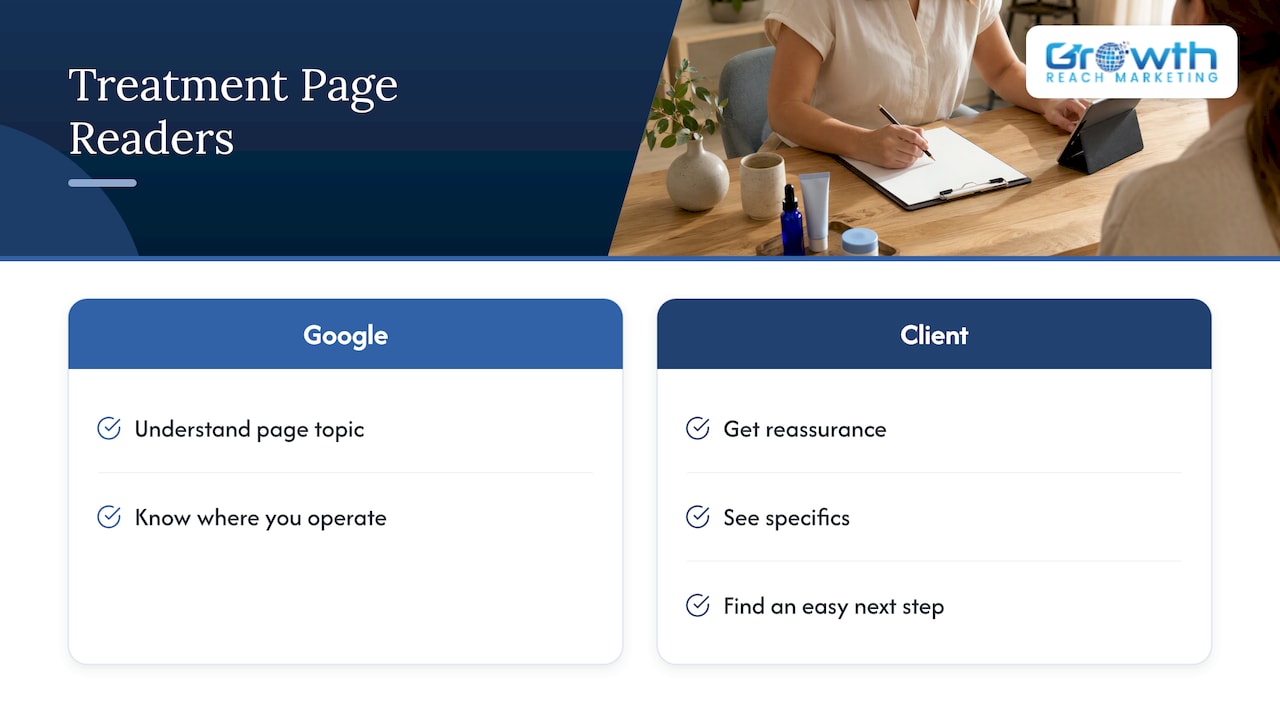
A treatment page has two readers: Google and a person deciding whether to trust you with their face or skin. Google needs to understand what the page is about and where you operate. The person needs reassurance, specifics and an easy next step.
Most clinic sites fail the second reader. A single “Services” page listing 25 treatments in one-line bullets cannot rank for any of them, and it gives a client nothing to act on. One page per treatment lets you match a specific search, such as “microneedling Dublin”, with a specific answer.
If you want help writing the copy itself, our guide to treatment page copywriting for Irish clinics and salons goes deeper on wording. This article covers the SEO frame around it.
Choose keywords that match what locals want
Start with the treatment, then add intent. People search in three broad ways:
- Treatment plus place: “laser hair removal Limerick”. Strong buying intent, and the best target for a treatment page.
- Treatment plus question: “how long does lip filler last”. Information intent, best answered inside the page or in a supporting article.
- Problem-led: “treatment for acne scarring”. Earlier in the decision, and a good way to feed clients into the relevant treatment page.
Pick one primary phrase per page. Then list the secondary phrases a real client would use: the treatment’s alternative names, the area it treats, and the concern behind it. If two pages target the same phrase they compete with each other, so merge them or separate their focus.
A simple selection process
- List every treatment you want to be found for.
- Type each into Google with your town or county and note what ranks: treatment pages, directories, or articles.
- Check the autocomplete suggestions and the “People also ask” box for wording clients use.
- Choose the phrase where a page like yours could realistically appear. Competition for broad terms is heavy; “treatment + town” is usually winnable.
- Record the phrase in a simple sheet: URL, primary phrase, secondary phrases, location.
Our piece on why salons need a keyword strategy explains how this connects to bookings.
What to put on the page
Ranking pages for clinic searches tend to share a pattern: they are specific, structured and clearly written by people who do the work. Here is a structure that covers both search and persuasion.
| Section | What it should answer | Why it matters |
|---|---|---|
| Opening paragraph | What the treatment is, who it is for, where you offer it | Confirms relevance to Google and the reader at once |
| How it works | Steps of the appointment, session length | Reduces anxiety |
| Suitability | Who it suits, who should not have it, when a consultation is needed | Builds trust, filters poor-fit enquiries |
| Results and downtime | Realistic expectations, recovery, number of sessions | Honest expectations lead to fewer complaints |
| Pricing | A starting price or range, or what affects cost | Clients leave pages that hide cost entirely |
| Practitioner | Name, qualifications, experience | Credibility, especially for medical aesthetics |
| Aftercare | What to do and avoid | Useful, and often searched separately |
| FAQ | Three to six real client questions | Captures question searches |
| Booking prompt | Button, phone number, consultation form | Converts the visit |
Aim for enough depth to answer the questions properly. For most treatments that means 600 to 1,200 words, but length is not the goal. If a section does not help a client decide, cut it.
Title, headings and meta description
Google’s own SEO starter guide stresses descriptive titles, clear page content and helpful link text. In practice:
- Title tag: lead with the treatment and place, then your brand. For example: “Lip Filler in Cork | Clinic Name”. Keep it short enough to display fully.
- H1: one per page, naming the treatment in plain words.
- H2s: the real questions and stages: “What to expect”, “Aftercare”, “Price”.
- Meta description: a human sentence on what the page offers and a reason to click. It will not directly boost rankings, but it affects whether people choose your result.
- URL: short and readable, such as /treatments/lip-filler/.
Images and links
Use real photos of your treatment room, equipment and team where possible. Name the files descriptively and write alt text that says what the image shows, not a string of keywords. Before-and-after photos need written client consent and must be genuine and unretouched.
Link in three directions:
- From the treatment page to related treatments (a facial page to a peel page, for example).
- From your homepage and services menu to each treatment page, so no page is orphaned.
- To your booking page or enquiry form, using a button with plain wording.
Use descriptive anchor text such as “book a consultation for skin boosters” rather than “click here”.
Local signals for Irish clinics
Treatment searches are usually local, even when the word “near me” is absent. Google advises business owners to keep Business Profile details complete and accurate, including address, hours and category, and to respond to reviews. It also notes that links to your business and reviews can influence local ranking.
For a treatment page, that translates into a checklist:
- Your name, address and phone number match your Google Business Profile exactly.
- The page names the town or area, and mentions nearby areas clients travel from, only if you genuinely serve them.
- Your profile lists the treatment as a service and links to the matching treatment page, not just the homepage.
- Recent reviews mention the treatment by name, where clients volunteer it naturally.
- An embedded map and clear directions or parking info sit on the page.
We cover the profile side in Google Business Profile optimization for beauty businesses and the map side in how to rank your salon on Google Maps in Ireland. For reviews, see our Google review strategy for beauty businesses. Do not offer incentives for reviews; ask politely after the appointment and make it easy.
If you run more than one location, give each its own page rather than one generic copy. Our salon location page checklist shows how.
Local links also help. A mention from a local business association, a wedding venue or a community event page signals that you are a real, rooted business. See four local links Irish salons need.
Credibility and responsible claims
Health-related pages are held to a higher standard, both by readers and by regulators. Treat your treatment page as advice a client may act on.
- Show who is behind it. Name the practitioner, their qualifications and registration where relevant. A page written by someone who performs the treatment is more believable than generic copy.
- Never promise results. Say what clients commonly experience, that results vary and that a consultation assesses suitability.
- Be careful with medical wording. Rules on advertising differ by treatment. Prescription-only medicines cannot be promoted to the public, so describe the consultation and the treatment area, not the product, and confirm the current rules with the relevant Irish regulator and advertising standards body before publishing.
- Respect sector rules. For example, Irish guidance on the Public Health (Sunbeds) Act prohibits health claims for sunbed premises and requires health information for potential clients. It shows how seriously Irish regulation treats health claims in beauty settings.
- Include safety information. Contraindications, downtime and aftercare belong on the page, not buried in a consent form.
Specific situations call for specific professionals: if you are unsure whether a claim is allowed for an injectable or a medical device, ask your clinical governance lead, your insurer or a solicitor experienced in healthcare advertising.
Technical checks
A good page that Google cannot crawl or a phone cannot load is wasted. Run through these:
- Indexable: the page is not blocked by robots.txt or a noindex tag, and is in your XML sitemap. Check it in Google Search Console with the URL Inspection tool.
- Mobile-first: Google primarily uses the mobile version of a page for indexing, so content hidden or trimmed on mobile may not count. Keep the same text, images and structured data on both versions.
- Speed: compress images, avoid heavy sliders and autoplay video, and test on a mid-range phone on mobile data.
- Tap-friendly booking: a call button and booking link visible without scrolling, forms short enough to finish with a thumb.
- Structured data: mark up your business details and, where it fits, FAQs, so your information is machine-readable. Validate it with Google’s testing tools.
- One canonical URL: avoid duplicate pages for the same treatment across locations or with tracking parameters indexed.
- Secure and stable: HTTPS, no broken links, no pop-ups covering content.
Turning visits into enquiries
Search traffic only pays when it books. Make the next step obvious at three points: near the top, after the pricing and results section, and at the end.
What helps:
- A specific button, such as “Book a free skin consultation”, rather than “Submit”.
- A phone number that can be tapped.
- A short form asking only what you need: name, contact, treatment, preferred time.
- Reviews or a short practitioner introduction beside the booking prompt.
- A clear reply promise, such as “We respond within one working day”, only if you keep it.
What to measure
| Metric | Where to find it | What it tells you |
|---|---|---|
| Impressions, clicks, average position for the page | Google Search Console | Whether the page is visible for its target phrase |
| Clicks from the Business Profile to the page | Business Profile insights and analytics | Whether local listings send people to the right page |
| Calls and direction requests | Business Profile | Local intent that never reaches your site |
| Form submissions and booking clicks | Analytics events | Whether visitors take the next step |
| Booked appointments by source | Your booking system, asking “How did you hear about us?” | Real revenue from the page |
Give a new page two to three months before judging it, and update it when prices, practitioners or protocols change. A page with a fresh review and a corrected price is better than a new page every month.
Our perspective
We work with salons, aesthetic clinics and beauty brands, and the pattern is consistent: clinics spend on ads and social media while their treatment pages say very little. Ads send people to a page; if the page cannot answer a basic question, the money is wasted.

We would start with the three treatments that matter most to your business, build one strong page for each, connect them to your Google Business Profile, and track enquiries for a quarter before expanding. Depth beats volume. A dozen thin pages will not outperform three that a client reads to the end.
We also keep our advice ethical. If a claim cannot be supported, it does not belong on the page, however well it might convert in the short term. Clients who trust the page arrive better informed and are easier to treat well.
— Gerard
Where we can help
If you would rather not build this alone, our team works with Irish salons and clinics on local SEO, paid search and social campaigns that send the right people to pages like these. You can see what we offer on our services page, or read how Google Ads for medical aesthetics can support your best treatment pages while organic rankings build.
For a broader view of why this matters at clinic level, read why aesthetic clinics need an SEO strategy.
FAQ
How many treatment pages should a salon have?
One for each treatment you want to be found for and are able to describe properly. Start with your highest-margin or most-requested services. Group very similar variations, such as different facial types, on one page until each has enough to say.
Should I put prices on a treatment page?
In most cases, yes, at least a starting price or range and what changes it. Clients compare options quickly and often leave pages that hide cost. If prices vary by assessment, say so and explain the factors.
How long does treatment page SEO take to work?
There is no fixed timeline. Low-competition local phrases can move within a few weeks to a few months, while competitive treatments in big towns take longer. Track impressions and enquiries in Search Console and your booking records rather than rankings alone.
Can I copy the same page for each location?
Avoid it. Duplicate text gives Google little reason to show either page and gives clients nothing local. Write each location page with its own address, team, directions and relevant reviews.
Do before-and-after photos help?
They can build trust, but only if they are genuine, taken with written consent and not presented as a guaranteed outcome. Check the current advertising rules for your treatment before publishing them.
Sources
- Google SEO starter guide
- Tips to improve your local ranking on Google
- Mobile-first indexing best practices
- The Public Health (Sunbeds) Act, Department of Health