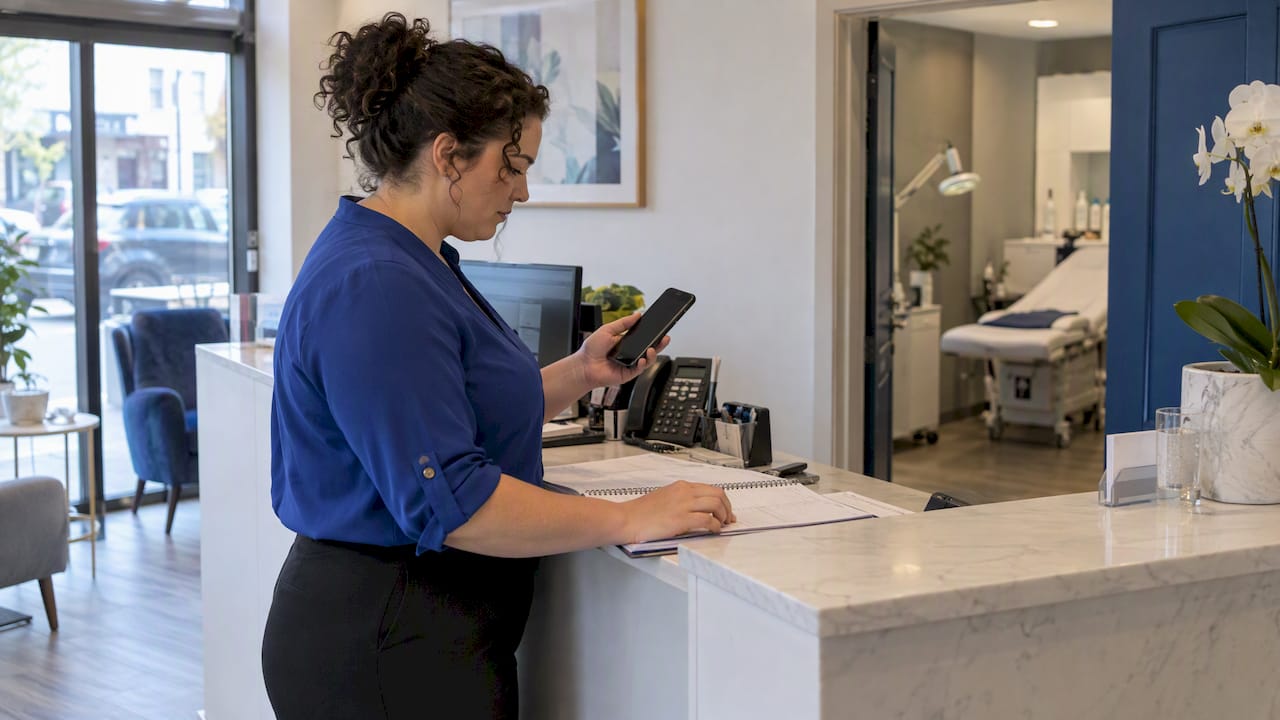
Pipeline automation for a clinic means setting up the steps between a stranger’s first enquiry and a paid, completed appointment so they run without someone chasing each one by hand: capture the lead, reply fast, book, confirm, remind, follow up, and invite the client back. Done well, your front desk stops being a switchboard and goes back to looking after people. Done badly, it sends the wrong message to the wrong person and lands you in front of the Data Protection Commission. This guide is for owners and managers of salons, aesthetic clinics and med spas in Ireland, and it shows what to automate, what to leave to humans, and which rules apply.
TL;DR
- Map your pipeline first: enquiry, response, consultation, booking, reminder, treatment, follow-up, rebooking. Automate the gaps between stages, not the conversations that need judgment.
- In Ireland, marketing messages need clear opt-in consent, or must fit the narrow existing-customer exception. Hand-typed emails count the same as automated ones.
- Start with the cheapest wins: instant replies to enquiries, appointment confirmations and reminders, and a rebooking prompt after treatment.
- Use automation to free staff time for care, not to replace it. Keep a human in every clinical or sensitive decision.
- Measure bookings and revenue, not form fills or messages sent.
Table of Contents
- What a clinic pipeline actually looks like
- Where to automate first
- The Irish rules you cannot automate around
- Choosing tools without buying the wrong thing
- A worked example: one lead, start to finish
- What we see from the marketing side
- Common mistakes to avoid
- A simple 30-day rollout
- Where we can help
- FAQ
- Sources
What a clinic pipeline actually looks like
Most clinics already have a pipeline. It just lives in people’s heads, a shared inbox and a paper diary. Before you buy or build anything, write it down as stages. A typical aesthetic clinic or salon pipeline runs like this:
- Attract: Google search, Instagram, Facebook, referrals, walk-ins.
- Enquire: a call, a DM, a web form, a WhatsApp message.
- Respond: someone replies, answers questions, suggests a consultation or treatment.
- Book: a time is agreed, a deposit or card is taken where appropriate.
- Prepare: confirmation, forms, aftercare or pre-treatment information.
- Attend: the appointment itself, or a no-show.
- Follow up: a check-in, a review request, aftercare.
- Return: a rebooking prompt, a reactivation message if the client goes quiet.
The leaks are almost never in stage 6. They are in the handoffs. An Instagram message sits unanswered overnight. A web enquiry arrives while the team is with clients. A booked client forgets. A happy client never rebooks because nobody asked. Those are the places automation earns its keep.
Where to automate first
If you try to automate everything at once, you will build something nobody trusts. Work from the leaks that cost you the most, in this order.
1. Respond to every enquiry quickly
A prospective client messaging three clinics will usually book with the one that answers first. An automated acknowledgment, sent within a minute and saying when a real person will reply, protects the lead without pretending to be a person. Pair it with a link to book online or a short list of questions you need answered.
This is also where your ad spend either pays off or leaks away. If you run paid social, the enquiry route matters as much as the ad, which is why we wrote about tracking bookings rather than form fills on Facebook lead ads.
2. Confirmations and reminders
This is the most dependable automation in any clinic. A confirmation straight after booking and a reminder before the appointment are transactional messages: they relate to a service the client has asked for. Keep them factual, include how to reschedule, and keep marketing content out of them. We cover timing in our guide to salon no-shows and why 48 to 72 hour reminders come before deposits.
Deposits and card-on-file can help in higher-value treatments, but they change how clients feel about booking with you. Introduce them where the cost of a missed slot is high, explain the policy plainly at booking, and only charge in the case of a documented no-show.
3. Pre-appointment preparation
Aesthetic clinics have more to collect before treatment than a salon: consultation forms, medical history, consent to treatment. Sending these automatically after booking means the consultation starts with the conversation, not the paperwork. The information is health-related, so keep access tight and make sure whoever hosts the forms is bound by a proper data processing agreement.
4. Follow-up and reviews
A short message a day or two after treatment, asking how the client is feeling and offering a way to reach the clinic, does more for trust than almost any advertisement. A review request can follow once you know the client was happy. Reviews feed your local search visibility, and you can build on that in our piece on why aesthetic brands need a social proof strategy.
5. Rebooking and reactivation
Most clinics treat a client who has not returned in six months as lost. A scheduled sequence that scores clients by recency and value, then reaches out with something genuinely relevant, is far cheaper than acquiring a new client. See our six-touch reactivation approach for salons and clinics, and for email wording, winback email templates built for care and Irish compliance. For the wider picture, our client retention strategy for salons sets out the tactics around it.
The Irish rules you cannot automate around
Automation multiplies whatever your process is. If the process breaks the rules, you break them at scale.
Consent for marketing messages
The Data Protection Commission (DPC) states that electronic direct marketing generally requires the clear, affirmative consent of the recipient, for example by specifically opting in, under the ePrivacy Regulations. There is a limited exception for existing customers. It applies only where you are marketing your own similar products or services, the customer had a chance to object when their details were collected and gets one in every later message, and the first message goes out within 12 months of the original purchase.
Practical consequences for a clinic:
- Pre-ticked boxes and silence are not consent.
- Consent should be recorded by channel (email, SMS) and by purpose (marketing versus admin), with a timestamp.
- Every marketing message needs a working way to opt out.
- A booking confirmation is not an invitation to send promotions.
Our article on the four soft opt-in tests for GDPR email marketing in Ireland goes through the exception in detail, and the SMS side, including telecom regulator rules, is in our guide to Irish med spa SMS marketing.
Manual does not mean exempt
Many owners assume the rules only bite on bulk, system-generated campaigns, and that an email typed by a receptionist is just a friendly note. The DPC’s published case studies show otherwise. Its 2024 annual report describes a complaint about an unsolicited marketing email sent by a well-known Irish clinic chain. What matters is the purpose of the message, not how it was typed or sent. The practical lesson is that compliance belongs in the process. A tool with consent records built in helps, but the rule is the same with or without one.
Before and after images and health data
Aesthetic clinics handle special category data, and marketing with treatment imagery raises its own questions beyond consent to receive messages. Before you put photos into any automated sequence or ad, read our note on before and after rules in Ireland.
AI inside your pipeline
If your automation uses AI, for instance to draft replies or sort enquiries, the direction of travel is clear. Ireland’s first national AI for Care strategy, published in March 2026, is aimed at public health and social care, so it does not bind your clinic directly. But it signals what patients and regulators will expect: safe, responsible use with human oversight. The government has also approved a distributed model for implementing the EU AI Act, with several sector-based authorities sharing the work. If you are unsure whether a particular tool falls under the Act, ask your solicitor or the vendor for its compliance documentation before switching it on.
A sensible house rule: AI may draft and sort, but a person approves anything that touches clinical advice, pricing exceptions, complaints or a client’s health.
Choosing tools without buying the wrong thing
We do not sell booking software, and the right choice depends on your size, so here are the criteria we would use rather than a brand list.
| Criterion | Why it matters for an Irish clinic |
|---|---|
| Beauty-specific scheduling | Multi-step treatments, processing time, room and equipment limits and gap-filling rules differ from generic diaries. |
| Irish VAT and numbers | Support for 9% and 23% rates and Irish mobile numbers for reminders saves manual fixes. |
| Data processing agreement | You are the controller. The vendor should sign a DPA and tell you where data is stored. |
| Consent records | Timestamped, per channel and per purpose, exportable if the DPC ever asks. |
| Integrations | Your website, ad platforms and inbox should feed the same diary rather than three separate lists. |
| Fit for your size | A large multi-staff operation needs reporting and inventory. A sole practitioner may do better with something lighter that handles booking and payment capture. |
On the last row, Irish industry analysis of booking software makes the same point: the best choice depends on the scale of the business, and the trend is toward software built for beauty rather than generic tools. Treat any vendor’s claimed reduction in no-shows as marketing until you have measured your own baseline.
Three questions to ask before signing anything:
- Can I export all my client data and consent records if I leave?
- What happens to a message if the client replies? Does it reach a human?
- Can I turn off each automation individually?
A worked example: one lead, start to finish
Here is how a well-built pipeline treats one fictional client, to show the stages together. This is an illustration, not a case study.
A woman sees an Instagram ad for skin treatments on a Tuesday evening and sends an enquiry through the form. The clinic is closed.
- Within a minute: she gets an acknowledgment with opening hours, a booking link for a consultation and the name of the person who will reply.
- Next morning: the coordinator sees the enquiry tagged with its source and answers her questions personally.
- On booking: she gets a confirmation and a form for her medical history, sent through a secure, DPA-covered system. She ticks an unticked box to receive offers by email only. SMS stays off.
- Two to three days before: a reminder with a reschedule link.
- After the consultation: a short note summarizing what was discussed, written or approved by the practitioner.
- Two days after treatment: an aftercare check-in with a phone number to call.
- Later: because she opted in to email, she gets a reminder when she is due for her next session. If she had not opted in, the clinic would rely on the existing-customer exception only if every condition is met, and otherwise would simply not send promotional email.
Notice that the human steps are the ones that need judgment, and the automated steps are the ones that need reliability.
What we see from the marketing side
We work with salons, aesthetic clinics and med spas, and the pattern we keep running into is that clinics spend on getting leads and then lose them in the pipeline. An ad that costs money to generate an enquiry, answered a day late by a stretched team, is money thrown away.
Our view is simple. Automation should be framed as giving time back to your team, not as a way to replace them. The Irish health service uses almost the same logic: its Digital for Care 2030 roadmap talks about improving how people experience care, not only how the organization works. In a private clinic the equivalent is that a receptionist who is not retyping appointment details has time to greet the client who just walked in.
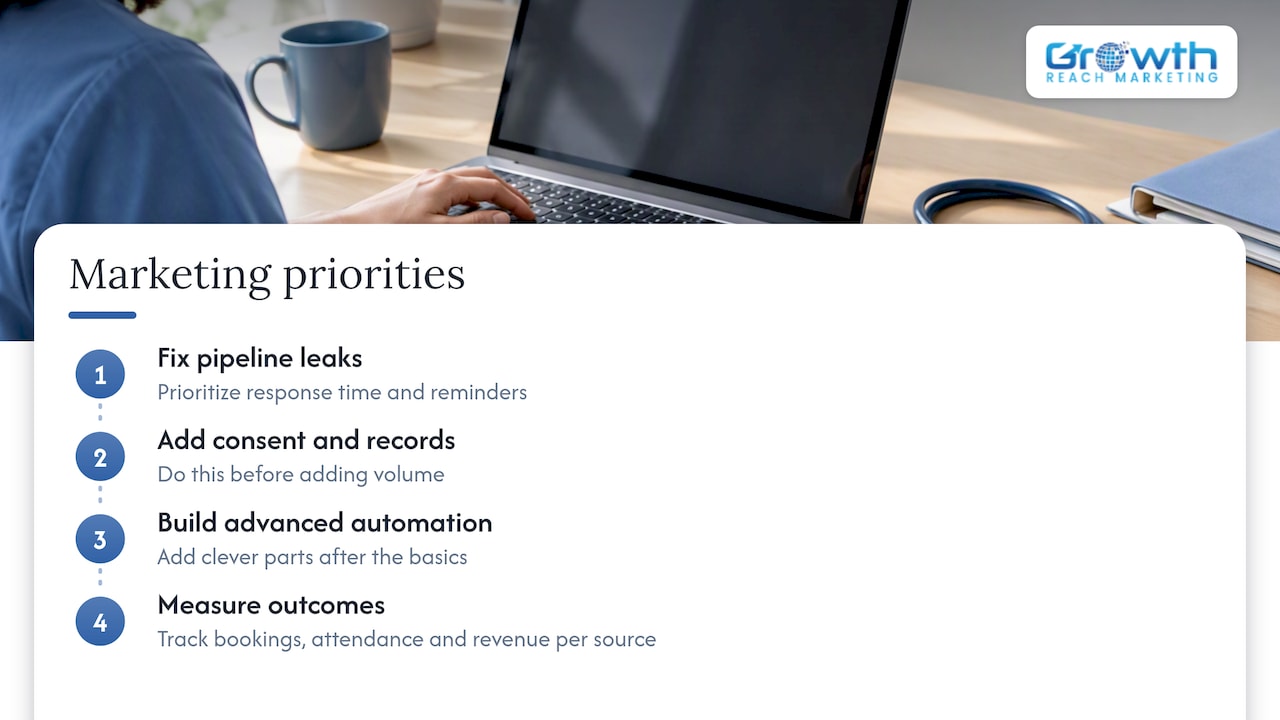
We also think the order matters. Fix the leak nearest the money first, which is usually response time and reminders. Add consent and records before you add volume. Only then build the clever parts. And measure bookings, attended appointments and revenue per source, not impressions or messages delivered. Our guide to tracking salon marketing results that matter shows how to set that up, and our salon automation marketing growth guide covers the wider system.
Being Irish-based and focused only on beauty and aesthetics means we start from the rules and realities you work under, not from a template written for another market.
— Gerard
Common mistakes to avoid
- Automating a broken process. If nobody owns follow-up today, a tool will not fix that. Name an owner for each stage.
- Treating every message as marketing, or none. A reminder is not a promotion. Keep them separate so consent rules apply where they should.
- Importing an old list and mailing it. A spreadsheet of past clients is not a consent record.
- No human fallback. A client who replies to an automated message with a worry must reach a person quickly.
- Too many touches. Three well-timed messages beat eight. Watch unsubscribe and complaint rates.
- Ignoring the lead source. If you cannot tell which ad or search produced a booking, you cannot decide where to spend.
- Skipping a review of tools you already pay for. Many clinics have booking, email and messaging tools that already do half of this.
A simple 30-day rollout
Week 1: map and measure. Draw the pipeline. Record how many enquiries arrive per week, how long the first reply takes, your no-show rate and how many clients rebook.
Week 2: respond and confirm. Switch on instant acknowledgment for enquiries, booking confirmations and one reminder. Check that each message names your clinic, reads like a person and offers a way to reschedule.
Week 3: consent and records. Audit how you collect marketing consent, add a clear opt-in at booking and on forms, and confirm the data processing agreements with each tool.
Week 4: follow-up and return. Add the post-treatment check-in, a review request and a single rebooking prompt. Compare your week 1 numbers.
Then review monthly. Retire anything that does not move bookings or client satisfaction.
Where we can help
If you would like the front of the pipeline handled too, we manage Facebook and Instagram ads, social media and LinkedIn for salons and clinics, so that the enquiries those campaigns generate arrive into a process built to book them. We do not publish prices, so get in touch through our services page and we will talk through what fits your clinic.
FAQ
What is pipeline automation for a clinic?
It is the use of software to move a prospective client through the stages from enquiry to booked, attended and repeat appointments with fewer manual steps. Typical pieces are instant enquiry replies, online booking, confirmations, reminders, follow-up and rebooking prompts. People still handle consultations, advice and anything sensitive.
Can I email my existing clients about new treatments without asking?
Only within a narrow exception. The DPC explains that the message must concern your own similar services, the client must have had a chance to object at the time and in every message, and the first message should go out within 12 months of purchase. Outside that, you need clear opt-in consent. If you are unsure, ask a data protection professional.
Is a message I type myself exempt from marketing rules?
No. The test is the purpose of the message. A personally typed promotion to a client who has not opted in can still be unsolicited direct marketing, so use the same consent checks for manual and automated sends.
Which should I automate first?
Start with the reply to new enquiries and appointment reminders. They are low risk, fast to set up and protect revenue you have already paid to attract. Add follow-up and rebooking once consent is properly recorded.
Do I need AI for this?
No. Most of the value comes from rules-based steps like triggers, timers and templates. If you add AI, keep a person in charge of approving anything clinical or sensitive, and check what the tool does with client data.
Sources
- Electronic Direct Marketing, DPC FAQ on consent
- Data Protection Commission Annual Report 2024
- Minister for Health publishes Ireland’s first national AI for Care Strategy
- Government approval of roadmap for implementing the EU Artificial Intelligence Act
- Digital for Care 2030, HSE’s digital health roadmap
- Best Booking Software for Irish Salons and Clinics (2026), Vendors.ie