

Build one central “Areas We Serve” hub linked to individual town or region pages, each explaining why patients from that specific place travel to your clinic. This hub-and-spoke structure for service area pages clinics need gives search engines a clean map of your regional coverage while giving patients the driving directions, parking details, and trust signals that turn a Google search into a phone call.
TL;DR:
- Only create individual town pages if they have significant search volume or an existing local patient base, otherwise group small towns into regional pages.
- Include a local relevance paragraph, driving directions, parking details, and clinician bios on each area page to improve conversion and trust signals.
- Use schema markup, descriptive title tags, and accurate contact information to strengthen local SEO signals and avoid thin-content penalties.
- Track each area’s performance with a 90-day review cycle, focusing on bookings and calls to determine whether to update, merge, or retire pages.
- Build backlinks from local sources like chambers of commerce and community sponsors to enhance page authority and search rankings.
Table of Contents
- What Are Service Area Pages for Clinics, Exactly?
- How Should You Structure the Hub and Subpages?
- What Belongs on Every Individual Service-Area Page?
- Which On-Page SEO and Schema Elements Actually Matter?
- How Do You Turn an Area Page Visitor Into a Booked Patient?
- How Do You Measure and Maintain These Pages Over Time?
- Who Should Be Behind the Content, and What Should Readers See?
- Strategies for Building Local Backlinks to Boost Page Authority
- Guidelines for Mobile Optimization on the Go
- Legal and Compliance Considerations for Local Advertising
- The Part of This Strategy Most Clinics Get Backwards
- How Growth Reach Marketing Builds This for Clinics
- Sources
- FAQ
What Are Service Area Pages for Clinics, Exactly?
Service area pages are individual URLs built for each town, suburb, or region a clinic wants to attract patients from, organized underneath a central hub page. Instead of one generic “Locations” tab, a clinic running this model has a page for “Areas We Serve” that links out to pages like “Serving Patients From [Town Name],” each targeting a specific location plus service combination in local search.
Clinics that do this well, like the Charlotte Weight Loss and Wellness Clinic’s service-area pages, name specific connecting roads and drive times from each surrounding town. That level of detail reassures a patient scanning search results at 9 p.m., wondering if the trip is worth it, before they ever pick up the phone.
The regional healthcare clinics that get this right are not padding their site with thin location pages stuffed with a town name swapped in and nothing else. They are answering a real question: why would someone drive from here to get care there?
How Should You Structure the Hub and Subpages?
The hub page functions as the index. It should introduce your overall service region in two or three sentences, then link out to every individual area page using descriptive anchor text, not “Click here.” Think of it as a directory a patient or a search crawler can scan in ten seconds and immediately understand your coverage.
Each subpage earns its own URL only when it can support genuinely different content. A useful rule of thumb:
- Give a town or suburb its own page if it generates measurable search volume or you have patients from there already.
- Group two or three small, adjacent towns into one regional page when individual search demand is too thin to justify separate URLs.
- Use anchor links within a grouped regional page so each micro-area still gets a distinct on-page mention, even without a dedicated URL.
- Keep the URL pattern consistent and readable, something like
/areas-we-serve/[town-name]/, so both users and search engines can predict the structure. - Canonicalize any near-duplicate pages back to the primary version if two area pages end up saying almost the same thing, to avoid diluting rankings with duplicate content.
This is also where internal linking earns its keep. The hub should link down to each area page, each area page should link sideways to relevant treatment or service pages, and every page in the cluster should link back up to booking or contact. Growth Reach Marketing’s guide to internal linking for clinic SEO walks through exactly how that link web should connect hub, service, and contact pages without creating orphaned pages that never get crawled.
What Belongs on Every Individual Service-Area Page?
A service-area page that actually converts follows a specific content order. Skip any block below and you are leaving a reason for the patient to hesitate.
- Hero title and meta description that place the town name and the core service together naturally, such as “Skin Treatments for [Town] Patients,” never forced or repeated twice in the same sentence.
- A local relevance paragraph explaining, in plain terms, why people from that area travel to you. Maybe you are the only physician-led clinic within 30 minutes, or you carry a specific device competitors do not.
- Driving directions and commute reassurance, including the main road or highway connection and an honest drive-time range, the way Bespoke Aesthetics in Gainesville lists approximate travel times from each surrounding town.
- Parking and accessibility notes, because “where do I park” is a real barrier that keeps people from booking, even when they like everything else about you.
- A clinician mini-bio and a short testimonial or two, ideally specific to patients from that area if you have them, followed by an immediate booking call-to-action.
If your clinic offers telehealth as a supplement to in-person visits, say so on the page. Vita Nova Wellness Clinic’s areas-we-serve page explains exactly when a virtual visit can substitute for the drive, which widens your effective service area without opening a second physical location.
Pro Tip: Write the local relevance paragraph before you write anything else on the page. If you cannot explain in three sentences why a patient from that specific town should drive to you instead of somewhere closer, the page will read hollow no matter how good the rest of it looks.
Which On-Page SEO and Schema Elements Actually Matter?
Search engines need explicit signals that a page serves a specific area, and those signals come from a short, specific list of technical elements rather than volume of text.
- Title tags and H1s should combine the town or region name with the core service, written as a natural phrase a human would actually search, not a keyword string.
- Meta descriptions should repeat that same town-plus-service pairing once, with a reason to click.
- LocalBusiness schema, with a complete PostalAddress and geo coordinates, tells search engines and AI-driven answer engines exactly where you operate.
- OpeningHoursSpecification markup keeps your hours visible in search snippets without a patient needing to click through.
- Every area page belongs in your XML sitemap, and mobile page speed needs to stay fast, since most of this traffic arrives from a phone.
Roughly 78.4% of AI-cited content originates from headings phrased as direct questions, which is worth remembering when you title your area pages: a heading like “Do You Treat Patients From [Town]?” answers the exact question in a searcher’s head.
The failure mode to avoid is the doorway page: dozens of near-identical area pages differing only by a swapped town name, with no unique content, no distinct local detail, and no reason for a search engine to treat them as separate answers. That pattern draws thin-content penalties and rightly so. Every area page needs at least one paragraph that could not be copy-pasted onto a different town’s page unchanged.
How Do You Turn an Area Page Visitor Into a Booked Patient?
The content above earns the click. What happens next on the page decides whether that click becomes revenue.
- Put your primary call-to-action, whether that is “Book Your Consultation” or “Call Us Today,” above the fold and repeated again at the bottom of the page.
- Add click-to-call and text-to-book options for mobile visitors, since most local searches happen on a phone in the first place.
- Use a booking widget with pre-filled location context when possible, so the patient does not have to hunt for which clinic branch to select.
- Include a short “not sure which location fits you?” prompt with a phone number or chat option, because indecision is often what causes someone to close the tab instead of booking.
- Place clinician photos, one or two location-specific reviews, and a three-question FAQ block near the bottom to handle last-minute objections before they leave.
Area pages that pair clinician names with a short bio consistently outperform pages that only list services and towns on trust signals, according to Bespoke Aesthetics’ service-area model. Patients want to know who they are meeting, not just where the building is.
Pro Tip: Test the “not sure which location fits you?” line even if you only operate one clinic location. It works just as well for patients unsure whether your service area actually reaches their town, and it turns hesitation into a phone call instead of a bounce.
How Do You Measure and Maintain These Pages Over Time?
Treat each area page like a small product with its own performance record, not a set-and-forget asset.
- Track organic clicks and impressions per page in Search Console, plus phone calls and booked appointments in GA4, and tie booking-system UTM parameters or landing-page-specific booking links to each area page so you know which town actually produces revenue, not just traffic.
- Give every new area page a 90-day window before judging it. Local search rankings take time to stabilize, and three months gives you a real read on whether it is pulling its weight.
- Set clear triggers: merge two underperforming small-town pages into one regional page, split a regional page once one town’s traffic justifies its own URL, or retire a page entirely if it has produced zero calls or bookings after two full quarters.
This is where most clinics fall short, not in building the pages, but in ever revisiting them once they are live.
Who Should Be Behind the Content, and What Should Readers See?
Content this specific to local healthcare needs a visible author and a visible track record behind it. Gerard, who covers clinic marketing and local SEO strategy, draws on hands-on experience helping aesthetic and wellness clinics build exactly this kind of page structure.
There are services built specifically for salons, aesthetic clinics, and beauty brands, spanning local SEO, content marketing, and conversion-focused site architecture. Clinics adopting this model should publish real clinician headshots, a short credentials line per provider, and, where available, a handful of area-specific reviews rather than a single generic testimonial block reused across every page.
Strategies for Building Local Backlinks to Boost Page Authority
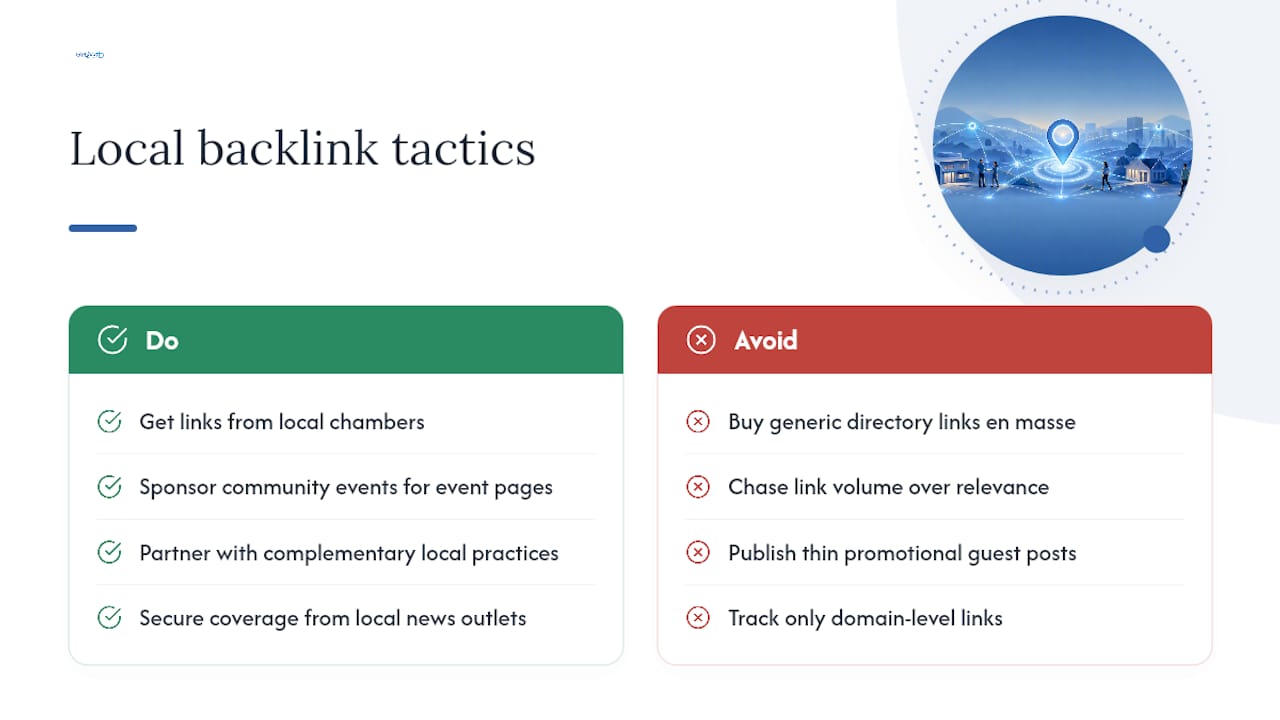
Area pages rank faster and hold their position longer when they carry backlinks from sources actually connected to that region, not generic directory submissions.
Local chambers of commerce, town business associations, and community event sponsorship pages are consistently underused by clinics. Sponsoring a 5K or a school health fair in one of your target towns often earns a natural link from that town’s own event page, which carries far more local relevance than a paid directory listing ever will.
Partnering with complementary local practices, a physical therapist referring to your aesthetic clinic, or a dermatologist cross-linking with your wellness practice, builds a link profile that mirrors how real referral networks actually work. Local news outlets covering a clinic opening, a new provider joining the practice, or a community health initiative also produce links that carry genuine geographic relevance.
Guest contributions to local business blogs or town Chamber newsletters work too, provided the content is genuinely useful rather than thinly disguised self-promotion. The pattern that hurts clinics is chasing volume: fifty low-quality directory links from sites with no connection to any of your service towns. A dozen links from sources actually rooted in your service area outperform that every time, because search engines weigh relevance heavily in local rankings.
Track new backlinks pointing to each area page specifically, not just to your domain overall, so you can see which pages are attracting authority and which still need outreach.
Guidelines for Mobile Optimization on the Go
Most searches for “[service] near me” or “[service] in [town]” happen on a phone, often while someone is already out running errands or sitting in a waiting room deciding whether to switch providers. That context changes what actually matters on an area page.
Page speed comes first. A service-area page that takes more than a couple of seconds to load loses visitors before they see the driving directions or the phone number at all. Compress images, particularly clinician photos and any location maps, and avoid loading unnecessary scripts on pages meant to close mobile searches quickly.
Click-to-call needs to be a real, tappable phone number, not an image or a number buried in body text. The booking button should sit within thumb’s reach near the top of the screen, not require scrolling past four paragraphs first. Maps embedded for driving directions should load fast and stay interactive without forcing a page reload.
Text should remain legible without pinching to zoom, and forms should use large, mobile-friendly input fields rather than desktop-sized text boxes shrunk down. Test every area page on an actual phone, on a real connection, not just in a browser’s simulated mobile view, since simulators routinely underestimate real-world load times on cellular data.
Legal and Compliance Considerations for Local Advertising
Claiming a service area comes with representation risk that clinics sometimes overlook. If a page implies a physical presence or licensed provider in a town where you have neither, that claim can create liability, particularly for regulated healthcare services where licensing is location-specific.
Be precise about what “serving” a town actually means. If patients from that town travel to a single physical clinic, say so plainly rather than implying a satellite office exists. If telehealth genuinely extends your service area into that region, state which services are available virtually and which still require an in-person visit, since regulations around remote consultation vary by service type and jurisdiction.
Testimonials and reviews tied to specific towns need to be real and attributable, never fabricated to make a page look more locally established than it is. Any before-and-after imagery, health claims, or outcome statements on an area page should meet the same advertising standards that apply to your main service pages. A location page is still a piece of medical advertising, not a neutral directory listing, and it should be reviewed with that in mind before publishing.
The Part of This Strategy Most Clinics Get Backwards
Most clinic marketing advice treats service area pages as a volume game: publish as many town pages as possible, sprinkle in the local keyword, and wait for rankings. That approach produces exactly the doorway-page problem search engines are built to penalize, and worse, it produces pages that do nothing for the patient actually reading them.
The pages that work treat local relevance as a real argument, not a keyword slot. Why does someone drive 25 minutes past three other clinics to reach yours? If you cannot answer that in the first paragraph of the page, no amount of schema markup will fix it. Conversion elements like click-to-call and booking widgets matter, but they only work once the content above them has already answered the patient’s real hesitation.
The most overlooked lever is the review cycle. Clinics build ten area pages, publish them, and never look again. The 90-day evaluation window is not a suggestion. It’s the difference between a page that quietly earns its keep and one that sits there as dead weight for two years before anyone notices it never worked.
— Gerard
How Growth Reach Marketing Builds This for Clinics
A practical alternative to hiring a generalist web developer to build these pages one-off exists, offering a process treating the hub-and-spoke structure, the schema markup, the internal linking, and the 90-day measurement cycle as one connected system built specifically for aesthetic clinics and salons, not retrofitted from a generic small-business template.
An initial engagement usually starts with an audit of your existing location content, followed by a prioritized plan for which towns deserve their own page versus a grouped regional page, then implementation of the content templates, schema, and booking-flow tweaks covered above. Measurement against calls and bookings follows from there, not just traffic. If your clinic is ready to turn “Areas We Serve” from a neglected tab into a page cluster that books appointments, the full breakdown of local SEO, content, and campaign services is on the Growth Reach Marketing services page.
Sources
- Medical Weight Loss Service Areas Near Charlotte, NC – Charlotte Weight Loss and Wellness Clinic, PLLC
- Service Areas Gainesville FL | Bespoke Aesthetics
- Areas We Serve | Vita Nova Wellness Clinic
FAQ
What Is a Hub-and-Spoke Service Area Page Structure?
It is a central “Areas We Serve” page linking out to individual town or region pages, each targeting a specific location and service combination. This lets a clinic rank for multiple local searches without duplicating content across a single generic locations page.
How Many Towns Should Get Their Own Page?
Give a town its own page only if it has measurable search demand or an existing patient base; group smaller nearby towns into one regional page otherwise. Splitting too early creates thin, near-duplicate content that can hurt rankings rather than help them.
Does Growth Reach Marketing Build These Pages for Clinics?
Yes, Growth Reach Marketing works with salons and aesthetic clinics on local SEO, content creation, and site architecture that includes this exact hub-and-spoke model. Pricing for services like local SEO and ad management is available directly on the services page.
How Long Before an Area Page Should Show Results?
Give each new area page a 90-day window before evaluating it, since local rankings take time to stabilize after publishing. After that window, use Search Console and GA4 data alongside booking-attributed links to decide whether to keep, merge, or retire it.
Do I Need Schema Markup on Every Area Page?
Yes, LocalBusiness schema with a complete address, geo coordinates, and opening hours helps search engines and AI answer tools understand exactly where and when you operate. Skipping schema on subpages weakens the local signal even when the written content is strong.