The fastest route to a strong salon brand identity is a focused six-step playbook you can execute in eight weeks. You don’t need a six-figure agency budget or a rebrand that shuts down operations. What you need is a one-page brand brief, a locked visual system, and a rollout plan your staff can actually follow.
Here’s what you’ll leave with after reading this guide:
- One-page brand brief template with mission, values, and positioning statement
- 30-day rollout checklist covering visual assets, staff training, and digital touchpoints
- Budget ranges from DIY ($500–$2,000) to mid-range freelancer ($3,000–$8,000) to full agency ($10,000–$25,000+)
Your first 24–72 hours have one job: write your brand brief. Everything else, the logo, the Instagram grid, the staff scripts, flows from that single document. Skip it and you’ll spend money on assets that don’t connect.
Salons that operate with a clear brand identity consistently outperform those that don’t on the metrics that matter most: rebook rate, average ticket, and client lifetime value (LTV). Salon Branding 101 confirms that a short brand blueprint, consistent application across touchpoints, and staff training are the three pillars that make a salon brand stick in daily operations.
Key Takeaways
A strong salon brand identity starts with a one-page brand brief and only becomes commercially effective when it’s applied consistently across every client touchpoint, from the booking flow to the staff script to the Instagram grid.
| Point | Details |
|---|---|
| Start with the brand brief | Write your mission, values, and positioning statement before touching the logo or any visual asset. |
| Lock your visual system early | Finalize logo formats, color codes, and typography in weeks 2–4 so collateral production doesn’t stall. |
| Train staff before launch | A two-hour brand workshop in week 7 ensures the brand lives in every client interaction, not just on paper. |
| Measure rebook rate and LTV | Track rebook rate (benchmark: 60–70%) and lifetime value to confirm the brand is driving retention, not just awareness. |
| Growthreachmarketing connects brand to bookings | Growthreachmarketing pairs brand identity work with local SEO, Google Ads, and keyword strategy to turn visibility into appointments. |
Table of Contents
- Why a clear salon brand identity drives bookings, retention, and LTV
- What does a salon brand identity guide actually cover?
- Step 1: How to define your salon’s brand foundation
- Step 2: Know your ideal client and map their journey
- Step 3: How to design your salon’s visual identity
- Step 4: How to craft your salon’s voice and messaging
- Step 5: How to translate your brand into the physical salon experience
- Step 6: Website, booking UX, and social media aligned to your brand
- Step 7: Rollout plan, staff training, and realistic budget ranges
- Step 8: How to measure brand success with the right KPIs
- What goes into a simple salon brand guideline?
- Mini case studies: before and after brand work in practice
- What actually moves bookings: an agency perspective on common pitfalls
- Growthreachmarketing helps salons turn brand identity into booked appointments
- Sources
Why a clear salon brand identity drives bookings, retention, and LTV
Brand clarity isn’t a design preference. It’s a revenue lever.
When a client walks into your salon and the experience matches what your Instagram promised, they rebook. When your website’s tone matches how your front desk speaks, they trust you faster. That alignment, between what you say you are and what clients actually experience, is what salon branding professionals call brand coherence, and it has a direct line to your bottom line.
Consider rebook rate. A salon with a clear positioning (say, a results-focused color clinic versus a walk-in cuts shop) attracts clients who already know what they’re buying. Those clients rebook at higher rates because the service met the expectation the brand set. Vague positioning attracts browsers. Clear positioning attracts buyers.
Average ticket follows the same logic. A brand that communicates premium expertise, through photography, service descriptions, and the physical environment, supports higher price points without friction. Clients don’t negotiate with brands they trust. They upgrade.
Lifetime value compounds both effects. A client who rebooks every six weeks and adds a retail purchase twice a year is worth dramatically more than one who visits once and drifts. Agency guidance from Mint Sauce Media makes the point plainly: in high-touch services like salons and aesthetics, brand trust built through a consistent client story and signature experience is the single most durable retention tool available.
The commercial case for investing in your brand identity isn’t abstract. It shows up in your booking software every month.
What does a salon brand identity guide actually cover?
Before diving into the steps, it’s worth naming what a salon brand identity guide actually is versus what people often confuse it with. Brand identity is the full system: your mission, your visual assets, your voice, your physical environment, and how all of those connect. A logo alone is not a brand identity. A color palette is not a brand identity. Those are components of one.
The six-step roadmap below covers every component in the order you should build them.
The six-step salon branding roadmap at a glance
- Brand foundation (Week 1): Write your mission, values, and positioning statement. Deliverable: one-page brand brief.
- Audience and personas (Week 1–2): Define your ideal client and map the client journey from discovery to retention.
- Visual identity (Week 2–4): Name, logo, color palette, typography, and photography guidelines.
- Voice and messaging (Week 3–4): Tagline, service descriptions, tone-of-voice guide, and staff scripts.
- Salon experience (Week 4–6): Interior, signage, uniforms, scent, music, and service rituals.
- Rollout and measurement (Week 6–8): Staff training, collateral production, digital launch, and KPI tracking.
Each step builds on the last. Skipping ahead to the logo before the brand brief is the most common and most expensive mistake salon owners make.
Step 1: How to define your salon’s brand foundation
Your brand foundation is the one document that makes every other decision easier. When you’re choosing between two logo concepts, the brief tells you which one fits. When a staff member isn’t sure how to handle a complaint, the values guide the response.
Writing your mission and values
A salon mission statement doesn’t need to be long. One paragraph, three sentences maximum. It answers three questions: who you serve, what you do for them, and why it matters.
Template:
“[Salon name] helps [ideal client description] achieve [core outcome] through [your method or approach]. We believe [core value 1], [core value 2], and [core value 3]. Our goal is [the change you create in clients’ lives or confidence].”
Your three core values should be specific enough to guide decisions, not generic enough to belong to any business. “Excellence” is not a value. “We never rush a consultation” is. “Honesty” is not a value. “We tell clients what their hair actually needs, not what costs more” is.
Positioning statement template
Your positioning statement is the sentence that goes in your website H1, your Instagram bio, and your front-desk script. It follows this structure:
“For [ideal client], [salon name] is the [category] that [unique benefit] because [reason to believe].”
Example: “For busy professionals in downtown Austin, Lux Studio is the color salon that delivers precision results in under two hours because every appointment is pre-planned with a digital consultation.”
Three salon archetypes worth knowing
Most salons fall into one of three positioning archetypes. Knowing yours sharpens every downstream decision.
- Premium results clinic: Clients pay for expertise and outcomes. Pricing is high, consultations are thorough, and the environment is clinical-clean. Think medical-grade skincare studios or master colorists with a waitlist.
- Community neighborhood salon: Clients pay for belonging and familiarity. Pricing is accessible, staff know regulars by name, and the vibe is warm and personal. Retention is the core metric.
- Trend-forward creative studio: Clients pay for access to what’s next. Pricing is mid-to-high, social content is central to the brand, and the team’s personal style is part of the offer.
None of these is better than the others. But trying to be all three at once is what makes a salon invisible.
Pro Tip: Before writing your brand brief, spend 20 minutes pulling your last 50 client records. Look at average spend, service type, and rebook frequency. The clients who spend the most and rebook the fastest are your real target persona, not the ones you imagine.
Step 2: Know your ideal client and map their journey
A persona is not a demographic profile. “Women aged 25–45” is not a persona. It’s a census category. A persona is a decision-making portrait: what does this person want, what stops them from booking, and what makes them loyal?
Persona template
Use these fields to build one primary persona (and a secondary if your services genuinely split across two distinct groups):
- Name and age range: Give them a real name. It makes the document usable.
- Occupation and income band: Affects pricing sensitivity and scheduling constraints.
- Primary goal: What outcome are they booking for? (Confidence, maintenance, a specific look?)
- Pain points: What has frustrated them about salons before? (Inconsistency, long waits, being upsold?)
- Decision triggers: What pushes them to book? (A special event, a friend’s referral, a before/after photo?)
- Preferred channels: Where do they discover salons? (Instagram, Google, word of mouth?)
- Price sensitivity: Are they value-driven, quality-driven, or convenience-driven?
Mapping the client journey
Once you have a persona, map the five touchpoints where your brand either wins or loses them:
- Discovery: Google search, Instagram, a friend’s recommendation. Is your brand findable and does it look the part?
- Booking: Website, phone, or app. Is the process fast, clear, and confidence-building?
- In-salon experience: Arrival, consultation, service, departure. Does the physical environment match the brand promise?
- Aftercare: Follow-up message, product recommendation, care instructions. Does the relationship continue after they leave?
- Retention: Rebooking prompt, loyalty program, birthday offer. What brings them back?
Map each touchpoint against your persona’s pain points. Where the journey creates friction, your brand loses ground. Where it creates delight, it builds loyalty.
Matching services and pricing to persona value is where this work pays off commercially. A persona who is convenience-driven needs an online booking system that works in under 60 seconds. A persona who is quality-driven needs detailed service descriptions and stylist bios. Build for the persona you actually have, not the one you wish you had.
Step 3: How to design your salon’s visual identity
Visual identity is the part most owners jump to first. Resist that instinct until Steps 1 and 2 are done. A logo designed before a brand brief is just decoration.
Naming and logo concepts
Before commissioning a logo, test your name concept against four criteria:
- Pronunciation: Can a stranger say it correctly on first read?
- Memorability: Can someone recall it 24 hours after hearing it once?
- URL and handle availability: Check GoDaddy and Instagram before you fall in love with a name.
- Trademark conflicts: Run a basic search on the USPTO database to avoid costly conflicts later.
Logo planning best practices recommend testing logo legibility across sizes and formats before finalizing anything. A logo that looks beautiful at full size but turns into a blur at 32 pixels (a browser favicon or app icon) is a liability, not an asset.
Logo system: three versions you need
Every salon logo should exist in three versions:
- Primary: Full name and any icon, horizontal or stacked. Used on the website header, signage, and printed materials.
- Secondary: A simplified version, often just the wordmark without the icon, for smaller applications like email headers.
- Icon/mark: The symbol alone, used for social profile images, favicon, and embossed packaging.
Document minimum size rules (typically no smaller than 1 inch or 72px wide for the primary) and clear-space rules (a margin equal to the height of the logo’s tallest letter on all sides).
Color palette and typography
Your color palette should have four slots: one primary brand color, one secondary, one neutral (usually off-white or warm gray), and one accent for calls to action. More than five colors in active use creates visual noise.
Color psychology in salon branding isn’t mystical, but it’s real. Deep greens and warm neutrals signal organic and wellness. Black and gold signal luxury. Bright, high-contrast palettes signal energy and trend-forward positioning. OPI’s color and product branding is a masterclass in how a consistent color system communicates brand positioning across every touchpoint, from packaging to salon displays.
Typography follows the same logic. Choose two typefaces: one for headings (personality-forward, distinctive) and one for body text (legible, neutral). Never use more than two in active brand materials.
Photography guidelines
Photography is where most salon brands either win or lose on social media. A few rules that matter:
- Before/after photos: Shoot both images in the same location, same lighting, same angle. Inconsistency in the “before” undermines the “after.” A dedicated guide to before/after photo marketing covers the specific specs and framing rules that make transformations perform on Instagram and Google.
- Lighting: Natural light or a ring light at eye level. Avoid overhead fluorescent lighting, which flattens color and skin tone.
- Image sizes: Instagram feed posts at 1080 x 1080px (square) or 1080 x 1350px (portrait). Website hero images at 1920 x 1080px minimum.
- Model releases: Get written consent from every client whose image you use commercially. A simple one-page release form covers you legally.
Pro Tip: Shoot a “brand day” once per quarter: 2–3 hours with a photographer, your best work, and your team in uniform. This gives you 30–40 images that keep your social content consistent for months without the daily scramble.
The Flowerful Hair Salon brand case study by Yasmine Design Co. shows exactly how a full visual system, from discovery and vision board through logo systems and a guideline sheet, comes together in practice. It’s worth reviewing before you brief a designer.
| Visual asset | Format needed | Primary use |
|---|---|---|
| Primary logo | SVG, PNG (transparent), PDF | Website, print, signage |
| Secondary logo | SVG, PNG (transparent) | Email headers, smaller print |
| Icon/mark | SVG, PNG (transparent), ICO | Social profile, favicon, packaging |
| Color palette | HEX, RGB, CMYK codes | All digital and print applications |
| Font files | OTF or TTF | Designer handoff, website embed |
| Photography | JPG at 72 DPI (web) | Website, social, collateral |
Step 4: How to craft your salon’s voice and messaging
Voice is how your brand sounds. Messaging is what it says. Both need to be documented so that your Instagram caption, your front-desk greeting, and your service menu all feel like they come from the same place.
Tone-of-voice workbook
Map your brand voice on three axes. For each axis, mark where your brand sits on a scale of 1–5:
- Formal (1) to Friendly (5): A luxury medical spa sits at 2. A neighborhood blowout bar sits at 5.
- Technical (1) to Approachable (5): A trichology clinic sits at 1–2. A color studio sits at 3–4.
- Playful (1) to Serious (5): A Gen Z-focused nail studio sits at 1–2. A bridal specialist sits at 4–5.
Write three “we say / we don’t say” examples for each axis. These become the most useful part of your voice guide because they give staff concrete examples, not abstract principles.
Service description template
Every service description should follow this four-part structure:
- Promise: What the client gets (the outcome, not the process).
- Process: A one-sentence description of how you deliver it.
- Result: The specific change they’ll notice.
- Call to action: A direct booking prompt.
Example: “Precision color correction restores balance to over-processed or uneven hair. Your colorist maps a custom formula in a 15-minute consultation before a single drop of color is applied. You leave with consistent, healthy-looking color that holds for 8–10 weeks. Book your consultation online.”
Staff scripts for three critical moments
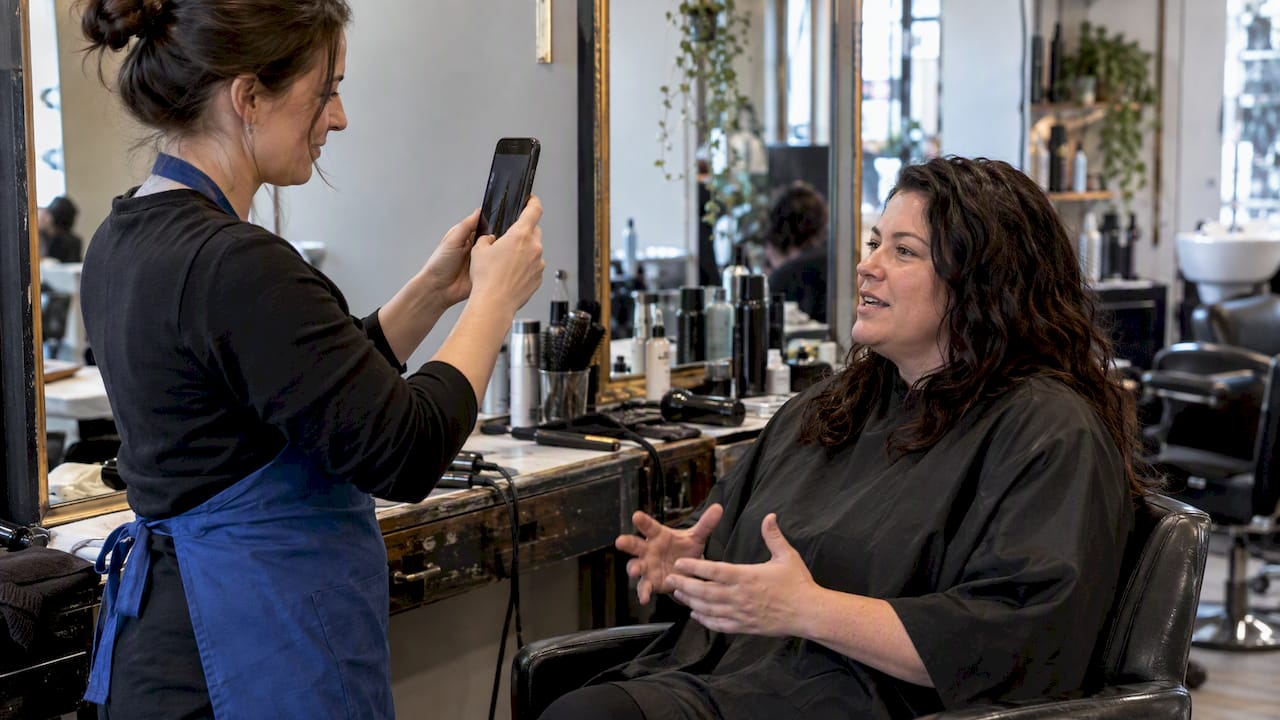
- Consultation opener: “Before we start, I want to make sure I understand exactly what you’re going for today. Can you show me a photo or describe the result you’re imagining?” This signals expertise and prevents mismatched expectations.
- Rebooking ask: “Your color will start to fade around week eight. I have openings on [specific dates]. Want me to hold one now?” Specific dates outperform open-ended asks every time.
- Handling objections: “I completely understand. A lot of our clients felt the same way before their first visit. What I can tell you is [specific reassurance tied to their concern].” Never argue. Validate, then redirect.
Step 5: How to translate your brand into the physical salon experience
Your brand doesn’t live in a PDF. It lives in the 45 minutes a client spends in your chair. Every sensory detail either reinforces or contradicts the brand promise you’ve made.
Interior, lighting, and signage
Interior finishes should map directly to your archetype. A premium results clinic needs clean lines, clinical whites, and minimal clutter. A community neighborhood salon can carry warm wood tones, personal touches, and local art. A trend-forward studio can push bolder colors and statement furniture.
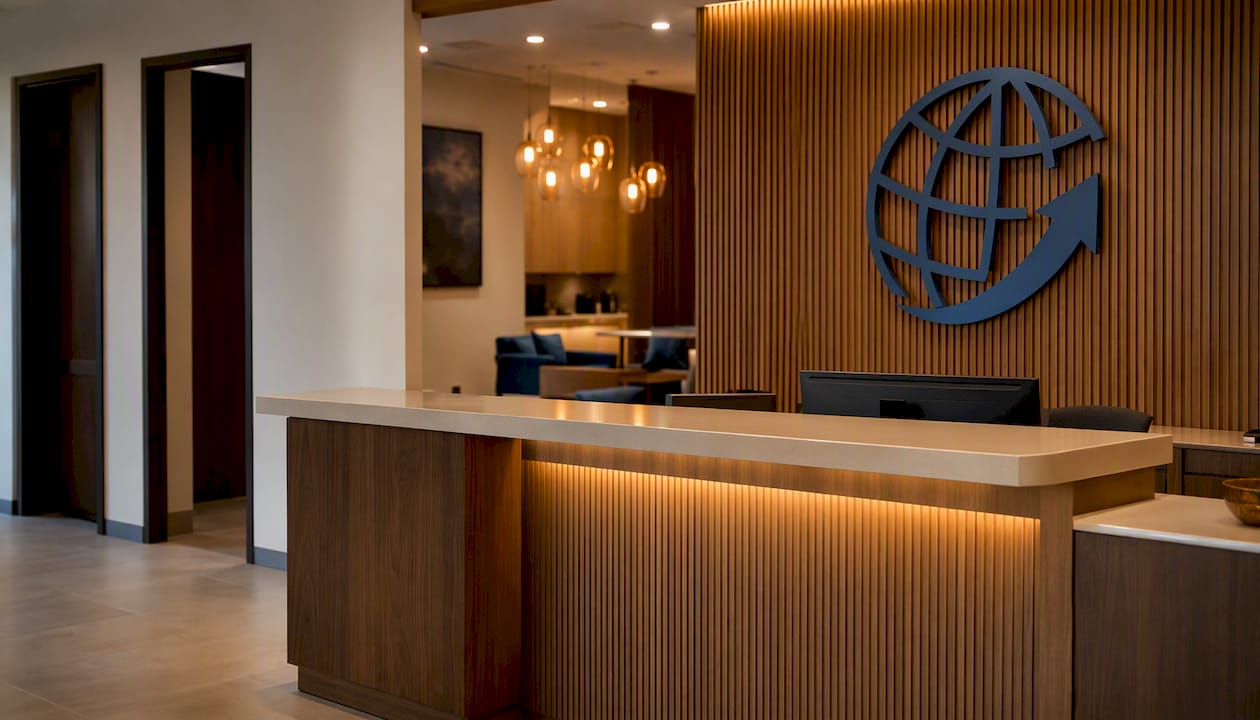
Lighting is the most underinvested element in most salons. Warm-white LED at 2700–3000K flatters skin tone and hair color during consultations. Harsh cool-white overhead lighting (above 4000K) makes clients look tired and makes color assessment harder. Fix the lighting before you invest in new furniture.
Signage should carry your logo, your brand colors, and nothing else. A cluttered reception desk with three different font styles on three different signs is a brand audit failure. Gene Juarez demonstrates how a local salon chain maintains consistent signage and guest experience standards across multiple locations, a useful benchmark for any salon planning to scale.
Signature service rituals
A signature ritual is a small, repeatable moment that clients remember and talk about. It doesn’t need to be expensive. Mint Sauce Media’s branding guidance emphasizes that the client story and signature experience are where brand trust is actually built in high-touch services.
Examples of low-cost, high-impact rituals:
- A warm towel and a specific scent at the shampoo bowl
- A handwritten card in every retail purchase bag
- A specific music playlist that clients start to associate with your salon
- A departure ritual: stylist walks the client to the door and names the next appointment date
Uniforms, packaging, and sensory details
Uniforms don’t need to be expensive, but they need to be consistent. A branded apron in your primary color costs less than $50 per staff member and immediately elevates the visual coherence of the space.
Packaging matters more than most owners realize. Drybar’s yellow-and-white visual system extends from the salon interior to their retail packaging, creating a coherent brand world that clients carry home. Even a simple branded tissue paper inside a retail bag signals attention to detail.
Scent and music are the two most emotionally powerful brand elements and the two most commonly ignored. Choose one signature scent (a diffuser, a candle, a product line) and one playlist direction (tempo, genre, energy level) and keep them consistent. Clients will start to associate both with your salon before they consciously realize it.

Pro Tip: Ask three loyal clients what they’d miss most if your salon closed. Their answers will tell you which sensory or experiential elements are actually driving loyalty, and those are the ones to protect and amplify.
Step 6: Website, booking UX, and social media aligned to your brand
Your digital presence is where most potential clients form their first impression. A beautiful salon with a clunky website or an inconsistent Instagram grid loses clients before they ever walk through the door.
Website page checklist
Every salon website needs these pages, in this order of priority:
- Home: Hero image, positioning statement, primary CTA (book now), social proof (reviews or before/after).
- Services: Individual service pages with descriptions using the four-part template from Step 4.
- Team: Stylist bios with photos, specialties, and individual booking links.
- Before/after gallery: Organized by service type, with consistent photography standards.
- Booking: Embedded booking widget, minimal steps, mobile-optimized.
- Contact: Address, hours, phone, map embed, and parking notes.
- FAQs: Answers to the 8–10 questions new clients ask most often.
Booking UX: reduce friction, increase conversion
The booking flow is where brand identity either converts or collapses. Three rules:
- Mobile first: Over 70% of salon bookings happen on a phone. If your booking page requires pinching and zooming, you’re losing clients.
- Fewer steps: Every additional click between “I want to book” and “booking confirmed” costs you conversions. Aim for three steps maximum.
- Confirmatory messaging: The confirmation email and SMS should sound like your brand, not a generic system notification. Use your voice, include a prep tip, and name the stylist.
Cross-sell opportunities belong in the confirmation flow, not the booking form. A post-booking email that says “Your color appointment is confirmed. Here’s what to expect, and here’s a product your stylist recommends for your hair type” adds value without friction.
Social content strategy aligned to brand
Your social content should rotate across four pillars:
- Transformations: Before/after work that demonstrates expertise. This is your highest-performing content type for new client acquisition. Salon video marketing adds a powerful layer here, showing the process and not just the result.
- Education: Tips, product recommendations, and technique explanations that position your team as experts.
- Team and culture: Behind-the-scenes content that builds trust and humanizes the brand.
- Client experience: Testimonials, in-chair moments (with consent), and retail recommendations.
Avoid the most common trap: posting only when you have something to sell. A content calendar built around these four pillars gives you a posting rhythm that builds the brand between promotions. Common social media mistakes in salons almost always trace back to inconsistent posting and a lack of content pillars.
Basic local SEO every salon must do
Local SEO is the fastest way to turn brand investment into bookings. Four actions that cost nothing but time:
- Claim and complete your Google Business Profile: Add every service, upload 10+ photos, and respond to every review within 48 hours.
- Consistent NAP: Your name, address, and phone number must be identical across your website, Google, Yelp, and every directory listing.
- Service keywords: Each service page should include the service name plus your city (e.g., “balayage color Austin”). Local SEO for beauty brands covers the full keyword strategy for salons trying to rank higher and book more.
- Image alt text: Every photo on your website should have a descriptive alt tag that includes the service and location.
For a deeper look at how digital strategy aligns with brand identity across channels, Coumba Win’s resource on modern brand strategy is worth bookmarking.
Step 7: Rollout plan, staff training, and realistic budget ranges
An eight-week rollout is achievable for most salons without closing or disrupting operations. The key is sequencing: finish the brand brief before you touch the logo, finish the logo before you print anything, and train staff before you go public.
Eight-week rollout timeline
| Week | Milestone | Key tasks |
|---|---|---|
| 1 | Brand brief complete | Write mission, values, positioning; confirm archetype and persona |
| 2 | Visual identity brief | Brief designer or begin DIY; confirm name, color direction, font shortlist |
| 3–4 | Visual assets in review | Logo drafts, color palette, typography locked; photography shoot scheduled |
| 5 | Assets finalized | Logo approved in all formats, brand guideline one-pager drafted |
| 6 | Collateral production | Business cards, signage, menu, uniforms, website updates begin |
| 7 | Staff training | Brand workshop, scripts, service standards, social media guidelines |
| 8 | Soft launch | Update Google Business Profile, social bio, website; announce to existing clients |
| 8+ | Full launch | Paid promotion, PR outreach, referral program activation |
Staff training agenda (Week 7)
A two-hour brand workshop covers:
- Brand story: why the brand exists and who it serves (30 minutes)
- Voice and scripts: consultation opener, rebooking ask, objection handling (45 minutes)
- Service standards: arrival ritual, consultation process, departure ritual (30 minutes)
- Social media guidelines: what to post, what not to post, how to tag the salon (15 minutes)
Follow up with a one-page “brand cheat sheet” each staff member keeps at their station. Salon Branding 101 recommends this kind of consistent application across touchpoints as the difference between a brand that lives on paper and one that clients actually experience.
Budget ranges
| Tier | Typical cost range | What’s included |
|---|---|---|
| DIY | $500–$2,000 | Canva Pro, stock photography, DIY website updates, printed collateral |
| Mid-range (freelancer/small agency) | $3,000–$8,000 | Logo design, brand guideline, website refresh, photography session |
| Full agency | $10,000–$25,000+ | Full brand strategy, custom logo system, website build, content production, launch campaign |
Most independent salons get strong results in the mid-range tier. The DIY route works if you have design skills; it fails if you don’t, because a poorly executed logo signals exactly the opposite of what you’re trying to communicate. The full agency tier makes sense when you’re opening a second location or repositioning after a significant market shift.
For rollout promotion ideas that align with your brand launch, goal-led promotional offers give you a framework for driving bookings without discounting your positioning.
Step 8: How to measure brand success with the right KPIs
Brand investment without measurement is decoration. These are the KPIs that tell you whether your brand identity is working commercially.
Primary KPIs and how to track them
- New client bookings per month: Track in your salon software (Vagaro, Mindbody, Fresha). A brand refresh should move this number within 60–90 days of launch.
- Rebook rate: The percentage of clients who book their next appointment before leaving. Industry benchmark is 60–70% for a healthy retention model. Track weekly.
- Average ticket value: Total revenue divided by number of appointments. Brand clarity supports higher-value service selection and retail add-ons.
- Client retention rate: The percentage of clients who return within 90 days. Segment by new vs. returning to see whether the brand is attracting the right persona.
- Lifetime value (LTV): Average ticket multiplied by average visits per year multiplied by average client tenure in years. This is the number that justifies brand investment.
Client feedback survey (3–5 questions)
Send this via SMS or email within 24 hours of an appointment:
- How did you hear about us? (Dropdown: Google, Instagram, referral, walked past, other)
- What made you choose us over other salons? (Open text)
- How would you describe our salon to a friend? (Open text — this is your brand perception data)
- How likely are you to rebook? (1–5 scale)
- Is there anything we could do better? (Open text)
Question 3 is the most valuable. When clients describe your salon in their own words, they’re telling you whether your brand identity is landing the way you intended.
Quarterly brand audit checklist
Every 90 days, review:
- Are all digital touchpoints (website, Google, social bios) using the current logo and color palette?
- Are staff following the consultation and rebooking scripts?
- Is photography consistent across Instagram, website, and Google?
- Have any new competitors entered your market with a similar positioning?
- Are your KPIs trending in the right direction?
A brand audit doesn’t require a full redesign. Most of the time, it surfaces small inconsistencies (an old logo on a Yelp listing, a staff member using a different greeting) that are easy to fix and meaningful to correct.
What goes into a simple salon brand guideline?
A brand guideline is the document that keeps your brand consistent when you’re not in the room. It doesn’t need to be 60 pages. A well-built one-pager does the job for most independent salons.
One-page guideline essentials
- Logo lockups: Primary, secondary, and icon versions with clear-space rules and minimum sizes
- Color codes: HEX (for digital), RGB (for screen), and CMYK (for print) for every brand color
- Typography scale: Heading font, body font, and size hierarchy (H1, H2, body, caption)
- Tone-of-voice bullets: Three “we say / we don’t say” examples
- Image examples: Two or three approved photography examples showing the correct style and lighting
AIGA’s design best-practice resources specifically recommend documenting usage rules and the rationale behind them so non-designers on your team can make consistent decisions without needing to ask every time.
One-pager vs. full guideline: when to upgrade
A one-pager is sufficient for a single-location salon with a stable team. Move to a full guideline (10–20 pages) when you’re onboarding a second location, hiring a marketing manager, or working with multiple external vendors (a web designer, a photographer, a social media manager) who all need to apply the brand independently.
File storage and naming conventions
Store all brand assets in a shared folder (Google Drive or Dropbox) with this naming structure:
[SalonName]_Logo_Primary_RGB.svg[SalonName]_Logo_Icon_CMYK.pdf[SalonName]_BrandGuideline_v1.pdf[SalonName]_Photography_Approved_2026/
Version control matters. When you update the logo or refresh the palette, archive the old version in a subfolder labeled _Archive rather than deleting it. You’ll need it when an old vendor sends you a file using the previous version.
Pro Tip: Add a “last updated” date to the cover of your brand guideline. It signals to every vendor and staff member that the document is actively maintained, not a one-time artifact.
For a practical step-by-step reference on building a brand identity from scratch, the founder’s guide to startup brand identity covers the same foundational process in a format that maps well to the salon context.
Mini case studies: before and after brand work in practice
Growth Reach Marketing client example
One salon client came to Growthreachmarketing with a strong service offering and a loyal core clientele but no coherent visual identity. Their Instagram mixed three different logo versions, their website used a different color palette than their printed menu, and their Google Business Profile had no photos. The brand brief exercise revealed they were positioned as a premium color studio but priced and presented as a mid-range walk-in shop.
After completing the brand brief, locking a visual system, and updating all digital touchpoints, the salon saw measurable improvements in new client inquiries via Google within 90 days of launch. The rebook rate climbed as the clearer positioning attracted clients who were specifically looking for precision color work rather than convenience appointments.
What to study in external design examples
Three external resources worth spending time with before you brief a designer:
- Yasmine Design Co.’s Flowerful Hair Salon case study: Shows the full process from discovery through logo systems and guideline sheets. Pay attention to how the vision board stage translates into specific color and typography decisions.
- Behance: Search “salon brand identity” to see how designers document guidelines and apply them across signage, packaging, and social templates. The portfolio format shows you what a complete deliverable looks like.
- Dribbble: Use it for current logo and typography trends in beauty and wellness. Filter by “branding” and “salon” to see what’s resonating in the market right now.
The practical lesson from all three: the salons with the strongest brand identities share one trait. Every visual decision traces back to a documented strategy, not a personal preference.
What actually moves bookings: an agency perspective on common pitfalls
Most salon owners approach branding backwards. They spend the most time on the logo and the least time on the brand brief. They invest in a beautiful website and ignore the booking flow. They train staff on services and skip the scripts. After working with salons across the US, these are the six pitfalls that consistently cost owners money.
Pitfall 1: Inconsistent application. A brand that looks different on Instagram than it does on the front door than it does on the service menu isn’t a brand. It’s a collection of assets. Consistency is the work, not the design.
Pitfall 2: Poor booking UX. You can have the most beautiful brand in your market and still lose clients at the booking step. A three-click mobile booking flow outperforms a stunning website with a clunky form every time.
Pitfall 3: Ignoring persona fit. Salons that try to serve everyone end up owning no one’s loyalty. The clearer your positioning, the more the right clients self-select and the fewer wrong-fit clients drain your team’s energy.
Pitfall 4: Skipping staff training. Your brand is only as strong as the weakest interaction a client has with your team. A front desk that doesn’t know the brand story, or a stylist who doesn’t use the rebooking script, undoes every dollar you spent on the logo.
Pitfall 5: Treating social media as a broadcast channel. Posting promotions and nothing else trains your audience to scroll past you. The four-pillar content strategy (transformations, education, team, experience) builds the brand between sales moments.
Pitfall 6: No measurement cadence. Brand investment without a 90-day review cycle drifts. The KPIs in Step 8 are not optional extras. They’re the feedback loop that tells you whether the brand is working or needs adjustment.
What to prioritize by budget stage
- Starter ($0–$2,000): Brand brief, one-page guideline, consistent photography, Google Business Profile. These cost almost nothing and move the needle immediately.
- Growth ($3,000–$8,000): Professional logo system, website refresh, booking UX audit, staff training workshop. This is where most independent salons should invest first.
- Scale ($10,000+): Full brand strategy, custom website build, paid social, local SEO campaign. Worth it when you’re at capacity and ready to grow revenue per client or open a second location.
The shortcut that keeps brand feeling premium without high cost: photography. A single well-lit, consistent set of images shot in your salon does more for brand perception than any logo redesign. Clients respond to what they can see, and great photography signals quality before they read a single word.
Growthreachmarketing helps salons turn brand identity into booked appointments
Building a brand brief is the first step. Getting it in front of the right clients in your local market is the next one, and that’s where most salon owners hit a wall.
Growthreachmarketing works specifically with salons, aesthetic clinics, and beauty brands to connect brand identity with the digital systems that drive bookings: local SEO that ranks your salon for the searches your ideal clients are already making, Google Ads that put your brand in front of high-intent local searchers, and content marketing that builds authority between promotions.
The services that map directly to this guide: brand brief creation, visual identity development, website builds with conversion-focused booking flows, and keyword strategy for salons that turns your positioning into search visibility. You get the brand and the marketing system that makes it work, not just the assets.
If you’re ready to move from brand brief to booked appointments, contact Growthreachmarketing to book a consultation and find out what a focused brand and SEO strategy looks like for your salon.
Sources
The resources below support the guidance in this guide and are worth bookmarking for your own research and design process.
Design authority resources:
- Aiga
- Aesthetics Salon Branding Guide | Mint Sauce Media
- Planning Your Salon’s Logo and Brand Identity With Purpose
- Salon Branding 101: How to Create a Memorable Salon Brand
Salon-specific branding references:
Photography and content inspiration:
Recommended
- Salon Before After Photos Marketing: 2026 Guide – Growth Reach Marketing
- What Is a Beauty Brand Identity? A Guide for Marketers – Growth Reach Marketing
- Types of Salon Target Audiences: 2026 Segmentation Guide – Growth Reach Marketing
- What Is Salon Content Marketing? 2026 Guide – Growth Reach Marketing