

The single number that tells you whether your marketing is profitable is cost per booked appointment. Calculate it as: marketing spend ÷ booked appointments. Flip it for the revenue view: revenue from booked treatments ÷ marketing spend. Those two figures, pulled weekly, tell you more than any dashboard full of clicks and impressions.
Here is the immediate action you can take today:
- Capture click IDs (GCLID from Google, fbclid from Meta) on every inquiry form and phone call using hidden fields and dynamic number insertion.
- Log booked treatment value in your CRM against each contact record, tied to the original click ID.
- Import those booked-treatment events back to Google Ads and Meta as offline conversions so the platforms optimize on revenue, not raw form fills.
That loop, click ID in at inquiry and booked-treatment value out to the ad platform, is the foundation of every reliable ROI measurement system for a med spa. Everything else in this guide builds on it.
Table of Contents
- Why tracking med spa campaign ROI the right way actually matters
- Which KPIs do you actually need to track campaign profitability?
- Formulas and worked examples you can plug your own numbers into
- How to set up attribution so booked treatments feed back to your campaigns
- What your ROI dashboard should show and how often to review it
- Proven ways to improve your med spa campaign ROI right now
- Common tracking mistakes that produce misleading ROI numbers
- Your 30/60/90-day action plan to measure and lift ROI
- How to include offline marketing and referrals in your ROI calculations
- Why client satisfaction data belongs in your ROI reporting
- Key Takeaways
- What the data gap actually costs you
- Growthreachmarketing helps med spas turn tracking data into booked revenue
- Useful sources and further reading
Why tracking med spa campaign ROI the right way actually matters
Most med spas measure cost per lead (CPL). It is easy to pull from Google Ads or Meta, and it feels like a performance signal. The problem is that CPL tells you nothing about what happened after the form was submitted. A campaign generating $25 leads sounds great until you discover that only 20% of those leads book a consultation, and only half of those consultations convert to a paid procedure. Your real cost per paying client just hit $250, not $25.

The metric that closes that gap is cost per booked appointment. It accounts for every drop-off in the funnel between click and chair.
What healthy performance actually looks like
Industry benchmarks show that a well-run single-location med spa typically has an all-in patient acquisition cost (CAC) between $150 and $300, while urban practices relying on paid search can run above $350. For campaign return on ad spend (ROAS), a minimum positive ratio is necessary for viability, with higher ratios enabling meaningful growth.
A few caveats worth keeping in mind:
- Referral and organic SEO typically have lower CAC (referral channels often below $100, organic SEO from $20–$80) but volume is limited and slow to scale.
- Paid social and paid search channels have higher CAC: paid social typically $150–$350, paid search $200–$450 depending on the market and service.
- Seasonality distorts monthly numbers. A slow January will inflate CAC even when the campaign itself is performing well.
- Membership and retention programs change the economics entirely. A client on a monthly membership has a lifetime value (LTV) that can be three to five times higher than a one-visit client, which means a higher CAC is justifiable at acquisition.
Retention data shows that a minority portion of med spa clients return within 90 days without a structured rebooking program. With one in place, that number improves significantly, affecting CAC calculations that factor in LTV.
Which KPIs do you actually need to track campaign profitability?
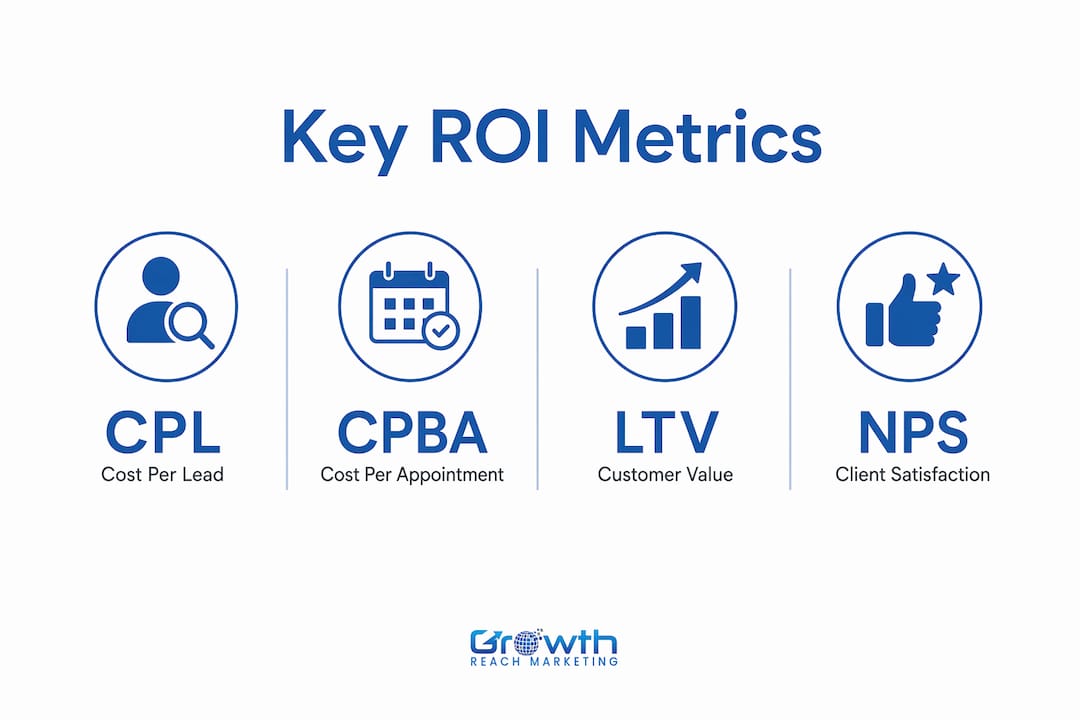
There are two tiers: headline metrics that drive budget decisions, and diagnostic metrics that explain why the headline is moving.
Headline metrics (review weekly, act on monthly):
- Cost per booked appointment — your primary profitability signal
- Revenue per booked appointment — average treatment value for appointments sourced from each campaign
- ROAS — total treatment revenue attributed to a campaign ÷ ad spend
- ROI — (revenue − ad spend) ÷ ad spend, expressed as a percentage
Diagnostic metrics (use to explain headline shifts):
- CPL (cost per lead) — useful for creative and audience testing, not for budget allocation
- Lead-to-appointment conversion rate — the percentage of inquiries that become booked consultations
- Appointment-to-procedure conversion rate — the percentage of consultations that convert to a paid treatment
- CAC by channel — all-in acquisition cost segmented by traffic source
- CLV / LTV — total revenue a client generates over their relationship with the clinic
- Churn and retention rate — percentage of clients who return within 90 and 180 days
Segment every metric by channel, campaign, and offer. A Google Ads campaign for Botox and a Meta campaign for body contouring will have completely different CPLs, conversion rates, and average ticket values. Blending them into a single number hides which campaign is actually profitable.
Pro Tip: High-volume, lower-margin services like neurotoxins often make the best acquisition foundation. The profit comes from structured rebooking and membership upsells, not the first visit. Track LTV by acquisition source, not just first-visit revenue.
Formulas and worked examples you can plug your own numbers into
Core formulas
| Metric | Formula |
|---|---|
| CPL | Ad spend ÷ total leads |
| Cost per booked appointment | Ad spend ÷ booked appointments |
| All-in CAC | (Ad spend + staff intake time cost) ÷ new paying clients |
| ROAS | Revenue from campaign ÷ ad spend |
| ROI | (Revenue − ad spend) ÷ ad spend × 100 |
| CLV / LTV | Average ticket value × average visits per year × average client lifespan (years) |
Worked example 1: Paid search campaign
A med spa spends $3,000 on Google Ads in a month. The campaign generates 120 leads. Of those, 36 book a consultation (30% lead-to-appointment rate). Of those, 25 convert to a paid procedure (69% appointment-to-procedure rate).
- CPL: $3,000 ÷ 120 = $25
- Cost per booked appointment: $3,000 ÷ 36 = $83.33
- Cost per paying client: $3,000 ÷ 25 = $120
- Average treatment value: $480
- ROAS: (25 × $480) ÷ $3,000 = 4:1 (400%)
- ROI: ($12,000 − $3,000) ÷ $3,000 × 100 = 300%
That is a healthy campaign. Now watch what happens when you improve one variable.
Worked example 2: Improving lead-to-appointment conversion
Same $3,000 spend, same 120 leads. But the front desk now responds within 30 minutes instead of 4 hours. Booking conversion rises from 30% to 45% (42 booked appointments). Procedure conversion holds at 69%, so 29 paying clients.
- Cost per booked appointment: $3,000 ÷ 42 = $71.43 (down from $83.33)
- Cost per paying client: $3,000 ÷ 29 = $103.45 (down from $120)
- ROAS: (29 × $480) ÷ $3,000 = 4.64:1 (464%)
No change in ad spend. No new creative. Just faster response. Research from Spa Ledger shows that cutting response time from 4 hours to 30 minutes can lift booking conversion by 12–18 percentage points, reducing effective CAC by roughly 15–25%.
Worked example 3: Membership LTV
A client acquires via paid social at a $200 CAC. First visit: $350 facial. Without a membership, she returns twice a year for two years: LTV = $350 × 4 = $1,400. With a $99/month membership, she visits monthly: LTV = $99 × 12 × 3 years = $3,564. The same $200 CAC now looks very different against a $3,564 LTV.

How to set up attribution so booked treatments feed back to your campaigns
This is where most med spas break the loop. The click ID that entered the system at the ad click gets dropped somewhere between the form submission, the phone call, and the CRM record. Fix it in this order:
- Tag every URL with UTM parameters (utm_source, utm_medium, utm_campaign, utm_content) and enable auto-tagging in Google Ads to capture GCLID automatically.
- Add hidden fields to every inquiry form to capture the GCLID and fbclid values from the URL. Most form builders (Gravity Forms, Typeform, HubSpot Forms) support this natively.
- Implement dynamic number insertion (DNI) on your website so phone callers are assigned a unique tracking number tied to their session and click ID. Call tracking platforms like CallRail or WhatConverts handle this.
- Map click IDs to CRM contact records at the moment of inquiry. Every new lead record should have a field for GCLID, fbclid, UTM source, and UTM campaign.
- Add a “first visit” marker in your booking system so you can distinguish new-client appointments from returning-client appointments in your revenue reports.
- When a treatment is paid, send the booked-treatment value back to Google Ads as an offline conversion using the GCLID. Use the Meta Conversions API for the same loop on Facebook and Instagram campaigns.
A few timing notes: there is often a 2–4 week lag between a consultation and a paid procedure, especially for higher-ticket services. Set your conversion window in Google Ads to at least 60 days to capture delayed conversions accurately.
Pro Tip: If your booked-treatment volume is below roughly 30 events per month, do not switch to value-based bidding yet. Optimize on consulted-attended as an interim signal while you build volume. Switching too early starves the algorithm of data and performance drops.
One important fallback: if offline conversion import is not yet live, use “consultation attended” as your conversion event rather than raw form fills. It is a closer proxy to revenue than a lead and will produce better bidding decisions in the interim.
What your ROI dashboard should show and how often to review it
A dashboard that tries to show everything shows nothing. Keep it to the metrics that actually drive decisions.
Recommended dashboard fields
| Metric | Reporting frequency | Decision trigger |
|---|---|---|
| Cost per booked appointment (by channel) | Weekly | Pause or scale channel |
| Revenue per booked appointment | Weekly | Adjust offer or creative |
| Booked-treatment volume | Weekly | Flag volume drops early |
| ROAS by campaign | Weekly | Reallocate budget |
| CAC by channel | Monthly | Channel mix decisions |
| LTV:CAC ratio by cohort | Monthly | Justify CAC ceiling |
| Lead-to-appointment conversion rate | Monthly | Front-desk or funnel fix |
| Appointment-to-procedure conversion rate | Monthly | Consult process review |
| CLV by acquisition cohort | Quarterly | Membership strategy |
Reporting cadence
Practical monitoring frameworks for 2026 emphasize event-level tracking and continuous monitoring rather than waiting for a full monthly slice. Here is how to structure that in practice:
- Weekly signal checks: Review cost per booked appointment and booked-treatment volume by channel. If cost per booked appointment rises more than 20% week-over-week without a volume explanation, investigate creative fatigue or audience saturation.
- Monthly performance reviews: Pull CAC by channel, LTV:CAC ratios, and full-funnel conversion rates. Make budget reallocation decisions here.
- Quarterly strategy reviews: Analyze CLV by acquisition cohort, assess membership retention rates, and decide whether to expand or contract channels based on 90-day LTV data.
Unified dashboards that pull from Google Ads, Meta, and your CRM into a single view reduce the time spent reconciling numbers and make cross-channel reallocation decisions faster. Google Looker Studio connected to GA4 and your CRM via a data connector is a practical, low-cost starting point.
The single KPI to watch for profitability: cost per booked appointment. Every other metric is context for why it is moving.
Proven ways to improve your med spa campaign ROI right now
Conversion levers (fastest impact)
- Cut lead response time to under 30 minutes. This single change can reduce effective CAC by 15–25% without touching ad spend.
- Audit your booking UX. If a prospective client has to call during business hours to book, you are losing appointments. Online booking that works 24/7 captures demand that would otherwise go cold.
- Train front-desk staff on phone scripts. The consult-to-treatment conversion rate is heavily influenced by how the first call is handled. A structured script with objection responses can move this rate by 10–15 percentage points.
- Build a post-consult follow-up sequence. Email and SMS sequences sent within 24–72 hours of a consultation that did not convert to a booking recover a meaningful share of undecided clients.
Value levers (medium-term impact)
- Introduce tiered packages and memberships. A $99–$149/month membership anchors retention and multiplies LTV, which makes a higher CAC justifiable at acquisition.
- Cross-sell at checkout. A client paying for a Botox treatment is the highest-intent moment to introduce a complementary service. A structured cross-sell sequence at the point of payment increases average ticket without additional ad spend.
- Segment offers by service margin. Promote high-margin services (body contouring, laser treatments) in paid campaigns; use lower-margin services (neurotoxins) as acquisition anchors with a clear rebooking path built in.
Efficiency levers (ongoing)
- Reallocate budget toward lowest-CAC channels first. Channel CAC data consistently shows organic SEO ($20–$80) and structured referral programs ($50–$100) outperform paid search ($200–$450) on a per-client basis, even if volume is lower. Fund them before scaling paid.
- Add negative keywords for price shoppers. Terms like “cheap,” “free,” and “discount” attract leads that rarely convert to full-price procedures. Excluding them tightens your audience and lowers CPL without reducing booking volume.
- Shift to value-based bidding once you have sufficient volume. Once you are importing 30+ booked-treatment conversions per month, switch Google Ads to Maximize Conversion Value or target ROAS. The algorithm will find the users most likely to book high-value treatments.
Pro Tip: Use a simple 2×2 prioritization matrix before committing resources: high impact + low effort (faster response time, phone scripts) goes first; high impact + high effort (full CRM integration, membership program launch) goes second. Low-impact items wait.
Common tracking mistakes that produce misleading ROI numbers
The most expensive mistake in med spa marketing is not overspending on ads. It is making budget decisions based on broken data.
Mistake 1: Reporting CPL as the headline metric.
CPL varies wildly by channel and service, and it ignores conversion rates entirely. Fix: replace CPL as your headline with cost per booked appointment and booked-treatment revenue. Keep CPL as a diagnostic for creative testing only.
Mistake 2: Losing the click ID at phone or manual booking.
A client clicks a Google Ad, calls the front desk, and books manually. The GCLID never makes it into the CRM. That booking is invisible to Google Ads, which then under-values the campaign and reduces bids. Fix: implement dynamic number insertion so every call session carries a click ID, and train staff to log the tracking number in the CRM record.
Mistake 3: Optimizing platforms on low-value actions.
If Google Ads is optimizing on form fills and many of those forms are from people who never book, the algorithm learns to find more non-bookers. Fix: import offline booked-treatment conversions so the platform optimizes on the action that actually generates revenue.
Mistake 4: Ignoring the consult-to-treatment lag.
Setting a 7-day conversion window misses the majority of conversions for higher-ticket services where clients take 2–4 weeks to decide. Fix: set conversion windows to 60 days minimum for services above $500.
Mistake 5: Blending all channels into a single ROI number.
A blended ROAS of 4:1 looks healthy, but it might be masking a paid search campaign at 2:1 subsidized by organic referrals at 12:1. Fix: segment every metric by channel and campaign before making budget decisions.
Pro Tip: Run a monthly data audit: pull 10 recent booked appointments from your CRM and trace each one back to its original traffic source. If more than 3 of the 10 show “direct” or “unknown” as the source, your click ID capture is broken and your attribution data is unreliable.
Here is a quick validation checklist:
- Confirm hidden GCLID/fbclid fields are present and populating on all active forms.
- Verify DNI is active on all high-traffic pages (homepage, service pages, contact page).
- Check that CRM records for the last 30 leads all have a populated UTM source field.
- Confirm offline conversion uploads are running on schedule (weekly minimum).
- Validate that Google Ads conversion reports show booked-treatment events, not just form fills.
Your 30/60/90-day action plan to measure and lift ROI
30 days: fix the data foundation
For business owners:
- Audit every active campaign and identify where click IDs are being lost (forms, phone, manual booking).
- Confirm your CRM has fields for GCLID, fbclid, UTM source, and UTM campaign.
- Decide which booking system fields will carry “first visit” and “treatment value” data.
For marketing managers:
- Implement hidden GCLID/fbclid fields on all inquiry forms.
- Deploy dynamic number insertion on the top 5 traffic pages.
- Set up GA4 conversion events for form submissions and phone call clicks.
60 days: close the CRM-to-platform loop
- Map CRM booking records to click IDs and begin weekly offline conversion uploads to Google Ads.
- Connect Meta Conversions API to send booked-treatment events with value data.
- Build the baseline ROI dashboard in Google Looker Studio: cost per booked appointment, ROAS, and booked-treatment volume by channel.
- Run your first monthly performance review using the new data.
90 days: optimize on revenue
- If booked-treatment volume exceeds 30 events per month in Google Ads, shift campaigns to Maximize Conversion Value or target ROAS bidding.
- Launch a membership or rebooking sequence for clients acquired in the first 60 days and track 90-day retention rate.
- Run a budget reallocation experiment: shift 15–20% of paid search spend toward the lowest-CAC channel identified in your monthly review and measure the impact on total booked-treatment volume.
- Schedule your first quarterly strategy review using CLV-by-cohort data.
How to include offline marketing and referrals in your ROI calculations
Offline marketing, print ads, event sponsorships, in-clinic promotions, and word-of-mouth referrals do not come with a GCLID. That does not mean they are unmeasurable. It means you need a different attribution method.
Unique phone numbers and promo codes are the most practical tools. Assign a dedicated phone number to each offline channel (a magazine ad, a local event, a referral card) and track inbound calls by number. Promo codes tied to specific campaigns let you connect a booking to its source even when the client walks in without clicking anything.
Referral tracking in your CRM requires a simple intake question: “How did you hear about us?” Train front-desk staff to ask it on every first call and log the answer in a standardized field. Over 90 days, that data shows you which referral sources are producing bookings and at what volume.
For word-of-mouth specifically, the metric to watch is new-client source attribution over time. If 30% of new clients in a quarter cite a friend or family member, and your paid campaigns are running at a $250 CAC, the blended CAC across all channels will be significantly lower. Include referral-sourced clients in your total new-client count when calculating blended CAC, but segment them separately so you can see the true cost of paid acquisition alongside the free channel.
A structured referral program with a defined incentive (a credit toward a future treatment, for example) converts passive word-of-mouth into a trackable, scalable channel with a CAC in the $50–$100 range, while informal word-of-mouth referrals can have a lower or even negligible CAC.
Why client satisfaction data belongs in your ROI reporting
A campaign that generates booked appointments from clients who leave unhappy is not a profitable campaign. It is a churn machine. Satisfaction data catches this before it destroys LTV.
The most useful satisfaction signal for ROI purposes is the Net Promoter Score (NPS) collected 48–72 hours after a treatment. A high NPS from a specific acquisition cohort predicts higher rebooking rates and more referrals. A low NPS from a specific campaign’s clients signals a mismatch between the ad’s promise and the in-clinic experience.
Connect satisfaction scores to acquisition source in your CRM. If clients acquired through a specific Meta campaign have a consistently lower NPS than clients from organic search, that is a signal worth investigating before you scale the Meta budget. The ad might be attracting the wrong audience, or the offer might be creating unrealistic expectations.
Google reviews are a lagging but public satisfaction signal. A drop in review velocity or average rating often precedes a drop in organic booking volume by 4–8 weeks. Monitor review counts monthly alongside your paid campaign metrics.
Qualitative feedback from post-treatment surveys also surfaces conversion barriers that quantitative data misses. If multiple clients mention that the booking process was confusing or that they felt rushed during the consultation, those are funnel problems that no amount of ad spend will fix. Address them first, then scale.
Key Takeaways
Tracking med spa campaign ROI accurately requires closing the loop between ad clicks and booked treatment revenue, with cost per booked appointment as the single headline metric that drives every budget decision.
| Point | Details |
|---|---|
| Primary KPI | Cost per booked appointment (ad spend ÷ booked appointments) is the definitive profitability signal. |
| Healthy benchmarks | Target ROAS of 3:1–5:1; all-in CAC of $150–$300 for single-location med spas, with urban paid search campaigns often running above $350. |
| Fastest ROI lever | Cutting lead response time to under 30 minutes can reduce effective CAC by 15–25% with no change in ad spend. |
| Attribution fix | Capture GCLID and fbclid at every inquiry and import booked-treatment value back to Google Ads and Meta as offline conversions. |
| Growthreachmarketing | Provides attribution setup, offline conversion imports, value-based bidding management, and ROI dashboards for med spas. |
What the data gap actually costs you
The conventional wisdom in med spa marketing is that more leads equal more revenue. It does not. A campaign generating 200 leads at $15 CPL and a 15% booking rate produces 30 appointments. A campaign generating 80 leads at $35 CPL and a 45% booking rate produces 36 appointments at a lower cost per booked appointment. The second campaign looks worse on every surface metric and is actually better.
The tracking gap that most clinics live with, CPL as the headline, CPL as the optimization signal, CPL as the budget justification, systematically directs money toward campaigns that look productive and away from campaigns that actually are. After working through the economics of dozens of clinic campaigns, the pattern is consistent: the moment a clinic starts importing booked-treatment conversions and optimizing on revenue, the platform’s algorithm finds a materially different audience than the one it was finding before. Not always a smaller audience, but often a more profitable one.
One practical caveat: this only works when the data volume is there. Thirty booked-treatment conversions per month is a reasonable minimum before value-based bidding becomes reliable. Below that threshold, optimize on consultation attended and build volume before switching bidding strategies. Patience here pays off in algorithm stability later.
Growthreachmarketing helps med spas turn tracking data into booked revenue
Med spas that want to measure and grow ROI without building an internal analytics team have a concrete alternative. Growthreachmarketing sets up the full attribution stack, from UTM tagging and dynamic number insertion through CRM click-ID mapping and offline conversion imports to Google Ads and Meta, so your campaigns optimize on booked-treatment revenue from day one.
The service covers Google Ads value-based bidding for medical aesthetics, membership and rebooking strategy to increase LTV, and a monthly ROI dashboard that shows cost per booked appointment, ROAS, and CAC by channel in one place. For clinics that want long-term, lower-CAC growth alongside paid campaigns, the SEO strategy for aesthetic clinics builds organic booking volume that compounds over time.
Book a tracking audit with Growthreachmarketing and get a clear picture of where your click IDs are being lost and what it is costing you in misallocated ad spend.
Useful sources and further reading
- Med Spa PPC: Track Campaigns That Book Treatments — WhatConverts. The most detailed technical guide available on capturing GCLIDs, implementing offline conversion imports, and closing the CRM-to-ad-platform loop for med spas. Start here for attribution setup.
- Med Spa patient acquisition cost benchmark — Spa Ledger. Authoritative CAC benchmarks by channel ($0–$450 depending on source), including the operational lever data on response time and booking conversion. Use this to evaluate whether your current CAC is competitive.
- Spas Industry Marketing Benchmarks 2026 — CUFinder. Benchmark table covering retention rates (28% returning within 90 days), email open rates, CPA ranges by channel, and device share. Useful for setting realistic performance targets.
- AdSpyder for Spa and Wellness Brands — AdSpyder. Covers unified dashboard approaches and cross-platform ROAS optimization for spa and wellness advertisers. Relevant if you are running campaigns across three or more channels.
- How to monitor digital campaign results in 2026 — Citric Media. Practical framework for reporting cadence and event-level monitoring. Useful for structuring weekly, monthly, and quarterly review cycles.
- How to track salon marketing results that matter — Growthreachmarketing. Clinic-focused tracking guide covering the metrics and reporting setup most relevant to salons and aesthetic practices. A practical companion to this article.
- Measuring Return On Marketing Investment: A Guide for 2026 — Sol Social Media. Broader ROMI framework useful for med spa owners who want to compare their tracking approach against general marketing best practices.
Recommended
- Clinic Treatment Package Marketing: A 2026 Growth Guide – Growth Reach Marketing
- 1783829821246_Med-spa-owner-reviewing-brand-strategy-notes – Growth Reach Marketing
- Why Aesthetic Clinics Lose Paid Ad Spend in 2026 – Growth Reach Marketing
- Med Spa Google Ads Benefits: 2026 Owner’s Guide – Growth Reach Marketing