
What does a salon peak season marketing checklist actually cover?
The most effective salon peak season marketing checklist covers seven core actions: updating your Google Business Profile, launching segmented email campaigns, activating SMS reminders, tuning your social media content, running seasonal promotions, setting up referral programs, and tracking campaign performance weekly. Do all seven consistently, starting 6–8 weeks before your peak window, and you will fill your books before competitors even start planning.
Here is the full checklist at a glance:
- Update your Google Business Profile with fresh photos, seasonal hours, and service categories
- Segment your client list and send targeted email campaigns with clear booking deadlines
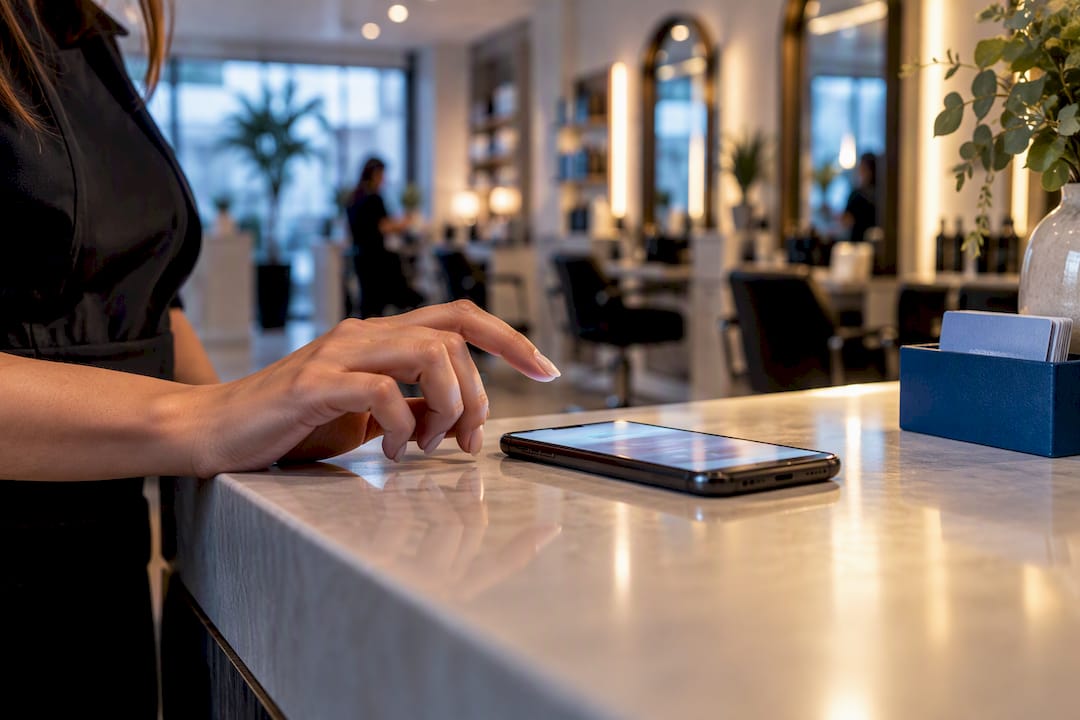
- Set up automated SMS reminders to cut no-shows and promote last-minute openings
- Post personality-driven social content with direct booking calls to action
- Launch limited-time package deals and dual-sided referral programs instead of blanket discounts
- Plan and test campaigns 3–4 months before peak season hits
- Track booking rates, client acquisition, and campaign ROI weekly
Stat to know: SMS appointment reminders get opened 98% of the time, compared to roughly 20% for email, and can cut no-shows by up to 33%.
Salons that build a connected marketing system around these touchpoints consistently outperform those that run random promotions. The checklist is not a one-time sprint. It is a repeatable system you refine each season.
How do you optimize your Google Business Profile for peak season?
86% of Google Business Profile views come from category-based searches like “balayage near me,” not from people typing your salon name. That one fact should change how you think about your profile. If your primary category is just “hair salon,” you are invisible to anyone searching for a specific service.
Fix your categories first. Add every service-specific category that applies: color correction, balayage, keratin treatment, nail salon, whatever you actually do. Then build out your services list with real descriptions and prices where possible.
Photos matter more than most owners realize. Post photos of actual work on actual clients, not your logo or your front door. Profiles ranking in the top three positions on Google Maps average significantly more images than those ranking in positions 11–20, so add new work weekly during peak season. For deeper guidance on this, Growthreachmarketing’s GMB optimization guide walks through every field worth filling out.
- Respond to every review within 24 hours, especially the negative ones
- Post a Google update weekly during peak season (a promotion, a new service, a seasonal offer)
- Add your seasonal hours before the rush, not during it
- Enable messaging so clients can ask questions without calling
Pro Tip: Local SEO compounds over time. Salons that maintain their Google Business Profile year-round, not just during peak season, see sustained ranking gains that make each peak period easier to capitalize on. Pair your profile work with a solid local SEO strategy to lock in those gains.
What email marketing strategies actually work for salons during peak season?
Segmentation is the difference between an email that books appointments and one that gets deleted. Sending the same message to every client on your list wastes your best asset. A client who came in for a balayage six months ago needs a different message than someone who booked a blowout last week.

Build at least three segments before your peak season campaign launches: lapsed clients (no visit in 90+ days), active regulars, and new clients from the past 60 days. Each group gets a different offer and a different subject line. Lapsed clients respond to “We miss you” angles with a specific incentive. Regulars want early access and loyalty rewards. New clients need social proof and a reason to rebook.
Subject lines drive open rates more than any other variable. Keep them under 40 characters, make them specific (“Your holiday color slot is filling fast”), and test two versions on a small segment before sending to your full list. A/B testing subject lines over two or three campaigns gives you real data on what your specific audience responds to.
- Send a “book early” campaign 6–8 weeks before your peak window opens
- Follow up non-openers with a different subject line three days later
- Include a direct booking link in every email, not just a link to your homepage
- Measure open rate, click rate, and actual bookings generated per campaign
Pro Tip: Email works best when it reinforces what clients are already seeing on your social channels and in their text messages. A client who sees your holiday package on Instagram, then gets an email about it two days later, and then receives an SMS reminder the week before the season starts is far more likely to book than one who only sees a single touchpoint.
Why is SMS marketing your most powerful peak season tool?
SMS is not just an admin tool for sending appointment confirmations. It is your highest-engagement marketing channel, and most salons use only a fraction of its potential. SMS open rates reach 98% versus roughly 20% for email, and automated text reminders can reduce no-shows by up to 33%. For a salon losing appointments to no-shows during its busiest weeks, that reduction alone pays for the entire system.
The numbers: SMS messages get opened 98% of the time, compared to about 20% for email. Automated reminders can cut no-shows by up to 33%.
Beyond reminders, SMS works for peak season in ways most owners overlook:
- Last-minute openings: A cancellation at 10 AM can be filled by 11 AM with a single text to your waitlist
- Seasonal promotion launches: “Holiday color packages are now bookable. Slots go fast.” sent to your full list drives immediate action
- Post-visit follow-ups: A text two weeks after a visit asking if they want to rebook before the holiday rush feels personal, not automated
- Exclusive early access: Loyal clients get a text before you open bookings publicly, which makes them feel valued and fills your calendar faster
Timing matters. Send reminders 48 hours before an appointment and again the morning of. For promotional texts, mid-morning on a Tuesday or Wednesday consistently outperforms weekend sends. Keep every message under 160 characters and always include a direct booking link.
How do you run social media and seasonal promotions that actually convert?
The stylist winning on social in 2026 is not the one with the most polished feed. Accounts with under 10,000 local followers regularly see engagement rates above 7%, compared to roughly 1.4% for accounts over 100,000. Personality and process beat production value every time.

Show the foiling. Show the consultation where the client changed her mind. Show the moment you pivoted the formula because the lighting revealed an undertone you did not expect. That content builds trust with potential clients before they ever walk through your door. Before-and-after transformations are still your strongest conversion content, but they land harder when paired with a 15-second clip of the process.
For seasonal promotions, avoid the “20% off everything” trap. A blanket discount trains clients to wait for sales and erodes your brand. Instead, run promotions that add value without cutting your core prices:
- Package a color service with a conditioning treatment at a combined price that feels like a deal
- Offer a free gloss add-on with any full-color booking made before a specific date
- Create a “holiday ready” bundle that groups your three most-booked services at a slight discount
- Run a gift card promotion with a bonus credit for the buyer (not just the recipient)
A dual-sided referral program outperforms blanket discounts on every metric that matters. Give the referring client a credit toward her next service and give the new client a discount on her first visit. It costs less than a 20% off promotion and brings in clients who are already pre-sold on your work.
Pro Tip: Paid social amplifies organic content that is already performing. Before you boost a post, check its organic engagement. A post with real comments and saves will convert far better with $50 behind it than a polished promotional graphic that got three likes organically. For Instagram-specific tactics, Growthreachmarketing’s Instagram SEO guide covers how to make your content discoverable beyond your existing followers.
How do you plan and track salon marketing campaigns for peak season?
Testing campaigns 3–4 months before peak season reveals booking flow issues, unclear messaging, and operational gaps that would otherwise cost you revenue during your busiest weeks. Most salons skip this step and discover problems when they can least afford to fix them.
Campaign planning starts with three decisions: your goal, your budget, and your channels. Set a specific, measurable target (fill 90% of available slots during the peak four-week window, or acquire 30 new clients in December). Then allocate your budget across channels based on where your current clients actually came from, not where you wish they came from.
| Campaign Phase | Key Actions | Metrics to Track |
|---|---|---|
| 3–4 months out | Set goals, build segments, test booking flow | Baseline booking rate, email list size |
| 6–8 weeks out | Launch email and SMS campaigns, update Google profile | Open rates, click rates, new bookings |
| 6–8 weeks before peak | Run social promotions, activate referral program | Referral conversions, social engagement |
| During peak | Monitor daily, fill cancellations via SMS | No-show rate, revenue per day |
| Post-peak | Analyze ROI, document what worked | Client retention rate, campaign ROI |
Track these four metrics every week during peak season: new client acquisition rate, returning client booking rate, no-show and cancellation rate, and revenue per available appointment slot. If your no-show rate climbs above your baseline, increase SMS reminder frequency. If new client bookings stall, check whether your Google Business Profile is current and whether your booking link is visible on every channel.
Quarterly reviews keep you from repeating the same mistakes. After each peak season, document what drove the most bookings, which promotions converted, and which channels underperformed. That data is worth more than any marketing template.
How do you avoid common marketing pitfalls and define your salon’s USP?
The most expensive mistake salon owners make during peak season is launching untested campaigns with no clear differentiation. You spend money, fill your calendar with one-time clients, and end the season with no measurable brand equity. The fix is defining your unique selling proposition before you write a single piece of marketing copy.
Your USP is not “great service” or “friendly staff.” Every salon claims those. A real USP is specific: you specialize in color correction for previously damaged hair, you are the only salon in your zip code offering a specific keratin system, or you run a luxury experience with guaranteed same-day appointments for regulars. That specificity attracts the clients who are willing to pay your prices and refer their friends.
Common pitfalls to avoid:
- Launching a peak season promotion without testing the booking flow first
- Offering blanket discounts that attract price-sensitive clients who never rebook at full price
- Posting inconsistently on social media during your busiest weeks because you ran out of content
- Ignoring Google reviews during peak season when new clients are actively researching you
- Trying to be on every channel instead of doing two or three channels well
Pro Tip: Define your USP in one sentence before you build any campaign. “We are the go-to salon in [city] for [specific service] for [specific client type].” Every piece of marketing copy you write during peak season should connect back to that sentence. Clients who find you through a specific USP are far more likely to rebook and refer.
The keyword strategy behind your online presence should reflect your USP directly. If you specialize in balayage, your Google profile, website, and social bio should all use that language consistently.
What local partnerships can do for your peak season bookings
Local partnerships give you access to audiences that already trust a business in your community, without the cost of paid advertising. A bridal boutique, a wedding photographer, a yoga studio, or a high-end clothing boutique all serve clients who overlap with yours. A cross-promotion during peak season, where each business promotes the other’s services to their own client list, can drive bookings that no amount of Instagram posts would generate.
The most effective partnerships are specific and reciprocal. Offer the partner business a genuine incentive for their clients (a first-visit discount or a complimentary add-on service) and ask for the same in return. A bridal boutique that hands a “complimentary trial blowout” card to every bride who books a dress fitting is sending you pre-qualified clients at zero cost.
Local events work the same way. Hosting a styling workshop at a boutique, co-sponsoring a community event, or participating in a neighborhood business fair puts your name in front of people who have never heard of you but are already in your geographic market. For deeper reach, Google Business Profile optimization ensures those new contacts can find and book you the moment they search.
How to build a referral program that fills your peak season calendar
A referral program works best when it rewards both sides of the transaction. Give the referring client a credit toward her next service and give the new client a discount on her first visit. That dual-sided structure outperforms generic discounts because it creates a reason for your existing clients to actively promote you, not just passively mention you.
Make the program trackable from day one. Use a unique code, a name field in your booking system, or a simple referral card with the referring client’s name on it. If you cannot measure it, you cannot improve it. After 90 days, check what percentage of new clients came through referrals. If it is under 5%, the incentive is too small or you are not reminding existing clients the program exists.
Remind clients about the referral program at three moments: at checkout after a great service, in your post-visit SMS follow-up, and in your pre-peak email campaign. Most referral programs fail not because the incentive is wrong but because clients simply forget the program exists.
Why online booking incentives convert hesitant clients
Roughly half of all salon bookings happen outside business hours. If a client remembers her roots are showing at 11 PM on a Tuesday and you are not bookable online, she books whoever is. That is not a marketing problem. It is a systems problem that marketing cannot fix.
Once your 24/7 online booking is in place, incentives turn browsers into confirmed appointments. A small discount for first-time online bookings, a free add-on for clients who book more than two weeks in advance, or priority slot access for clients who book through your app all reduce the friction between “I should book” and “I just booked.”
During peak season specifically, a “book early, save your spot” message with a clear deadline creates urgency without requiring a discount. Clients who value their preferred stylist and their preferred time slot will book early if you give them a reason to act now rather than wait.
How staff training drives upselling during your busiest weeks
Your front desk and your stylists are your highest-converting sales channel during peak season, and most salons underinvest in preparing them. A stylist who knows how to mention a conditioning treatment while applying color, or a receptionist who knows to ask “Would you like to add a gloss?” at checkout, generates more revenue per appointment than any promotional campaign.
Train your team on your peak season offerings at least two weeks before the rush starts. Walk through every package, every add-on, and every promotion so that every staff member can explain the value clearly and confidently. Role-play the upsell conversation so it feels natural, not scripted.
Set individual targets for add-on services and track them weekly. Tie a small incentive to hitting those targets, whether that is a bonus, a gift card, or public recognition at your morning briefing. Staff who understand the goal and have a personal stake in it perform differently than staff who are simply told to “mention the packages.”
How to create limited-time package deals that clients actually want
The best package deals solve a problem the client already has. A “holiday ready” package that combines a color refresh, a cut, and a blowout addresses exactly what a client is thinking in november: “I need to look good for the next six weeks of events.” That framing converts better than a generic “3 services for $X” offer.
Price your packages to feel like a deal without gutting your margins. A package priced at 10–15% below the sum of individual services gives the client a clear reason to book the bundle while preserving your revenue per appointment. Avoid discounting your highest-demand services. Discount the add-ons that have lower standalone demand instead.
Create scarcity honestly. “Available for bookings through december 20” or “limited to 20 packages this season” works when it is true. Clients respond to real deadlines. Fake urgency erodes trust the moment they notice it.
How do you set realistic booking capacity goals for peak season?
Start with your actual capacity, not your ideal capacity. Count your available appointment slots across all stylists for the peak period, subtract your historical no-show and cancellation rate, and set your goal as a percentage of that realistic number. Aiming for 95% fill rate when your historical peak is 78% sets you up for frustration and overpromising to clients.
Build a buffer for last-minute cancellations by keeping a short waitlist for every stylist. An SMS to your waitlist the moment a slot opens fills that appointment within minutes. During peak season, a filled cancellation is the difference between a good week and a great one.
Review your capacity goals weekly, not just at the end of the season. If you are tracking toward 110% of capacity in week two, you have a staffing problem brewing. If you are at 60% in week three, your promotional messaging needs to shift immediately. Weekly check-ins let you adjust before a problem becomes a loss.
Key Takeaways
A salon’s peak season results are determined by the systems built months before the rush, not by last-minute promotions launched the week before.
| Point | Details |
|---|---|
| Start 6–8 weeks early | Launch email and SMS campaigns well before peak season to secure top booking slots. |
| SMS outperforms email | SMS reminders get opened 98% of the time and can cut no-shows by up to 33%, protecting peak revenue. |
| Google profile drives discovery | 86% of Google Business Profile views come from category searches, not brand name searches. |
| Referrals beat blanket discounts | A dual-sided referral program outperforms generic 20% off promotions on every measurable metric. |
| Growthreachmarketing builds the system | Growthreachmarketing helps salons connect local SEO, campaign planning, and automation into one growth system. |
Peak season marketing is a project, not a campaign
Most salon owners treat peak season marketing as a sprint: a few Instagram posts, a discount email, and a hope that the calendar fills itself. The salons that consistently outperform their market treat it as a structured 3–4 month project with defined phases, measurable goals, and a system that compounds year over year.
The conventional wisdom says you need to be everywhere: paid ads, influencer partnerships, TikTok, email, SMS, Google, and a referral program all running simultaneously. That is the wrong frame. The salons I see growing predictably are doing fewer things with more consistency. They have a Google profile that is genuinely optimized, a booking system that works at midnight, an SMS sequence that runs automatically, and a referral program their clients actually know about. That is it. Four things, done well, every single week.
What gets overlooked is the compounding effect. A Google Business Profile updated weekly for 12 months does not just perform better during peak season. It performs better every week of the year, which means your peak season starts from a higher baseline. An email list that receives consistent, relevant communication does not just convert during the holidays. It converts in february and july too, because you have built a relationship, not just a list.
The other thing worth saying plainly: peak season is when your weakest systems get exposed. A booking flow that is slightly confusing costs you appointments when demand is high and clients have alternatives. A no-show rate that is manageable in a slow week becomes a revenue crisis in december. The checklist in this article is not just about capturing peak season revenue. It is about finding and fixing the gaps before they matter most.
Growthreachmarketing builds the marketing system behind your peak season
Filling your calendar during peak season takes more than a checklist. It takes a connected system where your Google profile, your booking flow, your content, and your campaigns all point in the same direction. That is exactly what Growthreachmarketing builds for salons.
Growthreachmarketing specializes in local SEO, Google Ads, content marketing, and booking automation for salons and beauty businesses across the United States. Where most agencies hand you a template and a monthly report, Growthreachmarketing builds the infrastructure that keeps your calendar full between peak seasons, not just during them. If your seasonal promotions are not showing up in local search, or your Google Business Profile is not converting views into bookings, those are fixable problems with a clear process. Explore Growthreachmarketing’s local SEO services for salons or reach out directly to talk through what your peak season plan is missing.
Recommended
- Salon Before After Photos Marketing: 2026 Guide – Growth Reach Marketing
- Salon Automation Marketing: Your 2026 Growth Guide – Growth Reach Marketing
- 1780736183123_Salon-owner-planning-marketing-strategies-outdoors – Growth Reach Marketing
- Types of Salon Target Audiences: 2026 Segmentation Guide – Growth Reach Marketing