
An aesthetic clinic growth strategy is the systematic approach a clinic uses to increase patient volume and revenue through visibility, trust, and conversion efficiency. Most clinic owners focus on one channel at a time and wonder why growth stalls. The real answer is that visibility, trust, and systems work as a unit. Clinics that master all three pillars reduce patient acquisition costs by 35–40% within 90 days. That is the benchmark separating practices that grow steadily from those that chase trends and burn budget.
What is an aesthetic clinic growth strategy built on?
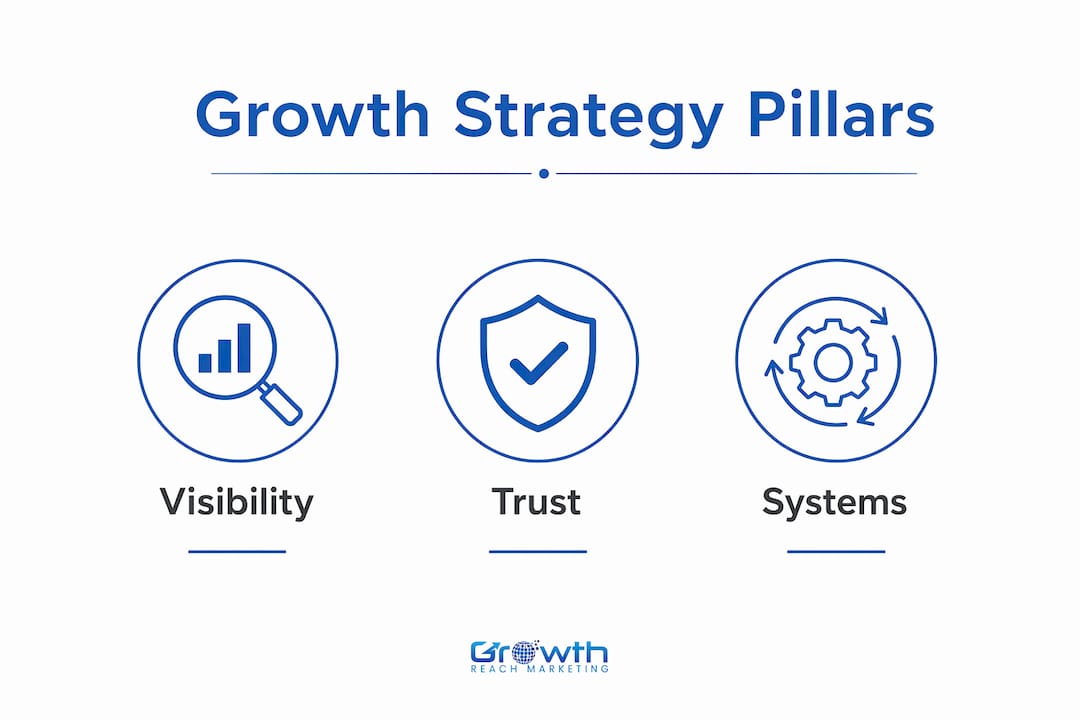
An aesthetic clinic growth strategy rests on three pillars: visibility, trust, and systems. Visibility means patients can find you when they search for treatments in your area. Trust means they choose you over the clinic down the street. Systems mean you convert inquiries into booked appointments and keep patients coming back without manual effort every time.
Each pillar feeds the next. A clinic with strong visibility but no trust signals loses patients at the research stage. A clinic with great reviews but no booking system loses them at the decision stage. Developing clinic growth strategies that address all three in sequence is the only way to build compounding results.
The industry has shifted. Patients in 2026 book based on trust built from consistent educational content, not just polished visuals. That shift changes where you spend your time and money.

How can local SEO and Google Business Profile optimization drive growth?
Local SEO consistently delivers the highest ROI for aesthetic clinics, with noticeable organic traffic growth appearing in 4–6 months. That timeline matters because it sets realistic expectations and prevents clinics from abandoning the channel too early.
Your Google Business Profile (GBP) is the first thing most local patients see. Treat it as a live asset, not a static listing. The clinics winning in local search update their GBP weekly with posts, add treatment photos regularly, and respond to every review within 24 hours.
Here are the core local SEO actions that move the needle:
- Accurate GBP information: Name, address, phone number, and hours must match your website exactly.
- Treatment-specific landing pages: Create a separate page for each treatment (for example, “lip filler in [city]”) with schema markup so Google understands the content.
- Review velocity: Automated SMS review requests sent 48 hours post-appointment can raise response rates to 40–60%. Most clinics ask once at checkout and leave it there.
- Location-specific content: Blog posts and FAQs that mention your suburb or city signal local relevance to Google.
| GBP Action | Expected Impact |
|---|---|
| Weekly posts with treatment photos | Improved local pack visibility |
| Automated SMS review requests | 40–60% review response rate |
| Treatment-and-location landing pages | Higher ranking for specific search terms |
| Schema markup on service pages | Better AI and featured snippet eligibility |
Pro Tip: Set a recurring calendar reminder every Monday to publish one GBP post. Clinics that post consistently outrank those that post in bursts.
For a deeper look at how local search ranking works for beauty and aesthetic businesses, the Growthreachmarketing guide on local SEO covers the full technical setup.
What role does social proof and patient trust play in growth strategies?
Social proof is the conversion engine inside every successful aesthetic clinic plan. Reviews, referral programs, and patient testimonials do not just look good. They directly determine whether a browsing patient books or keeps searching.
Structured referral programs yield 70% close rates compared to 30–40% for cold paid traffic. Referred patients also spend more per visit and return more frequently. That single data point should change how much budget you allocate to referral incentives versus paid ads.
“Patients referred by someone they trust arrive pre-sold. They have already heard a real experience, seen a real result, and made a decision before they even contact the clinic. No ad can replicate that level of trust at the same cost.”
Social media plays a supporting role here, but the content type matters. Educational posts, behind-the-scenes videos, and real patient stories outperform polished promotional content. Patients want to see the human side of your clinic before they trust you with their face.
- Automated review requests: Send via SMS 48 hours after each appointment.
- Referral cards or digital codes: Give every satisfied patient a simple way to refer a friend.
- Testimonial pages: Feature written and video testimonials on treatment-specific landing pages, not just a generic “reviews” page.
- Authentic social content: Post educational content explaining treatments, addressing common concerns, and showing real results with patient consent.
Pro Tip: Film a 60-second “what to expect” video for your three most popular treatments. Pin them to your Instagram profile and link them from your booking confirmation emails. Patients who watch these videos cancel less and arrive more prepared.
How do content marketing and AI search optimization support clinic growth?
Content marketing attracts patients who are researching before they are ready to book. These are high-quality leads because they are educating themselves, and the clinic that answers their questions best earns their trust first.
Displaying transparent pricing on your website increases conversion rates by 35–40% and reduces pre-appointment inquiries by 40%. That is a significant operational benefit. Fewer phone calls asking “how much does it cost?” means your front desk spends more time on patients who are ready to book.
The content types that perform best for aesthetic clinics include:
- Treatment comparison articles: “Botox vs. filler: which is right for you?” captures patients mid-research.
- Myth-busting posts: Addressing fears and misconceptions builds credibility faster than promotional copy.
- Pricing transparency pages: Ranges with explanations pre-manage expectations and reduce no-shows.
- FAQ sections with schema markup: These feed directly into Google’s featured snippets and AI search results.
| Content Type | Primary Benefit |
|---|---|
| Treatment comparison articles | Captures mid-funnel research traffic |
| Transparent pricing pages | 35–40% conversion rate increase |
| FAQ with schema markup | AI search and featured snippet eligibility |
| Myth-busting blog posts | Builds trust with hesitant patients |
For real-world examples of content that converts in the beauty and aesthetics space, Growthreachmarketing has published a detailed breakdown of formats and structures that work. The pricing page structure is also worth studying if you want to present costs in a way that moves patients toward booking rather than away.
What operational and system improvements maximize growth efficiency?
Operational systems are the least glamorous part of aesthetic practice growth strategies, and the most profitable. Acquiring a new patient costs 5–25 times more than retaining an existing one. A 5% increase in retention can yield a 25–95% profit boost. Those numbers make retention the highest-leverage activity in your entire business.
Here is a practical sequence for building retention systems:
- Automated booking confirmations and reminders: Reduce no-shows with SMS and email reminders sent 48 hours and 2 hours before each appointment.
- Rebooking nudges: Send a personalized message 4–6 weeks after a treatment suggesting the next appointment based on the specific service received.
- Membership or loyalty programs: Offer monthly memberships for regular treatments like skin boosters or maintenance facials. Members spend more and cancel less.
- Dormant lead reactivation: Patients who inquired but never booked, or who have not visited in 6+ months, respond well to targeted SMS or email campaigns. Reactivating dormant leads can generate 12–18% of monthly revenue with minimal acquisition cost.
- Personalized follow-up sequences: Reference the specific treatment each patient received. Generic “we miss you” messages underperform compared to messages that mention the patient’s last service.
Pro Tip: Segment your patient database by last visit date and treatment type before launching any reactivation campaign. A patient who had lip filler 8 months ago needs a different message than someone who had a facial 3 months ago.
How can paid advertising complement organic growth for immediate patient flow?
Paid advertising fills the gap while organic channels build momentum. Google Ads and Meta Ads targeting high-intent local keywords can deliver booked consultations within days of launch. The key word is “complement.” Clinics that run paid ads without organic foundations waste budget because there is nothing to catch patients who need more time to decide.
Paid ads targeting high-intent keywords achieve a target ROAS of 5:1 or higher when paired with treatment-specific landing pages. Generic homepage traffic converts poorly. A patient clicking an ad for “anti-wrinkle injections in [city]” needs to land on a page about exactly that treatment, with pricing, photos, reviews, and a clear booking call to action.
Common mistakes to avoid:
- Sending cold traffic directly to a booking page: Patients who do not know your clinic need a warm-up step, such as a consultation offer or a “what to expect” page.
- Using one ad for all treatments: Each treatment needs its own ad group, landing page, and tracking setup.
- Ignoring cost per booked consultation: Click-through rate and impressions are vanity metrics. Track cost per actual consultation booked.
- Skipping retargeting: Patients who visited your site but did not book are your warmest audience. Retargeting ads to this group cost less and convert better than cold traffic.
For clinics losing money on paid campaigns, the Growthreachmarketing analysis of why paid ad spend fails identifies the exact structural errors that drain budget without results.
Pro Tip: Allocate roughly 40% of your paid budget to awareness, 35% to consideration, and 25% to direct conversion campaigns. This staged structure mirrors how patients actually make decisions.
Key Takeaways
An aesthetic clinic growth strategy works when visibility, trust, and operational systems are built in sequence, not in isolation.
| Point | Details |
|---|---|
| Three-pillar foundation | Visibility, trust, and systems must all function together for sustainable growth. |
| Local SEO priority | Treatment-and-location pages plus active GBP deliver the highest ROI over 4–6 months. |
| Retention over acquisition | Retaining patients costs up to 25 times less than acquiring new ones. |
| Social proof drives conversion | Referral programs close at 70% versus 30–40% for cold paid traffic. |
| Content builds long-term trust | Transparent pricing and educational content increase conversion rates by 35–40%. |
What I have learned about building clinic growth that actually lasts
Most clinic owners I speak with have tried at least two or three marketing tactics before they find a system that works. They ran Google Ads for a month, posted on Instagram for a while, maybe hired someone to “do SEO.” None of it stuck because the tactics were not connected to each other.
The shift I keep seeing in 2026 is that patients are more skeptical and more informed than ever. They research treatments across multiple platforms before they contact a clinic. They read reviews, watch videos, check pricing, and look for evidence that the clinic is trustworthy. A single strong tactic does not satisfy all of those checkpoints.
What actually works is a 12-week rollout that starts with audits and GBP optimization, then builds trust signals, then adds paid acquisition once the foundation is solid. Clinics that skip the foundation and go straight to ads are essentially pouring water into a leaky bucket.
The other thing I want to be direct about: retention is where the real profit lives. Acquisition gets all the attention because it feels like growth. But a clinic that retains 80% of its patients and reactivates dormant ones consistently will outperform a clinic that constantly chases new patients at a much lower cost. The math is not close. Build the systems that keep patients coming back, and acquisition becomes a multiplier rather than a lifeline.
— Gerard
How Growthreachmarketing helps clinics build a real growth system
Growthreachmarketing works with aesthetic clinics to build the exact three-pillar system described in this article. That means AI-powered SEO, Google Ads built around treatment-specific landing pages, and content marketing that earns patient trust before they ever pick up the phone.
If your clinic is ready to move from scattered tactics to a connected growth plan, the Google Ads for medical aesthetics guide is a strong starting point for understanding how paid acquisition fits into a full strategy. For clinics focused on organic growth first, the SEO strategy for aesthetic clinics page outlines exactly where to begin. Growthreachmarketing builds systems that grow with your clinic, not campaigns that stop the moment the budget runs out.
FAQ
What is an aesthetic clinic growth strategy?
An aesthetic clinic growth strategy is a planned approach to increasing patient volume and revenue by building visibility in local search, establishing patient trust through social proof and content, and implementing systems that convert inquiries into bookings and retain existing patients.
How long does it take to see results from clinic growth strategies?
Local SEO typically shows noticeable organic traffic growth in 4–6 months. Paid advertising can deliver booked consultations within days, but works best once trust signals and landing pages are in place.
What is the most cost-effective way to grow an aesthetic clinic?
Patient retention is the most cost-effective growth lever. Acquiring a new patient costs 5–25 times more than retaining an existing one, and a 5% increase in retention can produce a 25–95% profit boost.
How do referral programs compare to paid ads for patient acquisition?
Structured referral programs close at 70% compared to 30–40% for cold paid traffic. Referred patients also spend more per visit and return more frequently, making referral programs a higher-value channel per dollar spent.
Why does transparent pricing improve conversion rates?
Displaying pricing ranges on your website increases conversion rates by 35–40% and reduces pre-appointment inquiries by 40%. Patients who see pricing upfront arrive better prepared and are less likely to cancel or no-show.