
Salon automation marketing is the practice of using software to handle client communications and marketing tasks automatically, without manual effort from you or your team. The industry term for this practice is “marketing automation,” and in the salon context it covers appointment reminders, rebooking prompts, birthday rewards, review requests, and reactivation campaigns. Salon owners who adopt these systems report that the automated marketing stack pays for itself within 60–90 days through recovered no-show revenue and stronger client retention. That payback speed makes automation one of the highest-return investments available in digital marketing for salons today.
What is salon automation marketing and how does it work?
Salon automation marketing is a system that sends the right message to the right client at the right time, triggered by their behavior or appointment data, with no manual input required. The core components are appointment reminders, rebooking messages, lifecycle campaigns, and review requests. Each one runs in the background while your team focuses on delivering services.
The foundation is your salon management software or booking platform. When a client books an appointment, the system triggers a confirmation message immediately. From that point, a sequence of timed messages runs automatically. Most salon marketing strategies that produce consistent revenue use this kind of trigger-based communication rather than manual outreach.
Automation works because it removes the human bottleneck. A front desk team can realistically follow up with a fraction of your client list each week. An automated system contacts every client, every time, without missing anyone. That consistency is what drives measurable results.
How do automated reminders cut no-shows and protect your schedule?
No-shows are one of the most expensive problems a salon faces. Automated appointment reminders reduce no-show rates from 15–20% down to 6–9% within the first month of implementation. That drop translates directly into recovered revenue on every working day.
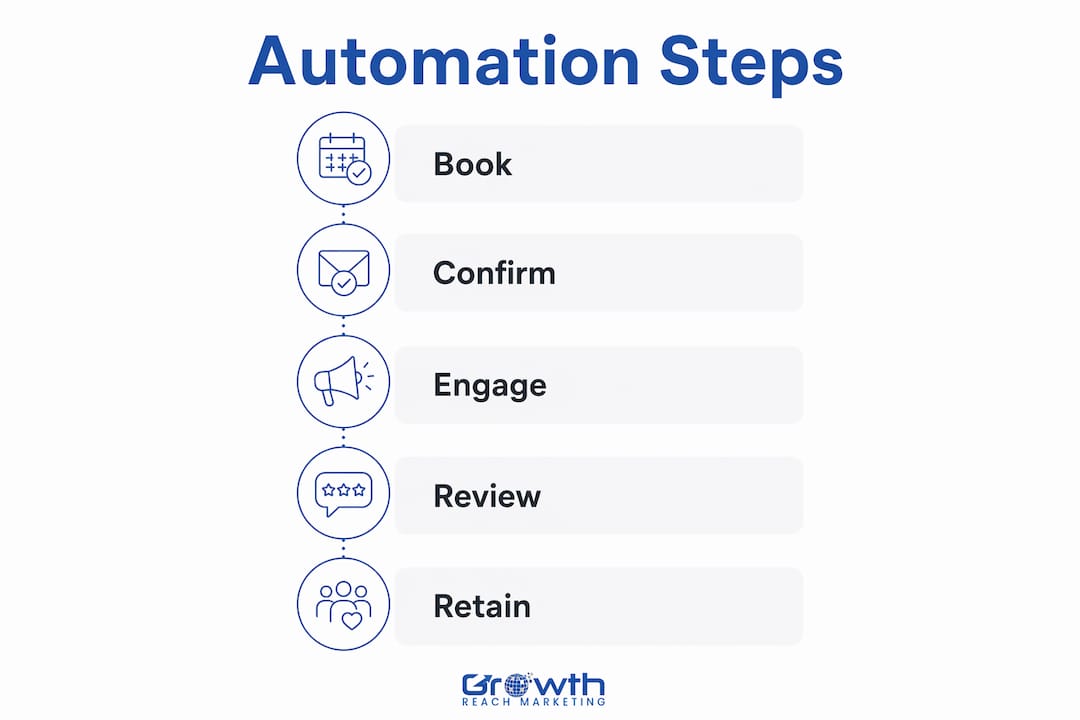
A well-built reminder sequence follows three steps:
- Immediate confirmation: Sent the moment a booking is made, confirming the date, time, stylist, and service. This sets expectations and reduces confusion.
- 48-hour reminder: Sent two days before the appointment with a confirm or cancel option. Clients who cancel early free up the slot for waitlisted clients.
- Same-day reminder: Sent the morning of the appointment. This is the final nudge that catches clients who forgot.
The confirm and cancel options inside the reminder are critical. When a client cancels 48 hours out, your system can automatically notify the next person on the waitlist and fill the slot. Without automation, that slot goes empty. With it, the chair stays productive.
Pro Tip: Personalize every reminder with the client’s first name and the specific service booked. “Hi Sarah, your balayage with Jessica is tomorrow at 2pm” outperforms a generic “You have an appointment tomorrow” every time.
SMS is the strongest channel for reminders. Automated SMS marketing achieves higher open rates than email or social media in salon client communications. That means your reminders are actually being read, not buried in an inbox.
How does lifecycle marketing keep clients coming back?
Lifecycle marketing is the practice of sending automated messages based on where a client is in their relationship with your salon. A new client gets a different message than a loyal regular, and a lapsed client gets a different message than both. This targeting is what separates effective automation from generic broadcast messaging.
The most effective lifecycle campaigns for salons include:
- Rebooking prompts: Sent 3–4 weeks after a service, based on the typical return interval for that treatment. Automated rebooking messages increase repeat bookings by 20–30%, reducing revenue lost to clients who leave without scheduling their next visit.
- Birthday rewards: A personalized discount or gift offer sent in the week before a client’s birthday. Birthday campaigns generate some of the highest redemption rates of any promotional message because they feel personal rather than commercial.
- “We Miss You” reactivation: Triggered when a client has not booked within a set window, typically 60–90 days past their usual return interval. These messages recover lapsed clients who simply forgot to rebook, not clients who left unhappy.
- Seasonal offers: Sent to segmented lists based on service history. A client who regularly books color treatments gets a pre-summer color promotion. A client who books cuts only does not receive that message.
Lifecycle campaigns fill calendars and keep bookings predictable up to 8 weeks in advance. That predictability lets you staff correctly, order supplies accurately, and plan promotions with confidence.
Pro Tip: Segment your client list by service type and visit frequency before building campaigns. A client who visits weekly for blowouts needs different messaging than one who comes in quarterly for a cut. Sending the wrong offer to the wrong segment wastes the message and can feel tone-deaf.
The ROI difference between one-time clients and retained clients is significant. A client who visits four times per year generates four times the revenue of a client who visits once and never returns. Lifecycle automation is the system that closes that gap at scale, without adding headcount.
For salons also running email campaigns, pairing lifecycle SMS with email marketing best practices creates a multi-channel approach that reaches clients through whichever channel they prefer.
How do automated review requests protect your reputation?
Your Google Business Profile rating directly affects how many new clients find and choose your salon. Automated review requests use a dual-path system: satisfied clients are directed to your Google review page, while dissatisfied clients are routed to a private feedback form. This protects your public rating while still capturing honest feedback internally.
The timing of the review request matters more than most salon owners realize. Sending the request 2–4 hours after the appointment, while the experience is still fresh, produces the highest response rates. A message sent the next day competes with a full inbox and a faded memory.
Key elements of an effective review request message:
- Personalization: Address the client by name and mention the specific service they received.
- Single clear action: Link directly to your Google review page. Do not ask clients to navigate there themselves.
- Private feedback path: If the client indicates dissatisfaction in a pre-screen question, route them to an internal form instead of the public platform.
Configuring feedback loops so that only positive experiences reach public platforms is a recognized best practice among salon marketing professionals. A salon with a 4.8-star average on Google ranks higher in local search results and converts more profile visitors into booked appointments than a salon with a 4.1-star average.
Pro Tip: Do not send review requests after every single visit for high-frequency clients. A client who comes in weekly for a blowout does not need a review request every time. Set a minimum interval of 60–90 days between review requests per client to avoid fatigue.
A strong review strategy pairs naturally with a broader online review approach that covers how to respond to reviews, handle negative feedback, and build long-term authority on Google.
How does automation fit into your broader digital marketing strategy?
Automation does not replace your other marketing channels. It amplifies them. Integrating automation with local SEO, social media, and paid ads produces stronger client acquisition results than any single channel alone.
Local SEO determines whether new clients find your salon when they search “hair salon near me” on Google. A well-optimized Google Business Profile, consistent NAP (name, address, phone) data across directories, and regular review activity all contribute to local ranking. Automation feeds the review activity component automatically, which means your SEO improves as a byproduct of your client communication system.
Paid ads on Google bring new clients to your booking page. Once they book, automation takes over: confirming the appointment, reminding them before the visit, and following up afterward with a rebooking prompt and review request. The paid ad acquires the client. The automation system retains them. For salons running Google Ads, pairing paid campaigns with salon Google Ads best practices ensures the traffic you pay for converts into long-term clients rather than one-time visitors.
| Digital marketing element | How automation adds value |
|---|---|
| Local SEO | Automated review requests build Google rating and improve local ranking |
| Google Ads | Post-booking automation retains clients acquired through paid traffic |
| Social media | Seasonal campaign content aligns with automated promotional messages |
| Email marketing | Lifecycle email sequences complement SMS reminders for multi-channel reach |
| Booking platform | Automation triggers run directly from booking data in real time |
Tracking performance across these channels requires setting clear benchmarks before you launch. Measure no-show rate, rebooking rate, review count, and average client visit frequency monthly. Those four numbers tell you whether your automation system is working and where to adjust.
Key Takeaways
Salon automation marketing delivers measurable ROI when it combines appointment reminders, lifecycle campaigns, and review requests into one connected system.
| Point | Details |
|---|---|
| Reminders cut no-shows | Automated sequences reduce no-show rates from 15–20% down to 6–9% within the first month. |
| Lifecycle campaigns retain clients | Rebooking prompts and reactivation messages increase repeat bookings by 20–30%. |
| Review automation protects ratings | Dual-path routing sends satisfied clients to Google and dissatisfied clients to private forms. |
| Automation pays back fast | Most salons recover the investment within 60–90 days through retained revenue. |
| Integration multiplies results | Automation paired with local SEO and paid ads produces stronger acquisition and retention than either alone. |
Why most salons underuse their best marketing asset
The most common mistake I see salon owners make is treating automation as a set-it-and-forget-it tool. They configure the basic reminder sequence, see the no-show rate drop, and stop there. That is leaving the majority of the value on the table.
The real power of automation is in the lifecycle layer: the rebooking prompts, the birthday campaigns, the reactivation messages. Those are the sequences that compound over time. A salon that runs all three consistently for 12 months builds a client base that books predictably, without the owner having to run a new promotion every week to fill the calendar.
The other mistake is over-automating at the expense of the client relationship. Automation should feel personal, not robotic. If your messages read like they came from a machine, clients disengage. Every message should use the client’s name, reference their actual service history, and sound like it came from someone who knows them. That tone is achievable with good segmentation and message templates. It takes more setup time upfront, but the retention numbers justify it.
Start with the reminder sequence. Get no-shows under control first. Then layer in rebooking prompts. Then add the lifecycle campaigns. Build the system in stages so you can measure the impact of each addition. Reputation management through automated review requests should go live early, because your Google rating affects every other marketing channel you run.
— Gerard
How Growthreachmarketing helps salons build marketing systems that grow
Growthreachmarketing works with salons and beauty clinics to build the full marketing system: automation, SEO, content, and paid ads working together. If your salon is running promotions without an SEO foundation behind them, you are paying to acquire clients who may never find you organically again.
A strong starting point is understanding why seasonal promotions need an SEO strategy before you run them. Growthreachmarketing builds the search visibility and automation infrastructure that makes every promotion more effective and every new client more likely to return. Reach out to discuss what a connected marketing system looks like for your salon.
FAQ
What is salon automation marketing in simple terms?
Salon automation marketing is the use of software to send appointment reminders, rebooking prompts, review requests, and promotional messages to clients automatically, based on their booking behavior and service history.
How quickly does salon marketing automation pay for itself?
Most salons see the investment recovered within 60–90 days through reduced no-show revenue loss and increased client return rates.
Which automation channel works best for salon client communication?
Automated SMS achieves higher open rates than email or social media for salon client communications, making it the most reliable channel for reminders and rebooking prompts.
How does automated review management protect a salon’s reputation?
The system routes satisfied clients to your Google review page and sends dissatisfied clients to a private feedback form, preventing negative experiences from appearing publicly while still capturing internal feedback.
Do I need separate software for each automation function?
Most salon management platforms include built-in automation for reminders, rebooking, and review requests. For more advanced lifecycle campaigns, dedicated marketing automation tools can integrate with your existing booking system.
Recommended
- What Is a Salon Marketing Funnel? 2026 Guide – Growth Reach Marketing
- Types of Salon Target Audiences: 2026 Segmentation Guide – Growth Reach Marketing
- 1781580788227_Salon-owner-reviewing-marketing-funnel-tools – Growth Reach Marketing
- What Is Salon Content Marketing? 2026 Guide – Growth Reach Marketing