
A keyword strategy is the system that matches your salon’s services to the exact phrases potential clients type into Google when they are ready to book. Without one, your website competes for attention using generic terms that attract browsers, not buyers. Salons that build a focused keyword strategy around service-specific and location-based terms consistently outrank competitors and fill their appointment books. Growthreachmarketing works with salons daily on this exact problem, and the pattern is clear: ranking for generic terms is far less effective than targeting specific, high-intent phrases that match where a client is in their decision process.
Why salons need keyword strategy to compete on Google
Keyword strategy for salons is not the same as general SEO. Salon SEO differs because the search intent is almost always booking, not browsing. A person searching “balayage salon Chicago” is not doing research. They want an appointment. That distinction changes everything about which keywords you should target.
The Salon Booking Funnel Audit is a useful framework here. It breaks the client journey into three steps: rank, click, and book. Each step depends on keyword choices.
- Rank: Your page must appear for the right search term. Targeting “hair salon” alone puts you against thousands of competitors. Targeting “balayage specialist in Austin” narrows the field dramatically.
- Click: Your page title and meta description must match the searcher’s intent closely enough to earn the click. Keyword alignment here directly affects your click-through rate.
- Book: Once a visitor lands on your page, the content must confirm they found exactly what they searched for. Mismatched keywords create bounce rates, not bookings.
Keyword relevance also affects your Google Maps ranking. Google’s local algorithm weighs how well your Google Business Profile and website content match a searcher’s query. Salons that align service keywords across their website and profile consistently appear higher in the local pack.
Pro Tip: Review your Google Business Profile services section and write a unique description for each service. “Balayage color service for brunettes” performs better in local search than a plain listing of “balayage.”
How competitor keyword analysis sharpens your salon strategy
Competitor keyword analysis is the practice of studying which search terms are driving traffic and bookings to other salons in your market. It removes guesswork from keyword selection and replaces it with real data.
- Identify your top local competitors. Search your core services in Google and note which salons appear consistently in the top three results and the local pack.
- Analyze their page titles and headings. These reveal the exact keywords they are targeting. A competitor ranking for “keratin treatment specialist Brooklyn” has already validated that phrase for your market.
- Find content gaps. If no competitor has a dedicated page for “natural hair color specialist” in your city, that gap is an opportunity you can fill first.
- Track changes over time. Competitor keyword strategies shift as trends evolve. Reviewing competitor content quarterly keeps your own strategy current.
Competitor analysis reveals which keywords generate real bookings in your specific market, not just which terms have high search volume nationally. That distinction matters because a keyword with modest national volume can drive significant local traffic if your competitors have ignored it. Using competitor data also gives you a clear direction for content creation, so you build pages that address proven demand rather than guessing what clients want.
The role of competitor keywords in salon strategy goes beyond copying what works. It shows you where the market is underserved, which is where the real growth happens.

Why long-tail keywords matter most for salon bookings
Long-tail keywords are search phrases that are longer and more specific than broad terms. “Hair salon” is a broad term. “Affordable balayage for thick hair in Los Angeles” is a long-tail keyword. The difference in conversion potential is significant.
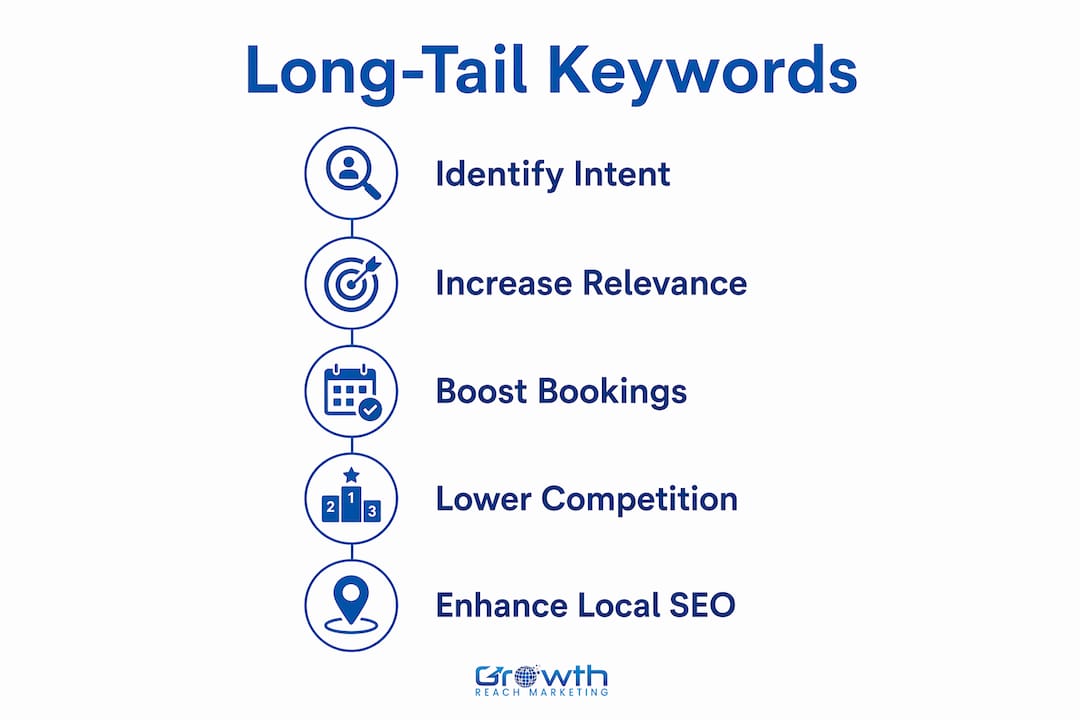
Long-tail keywords target clients who are closer to booking because the specificity of their search reflects a specific need and a clear intent to act. They also face lower competition, which means a well-written service page can rank on page one without years of SEO work.
The role of long-tail keywords for salons shows up most clearly in three places:
- Service pages: Write a dedicated page for each core service and include location and detail. “Highlights for fine hair in Denver” beats “highlights” every time for conversion.
- Google Business Profile: Add each service with a unique description that includes the specific technique and hair type where relevant.
- Blog content: Answer specific questions clients ask, such as “how long does a keratin treatment last for curly hair.” These posts rank for long-tail queries and build authority.
| Broad keyword | Long-tail alternative | Why it converts better |
|---|---|---|
| Hair color | Balayage for dark hair in Seattle | Matches specific client need and location |
| Haircut | Curly hair specialist in Miami | Targets a defined hair type and city |
| Hair treatment | Keratin treatment for frizzy hair Austin | Combines service, benefit, and location |
| Salon near me | Natural hair salon in Brooklyn | Adds specificity that filters for intent |
Pro Tip: Use Google’s “People also ask” and autocomplete suggestions to find long-tail phrases your clients are already searching. Type your core service into Google and note every suggestion that includes a location or hair type.
How visual content multiplies the power of keyword-targeted pages
Keywords get clients to your page. Photos convince them to book. These two elements work together, and ignoring either one costs you appointments.
Profiles with 50 or more quality client photos significantly outperform profiles that rely only on text optimization for bookings. The reason is straightforward: a client searching “blonde specialist in Nashville” wants to see blonde results before they commit. A keyword-matched page with no photos answers the search query but fails the trust test.
Here is how to connect visual content with your keyword strategy effectively:
- Name your image files with keywords. A file named “balayage-brunette-chicago.jpg” signals relevance to Google’s image index.
- Write descriptive alt text. Alt text like “balayage color result on brunette hair, Chicago salon” serves both accessibility and SEO.
- Organize photos by service. Group before-and-after photos on the relevant service page, not just in a general gallery.
- Update photos regularly. Fresh photos signal an active business to Google and give returning visitors new proof of your work.
Visual proof combined with keyword-optimized content produces higher engagement and booking rates than either element alone. Clients who see stylist results alongside a page that matches their search query convert at a measurably higher rate. This is why salon content marketing that pairs strong photography with targeted copy consistently outperforms text-only approaches.
Key Takeaways
A focused keyword strategy built around service-specific, location-based, and long-tail terms is the single most direct path from Google search to booked appointment for salons.
| Point | Details |
|---|---|
| Intent beats volume | Target booking-intent keywords like “balayage specialist in [city]” over generic high-volume terms. |
| Competitor analysis removes guesswork | Study which keywords drive local bookings for competitors, then fill the gaps they have missed. |
| Long-tail keywords convert faster | Specific phrases like “keratin treatment for curly hair Austin” attract clients ready to book now. |
| Google Business Profile matters | Add unique service descriptions with specific keywords to rank higher in local map searches. |
| Visuals close the deal | Pair keyword-optimized pages with 50 or more quality photos to convert searchers into clients. |
What I have learned from watching salons win and lose on Google
Salon owners often ask me whether they should focus on getting more traffic or better traffic. The answer is always better traffic. I have seen salons with modest website traffic fill their books every week because every visitor who found them was searching for exactly what they offer. I have also seen high-traffic salon websites with empty appointment slots because their keywords attracted curiosity, not commitment.
The mistake I see most often is chasing broad keywords because they look impressive in a traffic report. Ranking on page one for “hair salon” in a major city sounds like a win. But a client searching that phrase might be in a different neighborhood, looking for a different service, or just browsing. A client searching “blonde balayage specialist in [your city]” is ready to book today.
Competitor keyword analysis is the step most salon owners skip entirely. They build their keyword list based on what they think clients search, not what the data shows. Spending two hours reviewing the top-ranking salons in your market tells you more than any keyword tool alone. You see which service pages they have built, which terms they repeat in headings, and where they have left obvious gaps.
The Google Business Profile is also chronically underused. Most salons list their services with one-word labels. Adding a two-sentence description to each service, written with the specific technique and client type in mind, is one of the fastest ways to improve local search rankings without touching your website. Pair that with a consistent photo upload schedule and you have a profile that outperforms most competitors without a single paid ad. For salons thinking about filling chairs through marketing, keyword strategy is the foundation everything else builds on.
— Gerard
How Growthreachmarketing helps salons turn keyword strategy into booked appointments
Growthreachmarketing builds keyword strategies specifically for salons, aesthetic clinics, and beauty businesses. The process starts with a full audit of your current rankings, your competitors’ keyword positions, and the gaps in your Google Business Profile.
From there, Growthreachmarketing creates service pages, profile descriptions, and content built around the long-tail and location-based keywords that drive actual bookings in your market. Every piece of content is tied to the rank-click-book framework so your SEO investment produces appointments, not just traffic. If you want to see how seasonal SEO planning fits into a year-round keyword strategy, that resource covers the full picture. Salons that work with Growthreachmarketing stop guessing which keywords work and start building on what the data proves.
FAQ
Why does keyword strategy matter more for salons than other businesses?
Salon clients search with booking intent, not research intent. Keyword strategy for beauty salons must match that intent by targeting service-specific and location-based phrases that capture clients at the decision stage.
What are the best long-tail keywords for a hair salon?
The most effective long-tail keywords combine a specific service, a hair type or characteristic, and a city. Examples include “balayage for dark hair in Chicago” or “keratin treatment for curly hair in Austin.”
How does competitor keyword analysis help a salon grow?
Competitor analysis reveals which keywords are already driving bookings in your local market. It identifies content gaps you can fill and removes the guesswork from deciding which service pages to build.
How do I use my Google Business Profile for keyword strategy?
Add a unique, descriptive sentence to each service listing on your Google Business Profile. Specific descriptions that name the technique and client type rank higher for relevant local searches than generic one-word labels.
How many photos does a salon need for better SEO results?
Profiles with 50 or more quality client photos significantly outperform those with fewer images for local booking conversions. Organize photos by service and update them regularly to signal an active business to Google.