Omnichannel marketing is defined as the practice of integrating every patient touchpoint, from Instagram ads and Google Business Profile to SMS reminders and in-clinic consultations, into a single, coordinated experience. Aesthetic clinics that adopt this approach rather than running disconnected channels can reduce patient acquisition costs by 35% to 40% within 90 days. The difference between clinics that grow predictably and those that plateau often comes down to whether their marketing speaks with one voice or five competing ones. Tools like CRM platforms, Google Business Profile, and automated SMS follow-ups are not optional add-ons. They are the infrastructure that makes sustainable growth possible.
Why aesthetic clinics need omnichannel marketing to build trust
The core goal of omnichannel marketing in aesthetics is building patient trust by aligning what your clinic says online with what patients experience in person. A prospective patient might discover your clinic through a TikTok video, research you on Google, read your reviews, receive a consultation reminder via SMS, and then walk through your door. If any of those touchpoints contradict each other in tone, offer, or information, you lose the booking.
Unified patient data across clinical and marketing systems is what makes personalized communication possible rather than intrusive mass messaging. When your CRM knows a patient had a hydrafacial three months ago, your email campaign can send a timely reactivation message about a complementary treatment. That is not just good marketing. It is the kind of helpful communication that builds loyalty.

Patient retention deserves more attention than most clinic owners give it. Retaining an existing patient costs 5 to 25 times less than acquiring a new one, and a 5% increase in retention can boost profit by 25% to 95%. Those numbers explain why relational marketing, built on loyalty programs and personalized follow-ups, consistently outperforms transactional discounting.
The patient journey in aesthetics is rarely linear. Consider these touchpoints where integrated messaging makes or breaks the relationship:
- Discovery: Paid social ads on Instagram or TikTok introduce your clinic to cold audiences
- Research: Google Business Profile reviews, your website, and before/after content build credibility
- Conversion: A treatment-specific landing page with a clear booking call-to-action closes the lead
- Retention: Post-treatment SMS check-ins and email newsletters keep patients engaged between visits
- Advocacy: Automated review requests sent 48 hours after appointments generate the social proof that fuels the next patient’s discovery
Pro Tip: Map your patient journey before you build any campaign. Identify where patients drop off, and fix those gaps first. A leaky funnel wastes every dollar you spend on acquisition.
Omnichannel vs. multichannel: why the difference matters for clinics
Multichannel marketing means your clinic is present on multiple platforms. Omnichannel marketing means those platforms work together. The distinction sounds subtle but the business impact is significant.
A clinic running multichannel marketing might post on Instagram, send email newsletters, and run Google Ads independently. Each channel has its own content calendar, its own messaging, and no shared data. A patient who clicks a Google Ad and then searches your Instagram sees two different versions of your brand. That inconsistency erodes trust before a consultation even happens.
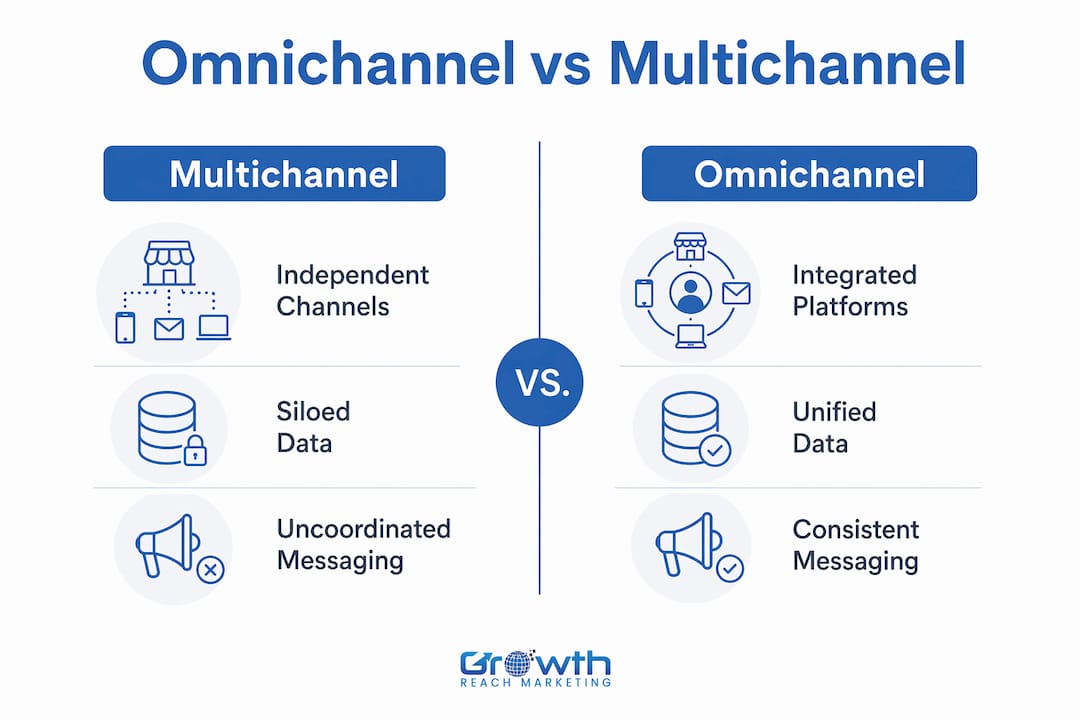
Omnichannel integration means a patient who books a consultation through your Google Ad is automatically added to your CRM, receives a branded confirmation SMS, gets a pre-appointment email with preparation tips, and is followed up post-treatment with a review request. Every channel reinforces the same patient experience rather than operating in isolation.
| Feature | Multichannel | Omnichannel |
|---|---|---|
| Channel coordination | Independent, siloed | Integrated, data-connected |
| Patient data | Fragmented per platform | Unified golden record |
| Messaging consistency | Variable by channel | Consistent across all touchpoints |
| Cost-per-acquisition | Higher due to duplication | Lower through shared attribution |
| Patient retention | Reactive | Proactive and automated |
| Campaign performance visibility | Limited | Full attribution via UTM tracking |
Pro Tip: Before transitioning to omnichannel, audit your existing channels for messaging conflicts. Inconsistent pricing, outdated before/after photos, or different tone of voice across platforms are the first things to fix.
What technology does an aesthetic clinic need for omnichannel?
Effective omnichannel marketing in aesthetic clinics depends on data integration across four core systems: CRM, electronic health records (EHR), billing software, and marketing automation tools. When these systems share data, you create what the industry calls a “golden record,” a single, accurate patient profile that informs every communication.
The move from multichannel to omnichannel in healthcare requires integrated data sharing between EHR, CRM, billing, and marketing tools to personalize communications at scale. Clinic management platforms like Consentz and PatientPerfect include marketing automation modules that handle appointment reminders, recall notifications, and post-treatment follow-ups without manual input. That automation frees your front desk to focus on the patient in the room rather than the one who needs a reminder email.
Key technology components every aesthetic clinic should evaluate:
- CRM with marketing automation: Tracks patient history, automates follow-up sequences, and segments audiences for targeted campaigns
- EHR and CRM integration: Enables HIPAA-compliant messaging based on actual visit history rather than marketing clicks alone
- Google Business Profile management: Controls local search visibility and patient review aggregation
- AI chatbots: Handle after-hours inquiries and pre-qualify leads before they reach your booking system
- Treatment-specific landing pages: Paired with high-intent keywords, these pages support a target ROAS of 5:1 on paid campaigns
| Technology | Primary function | Omnichannel benefit |
|---|---|---|
| CRM platform | Patient data and automation | Unified communication history |
| EHR integration | Clinical record access | Personalized, compliant messaging |
| Google Business Profile | Local search and reviews | Trust signals at discovery stage |
| SMS automation | Post-appointment follow-up | Retention and review generation |
| Paid ad platform | Acquisition campaigns | Treatment-specific targeting |
Using a unified taxonomy with consistent campaign naming and UTM parameters allows clinics to track service-level revenue accurately across locations and channels. Without that structure, you cannot tell which channel drove a booking, and you cannot optimize what you cannot measure.
How to implement omnichannel strategies for your aesthetic clinic
Building an omnichannel system does not require doing everything at once. The clinics that execute this well start with their highest-volume channels and expand from there.
-
Audit your current channels. List every platform where patients interact with your clinic, including Google, Instagram, email, SMS, and your website. Identify which channels have the most engagement and which have inconsistent messaging.
-
Prioritize by audience behavior. 80% of aesthetic clinicians use Instagram as their primary acquisition channel, with TikTok growing fastest for educational content. Start where your patients already are, then build outward.
-
Build your content strategy around education and trust. Before/after photos, treatment explainers, and patient testimonials perform better than promotional posts because they answer the questions patients are already asking. Beauty clinic content that educates converts at a higher rate than content that sells directly.
-
Automate your patient journey touchpoints. Set up automated sequences for new leads, post-treatment follow-ups, and recall notifications at 3, 6, and 12 months. SMS review requests sent 48 hours post-appointment consistently improve social proof and patient engagement.
-
Launch membership and loyalty programs. Shifting from one-off treatments to membership models creates predictable revenue and deepens patient relationships. Relational marketing through loyalty programs builds sustainable growth that discounting cannot replicate.
-
Structure paid campaigns for measurable returns. Use geo-targeting, treatment-specific keywords, and dedicated landing pages. For multi-location clinics, availability-based bid adjustments that respond to real-time appointment capacity can accelerate growth by 30% to 50%.
-
Measure, attribute, and iterate. Set up UTM parameters on every campaign link. Review channel performance monthly and reallocate budget toward the channels generating the lowest cost-per-acquisition.
Pro Tip: Do not launch paid ads until your Google Business Profile is fully optimized with current photos, accurate hours, and a minimum of 20 recent reviews. Paid traffic sent to a weak local presence wastes budget.
Key takeaways
Aesthetic clinics that integrate their marketing channels into a unified omnichannel system consistently outperform those running disconnected campaigns on acquisition cost, retention, and patient lifetime value.
| Point | Details |
|---|---|
| Omnichannel reduces acquisition cost | Clinics combining visibility, trust, and conversion systems cut cost-per-acquisition by 35% to 40% in 90 days. |
| Retention beats acquisition economics | Keeping a patient costs up to 25 times less than acquiring one; retention focus directly improves profit margins. |
| Technology integration is non-negotiable | CRM, EHR, and marketing automation must share data to create personalized, HIPAA-compliant patient communications. |
| Channel consistency builds trust | Patients who encounter conflicting messaging across platforms convert at lower rates and churn faster. |
| Automation scales what humans cannot | Automated SMS follow-ups, review requests, and recall notifications maintain engagement without adding headcount. |
Why I think most aesthetic clinics are leaving serious money on the table
After working with beauty clinics and aesthetic practices across different markets, the pattern I see most often is not a lack of marketing effort. It is fragmented effort. A clinic will invest in Instagram content, run a Google Ads campaign, and send occasional email blasts, but none of those channels talk to each other. The result is a patient experience full of gaps and inconsistencies that erode trust before a consultation ever happens.
The clinics I have seen grow most predictably are not the ones with the biggest ad budgets. They are the ones that treat every patient interaction as part of a single, continuous conversation. When a patient books online, gets a branded confirmation, receives a preparation guide, and then a follow-up message after their treatment, they feel looked after. That feeling is what drives referrals, repeat bookings, and five-star reviews.
The other shift worth noting is the move away from discount-led promotions. Clinics that compete on price attract price-sensitive patients who leave the moment a competitor offers a better deal. Clinics that compete on experience and relationship retain patients for years. Membership programs, personalized recall campaigns, and educational content are the tools that build that kind of loyalty. They require more upfront thinking but far less ongoing discounting.
The technology to do all of this exists and is more accessible than most clinic owners realize. The barrier is not cost or complexity. It is knowing where to start and having a clear system to follow.
— Gerard
How Growthreachmarketing helps aesthetic clinics grow with omnichannel strategies
Growthreachmarketing works specifically with aesthetic clinics, salons, and beauty brands to build the kind of integrated marketing systems described in this article. From Google Business Profile optimization and AI-powered SEO to Google Ads campaigns with treatment-specific landing pages, every service is designed to reduce your cost-per-acquisition and increase patient lifetime value.
If your clinic is running disconnected channels and not seeing the retention or booking numbers you want, the issue is almost always a structural one. Growthreachmarketing builds the systems that connect your channels, automate your patient journey, and give you clear visibility into what is working. Start with your seasonal promotion strategy or explore how Google Business Profile optimization can improve your local search visibility today.
FAQ
What is omnichannel marketing for aesthetic clinics?
Omnichannel marketing for aesthetic clinics is the practice of connecting every patient touchpoint, including social media, email, SMS, paid ads, and in-clinic experience, into a single, coordinated system. The goal is a consistent, personalized patient journey from first discovery through long-term retention.
How does omnichannel differ from multichannel marketing?
Multichannel marketing means being present on multiple platforms independently. Omnichannel means those platforms share data and deliver a consistent experience. The key difference is integration: omnichannel uses a unified patient record to personalize every communication across every channel.
What tools do aesthetic clinics need for omnichannel marketing?
Aesthetic clinics need a CRM platform, EHR integration, marketing automation software, Google Business Profile management, and treatment-specific landing pages. Platforms like Consentz and PatientPerfect offer clinic-specific modules that handle automation while maintaining HIPAA compliance.
How quickly can omnichannel marketing reduce patient acquisition costs?
Clinics that combine visibility, trust signals, and conversion systems can reduce cost-per-acquisition by 35% to 40% within 90 days. The fastest gains typically come from fixing inconsistent messaging and adding automated post-treatment follow-ups that improve retention.
Which social media channels should aesthetic clinics prioritize?
Instagram remains the primary acquisition channel for 80% of aesthetic clinicians, while TikTok is the fastest-growing platform for educational content. Both should feed into a broader omnichannel system that connects social discovery to booking, follow-up, and retention.