

HIPAA is a federal law that restricts how healthcare marketers can use patients’ Protected Health Information (PHI) in digital marketing campaigns, requiring explicit patient authorization in most cases. For digital marketers and business owners operating in healthcare sectors, understanding what HIPAA means for digital marketing is not optional. The Health Insurance Portability and Accountability Act governs every touchpoint where patient data intersects with advertising, email, tracking pixels, and ad platforms. Get it wrong and you face Office for Civil Rights (OCR) penalties that can reach into the millions. Get it right and you can still run data-driven, high-performing campaigns.
What does HIPAA mean for digital marketing?
HIPAA defines marketing as any communication that encourages the purchase or use of a product or service, and requires patient authorization when PHI is used in that communication unless a specific exception applies. This is the foundational rule every healthcare marketer must internalize before building a single campaign.
PHI is broader than most marketers assume. Under HIPAA, PHI includes 18 categories of identifiers linked to health information: names, phone numbers, email addresses, IP addresses, device IDs, and user IDs all qualify. The combination of an IP address and a visit to a healthcare-related webpage is classified as PHI exposure by HHS OCR. That means a standard Google Analytics pixel on a patient portal page can trigger a compliance violation without any additional action on your part.
Three exceptions exist where authorization is not required:
- Treatment communications. A covered entity can communicate with patients about treatment options, care coordination, or case management without authorization.
- Nominal promotional gifts. Gifts of nominal value given without requiring any action from the patient are permitted.
- Refill reminders. Prescription refill reminders and similar communications are allowed without authorization provided the covered entity receives no financial remuneration from a third party for sending them.
Financial remuneration changes everything. When a third party pays a covered entity to send marketing communications using PHI, explicit authorization is required with no exceptions. The authorization must also disclose that remuneration is involved.
How common digital marketing tactics interact with HIPAA
Most digital marketing tactics that work brilliantly in retail or e-commerce become compliance risks the moment PHI enters the picture. The table below maps common tactics to their HIPAA status.

| Marketing tactic | HIPAA compliance status | Key requirement |
|---|---|---|
| Email campaign to patient list | Requires authorization if PHI is used | Specific HIPAA authorization, not a general consent form |
| Facebook Custom Audiences from patient data | Non-compliant without a BAA | Meta does not sign BAAs; de-identification required |
| Google Ads remarketing via pixel on patient portal | High risk without safeguards | Pixel must be removed or a compliance layer applied |
| Prescription refill SMS reminder | Permitted without authorization | No third-party remuneration involved |
| Sponsored content paid for by a pharma brand | Requires authorization | Financial remuneration triggers full authorization requirement |
Uploading patient data or hashed identifiers to advertising platforms without Business Associate Agreements (BAAs) or explicit authorization is one of the most common violations leading to legal penalties. Hashed emails and phone numbers used to build custom audiences on Meta or Google still constitute PHI because they can be re-identified. Neither Meta nor Google currently signs BAAs, which means any direct upload of patient-derived data to those platforms is non-compliant.
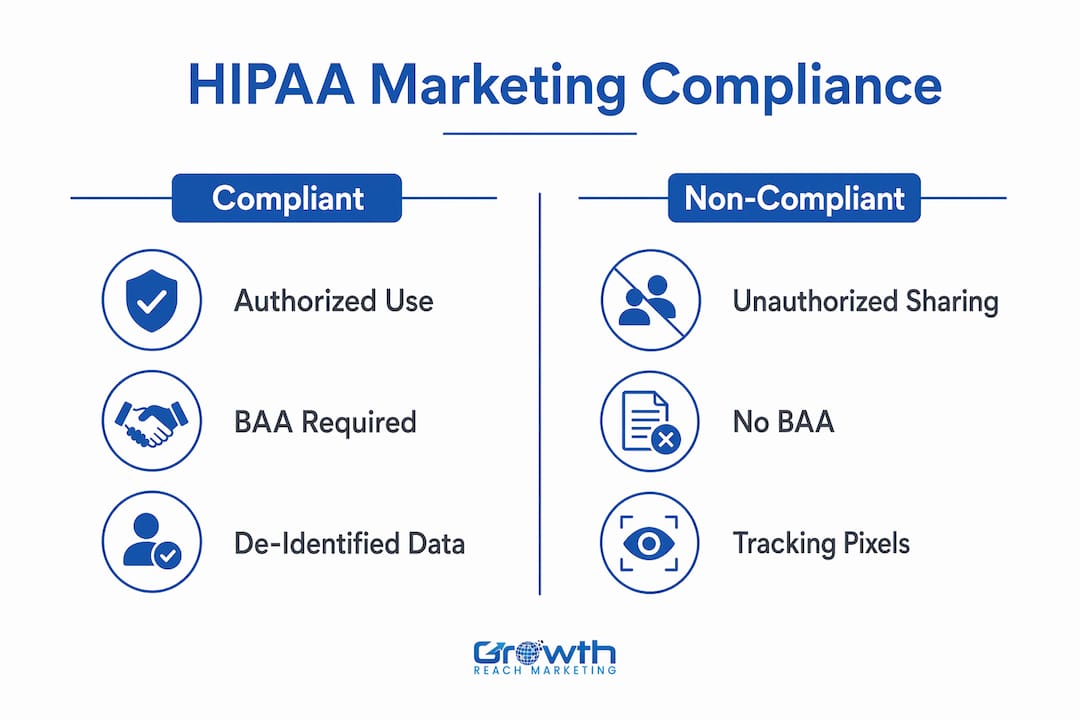
Tracking pixels present a subtler but equally serious risk. A pixel placed on a scheduling page, a symptom checker, or a patient portal transmits behavioral data that, combined with an IP address, creates PHI. OCR has made this explicit in guidance issued between 2022 and 2024.
Pro Tip: Before placing any third-party pixel on a healthcare website, map every page where health-related data could be collected. Remove pixels from those pages or route traffic through a compliance layer that strips PHI before forwarding data to ad platforms.
Healthcare email marketing requires the same scrutiny. Building a compliant email list for a clinic means understanding the difference between a general marketing opt-in and a HIPAA-specific authorization. Strategies for compliant email campaigns in health-adjacent businesses share structural principles with fully regulated healthcare email, even when the compliance threshold differs.
How to build a HIPAA-compliant digital marketing strategy
Building compliance into your marketing workflow from the start is far less expensive than retrofitting it after an OCR audit. Follow these steps to establish a solid foundation.
-
Audit your data flows. Map every point where patient or health-related data enters your marketing technology stack. Include your CRM, email service provider (ESP), analytics platform, tag manager, and ad platforms. Healthcare marketers must classify datasets clearly as PHI or non-PHI before applying controls.
-
Require BAAs from every vendor touching PHI. Every analytics vendor, CDP, ESP, and ad platform that accesses PHI must have a current BAA in place. If a vendor refuses to sign a BAA, that vendor cannot receive PHI. Period.
-
De-identify data before sending it to third parties. HIPAA de-identification requires either the Safe Harbor method (removing all 18 identifiers) or Expert Determination (a qualified statistician certifies re-identification risk is very small). Partial removal of identifiers does not satisfy de-identification standards and does not protect you from PHI classification.
-
Obtain valid HIPAA authorizations when PHI is used in marketing. A general privacy consent or a GDPR-style cookie banner does not constitute HIPAA authorization. The authorization must clearly describe which PHI is being used, for what marketing purpose, and who will receive it. HIPAA authorization is distinct from GDPR or CCPA consent in both form and legal effect.
-
Train your marketing team and maintain audit logs. A HIPAA security audit for marketing covers administrative safeguards (workforce training, policies), physical safeguards (device controls), and technical safeguards (access controls, audit logs in your marketing technology). Annual training is the minimum. Quarterly reviews of your technology stack are better.
Pro Tip: Use a dedicated HIPAA compliance layer like Freshpaint between your website and your ad platforms. These tools strip PHI automatically before data reaches Google or Meta, letting you run conversion tracking and audience building without exposing patient data.
For clinics running programmatic advertising, the compliance requirements extend to every demand-side platform and data management platform in the chain. A detailed breakdown of programmatic ad compliance for clinics covers the specific vendor and contractual steps required.
Compliant vs. non-compliant: spotting the difference
The gap between a compliant campaign and a violation often comes down to one overlooked detail. These are the most common pitfalls and their compliant alternatives.
Non-compliant practices to eliminate:
- Uploading a patient email list directly to Meta Ads Manager to build a Custom Audience
- Placing a Google Tag Manager container on a patient portal without reviewing which tags fire on health-related pages
- Sending a promotional SMS containing a patient’s appointment details or diagnosis to encourage a product purchase
- Assuming a checkbox on a new patient intake form covers HIPAA marketing authorization
Compliant alternatives that preserve marketing performance:
- De-identify patient data using Safe Harbor standards, then upload to platforms that have signed BAAs
- Use location-based targeting tools that do not rely on PHI. King Sixteen’s geo-targeting technology offers a privacy-first approach to reaching healthcare audiences by geography rather than patient identity
- Send treatment-related communications (appointment reminders, care instructions) without authorization, and keep promotional content in separate, properly authorized campaigns
- Use a written HIPAA authorization form that names the specific marketing use, the PHI involved, and the right to revoke
The consent confusion is the single most expensive mistake in healthcare marketing. Marketers trained in GDPR or CCPA compliance assume their consent frameworks transfer to HIPAA. They do not. HIPAA authorization is a separate legal instrument with specific content requirements, and using the wrong form exposes the covered entity to full enforcement liability.
How evolving regulations are reshaping HIPAA compliance in marketing
OCR’s 2022 and 2024 guidance updates increased enforcement scrutiny on tracking technologies, including pixels, tag managers, and third-party data sharing in healthcare marketing contexts. This shift means practices that were tolerated before 2022 are now active enforcement targets.
Several developments are reshaping the compliance picture in 2026:
- Pixel enforcement is active. OCR has pursued enforcement actions against health systems using standard analytics pixels on patient-facing pages. The guidance is clear: tracking technologies on patient portal pages transmitting PHI require BAAs or patient authorization.
- State laws add a second compliance layer. California’s CMIA, Washington’s My Health MY Data Act, and similar state statutes impose requirements that go beyond HIPAA. Healthcare marketers operating in multiple states must satisfy both federal and state standards.
- Modern compliance tools make data-driven marketing viable. Tools like Freshpaint strip PHI automatically before forwarding event data to ad platforms, enabling conversion tracking and audience building without PHI exposure. These tools represent the practical path forward for healthcare marketers who need performance data.
- Major platforms remain a structural problem. Google and Meta do not sign BAAs. Any marketing workflow that sends PHI to these platforms without a compliance layer or de-identification step is non-compliant regardless of the platform’s own privacy policies.
For aesthetic clinics and health-adjacent businesses running multi-channel campaigns, understanding omnichannel patient data flows is the starting point for identifying where PHI enters and exits your marketing stack.
Key takeaways
HIPAA compliance in digital marketing requires explicit patient authorization for any marketing communication that uses PHI, with no workaround available when financial remuneration from a third party is involved.
| Point | Details |
|---|---|
| PHI is broader than you think | IP addresses combined with health page visits qualify as PHI under HHS OCR guidance. |
| BAAs are non-negotiable | Every vendor in your marketing stack that touches PHI must sign a current BAA before receiving data. |
| Authorization beats consent | A GDPR cookie banner or intake form checkbox does not satisfy HIPAA marketing authorization requirements. |
| Pixels are enforcement targets | OCR actively pursues violations involving tracking pixels on patient-facing pages since 2022. |
| Compliance tools enable performance | Tools like Freshpaint strip PHI before it reaches ad platforms, preserving campaign measurement. |
Why I think most healthcare marketers are one pixel away from a violation
I have reviewed marketing stacks for health-adjacent businesses where the team genuinely believed they were compliant. In nearly every case, the problem was not malicious. It was a tag manager container that had never been audited, or a vendor relationship that predated HIPAA awareness, or an authorization form copied from a general marketing template.
The uncomfortable truth is that HIPAA compliance in digital marketing is not a legal department problem. It is a marketing operations problem. The people placing pixels, building audiences, and configuring email automations are the ones creating or closing the compliance gaps. Legal can write the policies, but if the marketing team does not understand why a pixel on a scheduling page is a liability, the policy is worthless.
What I have found actually works is treating compliance as a workflow design problem rather than a checklist. Map your data flows before you build your campaigns. Classify every dataset as PHI or non-PHI before it enters your stack. Build your authorization process into your patient intake workflow so it is collected at the right moment, not chased after the fact. And audit your vendor BAAs on a calendar, not just when something goes wrong.
The marketers who thrive in healthcare are not the ones who avoid data. They are the ones who build systems that use data correctly. Privacy-first tools, proper de-identification, and documented authorizations are not barriers to performance. They are the infrastructure that makes sustainable, scalable healthcare marketing possible.
— Gerard
How Growthreachmarketing helps healthcare marketers stay compliant
Growthreachmarketing works with aesthetic clinics, health-adjacent businesses, and local service providers who need marketing that performs without creating legal exposure. The team understands the intersection of HIPAA compliance in marketing and real campaign performance, from auditing your existing technology stack to building authorization workflows that hold up under scrutiny. Whether you need a full compliance audit of your digital marketing setup or a privacy-first campaign strategy built from the ground up, Growthreachmarketing delivers systems designed to grow your business within the rules. Explore how a structured SEO and compliance strategy can support your healthcare marketing goals without the regulatory risk.
FAQ
What is PHI in the context of digital marketing?
PHI is any health-related information linked to an identifiable individual, including names, IP addresses, email addresses, and device IDs. Under HHS OCR guidance, the combination of an IP address and a visit to a health-related webpage qualifies as PHI.
Do I need a BAA with Google and Meta for healthcare ads?
Google and Meta do not currently sign BAAs, which means you cannot send PHI directly to these platforms. You must de-identify data using HIPAA Safe Harbor standards or use a compliance layer like Freshpaint before forwarding any data to these ad platforms.
Is a patient consent form the same as HIPAA marketing authorization?
No. HIPAA marketing authorization is a distinct legal document that must specifically describe the PHI being used, the marketing purpose, and the patient’s right to revoke. A general consent form, cookie banner, or GDPR opt-in does not satisfy this requirement.
Can I send promotional emails to patients without HIPAA authorization?
Only if the communication qualifies under a HIPAA exception, such as treatment-related communications or prescription refill reminders with no third-party remuneration. Promotional emails that encourage the purchase of products or services using PHI require explicit patient authorization.
What happens if my marketing team violates HIPAA?
OCR can impose civil monetary penalties based on the level of culpability, ranging from violations where the covered entity was unaware to willful neglect. Penalties can reach into the millions per violation category per year, and enforcement activity around tracking technologies has increased significantly since 2022.
Recommended
- Programmatic Advertising for Clinics: 2026 Guide – Growth Reach Marketing
- 1780560807504_Marketing-manager-reviewing-omnichannel-patient-data – Growth Reach Marketing
- 1780560807504_Marketing-manager-reviewing-omnichannel-patient-data-1 – Growth Reach Marketing
- What Is Beauty Industry Content Marketing in 2026 – Growth Reach Marketing