

Audience segmentation means dividing a broad group of people into smaller subgroups based on shared characteristics, so you can reach each group with messages that actually fit them. The definition of audience segmentation is straightforward: it is a process of grouping people by defined criteria such as demographics, geography, psychographics, behavior, or media use. What makes it powerful is what happens next. Instead of broadcasting one generic message to everyone, you craft communication that speaks directly to each group’s needs, motivations, and context.
The main segmentation types every marketer should know include demographic, geographic, psychographic, behavioral, and firmographic (for B2B) segments, which encompass characteristics like age, gender, location, values, purchase patterns, and company attributes.

Segmentation sits at the core of any personalization framework. Without it, you are guessing. With it, you are making deliberate choices about who gets what message, through which channel, and at what moment. First-party data collected with clear consent is now the preferred foundation for building these groups, particularly as data privacy regulations tighten heading into 2026.
Table of Contents
- Why audience segmentation matters more than ever
- The main types of audience segmentation explained
- Common segmentation challenges and how to solve them
- What advanced segmentation looks like in 2026
- Key Takeaways
Why audience segmentation matters more than ever
Segmentation is not a nice organizational exercise. It is the mechanism that separates campaigns that convert from campaigns that burn budget. When your message matches the specific concerns of a defined group, relevance goes up and waste goes down.

The importance of customer segmentation lies in what it makes possible: systematic personalization rather than random personalization. Personalization without segmentation is just a friendly tone applied to a message nobody asked for. Segmentation gives you the rulebook. It defines who is in your audience, what message fits them, how much budget they deserve, and how you measure whether the campaign worked for that specific group.
Here is what segmentation directly supports in a marketing strategy:
- Personalization at scale: Tailor content, offers, and creative to each group without rebuilding strategy from scratch every time
- Budget allocation: Assign spend proportional to each segment’s revenue potential, not equally across all groups
- Customer journey mapping: Understand where different groups are in the buying process and meet them there
- Lift measurement: Isolate performance by segment so you know which groups respond and which do not
- Channel selection: Match each segment to the platform where they actually spend time
A salon running Google Ads without segmentation might target a broad demographic like women in a city. A segmented approach separates first-time visitors from loyal clients, high-spend clients from occasional ones, and people searching for specific services from those browsing broadly. Each group gets a different message and a different offer. The result is a campaign that earns its spend rather than averaging it out across people with completely different intentions.
The main types of audience segmentation explained
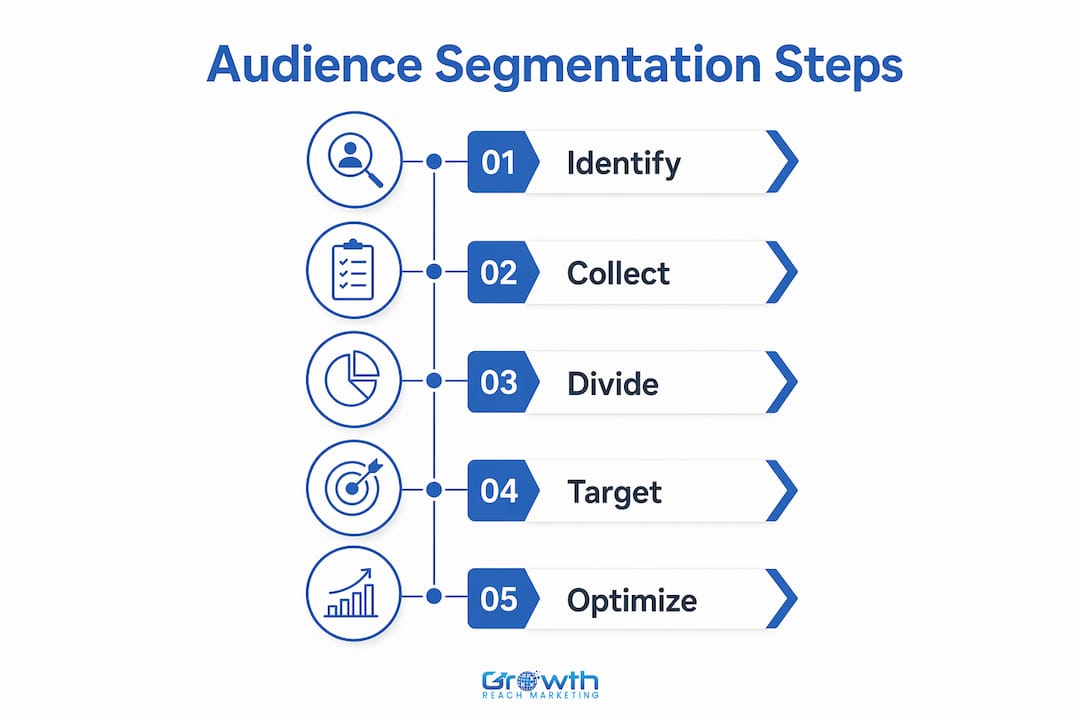
The four segmentation methods in marketing are demographic, geographic, psychographic, and behavioral, with firmographic added for B2B contexts. Each answers a different question about your audience, and used together they build a complete picture.
| Segmentation Type | Core Question | Key Attributes | Example Use Case |
|---|---|---|---|
| Demographic | Who are they? | Age, gender, income, education | Luxury skincare targeting women, household income high |
| Geographic | Where are they? | Region, city, climate, density | Geo-targeted local campaign for a clinic in a specific zip code |
| Psychographic | Why do they buy? | Values, lifestyle, attitudes, interests | Eco-conscious buyers responding to sustainability messaging |
| Behavioral | What do they do? | Purchase frequency, loyalty, engagement | Retargeting users who viewed a service page but did not book |
| Firmographic (B2B) | What kind of company? | Industry, size, revenue, structure | SaaS targeting mid-market companies with 50–500 employees |
Demographic segmentation is the most common starting point because the data is easy to collect. Age, gender, and income are available from most ad platforms and CRM systems. The limitation is that demographics tell you who someone is, not why they buy or what they actually want.
Psychographic segmentation fills that gap. Two people with identical demographics can have completely different motivations. A 40-year-old woman earning $90,000 might prioritize convenience above everything, while another with the same profile shops based on brand ethics. Psychographics explain the internal motivations that demographics miss entirely.
Behavioral segmentation is arguably the most predictive. It is built from what people actually do: pages visited, emails opened, purchases made, features used. This data reflects real intent rather than assumed characteristics. Behavioral audience data consistently outperforms demographic-only targeting for conversion-focused campaigns because it reflects what people are actively doing, not just who they are on paper.
Geographic segmentation becomes especially useful for local service businesses. A beauty brand with three locations in different neighborhoods needs different messaging for each area, even if the demographic profiles overlap.
Firmographic segmentation is the B2B equivalent of demographics. Instead of individual attributes, you segment by company characteristics: industry vertical, employee count, annual revenue, technology stack, or organizational structure. A marketing agency pitching to a 10-person startup needs a completely different message than one pitching to a 500-person enterprise, even if both companies need the same service.
Pro Tip: Do not let demographic data carry the full weight of your segmentation strategy. Demographics tell you who is in the room; behavior tells you what they are ready to do. Layer behavioral signals like email engagement, page visits, and purchase recency on top of demographic filters to build segments that actually predict outcomes.
Common segmentation challenges and how to solve them
Even marketers who understand segmentation theory run into problems when they try to apply it. The most common issues are not technical. They are strategic.
Over-segmentation is the most frequent mistake. When you divide your audience into too many small groups, each segment becomes too small to be worth targeting individually. Over-segmentation creates segments that are theoretically precise but practically useless because you cannot reach them at meaningful scale without burning through budget on micro-audiences.
Data quality problems undermine even well-designed segmentation frameworks. Outdated CRM records, inconsistent data collection, and gaps between online and offline behavior all produce segments that do not reflect reality. Static segments built once and never updated are particularly dangerous because customer behavior shifts constantly.
Privacy and compliance constraints are now a core operational challenge. Laws including GDPR, CCPA, and the EU AI Act require that segmentation be built on data collected with verified consent, with documented consent timestamps and legal basis. Using data without verified consent carries real legal liability, not just reputational risk.
Practical solutions that work:
- Set clear in/out boundaries first. Before building segments, define who qualifies and who does not. Vague boundaries produce overlapping, inconsistent groups.
- Use first-party data as your foundation. Email engagement, purchase history, and on-site behavior collected directly from your audience is both more accurate and more compliant than third-party data.
- Apply AI for dynamic segmentation. AI-powered segmentation uses real-time behavioral and intent signals rather than static snapshots, which keeps segments current as behavior evolves.
- Audit segments regularly. Set a quarterly review cadence to check whether segments still reflect actual customer behavior and whether the boundaries still make sense.
- Match investment to segment value. A high-value segment with strong purchase intent deserves more budget than a broad awareness segment. Treating all segments equally wastes money on the wrong groups.
For data collection, the most reliable sources are your own CRM, email platform engagement data, website analytics tools like Google Analytics 4, and customer surveys. Audience research methods that combine quantitative behavioral data with qualitative survey responses tend to produce the most accurate segment profiles.
What advanced segmentation looks like in 2026
The shift that defines segmentation practice right now is the move away from static demographic personas toward dynamic, behavior-driven, and intent-based segments. High-performing marketers prioritize first-party signals like product usage, email engagement, and intent data over demographic filters because those signals predict what someone will do next, not just who they are.
Segmentation today feeds directly into the STP framework: Segmentation, Targeting, Positioning. Segmentation identifies the groups. Targeting selects which groups to pursue. Positioning determines how to frame your offer for each group. Skipping or rushing segmentation means the targeting and positioning steps are built on guesswork, which shows up in campaign performance.
For B2B marketers, account-level segmentation has become the standard. This means layering firmographic fit scoring with buying committee mapping: identifying not just which companies match your ideal customer profile, but which roles within those companies influence the purchase decision. A CFO, a department head, and an end user at the same company all need different messages even though they are part of the same account.
Advanced practices worth implementing now include enriching first-party data with behavioral signals, using intent-based segmentation to identify buying cycle stages, managing documented consent for compliance, mapping buying committees in B2B contexts, and ranking segments by predicted value to optimize budget allocation.
The salon segmentation guide from Growthreachmarketing shows how these principles apply in local service businesses: separating new clients from returning ones, high-spend clients from occasional visitors, and service-specific seekers from general browsers. The same logic scales to any industry.
One principle holds across every context: segment investment should match segment value. Sophisticated AI models and personalization tactics layered on top of poorly defined boundaries will not fix the underlying problem. Get the boundaries right first, then add sophistication.
Key Takeaways
Effective audience segmentation requires clear group boundaries, first-party behavioral data, and regular audits to keep segments accurate and compliant.
| Point | Details |
|---|---|
| Segmentation types | Five core types: demographic, geographic, psychographic, behavioral, and firmographic (B2B). |
| Behavioral data wins | Behavioral signals predict future actions more reliably than demographic filters alone. |
| Over-segmentation risk | Segments too small to reach at scale waste budget; set clear in/out boundaries before adding complexity. |
| Compliance is non-negotiable | GDPR, CCPA, and the EU AI Act require consent-verified data with documented timestamps for every segment. |
| STP framework connection | Segmentation feeds into Targeting and Positioning; weak segmentation undermines both downstream steps. |