Multi-location salon marketing works when you split it in two: the brand is managed once, centrally, and every branch is marketed as its own local business. Each location needs its own Google Business Profile, its own web page, its own local ads and its own numbers. When a group treats all its branches as one market, the Blackrock salon and the Naas salon end up competing with each other and with every local rival, and none of them ranks well.
This guide is written for owners and managers of salons, beauty clinics, aesthetic clinics and med spas running two or more sites in Ireland. It covers the structure, the local search setup, the content, the ads, retention and what to measure.
TL;DR
- Run brand assets (website, visual identity, tone of voice, review-reply standards) centrally, and give each branch its own local marketing layer.
- Create one Google Business Profile per location, each with its own address, phone number, hours and a distinct page on your website.
- Aim local ads at a radius around each branch, and make sure every lead and booking is traced back to the branch that earned it.
- Use automated follow-ups, review requests and rebooking reminders across the group, with room for each manager to send local messages.
- Compare branches monthly on the same few numbers: new clients, rebooking rate, reviews, cost per booking.
Table of Contents
- Why a group cannot market like a single salon
- Step 1: Give every branch its own Google Business Profile
- Step 2: Build one real page per location
- Step 3: Win the treatment-plus-place search
- Step 4: Be findable in AI search as well as Google
- Step 5: Local social content and paid ads, branch by branch
- Step 6: Keep clients coming back to the group
- Step 7: Measure each branch on the same few numbers
- A simple 90-day plan for a group
- How we help groups with this
- Our view: one brand, many local businesses
- FAQ
- Sources
Why a group cannot market like a single salon
A client does not book “your group”. They book the nearest place that looks good, has recent reviews and has a slot on Saturday. A guide to multi-location salon management makes the point that clients care about their neighbourhood, their stylist and whether there is a promotion running this weekend, not about a corporate calendar. It also warns against treating every location as the same market: a city-centre branch and a suburban one need different messaging, different hours emphasis and different offers.
That is why the plan below has three layers.
| Layer | Who runs it | What it covers |
|---|---|---|
| Brand | Head office or marketing lead | Website, visual identity, email templates, brand voice, standards for replying to reviews |
| Location | Branch manager, with a budget and guardrails | Google Business Profile, local partnerships, community events, hyper-local ads |
| Stylist or practitioner | Individual team members | Personal Instagram, referrals, rebooking their own clients |
The split is based on the same Vagaro guide. The practical rule: if a change would look wrong on a different branch’s page, it belongs in the location layer. If it must look identical everywhere, it belongs in the brand layer.
In Ireland there is a second reason to keep the layers distinct. Most of your customers search by place: a treatment plus a town or Dublin postcode area. A group-level page that tries to rank for “hair salon Ireland” competes with nobody useful. A branch page that ranks for “balayage Dublin 2” competes with the salons your client would actually visit.
Step 1: Give every branch its own Google Business Profile
Google Business Profile (GBP) is the listing that appears on Google Search and Maps with your address, hours, photos and reviews. For a local branch it is usually the most important page you have, ahead of your own website, because it is what appears in the map results people see first.
A GBP guide for Irish businesses recommends that any business with two or more locations create a separate profile for each one, with its own address, phone number and hours, link them together through the Locations setting in GBP, and never create a single profile that lists every location. Doing the latter confuses Google and hurts ranking.
For each profile:
- Verify it. An unverified profile cannot be fully managed.
- Choose the primary category carefully. Irish guidance from Treatwell’s partner resources lists accurate categories such as “Hair Salon” or “Balayage Service” among the basics, alongside current opening hours and detailed treatment descriptions.
- Use a local phone number that reaches that branch’s reception, not a central call centre.
- Add fresh photos of the actual premises, team and work. Posts and new images show Google and clients that the branch is active.
- Switch on booking and messaging links that point to that branch’s own calendar.
- Reply to every review using your group standard, in the voice of that branch.
The errors that cost multi-site groups most are inconsistency ones: a branch that moved but still shows the old address on a directory, a phone number that differs between the website and the listing, or a profile name stuffed with keywords. Pick one master record for each branch (name, address, phone, hours) and have everything else, including the website and directories, read from it.
If you want the detailed weekly routine for moving up the map results, we have written it up in our guide to moving up Google Maps in 60 to 90 days. For the profile setup itself, see our Google Business Profile optimization guide for beauty businesses.
Step 2: Build one real page per location
Your website should reinforce the profile, not contradict it. For each branch, create a page that exists for that branch alone. A Google Business Profile setup guide for Ireland puts it plainly: build a clear page for each genuine location with its own staff, services, directions, proof and FAQs, rather than dozens of near-identical pages with only the county name swapped.
A solid branch page includes:
- Address, local phone number, opening hours and an embedded map
- The treatments actually offered at that branch (not every treatment your group offers)
- The team who work there, with photos
- Directions, parking and public transport notes
- Reviews and before-and-after work from that branch
- A booking link that goes straight to that branch’s calendar
- Three or four questions clients ask about that specific location
Structure matters as well as content. Keep all branches on one domain with a clear hierarchy, for instance a locations hub page that lists every branch, and individual pages beneath it. The hub helps a new client pick a branch. Each branch page links to the shared treatment pages that explain what a service involves, so you write that explanation once. Your developer can also add LocalBusiness structured data to each page (code that tells search engines the branch’s address, hours and phone in a machine-readable form), following Google’s local business structured data guidance. The details in that code must match what is visible on the page.
We have a copy-and-paste location page checklist and a broader guide to multi-location SEO for salons that walk through this page by page. If your branches operate under franchise arrangements, franchise SEO for salons covers how to keep local owners within brand rules.
Step 3: Win the treatment-plus-place search
Generic searches are crowded and rarely convert. Treatwell’s Irish guide advises that for local intent, salons should target treatment-plus-place searches such as “balayage Dublin” instead of just “hair salon”. Apply that per branch.
For a clinic or med spa, the same logic applies to your highest-value treatments. List the five treatments that make the most profit at each branch and make sure each has a clear description on that branch’s page, with the town or area named naturally in the text, headings and image descriptions.
Two cautions:
- Do not copy one branch’s text to another and change the place name. It reads as thin to clients and to search engines.
- Aesthetic clinics should keep treatment claims within advertising rules for their sector. Our guides on why aesthetic clinics need an SEO strategy and the clinic compliance playbook for Instagram lead ads cover this.
Step 4: Be findable in AI search as well as Google
More clients now ask an AI assistant where to book. A February 2026 Fresha press release reports that bookings referred from Google Gemini, ChatGPT and Claude on its platform are growing 50% month-on-month, and that in Asia-Pacific, Gemini and other large language models account for 25% of online booking referrals. Those figures describe one platform and one region, so treat them as a direction of travel, not an Irish benchmark.
What it means for a group is practical. AI tools draw on the same signals as local search: consistent business details, clear page content, reviews and well-described services. A group with clean, distinct branch pages and well-kept profiles is easier for these tools to recommend. Our guide to AI SEO for salons explains how to get found in Google and ChatGPT.
Step 5: Local social content and paid ads, branch by branch
Social media is where the stylist layer and location layer meet. Treatwell’s Irish guide suggests Instagram for before-and-after transformations, TikTok for behind-the-scenes clips aimed at younger audiences, and Facebook for local community groups. It also recommends consistent lighting, fast replies, a link in your bio to the booking page and the booking widget embedded in social profiles.
For a group, a workable pattern is:
- Brand account: campaigns, seasonal offers, brand-wide announcements.
- Branch accounts or branch-tagged content: new team members, local events, tagged locations, posts by the manager.
- Stylist accounts: the team’s own work, with the branch tagged and the booking link in the bio.
For paid reach, the same guide suggests location-targeted Facebook and Instagram ads, Google Ads for “near me” searches, and a radius of 8 to 16 km. For a city branch, the tight end of that range is usually right. For a rural or small-town branch, the wider end may be needed.
Before launching ads, decide three things for each branch:
- The one treatment you will promote and the offer attached to it.
- The radius around that branch.
- Where the lead goes. A form that lands in a central inbox loses the booking. A form that goes to the right branch within minutes wins it.
A Dublin group with four salons across Dublin and Kildare reported, in a software provider’s case study, an average return of 318% on Facebook and Instagram ad spend, which it expressed as €4.18 in direct bookings per €1 spent, plus more than 400 new five-star Google reviews averaging 100 per location. That is one group’s reported result, not a promise, but it shows the shape of a working system: ads, reviews and email running at branch level.
We go deeper on the mechanics in our guides to Instagram ads targeting salon clients, Facebook lead ads for salons, and using client content in salon ads. For clinics, see Facebook lead ads for Irish clinics.
Step 6: Keep clients coming back to the group
Winning a new client is the expensive part. Rebooking is where a group earns its margin, and it is also where central systems help most.
The same Treatwell guide describes an automation sequence worth copying in principle: booking confirmations, reminders 24 hours ahead by email or 4 hours ahead by SMS, patch-test reminders 7 days ahead, review requests around 48 hours after the visit, and rebooking reminders by email and SMS. A multi-location management guide recommends running campaigns such as seasonal promotions, rebooking reminders and loyalty messages across all locations from one system, while letting location managers send targeted local messages. It also cites a 23% revenue boost from automated rebooking prompts for salons that apply them consistently. That figure comes from the guide itself and is a vendor-side estimate, so use it to set a direction, not a forecast.
A sensible split for a group:
- Central: confirmations, reminders, review requests, rebooking prompts, birthday and reactivation emails.
- Branch: a Saturday gap-filler, a new-team-member announcement, a local event invitation.
- Stylist: a personal message to a client who is due for a colour refresh.
Our guides to salon automation marketing and seasonal promotions and SEO show how to set these up.
Step 7: Measure each branch on the same few numbers
You cannot manage what you cannot compare. Vagaro’s guide recommends reviewing location-specific profit and loss monthly, covering revenue, labour, rent, product cost and profit, and reviewing a short list of KPIs weekly with each manager: rebooking rate, retail-to-service ratio, average ticket, new client count and staff productivity.
Add marketing numbers on top, per branch:
| Metric | Where it comes from | Why it matters |
|---|---|---|
| New clients per month | Booking system | Shows whether local marketing is filling the diary |
| Source of each new client | Booking form question, call tracking, ad lead data | Links spend to bookings, not clicks |
| Google Business Profile actions (calls, direction requests, website clicks) | Profile insights | Shows local search strength |
| Review count and average rating | Google profile | Feeds ranking and trust |
| Cost per booked appointment | Ad spend divided by bookings | The number that decides budget |
| Rebooking rate | Booking system | Measures retention |
Two habits make this table useful. First, ask every new client how they found you, at booking and again in the first appointment. Second, give each branch its own tracking phone number or tagged booking link, so you can tell a Maps call from an ad lead. Move budget towards the branches where cost per booking is lowest, and look for the cause where it is highest: a thin page, few reviews, a poor offer or a slow response to enquiries.
A simple 90-day plan for a group
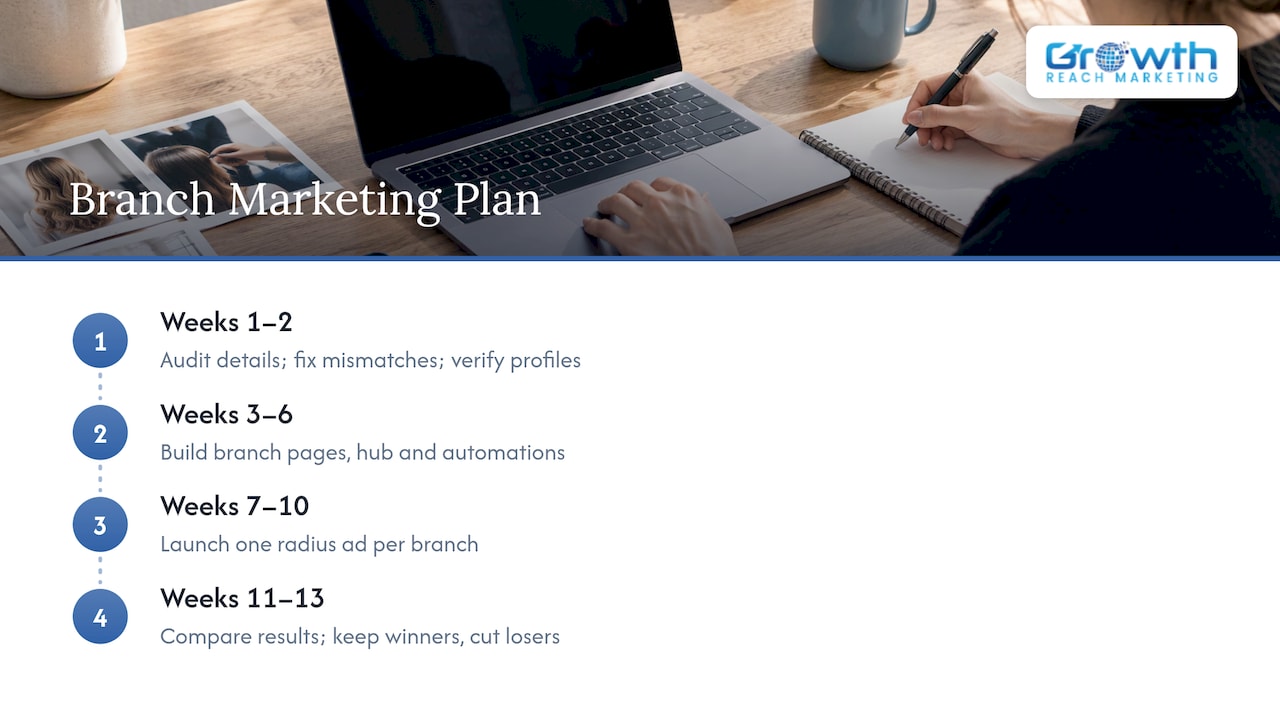
Weeks 1 to 2: audit and clean up. List every branch’s name, address, phone and hours as they appear on your website, Google, social profiles and directories. Fix mismatches. Claim and verify every profile.
Weeks 3 to 6: build the foundation. Publish a distinct page for each branch plus a locations hub. Add photos, services and categories to each profile. Set up central automations for confirmations, reviews and rebooking.
Weeks 7 to 10: switch on local demand. Launch one radius-targeted ad per branch, promoting one treatment with a clear offer. Route leads to the branch team.
Weeks 11 to 13: review and reallocate. Compare branches on the table above. Keep what books clients, cut what does not, and repeat the cycle with a new treatment focus.
Note that organic map and search gains take time. A 2021 piece by a digital marketing specialist for Professional Beauty Ireland framed local visibility as a steady-stream strategy that needs consistent details and patience, up to 12 weeks, to reach the top three map listings in your town. Paid ads can fill the gap while that builds.
How we help groups with this
Growth Reach Marketing is an Irish marketing agency that works with salons, aesthetic clinics, beauty brands and local service businesses. For multi-location groups, our work covers SEO and AI search visibility, Facebook and Instagram ads management, social media management, AI enquiry handling with follow-ups and booking automation, lead generation and conversion optimisation, and email marketing and customer reactivation. We build bespoke strategies for the beauty and aesthetics industry rather than a template, and you work with us directly.
If you run several branches and want each one to rank, book and report on its own, see our services or get in touch.
Our view: one brand, many local businesses
Most groups we speak to have the same problem. The brand looks polished, but each branch is invisible to the people living ten minutes away. The fix is rarely more content for the whole group. It is a clear page, a clean profile and a local offer for each branch.
We think of a multi-location system as a set of small, local engines running on shared parts. The shared parts are the brand, the website framework, the reporting and the automations. The engines are the branch pages, the profiles, the reviews and the ads that point to one calendar. Keep the parts consistent and let the engines differ.
That is also why we work on tailored systems for the beauty and aesthetics industry, with ethical, data-driven reporting that shows bookings by branch. The aim is simple: when someone nearby searches, asks an AI assistant or scrolls Instagram, your nearest branch is the one they find and book.
Gerard
FAQ
Should every salon location have its own website?
Usually no. One website with a distinct page for each branch, grouped under a locations hub, is easier to maintain and lets the branches share authority. The key is that each page is genuinely different: its own team, treatments, directions, reviews and booking link.
How many Google Business Profiles do I need?
One per physical location that clients can visit, each with its own address, phone number and hours. Do not create one profile that lists all your branches. Link the profiles together in your Google account so you can manage them as a group.
Who should control the marketing budget: head office or branch managers?
A hybrid works best. Head office holds brand, website, reporting and automation budgets. Each branch manager holds a local budget for ads and events, with guardrails on offers, tone and claims. This follows the brand, location and stylist split described above.
How do I know which branch an ad lead or booking came from?
Give each branch its own tracking phone number, tagged booking link and lead form, and ask every new client how they found you. Then compare cost per booked appointment by branch each month, not just clicks or form fills.
How long before local search results improve?
Expect weeks, not days. One Irish industry article puts the build to top map positions at up to 12 weeks of consistent work. Paid local ads can bring bookings sooner while your profiles and pages gain strength.
Sources
- Salon Multi-Location Management: The Real Guide (Vagaro)
- The Complete Guide to Google Business Profile Optimisation (MyReputation.ie)
- How to attract new salon clients and fill your calendar (Treatwell Ireland)
- Google Business Profile Ireland: 2026 Setup Guide (Seoweb.ie)
- Local business structured data (Google Search Central)
- The AI Revolution in Selfcare (Fresha press release)
- Switching to Phorest Helped Zeba Reach New Heights
- How to Manage Multiple Salon Locations (GlowBook)
- Digital direction, Professional Beauty Ireland