Five actions move the needle fastest for medical spa marketing this month: fix your Google Business Profile and local SEO, publish one treatment-specific results gallery, run a small Google Search campaign, set up email/SMS nurture for new leads, and start asking for reviews and referrals systematically. Local SEO fixes take 1 to 2 weeks and cost little beyond your own time. A single before-and-after gallery takes a weekend to shoot and organize. A modest Search campaign can go live in a few days with a $500 to $1,500 monthly budget. Nurture automation takes an afternoon to build once. The review ask costs nothing but discipline.
Start today with:
- Claim and fully complete your Google Business Profile.
- Photograph three recent client results for one flagship treatment.
- Draft a five-touch email sequence for new leads.
Key Takeaways
Medical spa marketing works when treatment-specific content, tracked paid campaigns, and automated nurture sequences all point toward one measurable outcome: booked consultations.
| Point | Details |
|---|---|
| Fix local SEO first | Complete your Google Business Profile and treatment pages before spending on ads. |
| Build one gallery page per treatment | Treatment-specific pages with alt text outperform generic service pages in search. |
| Automate the first 48 hours | Immediate confirmation plus a 48-hour educational message keeps new leads warm. |
| Track consults, not clicks | Use UTM tags and booking-source fields to measure real conversion, not vanity metrics. |
| Consider Growthreachmarketing for full-system support | Growthreachmarketing runs SEO, paid ads, content, and nurture as one connected system for owners short on time. |
Table of Contents
- What Is Medical Spa Marketing, Exactly?
- Who Is Your Ideal Client, and Which Treatments Come First?
- Does Your Website Actually Convert Consultations?
- Which Paid Channels Actually Book Consultations?
- What Should You Post, and How Often?
- How Do You Turn Leads Into Booked Consultations?
- How Do You Scale Reviews, Referrals, and Local Partnerships?
- Which Promotions Grow Bookings Without Cheapening the Brand?
- What KPIs Actually Prove Your Marketing Is Working?
- How Does an Agency Like Growth Reach Marketing Help?
- Growthreachmarketing: A Faster Path to Booked Consultations
- Sources
What Is Medical Spa Marketing, Exactly?
Medical spa marketing is the combination of local SEO, paid search and social ads, content and before/after visuals, and retention automation that turns searchers into booked consultations and repeat clients. It differs from general spa marketing because it involves regulated medical treatments, licensed providers, and stricter rules on testimonials and imagery. Owners who treat it like generic small-business marketing usually underperform because they skip the compliance layer and the treatment-specific content that actually ranks and converts.
Who Is Your Ideal Client, and Which Treatments Come First?
Write a one-paragraph client profile: age range, gender skew, top three concerns (fine lines, body contouring, acne scarring), life stage (new parent, pre-wedding, post-fifty), and price sensitivity (value-seeker vs. premium). This template forces clarity before you spend a dollar on ads.
Pick one to three flagship treatments where search demand is decent and margin is strong, such as injectables, laser hair removal, or body contouring. Avoid marketing “everything we offer.” Then check your brand against that positioning:
- Does your homepage headline name the flagship treatment, not just “medical spa services”?
- Do your photos and color palette match the client profile’s aesthetic expectations?
- Does your pricing page speak to the price sensitivity you defined?
Pro Tip: A micro-niche focus, like “CoolSculpting for postpartum bodies,” usually outpulls broad “all services” messaging in both paid and organic results because it matches a specific search intent instead of competing with every med spa in town.
Does Your Website Actually Convert Consultations?
Generic “Services” pages rank poorly and convert worse than treatment-specific pages. A page titled “Botox Before and After” targets exact buyer intent; a page titled “Injectables” does not. Treatment-specific galleries paired with focused educational copy match high-intent queries like “Botox before and after [city]” and pull organic traffic a generic page never sees, according to SEO and legal best-practice guidance for med spas.
Run through this checklist:
- Build one dedicated gallery page per flagship treatment, with descriptive captions and keyword-rich alt text.
- Add local keywords (city, neighborhood) to page titles and headers.
- Add service schema markup so Google understands what you offer and where.
- Keep your Google Business Profile hours, photos, and services current.
- Place a booking button above the fold on every page, not buried in a menu.
- Compress images to WebP under roughly 200KB and confirm mobile load speed passes Core Web Vitals.
- Add SMS appointment reminders to cut no-shows.
Hand that last block straight to your developer or website design partner.
Which Paid Channels Actually Book Consultations?
Google Search wins for intent capture: someone typing “lip filler near me” is ready to book. Meta and Instagram work better for awareness and retargeting people who already visited your site but didn’t convert.
Before spending anything, confirm you have:
- A dedicated landing page per campaign, not your homepage.
- Conversion tracking installed on your booking form or phone number.
- UTM parameters on every ad link so you know which campaign drove which lead.
- Offline conversion import from your booking system when the platform supports it.
Budget reality check: a small single-location spa often starts with $800 to $1,500 monthly on Search and sees its first steady stream of consult requests within 4 to 6 weeks. A growth-stage spa running $3,000 to $6,000 monthly across Search and retargeting typically books enough volume to justify a dedicated front-desk coordinator for inquiries. Set up Google Ads conversion tracking and Analytics goals before the first dollar spends, not after.
What Should You Post, and How Often?
Visual results content is the top decision factor for prospective patients, according to before-and-after photo marketing research, so your calendar should lean heavily on it. Here’s a four-week template you can adapt across Instagram, Facebook, TikTok, and your blog:
- Week 1: Educational post explaining a flagship treatment (what it is, who it’s for).
- Week 2: Short-form video testimonial or provider walkthrough.
- Week 3: Treatment-specific before/after carousel with context and captions.
- Week 4: Behind-the-scenes or staff spotlight to build trust.
Static side-by-side photos struggle in paid placements because Meta and TikTok ad policy restricts close-up before-and-after imagery; short-form video and carousel formats with context clear ad review more reliably and tend to perform better.
Repurpose every captured result across at least five touchpoints: Instagram post, Instagram Story, website gallery, email newsletter, and a Google Business Profile update.
How Do You Turn Leads Into Booked Consultations?
A lead that doesn’t hear from you within an hour usually books somewhere else. Build this sequence once and let it run: immediate confirmation text, a 48-hour educational email about the treatment they inquired about, a 7-day trust-builder (staff credentials, client results), and a 21-day consult reminder if they haven’t booked.

For post-treatment clients, mix email and SMS: a same-day aftercare text, a 2-week check-in email, and a 90-day rebooking nudge tied to their treatment’s typical maintenance cycle.
Set automation triggers for three events: new lead intake, consultation no-show, and post-treatment follow-up. Each needs its own message, not a generic template.
Pro Tip: Lead with education and results, not discounts. Discount-first nurture trains prospects to wait for a sale, which erodes margin over time. Full email nurturing benchmarks show sequences like this consistently outperform one-off promotional blasts.
How Do You Scale Reviews, Referrals, and Local Partnerships?
Ask for reviews within 24 hours of a great result, while satisfaction is fresh. A simple in-clinic script works: “We’d love if you shared your experience. Here’s a quick link.” Follow up by email or SMS if they don’t respond immediately. Avoid discount-for-review offers; they invite scrutiny and train price sensitivity.
For referrals, reward both parties, such as a treatment credit for the referrer and a modest discount for the new client, structured so it doesn’t erode margin on high-cost services.
Build a short partner list: local dermatologists, gyms, and bridal shops. Offer them a co-marketing angle (joint content, cross-promotion) rather than a straight discount. Track every referral and partner-driven booking with a unique code or intake question so you know what’s actually working.
Which Promotions Grow Bookings Without Cheapening the Brand?
Bundle services instead of discounting single treatments. A “bridal prep package” combining facials and injectables protects per-treatment pricing while raising average order value. Limited-time consult add-ons (a free skin analysis with a booked consult) attract new patients without training anyone to wait for a sale.
Host quarterly educational events, like an open house or a “new patient night,” to feed local awareness cheaply.
Before publishing any promotional before/after content, confirm you have signed marketing-specific consent, FTC disclosure language if results aren’t typical, and documentation on file.
Pro Tip: A “new patient” package always outperforms a blanket percentage-off deal because it targets acquisition, not your existing loyal client base who would have paid full price anyway.
What KPIs Actually Prove Your Marketing Is Working?
Track consults booked and lead-to-consult conversion rate as your primary numbers, not likes or impressions. Add average treatment value, lifetime value, and cost per acquisition by channel so you know which dollar is working hardest.
Your attribution checklist: UTM tags on every campaign link, a “how did you hear about us” field on every intake form, offline conversion import into ad platforms where available, and a consistent conversion window (7 to 30 days depending on treatment consideration length).
Med spas should measure booked consultations as the real outcome and feed booking data back into analytics platforms for genuine ROI, not just reach, according to comprehensive med spa marketing guidance.
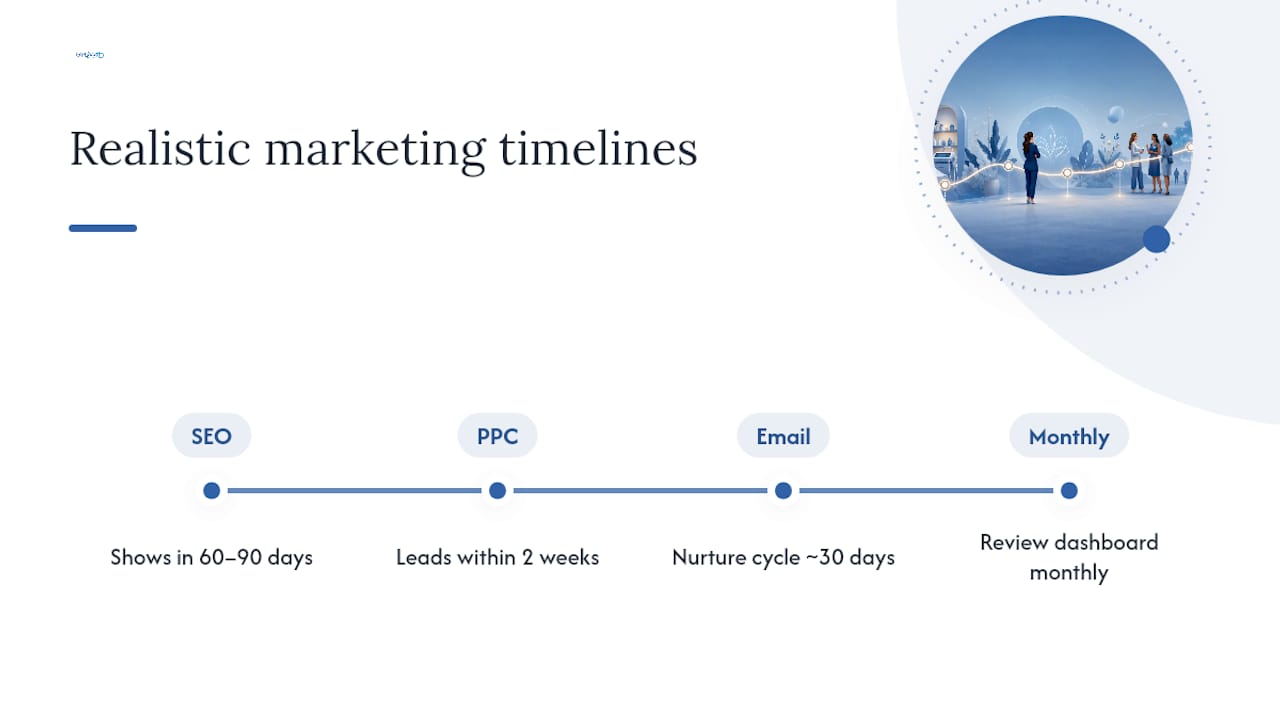
Realistic timelines: local SEO improvements often show up in 60 to 90 days. Paid search can generate leads within the first two weeks. Email nurture improves consult rates within a single sequence cycle, often 30 days. Review a simple dashboard monthly: leads by channel, conversion rate, and cost per booked consult.
How Does an Agency Like Growth Reach Marketing Help?
An agency earns its fee when it handles the pieces owners rarely have time for: local SEO, treatment-level content, Google Ads management, conversion-focused site design, and email/SMS automation running in the background.
Expect local SEO gains within 60 to 90 days, paid search leads within the first two weeks, and full nurture and retention systems operational within 30 days of setup.
Owners who DIY marketing often plateau not because the tactics are wrong, but because nobody owns tracking, testing, and follow-through week after week.
If you’re spending more than a few hours weekly untangling ad accounts or chasing no-show follow-ups instead of seeing patients, that’s the signal to hire out rather than DIY.
Author Perspective: What We’ve Seen Work and Common Mistakes
The four mistakes that burn budget fastest: scattering spend across too many channels at once, launching ads without tracking the booking flow, letting before-and-after quality slip, and ignoring local SEO because it feels slow. One spa we’ve seen data on doubled consult requests simply by fixing Google Business Profile categories and adding treatment-specific gallery pages, no new ad spend required.
Growthreachmarketing: A Faster Path to Booked Consultations
Growthreachmarketing exists for owners who’d rather spend Tuesday afternoon with patients than fighting with a Google Ads dashboard. Instead of hiring separately for SEO, ad management, content, and automation, you get one team running local SEO, service-level content, paid campaigns, and email/SMS retention as a connected system, not disconnected vendors billing you month to month.
That matters most for the treatment-specific gallery pages and Search campaigns covered above. They only work when someone is watching conversion tracking weekly and adjusting, not setting it once and walking away. If your booking calendar has more open slots than you’d like, start with a local SEO review to see exactly where leads are slipping through before you spend another dollar on ads.
Sources
- Med Spa Before-and-After Content Rules: HIPAA, Consent, and Platform Compliance (2026)
- Medical Spa Marketing: Complete Guide to Growing Your Med Spa
Have legal counsel review consent forms and any paid before-and-after placements before publishing patient photos.
Recommended
- Med Spa Lead Generation Types: Your 2026 Playbook – Growth Reach Marketing
- 1783829821246_Med-spa-owner-reviewing-brand-strategy-notes – Growth Reach Marketing
- Track Med Spa Campaign ROI: A Clinic Owner’s Playbook – Growth Reach Marketing
- Med Spa Google Ads Benefits: 2026 Owner’s Guide – Growth Reach Marketing