
Tracking salon marketing results is the process of measuring specific business metrics to evaluate the return on investment of your marketing campaigns. Salon owners who proactively track and act on key performance metrics grow revenue 2.1 times faster than those who do not. The industry standard term for this practice is KPI monitoring, short for key performance indicator monitoring. You do not need expensive software or a marketing degree to do it well. You need the right metrics, a consistent routine, and the discipline to act on what you find.
What KPIs should you track salon marketing results with?
The most common mistake salon owners make is tracking too many numbers at once. Focusing on five core KPIs provides 90% of the insights you need to drive growth. Tracking everything produces noise. Tracking the right things produces decisions.
The seven KPIs that move the needle
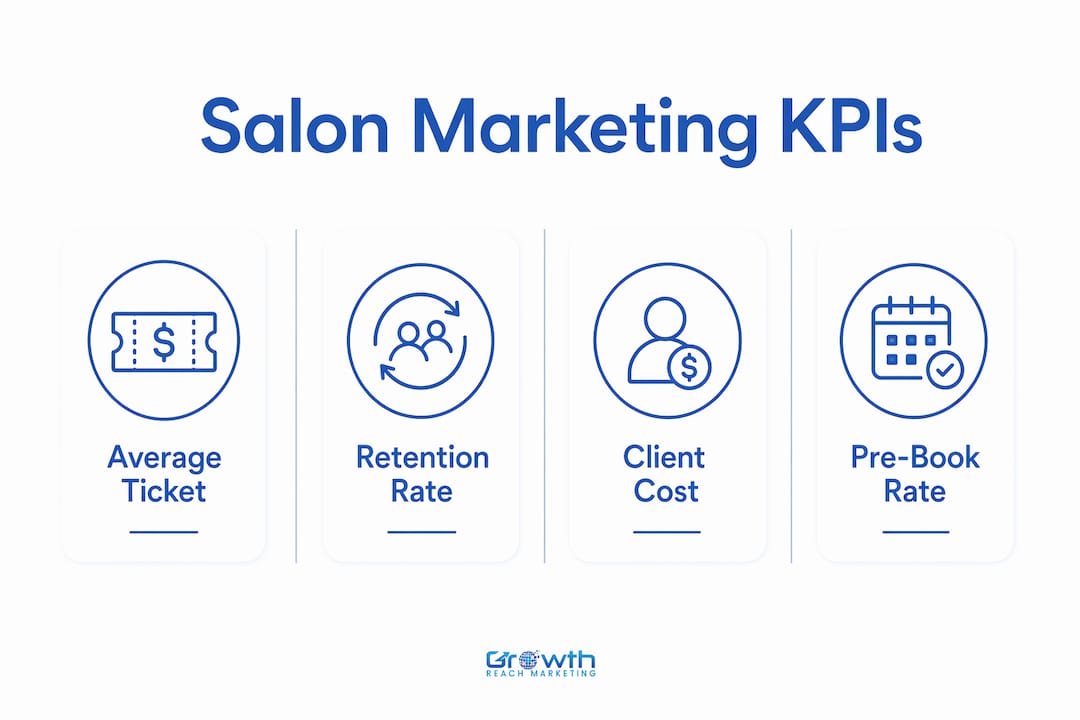
Average service ticket value measures how much each client spends per visit. A low average ticket signals that upselling or service bundling is underperforming.

Client retention rate shows the percentage of clients who return within 90 days. A 5-point improvement in retention increases annual revenue by 25–95%. That single number has more leverage than almost any ad campaign.
New client acquisition cost tells you how much you spend in marketing to bring in one new client. Targeted local Google Ads campaigns have acquired new bookings for as low as $2.03 each, which sets a realistic benchmark for what efficient paid advertising looks like.
Pre-book rate tracks the percentage of clients who rebook before leaving. A low pre-book rate is a scheduling and revenue problem hiding in plain sight.
Retail-to-service ratio measures product sales against service revenue. Profit is often lost in the gap between total revenue and individual KPIs like this one. Owners who ignore it miss a consistent revenue stream.
Chair utilization rate shows what percentage of available appointment slots are actually filled. Low utilization means your marketing is not converting, or your scheduling is leaking capacity.
Net profit margin is the final truth. Every other KPI feeds into it. If your margin is shrinking, trace it backward through the KPIs above to find the leak.
| KPI | What it measures | Why it matters |
|---|---|---|
| Average service ticket | Spend per visit | Reveals upsell and bundling gaps |
| Client retention rate | Return visits within 90 days | Directly tied to annual revenue growth |
| New client acquisition cost | Marketing spend per new client | Benchmarks ad efficiency |
| Pre-book rate | Clients rebooked before leaving | Predicts future revenue and scheduling |
| Chair utilization rate | Filled slots vs. available slots | Exposes conversion and capacity issues |
| Retail-to-service ratio | Product vs. service revenue | Uncovers a hidden revenue stream |
| Net profit margin | Bottom-line profitability | The single number that tells the whole story |
Pro Tip: Pick three KPIs to start. Track them every week for one month before adding more. Consistency with three beats inconsistency with ten.
How do you collect and measure salon marketing data?
The tools you use matter less than the habit you build around them. A notebook, a calculator, and 15 minutes each week tracking seven KPIs can yield more useful insights than an expensive dashboard you check once a month. That said, the right tools reduce friction and make consistency easier.
Manual tracking vs. software tracking
Manual tracking works well for solo operators and small teams. You pull numbers from your booking system, write them in a spreadsheet or notebook, and calculate your KPIs by hand. The advantage is that you understand every number because you calculated it yourself. The disadvantage is time and the risk of human error.
Salon management software automates data collection and generates reports. Most platforms track bookings, revenue, and client visit history automatically. The trade-off is cost and the temptation to let the software run without ever reviewing the output.
| Method | Best for | Main advantage | Main trade-off |
|---|---|---|---|
| Spreadsheet or notebook | Solo operators, small teams | Full understanding of every number | Time-intensive, error-prone |
| Salon management software | Multi-chair or multi-location salons | Automated reports, real-time data | Cost, risk of passive use |
| Ad platform dashboards | Owners running paid campaigns | Channel-level attribution | Requires setup and ongoing review |
For paid advertising, conversion tracking and channel attribution are non-negotiable. Without them, you cannot tell whether a new booking came from a Google Ad, an Instagram post, or a referral. Misattribution leads directly to wasted ad spend. Setting up conversion tracking in Google Ads takes less than an hour and pays for itself immediately.
- Connect your booking page as a conversion goal in Google Ads
- Use UTM parameters on all links in email and social campaigns
- Ask new clients at checkout how they heard about you and log it
- Review channel attribution weekly alongside your KPI log
Pro Tip: Set a recurring 15-minute block every Monday morning to review last week’s numbers. Treat it like a standing appointment. Salons that review KPIs weekly catch problems before they compound.
How do you analyze salon advertising results and act on them?
Data without action is just a record of the past. The goal of analyzing your salon advertising results is to make one better decision this week than you made last week. Start by reading trends, not individual data points.
A single week of low pre-book rate might be noise. Three consecutive weeks of decline is a signal. When you spot a downward trend in retention, investigate immediately. Tracking retention monthly and acting on any drop of 3 or more points allows targeted win-back campaigns before revenue loss compounds.
Turning KPI shifts into marketing decisions
When your new client acquisition cost rises, your ad targeting or landing page is underperforming. Review your local ad targeting and test a new headline or offer before increasing budget.
When your average ticket drops, your team is not presenting retail or upgrades consistently. A brief team training session costs nothing and often produces an immediate lift.
When chair utilization falls below 70%, your marketing volume is insufficient or your booking process has friction. Test a limited-time offer on a slow day to fill gaps and measure the response rate.
- A retention drop of 3+ points triggers a win-back email or SMS campaign
- A rising acquisition cost triggers a landing page or ad copy review
- A falling average ticket triggers a team conversation about service presentation
- A low pre-book rate triggers a scripted rebooking prompt at checkout
Weekly KPI reviews catch dips early, before they become expensive problems. Quarterly reviews are too slow. By the time you notice a trend in a quarterly report, you have already lost three months of revenue.
What mistakes do salon owners make when tracking marketing performance?
The most common mistake is tracking too many KPIs and making zero decisions. Most salon owners track many metrics but act on none effectively. The result is paralysis by analysis. You spend time collecting data and no time using it.
The second most common mistake is ignoring attribution. Incorrect assumptions about which channels drive bookings skew your entire marketing budget. If you think Instagram is driving bookings but it is actually Google, you will keep spending on the wrong channel.
“The goal is not to track everything. The goal is to track the right things consistently and make at least one decision each month based on what you find.”
- Tracking too many KPIs: Limit your active KPI list to five to seven metrics. Review and prune quarterly.
- Failing to act on data: Schedule a monthly decision meeting. Pick one KPI that underperformed and decide what changes next month.
- Ignoring retention trends: Retention is your most cost-efficient growth lever. A client who returns costs nothing to acquire again.
- Skipping attribution setup: Without conversion tracking, every marketing decision is a guess. Set it up once and maintain it.
- Inconsistent tracking cadence: Gaps in your data make trends invisible. Weekly tracking, even manual, beats monthly tracking with software.
Pro Tip: At the end of each month, write down one number that surprised you and one decision you made because of it. That two-sentence log becomes your most valuable business record over time.
Key Takeaways
Salons that track five to seven focused KPIs weekly and make at least one data-driven decision monthly grow revenue faster than those who track everything and act on nothing.
| Point | Details |
|---|---|
| Focus on fewer KPIs | Five to seven core metrics provide 90% of the insights needed to grow a salon. |
| Retention is your top lever | A 5-point retention improvement can increase annual revenue by 25–95%. |
| Weekly tracking beats monthly | Reviewing KPIs weekly catches problems before they cost three months of revenue. |
| Attribution accuracy is non-negotiable | Without conversion tracking, you cannot tell which marketing channels actually drive bookings. |
| Action beats analysis | Make at least one marketing decision each month based on your KPI data. |
Why simple tracking beats complex dashboards every time
I have worked with salon owners who spent hundreds of dollars a month on analytics platforms and could not tell me their retention rate off the top of their head. I have also worked with owners who tracked seven numbers in a spiral notebook every Monday morning and made more money than anyone in their market. The notebook owners won almost every time.
The reason is simple. When you calculate a number yourself, you understand it. When a dashboard calculates it for you, you trust it without questioning it. That trust is dangerous when the data is misconfigured or when you stop checking it because the interface feels overwhelming.
The biggest ROI improvements I have seen come from two places: retention monitoring and new client acquisition cost. When a salon owner starts watching retention weekly and responds to every 3-point drop with a win-back campaign, revenue stabilizes within 60 days. When they start tracking acquisition cost per channel, they almost always discover they have been overspending on one platform and underspending on another.
Start with a spreadsheet. Track your seven KPIs every Monday. Make one decision each month. Build from there. The salon marketing strategies that fill chairs are not complicated. The discipline to measure them consistently is what separates growing salons from stagnant ones.
— Gerard
How Growthreachmarketing helps salons measure and grow
Knowing which metrics to track is the first step. Knowing how to build the marketing systems that move those metrics is where most salon owners need support.
Growthreachmarketing specializes in SEO, Google Ads, and local search for salons and beauty businesses. The team builds conversion-tracked ad campaigns, optimizes Google Business Profiles, and creates content that attracts qualified local clients. If your seasonal promotions are not generating measurable bookings, the SEO strategy behind your promotions is likely the missing piece. Growthreachmarketing also provides Google Ads guidance for beauty clinics that applies directly to salon paid advertising. Every campaign is built to be tracked, measured, and improved.
FAQ
What are the best metrics for salon marketing?
The seven most impactful metrics are average service ticket, client retention rate, new client acquisition cost, pre-book rate, retail-to-service ratio, chair utilization rate, and net profit margin. Focusing on these five to seven KPIs provides 90% of the insights needed to grow a salon.
How often should I review my salon marketing data?
Weekly reviews are the standard for catching problems early. Quarterly reviews are too infrequent to catch declining trends before they cost significant revenue.
How do I track which marketing channel brings in new clients?
Set up conversion tracking in Google Ads, use UTM parameters on all campaign links, and ask new clients at checkout how they found you. Without these three steps, channel attribution is unreliable.
What is a good client acquisition cost for a salon?
Targeted local Google Ads campaigns have achieved acquisition costs as low as $2.03 per booking. Your target will vary by market and service price, but tracking this number weekly lets you spot when a campaign becomes inefficient.
Why does my retention rate matter more than new client numbers?
A 5-point improvement in retention increases annual revenue by 25–95%, while acquiring a new client costs significantly more than retaining an existing one. Retention is the most cost-efficient growth lever available to any salon owner.