
Yes: use demand forecasts, specifically Google Ads Insights and Performance Planner, to schedule ad spend and short promotions so you catch predicted booking peaks before they happen. In practice, that means scheduling a short promo to launch on a forecasted start date, or raising Performance Max and Search budgets a few days ahead of a predicted volume spike. Campaign calendars can be built around exactly this kind of signal.
TL;DR:
- Google Ads demand forecasts provide predicted start dates and peak volumes up to 180 days in advance, but should be treated as directional signals.
- Combining platform forecasts with bookings-on-hand and recent performance data improves accuracy and reduces forecast errors for small salons.
- Testing methods like blocking some booking slots or running A/B calendar displays can determine if scarcity signals effectively boost demand.
- Evaluating forecast-driven campaigns requires a fixed, weekly measurement window that accounts for booking delay and repeated testing across multiple peaks.
- Growth Reach Marketing offers short pilot campaigns to assess demand forecast accuracy tailored to each salon’s specific booking and advertising data.
Table of Contents
- What AI demand forecasting means for salon marketing
- Which tools and data actually help right now
- Six steps from forecast to timed campaign
- Measuring whether the forecast-driven push worked
- Booking visibility and the scarcity signal worth testing
- How Growth Reach Marketing approaches forecast-driven timing
- Run a forecast-driven pilot with Growth Reach Marketing
- Primary sources and docs to read next
- Sources
- FAQ
What AI demand forecasting means for salon marketing
This is about timing, not staffing. AI demand forecasting for salon marketing means using predictive signals to decide when to spend on ads, when to launch a promotion and when to push a lead-gen push, not forecasting busy shifts for rostering or restocking shelves. Those are real problems, but they belong to a different team with different tools.
The inputs that matter here are campaign-level, not salon-floor-level. You need Google Ads demand forecasts from the Insights page, output from Performance Planner, your current bookings-on-hand, and recent campaign performance data such as click-through and conversion rates from the last few weeks.
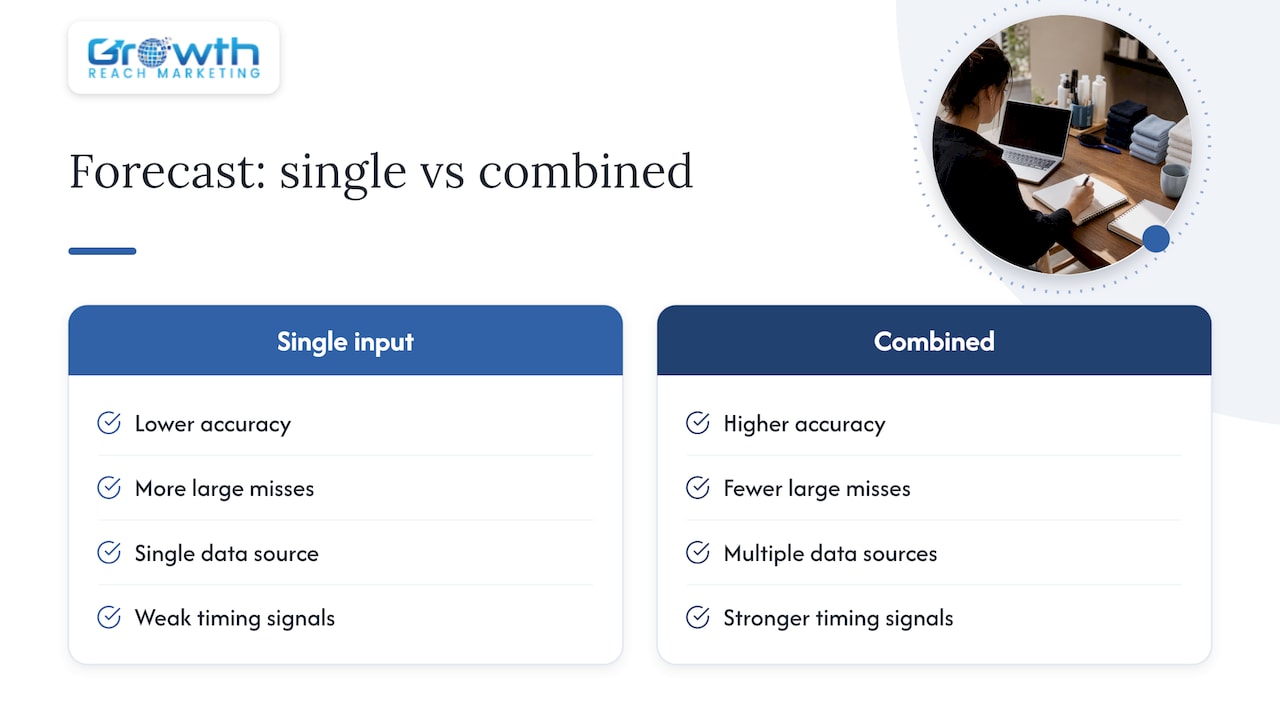
None of these are reliable alone. Platform forecasts are built on aggregate search trends across many advertisers, not your specific client base, while your bookings-on-hand reflect only what has already been reserved. Academic work on small and medium business forecasting found that combining long-term historical patterns with short-term reservations-on-hand produces better forecast accuracy and fewer large forecast misses than either source used in isolation.
Which tools and data actually help right now
A handful of platform features do most of the work, and each comes with a limit worth knowing before you act on it.
- Google Ads Insights demand forecasts report a predicted start date, expected volume and peak volume for up to 180 days ahead, updated daily.
- Performance Planner simulates spend scenarios using your recent account data, though it has minimum data thresholds and some campaign types are not eligible.
- Seasonality adjustments let you schedule a short, temporary conversion-rate change, best suited to events lasting one to seven days, so Smart Bidding does not overreact or underreact during a promo window.
- Bookings-on-hand and booking velocity tell you what is already confirmed versus what a forecast is predicting, which is the fastest sanity check available to a small team.
- Landing-page conversion rate from the last few weeks tells you whether extra traffic during a peak will actually convert or just add cost.
Treat platform estimates as a directional signal rather than a precise prediction. Delivery estimates across ad platforms tend to run optimistic, and salon accounts with limited historical spend often produce sparse, noisy forecasts that need a manual gut check before you commit real budget.
Six steps from forecast to timed campaign
Turning a demand forecast into a live campaign decision is a short, repeatable sequence.
- Pull the forecast. Check Google Ads Insights and Performance Planner for the predicted start date and expected versus peak volume over the next 180 days.
- Validate against bookings. Compare the forecast against your current bookings-on-hand and recent booking velocity to see if reality is tracking the prediction.
- Set weekly spend envelopes. Define a budget range per week with simple trigger rules: increase spend if bookings outpace forecast, hold if flat, reallocate if underperforming.
- Schedule seasonality adjustments. Line up a short-term conversion-rate adjustment ahead of the predicted peak and have creative and landing pages ready before the window opens.
- Run a lightweight test. Use an A/B or holdout structure to check whether the forecast-driven timing actually produced incremental bookings.
- Confirm operational readiness. Check appointment capacity, alert staff to the expected surge and decide in advance how many open slots to display publicly.
Pro Tip: Set your weekly spend envelope on a Friday for the week ahead, using Monday morning booking counts as your first check against the forecast.
Our salon peak season marketing checklist walks through step six in more detail, including how to brief staff before a predicted rush.
Measuring whether the forecast-driven push worked
Three numbers matter most: booked appointments, cost per booked appointment, and the incremental lift attributable to the timed campaign rather than to normal demand. Raw click or impression counts tell you almost nothing about whether the timing decision paid off.
Conversion lag complicates this. A person who sees a promo ad on a Tuesday might not book until the following week, so evaluation windows need to account for that delay rather than judging a campaign’s success the day after it launches.
- Aggregate results weekly instead of daily to smooth out normal booking noise.
- Run a campaign-pair test: one campaign follows the forecast-driven schedule, another follows your usual baseline timing, then compare booked appointments over a fixed window.
- Repeat the test across two or three forecasted peaks before trusting the pattern, since a single result from a small salon account can be noise rather than signal.
A unified AI forecasting approach using model compression and drift detection can cut prediction error by 15% to 25% compared with classical forecasting models like ARIMA or Prophet, according to a 2025 evaluation, a gap that matters most for small operations without the infrastructure to run heavier models.
Booking visibility and the scarcity signal worth testing
Customers often read your booking calendar as a quality signal. Peer-reviewed research on online-appointment systems found that showing only a subset of available slots, rather than a fully open calendar, can sometimes increase demand because customers infer that a busier-looking schedule means better service. This effect is more likely to matter for non-standardized services like hair color correction or injectables, where quality is harder to judge in advance than for a simple wash and blow-dry.
Three safe ways to test it:
- Block a small number of low-value or off-peak slots and compare booking rates against a control period.
- Release your most preferred time slots first, rather than all slots at once.
- Run a straightforward A/B test of a fully open calendar against a partially blocked one before making it permanent.
Only roll out slot blocking after testing it, and pair it with visible star ratings or client reviews to avoid the calendar looking artificially scarce rather than genuinely in demand.
How Growth Reach Marketing approaches forecast-driven timing
We build campaign calendars around Google Ads demand forecasts, pairing predicted peaks with a client’s own bookings-on-hand before committing spend, then run a short pilot to confirm the timing actually moves bookings rather than just traffic. That combination of platform forecasting and salon-specific booking data is the same approach outlined in the sections above, applied to a live account instead of a hypothetical one. Our work centers on Facebook and Instagram ad management, social media management and LinkedIn management for salons, aesthetic clinics and beauty brands, built around Irish-based service and direct client relationships rather than templated campaigns.
— Gerard
Run a forecast-driven pilot with Growth Reach Marketing
A short engagement can help determine whether this approach works for a salon without committing to a long contract. Typically, this involves a forecast audit of Google Ads account and booking data, building a pilot campaign timed to a predicted peak, and providing a measurement report showing the results.
- A forecast readout showing predicted start dates and volume for your account.
- A campaign timing plan with weekly spend envelopes and trigger rules.
- Seasonality adjustments scheduled ahead of your predicted peak.
- A measurement setup that tracks booked appointments and cost per booking.
Visit our services page to request a forecast audit and see how a pilot could fit your salon’s calendar.
Primary sources and docs to read next
- Demand forecasts on the Insights page
- Performance Planner
- Seasonality adjustments
- Booking-status quality inference research
- SME forecasting accuracy study
- Unified AI forecasting for SMEs
- Practical forecasting guide for SMEs
Sources
- Performance Planner – Google Ads Help
- Demand forecasts on the Insights page – Google Ads Help
- About seasonality adjustments – Google Ads Help
- Control of online-appointment systems when the booking status signals quality of service (Schmalenbach Journal of Business Research, 2024)
- Academic research on SME forecasting (2019)
- Unified AI platform for SME forecasting (Zenodo, 2025)
FAQ
How far ahead can Google Ads predict salon demand?
Google Ads demand forecasts on the Insights page cover up to 180 days ahead and refresh daily. Treat forecasts further out as directional rather than precise, since they draw on aggregate trends rather than your specific client history.
Can small salons with limited data still use AI forecasting tools?
Yes, though sparse account data makes forecasts noisier, so it helps to combine platform predictions with your own bookings-on-hand as a sanity check. A 2025 evaluation found that resource-efficient forecasting approaches can improve accuracy for smaller operations without heavy infrastructure.
Should I limit visible booking slots to create urgency?
Only after testing it. Research on appointment systems shows that showing a partial schedule can sometimes increase demand because customers read it as a quality signal, but this should be A/B tested against a fully open calendar rather than adopted outright.
How long should I wait before judging a forecast-timed promo?
Use a fixed evaluation window that accounts for conversion lag, since a person who sees an ad rarely books the same day. Aggregate results weekly rather than daily, and repeat the test across at least two forecasted peaks before drawing conclusions.
What does Growth Reach Marketing charge for this kind of campaign work?
Pricing for Facebook and Instagram Ads Management, Social Media Management and LinkedIn Management is available on request through our services page. Each engagement is scoped to the salon’s current campaign setup and booking data before a price is quoted.