Franchise SEO for salons means making each branch visible for the people who live and work near it, while the brand as a whole stays strong and consistent. The head office sets the rules. Each branch supplies the real local facts. Done well, a client searching “hair salon near me” in Galway sees your Galway branch, not a generic brand page and not your Cork branch.
This guide is for owners and marketing managers of salon groups, franchises and multi-site beauty clinics in Ireland. It covers what to build centrally, what each branch must own, how to stop your own locations competing, and how to measure bookings.
TL;DR
- Give every branch its own Google Business Profile, its own page on your website and its own reviews. Never one shared page for all locations.
- Head office controls structure, data standards, schema and tracking. Branches supply unique local content: team, services, photos, parking, nearby landmarks.
- Google’s local results rest on relevance, distance and prominence, so the work is accurate data, the right categories and a steady flow of genuine reviews.
- Avoid city-swapped duplicate pages. They add no value and push your branches to compete with each other.
- Measure by branch: profile views, direction requests, calls, booking clicks and actual appointments.
Table of Contents
- How franchise SEO differs from single-salon SEO
- What Google uses to rank each branch
- Build the central framework first
- Google Business Profile: one per branch, set up properly
- Branch pages that earn their place
- Stop your branches competing with each other
- Reviews, citations and links per branch
- Local search terms: what each branch should target
- Perspective: what we see in beauty groups
- Measuring whether it works
- A 90-day rollout for a multi-branch group
- Where AI search fits
- How we can help
- FAQ
- Sources
How franchise SEO differs from single-salon SEO
A single salon has one profile, one page, one set of reviews. A franchise or multi-branch group has to do the same job several times over, and keep the brand coherent while doing it.
There are two layers:
- Local layer. Each branch competes in its own catchment: Dundrum against Dundrum’s other salons, not against your Limerick branch.
- Brand layer. The group builds authority, links, press and recognition that lift every branch.
Most groups get the first layer half right and ignore the second, or the reverse. A strong brand site with weak branch profiles loses the map pack. Brilliant branch profiles with a messy website leave Google unsure how your locations relate.
If you run only one salon, our guide to moving up Google Maps in 60 to 90 days is the better starting point. Everything below assumes at least two locations.
What Google uses to rank each branch
Google says local results are mainly based on relevance, distance and prominence, and that prominence draws on information such as links to the business and its reviews. For a multi-site group, each factor behaves differently.
| Factor | What it means for a branch | Who owns it |
|---|---|---|
| Relevance | Does the profile and page match the service searched (balayage, lash lift, laser hair removal)? | Head office sets the template, branch fills in services |
| Distance | How close the branch is to the searcher. You cannot change this, but you can make sure the address and service area are correct. | Branch |
| Prominence | Reviews, mentions, links, general brand awareness | Shared |
Distance is why a franchise cannot “win” a whole county with one page. A salon in Swords will not outrank a closer one in Swords just because your brand is bigger. Each branch has to earn its own area.
Build the central framework first
Before any branch does anything, head office should fix the rules. This is the hub in a hub-and-spoke model: central control of technical standards, site structure, data and measurement, with branches feeding in the local detail. That is the approach multi-location guidance from FranOps recommends, and it matches what we see working in practice.
Your central framework should settle:
- Naming. One exact business name format. Add a location only if it is genuinely part of how the branch trades.
- NAP data. Name, address and phone number written identically everywhere, including Eircode.
- Categories. A primary category per branch chosen deliberately. Our note on the “Salon” category mistake explains why the generic option often costs visibility.
- URL structure. A clear pattern such as /locations/dublin-rathmines/ rather than a mix of formats.
- Booking links. One link per branch pointing to that branch’s own booking page.
- Analytics. Consistent tracking so branches can be compared fairly.
Write this into a one-page standards document. When a branch manager asks “can I change our opening hours on Google?”, the answer should already exist.
Google Business Profile: one per branch, set up properly
Every branch with a staffed premises that clients visit should have its own verified profile. Treat the profile as the most valuable asset the branch owns.
For each branch, check:
- Primary and secondary categories match the services that actually earn money there.
- Opening hours are accurate, including bank holiday hours.
- Services and prices (where you publish them) are filled in.
- Photos are of that branch: the shopfront, the chairs, the team, real work.
- The website link goes to the branch page, not the homepage.
- The booking link goes to the branch’s own booking page.
That last point is a rule, not a preference. Google’s guidance says that for multiple locations, an appointment or booking link must lead to the specific location’s website, not a general landing page or another branch. A group that sends every profile to one central booking form is breaking policy and sending clients to the wrong place.
For a fuller walkthrough of a single profile, see our guide to Google Business Profile optimization for beauty businesses.
Branch pages that earn their place
The branch page is where most franchise sites fail. The usual pattern: one template, the town name swapped, everything else identical. Google sees dozens of near-identical pages, and clients see nothing that tells them why this branch is for them.
The standard to hold every branch page to: could this page only be about this branch? If you can swap the town and nothing else changes, it is not ready.
What a strong branch page contains
- Branch name, full address, phone, opening hours and a map
- A booking button that goes to this branch’s booking flow
- The services this branch offers (not all branches offer all services)
- The stylists, therapists or practitioners who work there, with short bios
- Photos taken in the branch
- Directions, parking, public transport, nearby landmarks
- Reviews from this branch’s clients
- Local FAQs: “Is there parking near the Rathmines branch?”, “Do you take walk-ins in Cork city?”
We have laid out the full build in our salon location page SEO checklist, which you can hand to a web developer as is.
Structured data for each location
Google’s documentation says each physical business location should be defined as its own LocalBusiness entity, using the most specific applicable subtype. The data can include name, address, telephone, URL, coordinates and opening hours. In practice, that means every branch page carries its own markup with its own details, and nothing is copied from the head office page. Our guide to salon schema markup shows what to add and where it goes.
Stop your branches competing with each other
Cannibalization is the franchise-specific problem. Two of your pages or profiles chase the same search, Google picks one unpredictably, and neither performs.
It usually comes from three causes.
1. Duplicate city-swapped pages
The same text across ten towns gives Google no reason to prefer any of them. The hub-and-spoke guidance cited above says copying one page across towns is weaker than adding branch-specific evidence and customer guidance. Give each page its own team, photos, reviews and local advice.
This is also a localisation problem in the proper sense: adapting content to a real place and audience rather than swapping a name. The principles are covered well in this overview of website localisation, and they apply as much to Cork and Galway as to different countries.
2. Brand pages competing with branch pages
If your homepage and service pages target “hair salon Dublin”, they will compete with your Dublin branch pages. Keep brand pages for brand topics (what you do, your approach, your services in general) and let branch pages own the “in [area]” searches.
3. Overlapping catchments
Two branches six kilometres apart will share some searchers. Do not try to hide this. Make each branch distinct by service mix, neighbourhood references and the exact address in its profile. Link branches to each other where it helps the client: “Also available at our Blackrock branch.”
Reviews, citations and links per branch
Reviews are the most visible part of prominence, and they belong to the branch, not the brand.
- Ask at the point of service. The stylist sends the review link for that branch’s profile right after the appointment.
- Reply to every review, positive or negative, in the branch’s own voice.
- Do not pool. A group-wide star rating does not help the Ranelagh branch rank in Ranelagh.
- Plan for moves. Google says that if a business moves address and keeps the same name, its reviews transfer automatically, with some exceptions for certain business categories. Keep the name identical when relocating a branch and check the profile afterwards.
For citations, make sure each branch is listed in the Irish directories and beauty-specific listings relevant to it with identical NAP data. For links, the brand layer carries the weight: local press, charity events, supplier features and community sponsorship, each tied to the branch it concerns. Our piece on earning local press coverage for your salon in Ireland covers how to pitch.
Local search terms: what each branch should target
Keywords differ between branches. A city centre branch might win on “bridal hair Cork”, while a suburban branch wins on “kids’ haircuts” because of family footfall. Pull service demand per area rather than assuming every branch wants the same terms. Our article on why salons need a keyword strategy explains how to map services to searches.
Then apply a simple rule: one primary search target per page, and each target belongs to one page only. A short spreadsheet with columns for branch, URL, primary term, secondary terms and owner prevents most overlap.
For clinics and med spas, add care. Treatment pages for injectables and similar procedures carry advertising and claims rules in Ireland, so branch teams should not freelance their own wording. Central approval of treatment content protects the whole group.
Perspective: what we see in beauty groups
In our work with salons and clinics, the same pattern repeats. Groups spend money on a polished brand site and treat branch profiles as an afterthought, then wonder why a small independent down the road takes the map pack. The independent has a profile that is accurate, photographed, reviewed weekly and linked to a real booking page. That is not magic. It is discipline.
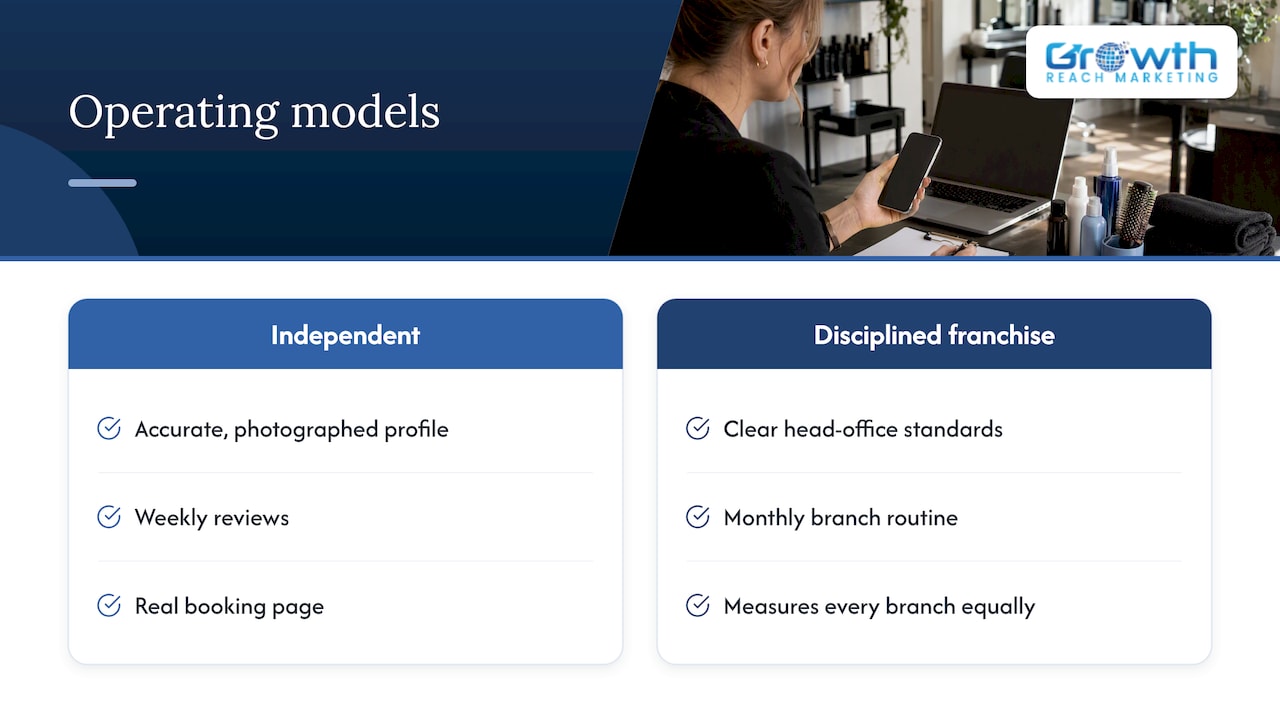
We believe a franchise’s advantage is exactly that it can impose discipline at scale. A head office that sets clear standards, gives branch managers a simple monthly routine (photos, review requests, service updates) and measures every branch the same way will beat most independents within a few months. A head office that publishes forty copies of one page will not.
We are an Irish agency working specifically with beauty and aesthetics businesses, so we build around Irish search habits, Irish towns and Irish rules rather than adapting a US playbook. And we are cautious about promises: local SEO compounds over months, and anyone guaranteeing a number one ranking in a fortnight is guessing.
— Gerard
Measuring whether it works
Rankings are a means. The goal is booked appointments at each branch. Track these per location, monthly, in one shared report.
| Metric | Where to find it | What it tells you |
|---|---|---|
| Profile views and searches | Google Business Profile performance | Visibility in local search |
| Calls, direction requests, website clicks | Google Business Profile | Intent to visit |
| Booking button clicks | Website analytics with branch-level events | Intent to book |
| Completed bookings by source | Your booking system | Real revenue |
| Review count and average rating | Each profile | Prominence and trust |
| Branch page organic sessions | Analytics and Search Console | Website visibility |
A few practical habits help:
- Add tracking parameters to each profile’s website and booking links so branch traffic is separable.
- Ask new clients how they found the branch, and record the answer at the front desk.
- Compare branches with similar size and catchment, not the flagship against the smallest.
- Review in 90-day windows. Weekly movement in map positions is noise.
If one branch lags, check in this order: profile accuracy, review volume, page uniqueness, then local links. Most problems sit in the first two.
A 90-day rollout for a multi-branch group
Days 1 to 30: audit and standards. List every location, confirm which have verified profiles, find duplicates, fix NAP data and categories, and write the standards document.
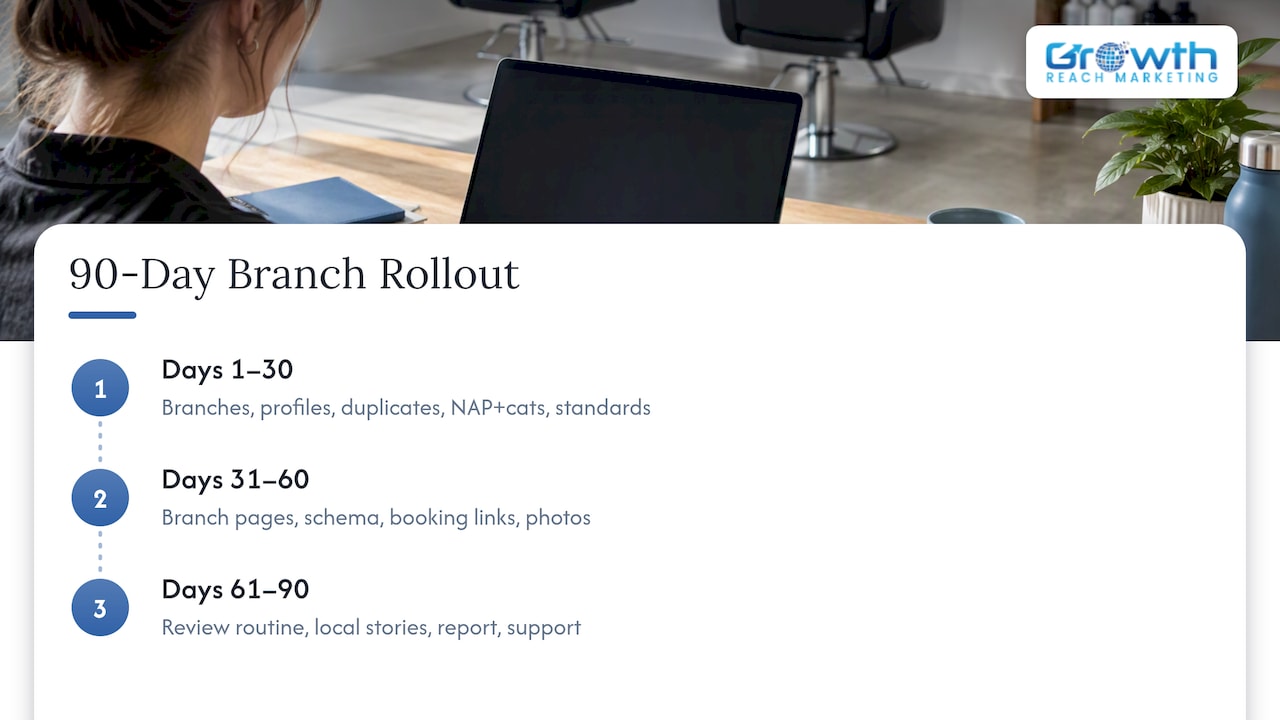
Days 31 to 60: build. Rebuild branch pages around the checklist, add per-branch schema, connect branch booking links and photograph each location.
Days 61 to 90: grow and measure. Start a review routine, pitch local stories, set up the branch report and decide which branches get extra support.
This order matters. Reviews and links sent to a profile with the wrong category or a broken booking link are wasted.
Where AI search fits
People increasingly ask ChatGPT and Google’s AI answers for recommendations, and those answers lean on the same signals: consistent business data, clear service descriptions and genuine reviews. Branch pages with short, direct answers to local questions give AI tools something to cite. Our guide on AI SEO for salons covers this in detail.
How we can help
If you run several salons or clinics in Ireland and want one team to handle the structure, the branch profiles and the reporting, we build tailored systems for beauty and aesthetics businesses. Alongside search, we manage Facebook and Instagram ads, social media and LinkedIn for the same locations, so local visibility and paid campaigns point at the same booking pages. See our services or get in touch through Growth Reach Marketing.
FAQ
Does every salon branch need its own Google Business Profile?
Yes, if clients visit the premises and staff work there. Each profile carries its own address, hours, reviews and booking link. A single profile cannot represent several physical locations.
Can I use one page for all my locations?
It is a poor idea. A single page cannot carry each branch’s address, team, photos and reviews, and Google’s booking-link guidance expects a link to the specific location’s website. Give each branch its own page with content only that branch could have.
How long does franchise SEO take to show results?
Expect the first movements in profile views and calls within a few weeks of fixing data and categories, with steadier ranking gains over three to six months. Results vary by town, competition and how much review activity each branch generates.
What is the biggest mistake salon franchises make?
Publishing near-identical branch pages with only the town name changed. It gives Google no reason to rank any of them and leaves your branches competing with each other. Real local detail fixes it.
Sources
- Local Business (LocalBusiness) structured data, Google Search Central
- Business links policies and guidelines, Google Business Profile Help
- Tips to improve your local ranking on Google, Google Business Profile Help
- Move your reviews across Business Profiles, Google Business Profile Help
- Multi-Location SEO for Franchises: How to Rank Every Unit, FranOps
- What is website localisation? A 2026 guide