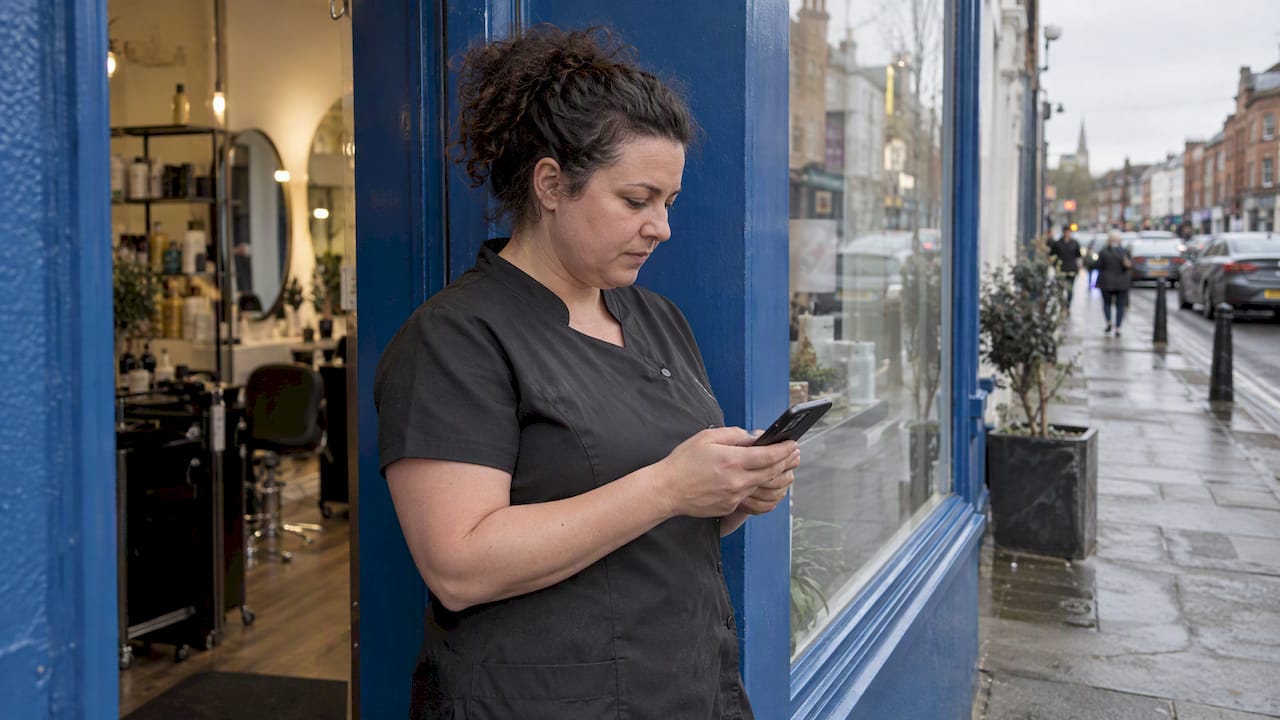

You earn local press for a salon by giving a named reporter a real story about people in your area, and making it easy to run. Press coverage is not bought. Your new treatment menu is not news on its own. A local apprentice winning a national title, a salon donating its time to a charity day, or a second-generation owner reopening a town-centre shop are all stories.
This guide covers how to find the angle, who to send it to, what to put in the release and what to do once you are featured. It is written for owners of salons and beauty clinics in Ireland, where the regional paper, the local radio station and the county news site still carry weight.
TL;DR
- Pitch a human story, not an advert. Reporters need content, and a local person doing something interesting is content.
- Send it to a named editor or reporter who covers local business, not a generic inbox. Keep a simple spreadsheet of contacts.
- Write a short release with a ready-to-paste section at the bottom so a busy desk can publish it with minimal editing.
- Turn each feature into links, reviews and social posts, and make sure your Google Business Profile and website can handle the traffic.
- Know your numbers first, so a rush of new clients is profitable and not just busy.
Table of Contents
- Why local press still works for salons
- Do it yourself first
- Find a story worth telling
- Build a short media list
- Write a release an editor can use
- Pitch the right person
- What we think
- Make the coverage work harder
- Be ready for the rush
- Supports that can help
- Where paid marketing fits
- A simple 30-day plan
- FAQ
- Sources
Why local press still works for salons
Salons sell to people within a short drive. A write-up in the paper your clients’ mothers read, or a mention on the county radio show, reaches exactly those people and carries a trust that an ad does not.
It also helps your online presence. A news site that mentions your salon by name, in your town, is a relevant local signal, and our guide to local links Irish salons need explains how press mentions fit alongside directories, suppliers and community partners.
There is a practical point too. Irish small businesses are the norm, not the exception: SMEs account for 99.8% of enterprises and 69.2% of employment, so local editors see a steady stream of business pitches. The ones that get used are the ones with a person and a point.
Do it yourself first
You do not need a PR agency to begin. Local Enterprise Ireland’s PR training material for small firms says that good PR is something you and your team can do for yourselves, whether that is a press release or a simple phone call or email to the media.
The skill is not writing polish. It is judgment: what is genuinely of interest to someone who does not own your salon.
Find a story worth telling
Ask one question about every idea: would a reader who has never heard of us care? If the answer is no, it is an advert.
Communications consultant Aileen O’Meara, a former journalist, describes journalists and PR people as having a symbiotic relationship: reporters need material, and you need exposure. Treat the journalist as a partner and not a target, and lead with a human story.
Angles that tend to suit salons
| Angle | Why a local editor may run it | What to have ready |
|---|---|---|
| Staff or apprentice achievement | A local person succeeding is a classic regional story | Name, age, townland or town, a good photo |
| Charity or community event | Fits the community pages and event listings | Date, venue, cause, how readers can take part |
| Milestone | Ten years open, a move, a reopening | Brief history, owner’s own words, then-and-now photos |
| Seasonal useful advice | Formal season, wedding season, back to school | One or two specific tips from a named stylist |
| Hiring or training | Jobs and skills stories matter locally | Number of roles, training route, who to contact |
| Local trend | Something your chairs are seeing this year | Honest observation, no invented statistics |
Notice what is missing: sales, discounts and a new product line. Those belong in your ads and social posts. If you want help with those, our article on how to target local clients with salon ads covers them.
Check the story against three tests
- Local: does it involve a named person or place in the paper’s patch?
- Timely: is there a reason to run it this week or this month?
- Visual: can you supply a sharp, well-lit photo that is not a stock image?
If it passes two of the three, it is worth a pitch.
Build a short media list
A generic newsroom address is the weakest route. Local Enterprise Ireland’s PR guidance recommends building your own simple media database, tracking contacts, their beats and when you last spoke, in place of expensive distribution services.
A spreadsheet with these columns is enough:
- Outlet (regional paper, local radio, county news site, community Facebook news page)
- Contact name and role
- Their beat (local business, features, community, lifestyle)
- Preferred contact method and submission rules
- Date of last contact and what you sent
- Outcome
Read each outlet for two weeks first. Note who writes the business and community stories and what length and tone they use. Many papers also publish their own submission advice. The Cork Independent, for example, has a page telling readers how to submit news and event press releases. Look for the equivalent page for your own county paper and follow it to the letter.
Write a release an editor can use
Keep the release to a single page. We have laid out the structure in detail in our post on the five parts of a usable Irish press release, but the essentials are these.
- A plain headline. Say what happened and where. “Tullamore stylist wins national colour award” beats a clever pun.
- A first paragraph that answers who, what, where and when. If the editor reads nothing else, this should be enough.
- One quote from a real person. Use the owner or the person in the story, in natural speech.
- Practical details. Dates, times, address, how to book or attend, a phone number for follow-up.
- Contact and images. Name, mobile number, and a photo attached with a caption naming everyone in it.
Add a web-ready section
Busy desks like copy they can drop in. The Cork Independent’s guidance suggests including a short section that editors can copy and paste onto the news website. Put a few self-contained paragraphs at the bottom of your release for this purpose. It lowers the effort needed to publish you, which is often the deciding factor on a slow news day.
Write it in your own voice, and keep it honest
Never claim awards you have not won or numbers you cannot show. If you mention a health or safety point about a treatment, such as patch testing, state it exactly as your insurer and training body advise. A correction in the paper costs more than any coverage is worth.
Pitch the right person
Personalized pitches to a named reporter are significantly more likely to get a response than a mass email, as Local Enterprise Ireland’s PR guidance puts it when advising on a media database and direct contact.
A short pitch email works like this:
- Subject line: the story in a line, with the town in it.
- Opening: one sentence showing you know their work, such as a recent piece on a local business.
- The pitch: two or three sentences with the human angle.
- The offer: a photo, an interview, access to the salon on a day that suits them.
- Paste the release below, not as an attachment only.
Send it in the morning, early in the week where you can. Follow up once, by phone or email, after a few days. If they pass, say thanks. Over time that goodwill is worth more than any single piece.
Radio and community pages count too
County radio shows always need guests, and community news pages on social media often run local stories within hours. They suit shorter, more personal stories than a newspaper. Add them to your list.
What we think
We work with salons and aesthetic clinics, and the pattern we see is that owners treat press as a separate, glamorous activity, when it is really a part of how they are found online. A feature in a local paper is useful the moment someone searches your name, your town or your treatments, and a mention on a news site can help that story last far beyond the print run.
The mistakes are consistent. The owner writes an advertisement and calls it a release. They send it to ten generic inboxes. They get one mention, say nothing about it, and let the moment pass. Then they decide press “does not work”.

Our view is simple. Press is a relationship, built over months, with a small number of named people. It needs a story that is true, a photo that is good and a salon that is ready to be found. We would rather you do the first three pitches yourself and learn what your local editors want than hand it to someone who does not know your town.
Where we can help is what happens around the coverage: making sure the website, Google profile and booking path convert the attention into appointments. And because we are Irish-based, we know the difference between the regional paper that wants a community angle and the county news site that wants quick, tidy copy.
— Gerard
Make the coverage work harder
A feature is not finished when it is published. Use it.
- Share it on your own social channels the day it runs, tagging the outlet and the reporter. Our post on why salon social media needs a strategy shows how to keep that content consistent.
- Add an “as seen in” line to your website, naming the outlet and linking to the story. Only name coverage you have actually earned.
- Check your Google Business Profile. Hours, phone, services and photos should be correct before the story runs, because readers will search your name.
- Ask happy clients for reviews around the time of coverage, when more people are paying attention.
- Keep a clippings folder of links and scans, which makes the next pitch easier.
If a story or review ever turns negative or inaccurate, handle it calmly and early. A specialist in reputation management and communications can advise on that kind of situation.
Be ready for the rush
Press can fill your diary quickly. That is only good if the numbers work. Treatwell’s business guidance stresses unit economics: the cost of time, product and labor behind every service, so that new traffic makes you profitable and not just busy.
Before you pitch, work out:
- The real cost and margin of the treatment you want to promote
- How many extra bookings your team can take without turning away regulars
- Whether your online booking, phone line and cancellation policy can cope
If you are near the VAT threshold, plan for it too. Revenue’s guidance sets the registration threshold for services at €42,500, and the same document is where to check the current rate that applies to hairdressing. Confirm your own position with your accountant.
Supports that can help
If you are starting out, your Local Enterprise Office is the first call. Industry coverage notes that LEOs are a gateway for digital and growth support for beauty SMEs, including mentoring and training. Some programs, including the Local Enterprise Office PR training tool for small businesses, are free to use.
New business owners getting the Back to Work Enterprise Allowance may also be able to claim the Enterprise Support Grant. Citizens Information says it can provide up to €2,500 over 24 months toward approved startup costs, with a matching contribution from you. Check eligibility directly with the Department of Social Protection or your LEO before spending.
Where paid marketing fits
Press is slow, free and unpredictable. Paid ads are fast, measurable and controllable. Most salons need both. Earned coverage builds trust, while a well-run campaign puts your offer in front of people in your catchment every week.
At Growth Reach Marketing we manage Facebook and Instagram ads, social media and LinkedIn for beauty businesses, working around your clients and your capacity. If you want to talk about how that could support a press push, get in touch through our website. For a wider view of the options, see our overview of salon marketing strategies that fill chairs.
A simple 30-day plan
| Week | Task |
|---|---|
| 1 | List three possible stories. Pick the strongest. Read your target outlets and note the right reporter for each. |
| 2 | Write the release with a web-ready section. Take and caption photos. Tidy your Google profile and website. |
| 3 | Send personalized pitches to two or three named contacts. Follow up once by phone or email. |
| 4 | Share any coverage, update your site, ask for reviews, log results in your spreadsheet. |
Repeat quarterly. After a year you will have a media list that actually knows you.
FAQ
Do I need a PR agency to get my salon in the local paper?
No. Local Enterprise Ireland’s PR guidance for small businesses says owners can generate coverage themselves with a release, an email or a phone call. What matters is a real local story and a named contact. An outside adviser can help later if you want to scale it.
What should a salon press release include?
A plain headline, a first paragraph answering who, what, where and when, one real quote, practical details and a contact with photos. Add a short web-ready section at the bottom so editors can publish it easily.
Should I send the same release to every outlet?
Send the same facts, but personalize the email to each named reporter and adapt the angle to their patch. A county radio show wants a speaker. A newspaper wants a photo and a short story. Avoid mass-blasting a generic inbox.
How long until I see results?
There is no guaranteed timeline. A pitch can be used within days or never, and relationships take months. Treat each attempt as practice, track outcomes in your spreadsheet and keep going.
Sources
- Ten Tips to get a journalist’s attention, Rathdown Media Institute
- How PR Worked, Local Enterprise Ireland PR training tool
- Cork Independent, how to submit news and press releases
- Irish Government establishes dedicated Small Business Unit, Professional Beauty
- Beauty business plan guide, Treatwell Business
- Finance Act 2024 VAT Notes for Guidance, Revenue
- Back to Work Enterprise Allowance, Citizens Information