
The highest-converting med spa lead generation types right now are Google search (organic plus Google Business Profile), treatment-level Google Ads, patient referrals, and a conversion-optimized website. Start this week by claiming and fully completing your Google Business Profile, then build one service-specific landing page for your highest-margin treatment. Those two moves alone will outperform most paid campaigns that skip this foundation, according to PatientNow’s 2026 lead generation research.
Your 30–90 day priority action plan:
This week (Days 1–7):
- Complete every field in your Google Business Profile: primary category set to “Medical spa,” real treatment photos, service entries for each procedure, and at least three seeded Q&A responses.
- Audit your top-traffic landing page for a single clear CTA and a visible booking button above the fold.
- Set a speed-to-lead SLA: every inbound inquiry gets a response within 10 minutes during business hours.
This month (Days 8–30):
- Launch one treatment-level Google Ads campaign targeting booking-intent keywords (e.g., “Botox near me,” “laser hair removal [city]”).
- Build a simple referral program with a reward structure for existing clients.
- Connect a CRM or booking platform to auto-route web form leads to SMS follow-up within minutes.
This quarter (Days 31–90):
- Add Meta retargeting ads to warm up visitors who did not book.
- Build a 21-day email and SMS nurture sequence for unconverted inquiries.
- Set up review request automation after each appointment.
Pro Tip: Fix your Google Business Profile before spending a dollar on paid ads. Owners who run Google Ads to a weak GBP listing pay for clicks that land on a profile with no photos, no reviews, and no service details — and those visitors leave without booking.
Table of Contents
- What types of med spa leads convert best by channel?
- How does local SEO and your Google Business Profile drive high-intent leads?
- How do you turn your website into a lead capture machine?
- How should you structure Google Ads for med spa bookings?
- How do Meta ads build awareness and convert med spa leads?
- How do you build a referral program that consistently produces leads?
- What email and SMS sequences convert med spa inquiries into bookings?
- How do you generate and manage reviews to win more bookings?
- What speed-to-lead SLAs and front-desk scripts raise your booking rate?
- What KPIs and budgets should you track for med spa lead generation?
- Your 90-day implementation roadmap by budget tier
- How Growthreachmarketing runs med spa campaigns: templates and KPIs
- Key Takeaways
- What separates good med spa lead gen from great
- Growthreachmarketing’s med spa lead generation services
- Useful sources and references for further reading
What types of med spa leads convert best by channel?
Understanding which channel produces which quality of lead is the fastest way to stop wasting budget. The table below maps each major source against lead intent, typical conversion likelihood, relative cost, and how quickly you can expect results.
| Channel | Lead Intent | Conversion Likelihood | Relative Cost | Time to Results |
|---|---|---|---|---|
| Organic search (SEO) | High | High | Low (time investment) | 3–6 months |
| Google Business Profile | High local intent | High | Low | 2–4 weeks |
| Google Ads (treatment-level) | Very high | Very high | Medium–High | 1–2 weeks |
| Meta Ads (awareness) | Low–Medium | Medium | Medium | 2–4 weeks |
| Meta Ads (retargeting) | High | High | Low–Medium | 1–2 weeks |
| Patient referrals | Very high | Very high | Very low | Ongoing |
| Email/SMS (warm list) | High | High | Very low | Days |
| Social media (organic) | Low–Medium | Low | Low (time investment) | Months |
| Influencer/partnerships | Medium | Medium | Varies | 4–8 weeks |
Read this table as a prioritization tool, not a fixed ranking. A clinic with zero online presence should start with GBP and one Google Ads campaign. A clinic with steady traffic but poor bookings should focus on website conversion and email nurture first. The channels with “Very high” intent (Google Ads, referrals) are where you put budget when you want bookings fast. Organic search and GBP are where you invest time for compounding returns.
How does local SEO and your Google Business Profile drive high-intent leads?
Local search is where med spa clients make their first decision. Someone searching “lip filler near me” or “best Botox in city]” is ready to book, not just browse. That search intent is why [Alev Digital’s 2026 med spa strategy guide places GBP optimization at the top of every clinic’s checklist.
GBP priorities, in order:
- Set your primary category to “Medical spa” (not “Day spa” or “Beauty salon”).
- Add at least 10 real photos: exterior, reception, treatment rooms, and staff.
- Create a service entry for every treatment you offer, with a description and price range where possible.
- Seed your Q&A section with the five questions clients ask most often, and answer them yourself before a stranger does.
- Post weekly: a treatment spotlight, a limited offer, or a before/after result (see the HIPAA note below).
- Build review velocity: aim for at least two to four new reviews per month, not a one-time burst.
- Keep your Name, Address, and Phone number (NAP) identical across every directory, your website, and your GBP listing.
For local SEO beyond GBP, build service-area pages for each city or neighborhood you serve, and create treatment-specific landing pages (one page per procedure). Add LocalBusiness and MedicalBusiness schema markup to your homepage and location pages. Track progress through GBP Insights: map impressions, clicks to website, direction requests, and call clicks are your four core metrics. You can find a deeper breakdown of GBP post strategy for med spas in Growthreachmarketing’s dedicated guide.
Pro Tip: Before/after galleries are powerful trust signals on your GBP and website, but they require written patient consent and careful handling under HIPAA. Never upload identifiable photos without documented authorization. Check your state medical board’s specific rules on before/after advertising before publishing.
How do you turn your website into a lead capture machine?
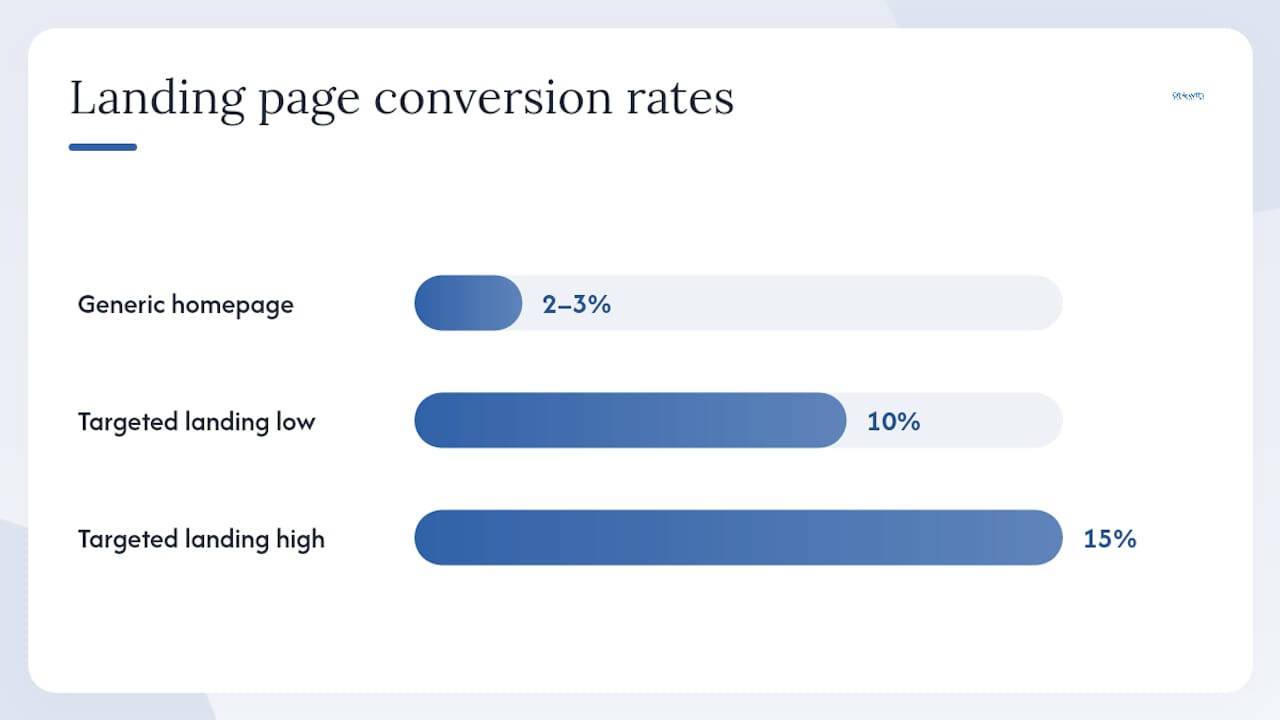
Traffic without conversion is just an electricity bill. Most med spa websites lose leads at two points: a landing page that fails to match what the visitor searched for, and a booking flow with too many steps. SmartLifeRadar’s 2026 salon and spa research found that service-specific landing pages can lift conversion rates from roughly 2–3% to 10–15% on targeted offers, compared to sending paid traffic to a generic homepage.
High-converting landing page elements:
- Headline that mirrors the search term or ad copy exactly (e.g., “Botox in [City] — Book Your Consultation Today”).
- Trust signals above the fold: star rating, number of reviews, provider credentials, and a recognizable certification logo.
- Visible price range or starting price — hiding prices increases bounce rates on high-intent pages.
- Before/after gallery with consent-compliant images.
- A single primary CTA: one booking button, not four different options competing for attention.
- Click-to-call button visible on mobile without scrolling.
- Calendar availability widget so visitors can see open slots immediately.
Lead capture tactics beyond the booking form:
- Multi-point capture: offer a secondary opt-in (e.g., “Download our treatment guide”) for visitors who are not ready to book.
- SMS-first forms: ask for a phone number before an email address — SMS response rates are significantly higher for appointment confirmations.
- Exit-intent offer: trigger a popup when a visitor moves to close the tab, offering a complimentary high-margin enhancement (such as a lip gloss treatment add-on) in exchange for their contact details. Trading a high-value enhancement for contact info converts better than a broad discount because it protects your pricing.
- Partial-book flow: if a visitor starts booking and abandons, trigger an immediate SMS with a one-click link to resume exactly where they left off.
A/B test plan for your first 60 days:
- Test headline variants: benefit-led (“Look 10 Years Younger”) vs. intent-led (“Botox in [City] — Same-Week Appointments”).
- Test CTA button copy: “Book Now” vs. “Check Availability” vs. “Get My Free Consult.”
- Test form length: three fields (name, phone, treatment interest) vs. six fields.
- Test social proof placement: reviews above the fold vs. below the hero image.
For a full breakdown of booking flow design, Growthreachmarketing’s med spa website design guide covers layout, mobile optimization, and conversion-focused page structure.
How should you structure Google Ads for med spa bookings?
Google Ads is the fastest path to booked consultations when the campaign is built around treatment-level intent. The mistake most clinics make is running one broad campaign for the whole practice. A search for “Botox near me” and a search for “laser resurfacing cost” represent completely different buyers at different stages — they need different ads, different landing pages, and different offers.
Campaign structure that works:
- One campaign per treatment category (injectables, laser, body contouring, skin care).
- Tightly themed ad groups within each campaign: one ad group for “Botox,” a separate one for “lip filler,” another for “Dysport.” This is sometimes called a SKAG (Single Keyword Ad Group) structure, though tightly themed groups of two to three close variants work just as well.
- Call extensions and location extensions on every campaign.
- Import booking conversions from your scheduling platform so Google’s algorithm optimizes for actual appointments, not just form fills.
Keywords to target:
- Treatment + location: “Botox [city],” “lip filler near me.”
- Treatment + intent: “Botox consultation,” “laser hair removal cost.”
- Provider type + location: “med spa near me,” “aesthetic clinic [neighborhood].”
Negative keywords to add from day one: “DIY,” “training,” “school,” “certification course,” “how to do,” “at home.”
Budget guidance varies by market, but treatment-level keywords in competitive metro areas typically carry higher CPCs than broad brand terms. Start with a budget that allows at least 30–50 clicks per ad group per month before drawing conclusions. For detailed campaign structure examples and budget frameworks, Growthreachmarketing’s Google Ads guide for medical aesthetics is the most practical starting point.
Early success signals: A click-through rate above 5% on treatment-specific ads, a landing page conversion rate above 8%, and a cost per lead that sits below your average treatment margin. If any of those three numbers are off after 30 days, test a new headline before adjusting budget.
How do Meta ads build awareness and convert med spa leads?
Meta (Facebook and Instagram) works differently from Google. People on Meta are not searching for treatments — they are scrolling. That means Meta is best for discovery and retargeting, not for capturing someone who is ready to book right now. Pair every Meta campaign with a conversion-focused landing page and a qualification filter, or you will fill your pipeline with low-intent contacts who never show up, as Meevo’s 2026 med spa lead generation guide notes.
Campaign types by funnel stage:
- Awareness/traffic: Video or carousel showing a treatment process, safety credentials, and a real result. Goal is reach and video views, not clicks.
- Lead form campaign: Use Meta’s native lead form with two to three qualifying questions (“Have you had this treatment before?”, “What is your budget range?”, “When are you looking to book?”). Cheap top-of-funnel volume, but requires immediate follow-up to be useful.
- Retargeting: Serve an offer ad (e.g., a complimentary consultation or a limited-availability promotion) to anyone who visited your landing page or watched 50% of your video in the last 30 days.
Creative that converts for aesthetic treatments:
- Before/after narratives with consent-compliant images and a clear caption explaining the procedure and timeline.
- Process transparency videos: a 30–60 second walkthrough of what a treatment appointment actually looks like, including the consultation, the procedure, and the recovery.
- Provider credentials and safety messaging — especially effective for first-time clients who are nervous about needles or lasers.
Pro Tip: Set up an immediate SMS automation the moment a Meta lead form is submitted. Lead heat drops fast — a contact who filled out a form at 2 PM and hears nothing until the next morning is already comparing three other clinics. A text within five minutes changes that dynamic entirely.
Rotate creative every three to four weeks. Meta’s algorithm fatigues on static images faster than on video, and frequency above 3.0 on a single creative set typically signals it is time to swap.
How do you build a referral program that consistently produces leads?
Referrals are the lowest-cost, highest-quality leads in any med spa’s channel mix. A referred client arrives with pre-built trust, converts at a higher rate, and tends to spend more per visit. The problem is that most clinics rely on organic word-of-mouth rather than a structured program, which means results are inconsistent. CUFinder’s spa lead generation research recommends treating referrals as a formal channel with tracking, incentives, and a repeatable flow.
Step-by-step referral program flow:
- Identify your top 20% of clients by visit frequency and spend — these are your natural advocates.
- Send a personal outreach (text or handwritten note) explaining the program and the reward.
- Give each advocate a unique referral link or a personalized code tied to their name in your CRM.
- When a referred client books and completes their first appointment, trigger the reward automatically.
- Track redemptions monthly and report back to advocates so they feel invested in the program.
Incentive structure that protects pricing:
- For the referrer: a service credit, a complimentary enhancement, or a product gift — not a percentage discount on their next treatment. Discounts erode perceived value; upgrades do not.
- For the referee: a complimentary add-on at their first visit (e.g., a free lip treatment with any injectable booking), not a flat dollar discount off the procedure price.
Local B2B partnerships to pursue:
- Bridal boutiques and wedding planners (high-intent, time-sensitive clients).
- Luxury gyms and personal trainers (body-conscious, higher-income demographic).
- Hair salons and blowout bars (existing beauty spend, easy cross-referral).
- Dermatologists and primary care physicians (clinical credibility, warm referrals for aesthetic treatments).
Reach out with a simple co-referral proposal: you send their clients a welcome offer, they display your cards or mention your clinic at checkout. Keep the outreach short and lead with what is in it for them.
What email and SMS sequences convert med spa inquiries into bookings?
Fast, multi-channel follow-up is where most clinics lose leads they already paid to generate. An inquiry that gets a response within minutes converts at a dramatically higher rate than one that waits hours, according to PatientNow’s speed-to-lead research. The sequence below is designed to keep your clinic top of mind across 21 days without feeling like spam.
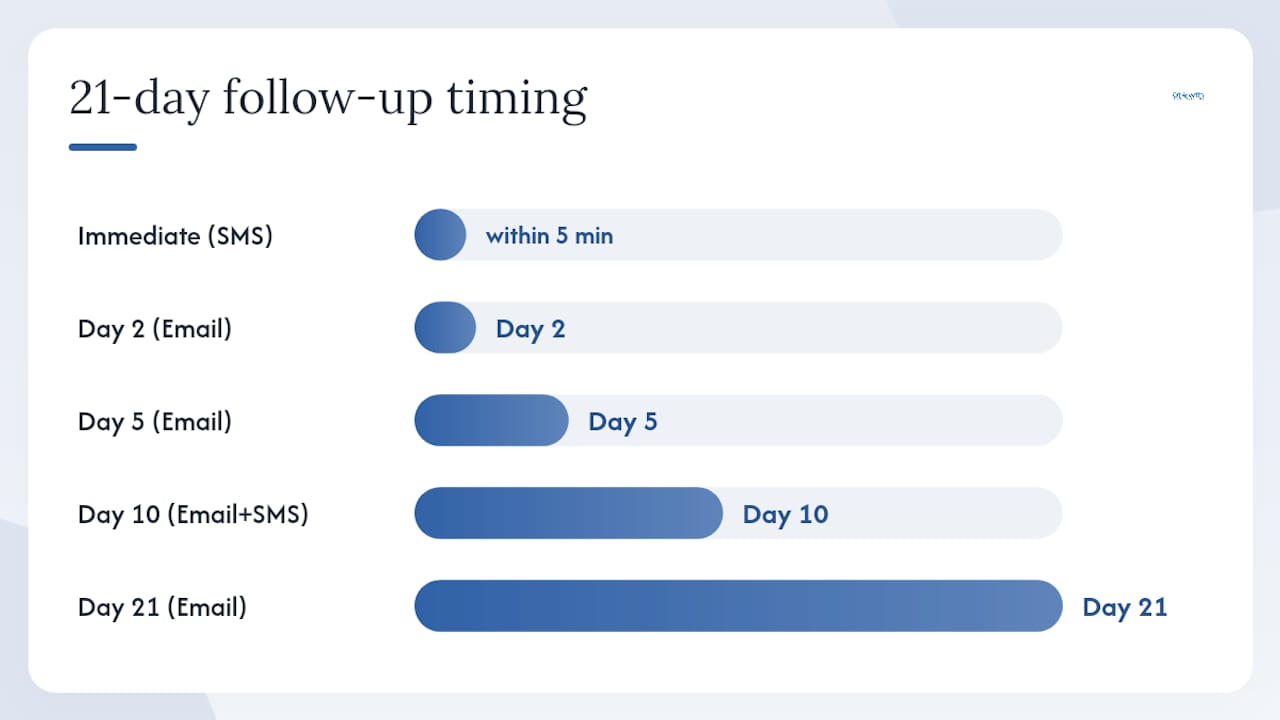
21-day nurture sequence:
- Immediate (within 5 minutes): SMS — “Hi [Name], thanks for your interest in [Treatment] at [Clinic]. I’d love to get you booked — here’s a link to check availability: [link]. Reply STOP to opt out.”
- Day 2: Email — Treatment overview, what to expect at a consultation, and a link to your before/after gallery.
- Day 5: Email — Social proof: a real client story (with consent) or a summary of your most recent Google reviews, plus a soft CTA to book.
- Day 10: Email + SMS — A limited-time offer or a “we have an opening this week” message with a direct booking link.
- Day 21: Email — Final check-in: “Still thinking it over? Here are answers to the three questions we hear most often.” Include an FAQ and a no-pressure CTA.
- Ongoing drip (monthly): Educational content, seasonal promotions, and new treatment announcements to keep unconverted leads warm.
Compliance basics (HIPAA and TCPA):
- Collect explicit written opt-in for SMS at the point of form submission — a checkbox with clear language is the minimum.
- Never include treatment details, diagnosis references, or appointment specifics in SMS messages that could constitute protected health information (PHI).
- Honor opt-out requests immediately and document them in your CRM.
- Consult your clinic’s legal counsel for a compliant consent template before launching any automated SMS sequence.
For detailed automation setup and email nurturing sequences for med spas, Growthreachmarketing’s dedicated guide covers CRM routing, trigger logic, and sequence templates. Additional lead nurturing techniques for converting prospects are worth reviewing alongside your CRM setup.
Pro Tip: Score leads in your CRM by behavior: a lead who opened three emails and clicked your booking page twice is hotter than one who opened once. Route high-score leads to a personal phone call from your front desk, not just another automated message.
How do you generate and manage reviews to win more bookings?
Review velocity, meaning how frequently new reviews appear, affects your ranking in Google’s local pack and your conversion rate from GBP profile views. A clinic with 200 reviews and a 4.8 rating converts meaningfully better than one with 40 reviews and a 4.6, even when the service quality is identical, as AestheticsPro’s research on med spa lead sources confirms.
Operational review checklist:
- Ask at the right moment: immediately after a successful treatment, while the client is still in the clinic and the experience is fresh.
- Make it frictionless: send a direct Google review link via SMS within 30 minutes of checkout — do not ask clients to search for your profile.
- Train every staff member to make the ask feel personal, not scripted: “If you’re happy with your results today, a quick Google review would mean a lot to us.”
- Monitor reviews weekly using Google Alerts or your practice management software’s reputation module.
Response scripts:
- Positive review: “Thank you so much, [Name]! We’re thrilled you’re happy with your [treatment] results. We look forward to seeing you at your next visit.”
- Neutral review (3–4 stars): “Thank you for your feedback, [Name]. We’d love to learn more about your experience — please reach out to us directly at [email] so we can make it right.”
- Negative review: “We’re sorry to hear this, [Name]. We take all feedback seriously and would appreciate the chance to speak with you directly. Please contact us at [email/phone].” Never argue, never disclose treatment details publicly.
Surface your best reviews on treatment landing pages as text testimonials (with written permission) and in Meta ad creative. Google’s terms prohibit gating reviews or offering incentives for positive feedback — keep your request process clean.
What speed-to-lead SLAs and front-desk scripts raise your booking rate?
Contacting a lead within 10 minutes of their inquiry multiplies your qualification rate compared to same-day contact. That single operational change, a 10-minute response SLA, is one of the highest-ROI moves a med spa can make without spending an extra dollar on advertising.
Response-time targets by channel:
| Channel | Target Response Time | Owner | Escalation Trigger |
|---|---|---|---|
| Phone call (missed) | Callback within 5 min | Front desk | No answer after 2 attempts → SMS |
| Web form submission | SMS within 5–10 min | Automated CRM | No reply after 1 hour → front desk call |
| Meta lead form | SMS within 5 min | Automated CRM | No reply after 30 min → front desk call |
| GBP message | Reply within 1 hour | Front desk or owner | No reply after 2 hours → owner alert |
| Email inquiry | Reply within 1 hour | Front desk | No reply after 4 hours → phone call |
CRM routing rules:
- Tag every lead with source (Google Ads, GBP, Meta, referral, organic) at entry so you can track CAC by channel.
- Score leads on three fields: treatment interest, budget signal, and timeline. High-score leads (treatment named + budget confirmed + “this month”) go to a personal call queue immediately.
- Capture: name, phone, email, treatment interest, and how they heard about you. Those five fields are the minimum for meaningful attribution.
Front-desk phone script (first contact):
“Hi, this is [Name] from [Clinic]. I’m calling because you reached out about [treatment] — I wanted to make sure I caught you quickly. Do you have two minutes to talk about what you’re looking for?” Keep it warm, not clinical. The goal of the first call is to confirm interest and get a consultation booked, not to explain the procedure in detail.
What KPIs and budgets should you track for med spa lead generation?
You cannot improve what you do not measure. The five core metrics for any med spa lead generation program are: cost per lead (CPL), cost per acquisition (CPA), booking-to-paid conversion rate, return on ad spend (ROAS), and client lifetime value (LTV).
Formula reference:
- CPL = Total ad spend ÷ Total leads generated
- CPA = Total ad spend ÷ Total new paying clients
- ROAS = Revenue from ad-attributed clients ÷ Total ad spend
- LTV = Average transaction value × Average visits per year × Average client lifespan in years
Sample budget tiers:
| Tier | Monthly Ad Budget | Suggested Channel Split | Expected Time to Results |
|---|---|---|---|
| Bootstrapped/DIY | $500–$1,500 | 70% Google Ads, 30% Meta retargeting | 4–8 weeks |
| Moderate (in-house + freelancers) | $1,500–$5,000 | 50% Google Ads, 30% Meta, 20% SEO/content | 6–10 weeks |
| Agency-managed (growth) | $5,000–$15,000+ | 40% Google Ads, 30% Meta, 20% SEO, 10% email/SMS | 4–8 weeks |
Using early funnel metrics to decide what to do next:
- CTR below 3% on Google Ads: test new headlines before raising budget.
- Landing page conversion below 5%: fix the page before adding traffic.
- CPL rising week over week: check for audience fatigue on Meta or keyword competition increases on Google.
- Leads not converting to bookings: the problem is speed-to-lead or nurture, not the ads.
The AdSpyder funnel guide for spa lead generation covers how to align ad spend with funnel stage to avoid the most common mismatch between ad promise and landing page delivery.
Your 90-day implementation roadmap by budget tier
The right starting point depends on your budget and who is doing the work. Here is a practical roadmap across three tiers.
Tier 1: Bootstrapped/DIY
- Week 1: Complete GBP profile, set NAP consistency across directories, build one treatment landing page.
- Week 2: Launch a small Google Ads campaign ($20–$50/day) for your highest-margin treatment.
- Week 3–4: Set up a basic CRM (HubSpot free tier or similar), connect web form to SMS auto-reply.
- Month 2: Add a referral program, start review request automation.
- Month 3: Add Meta retargeting to website visitors, build a 5-email nurture sequence.
Tier 2: Moderate budget (in-house + freelancers)
- Week 1–2: GBP audit, two to three treatment landing pages, Google Ads launch with conversion tracking.
- Week 3–4: Meta awareness campaign, lead form with qualifying questions, immediate SMS automation.
- Month 2: A/B test landing page headlines and CTAs, launch referral program, add local partnership outreach.
- Month 3: Full 21-day nurture sequence, review generation automation, monthly KPI review cadence.
Tier 3: Agency-managed (growth)
- Week 1: Full audit (GBP, website, existing ads), campaign architecture built, tracking installed.
- Week 2: All campaigns live (Google Ads, Meta, GBP posts), CRM routing configured.
- Month 2: A/B testing in progress, referral program launched, nurture sequences running.
- Month 3: Optimization based on 60 days of data, SEO content calendar started, LTV and ROAS reporting.
When to hire an agency: If you are spending more than $3,000/month on ads without a clear attribution system, if your CPL is rising and you do not know why, or if your front desk is handling lead routing manually and missing the 10-minute SLA — those are the three clearest signals that in-house management is costing more than agency fees. For a broader view of salon and clinic lead generation channels, Growthreachmarketing’s channel framework is a useful complement to this roadmap.
How Growthreachmarketing runs med spa campaigns: templates and KPIs
Growthreachmarketing’s standard playbook for med spas opens with three moves before any paid budget is committed: GBP completion, one treatment landing page per high-margin service, and speed-to-lead automation. Those three foundations determine whether paid traffic converts or leaks.
Campaign structure template:
- Google Ads: one campaign per treatment category, tightly themed ad groups, call extensions active, conversion tracking tied to booking confirmations.
- Meta: a two-stage funnel (awareness video → retargeting offer), with a qualifying lead form between stages.
- Email/SMS: immediate reply automation, 21-day sequence, monthly re-engagement for unconverted leads.
KPI targets we aim for in the first 90 days:
- Google Ads CTR: above 5% on treatment-specific ad groups.
- Landing page conversion rate: above 8% on targeted treatment pages.
- Lead-to-consultation booking rate: above 30%.
- Speed-to-lead: first contact within 10 minutes for 90% of inbound leads.
- Review velocity: minimum two to four new Google reviews per month.
Case-style example (anonymized):
A mid-size aesthetic clinic in a competitive metro market engaged Growthreachmarketing with an existing Google Ads account that was generating leads but converting poorly. Within the first 30 days, the team rebuilt the campaign structure around treatment-level ad groups, built three new landing pages, and connected a CRM for automated SMS follow-up. By day 60, the lead-to-booking rate had improved substantially, and the cost per acquisition dropped as the algorithm optimized toward confirmed appointments rather than form fills. By day 90, organic GBP traffic had also increased following weekly posts and a review generation push.
Pro Tip: The single most underused tactic in med spa marketing is the post-consultation follow-up for clients who did not book on the day. A two-step sequence (SMS on day 2, email on day 5 with a before/after result for the specific treatment they consulted on) converts a meaningful share of “I need to think about it” responses into paid appointments.
Key Takeaways
The most effective med spa lead generation strategy combines high-intent search channels (Google Ads and GBP) with a conversion-focused website, a structured referral program, and a 10-minute speed-to-lead SLA that prevents warm leads from going cold.
| Point | Details |
|---|---|
| Start with GBP and one landing page | Complete your Google Business Profile and build one service-specific landing page before spending on ads. |
| Speed-to-lead is the conversion multiplier | Contact every inbound lead within 10 minutes; same-day responses lose a significant share of bookings. |
| Match channel to funnel stage | Use Google Ads for booking intent, Meta for discovery and retargeting, and email/SMS for nurturing warm leads. |
| Track CPL, CPA, and ROAS by channel | Without per-channel attribution, you cannot tell which spend is producing clients and which is wasting budget. |
| Growthreachmarketing builds the full system | Growthreachmarketing runs GBP optimization, treatment-level Google Ads, Meta funnels, and CRM automation as an integrated playbook for med spas. |
What separates good med spa lead gen from great
Most med spa owners treat lead generation as a marketing problem. The ones with full appointment books treat it as an operations problem.
The marketing part, running Google Ads and posting on Instagram, is genuinely not that hard to set up. What separates a clinic generating 20 leads a month from one generating 20 bookings a month is almost always what happens after the lead arrives: how fast the phone gets answered, how well the front desk handles the first conversation, whether the CRM routes hot leads to a human or lets them sit in an automated queue for six hours.
Paid ads amplify whatever your conversion system already does. If your landing page converts at 3% and your front desk misses half the callbacks, doubling your ad budget doubles your waste. Fix the funnel first, then scale the spend.
The other thing most guides skip: channel integration matters more than channel selection. A clinic running Google Ads, Meta, and email as three separate efforts with no shared attribution, no consistent messaging, and no unified lead scoring will always underperform a clinic running two channels with a tight handoff between them. Weekly KPI reviews, a shared campaign playbook, and a single source of truth for lead data are not nice operational habits. They are what makes the difference between a campaign that runs and a channel that compounds.
The clinics I see sustain growth over 12 to 24 months are not the ones with the biggest budgets. They are the ones that review their numbers every week, test one variable at a time, and treat their front desk as part of the marketing team.
Growthreachmarketing’s med spa lead generation services
Growthreachmarketing builds complete lead generation systems for med spas: local SEO and Google Business Profile management, treatment-level Google Ads campaigns, Meta awareness and retargeting funnels, conversion-focused landing pages, CRM automation, and email/SMS nurture sequences. The difference from running these channels separately is that every piece is built around a single attribution system, so you always know which channel is producing paying clients and which needs adjustment.
If your clinic is generating leads but not converting them into bookings, or if you are spending on ads without a clear picture of your cost per acquisition, the next step is a strategy call. Growthreachmarketing’s beauty clinic lead generation playbook outlines the full system, and the team can walk you through a 90-day plan built around your current budget, your highest-margin treatments, and your existing conversion gaps. Book a strategy call to get a channel audit and a prioritized action plan specific to your clinic.
Useful sources and references for further reading
- How to generate leads for a medical spa: What actually works in 2026 | PatientNow
- Med Spa Lead Generation Strategies For 2026 | Alev Digital
- Salon and Spa Lead Generation Tactics That Actually Work in 2026 | SmartLifeRadar
- Lead Generation for Spas: 10 Plays to Fill Rooms | CUFinder
- Spa Lead Generation Funnel: Convert Clicks into Bookings in 2026 | AdSpyder
- How To: Optimize Lead Generation for Your Med Spa — Meevo
- Top Lead Sources for Medical Spa Practitioners | AestheticsPro
Recommended
- Beauty Clinic Lead Generation: Your 2026 Playbook – Growth Reach Marketing
- Med Spa Email Nurturing Benefits That Fill Your Calendar – Growth Reach Marketing
- Med Spa Brand Positioning Steps for 2026 Growth – Growth Reach Marketing
- Med Spa Website Design That Books More Clients in 2026 – Growth Reach Marketing