
Salon branding is defined as the deliberate creation of a unique, consistent identity that communicates your salon’s personality, values, and client promise across every touchpoint. It goes far beyond a logo or color scheme. The industry term for this practice is “brand identity development,” and understanding what does salon branding mean is the first step toward building a business clients return to by choice, not convenience. Well-crafted branding increases customer trust by up to 82%, which directly connects to client retention and profitability. Salons with a clear brand identity sustain higher profitability and client loyalty in competitive markets.
What does salon branding mean at its core?
Salon branding is the sum of every impression your business makes on a client, from the moment they find you on Google to the moment they leave your chair. It is not a logo. It is not a mood board. A logo is merely visual shorthand; the real brand lives in your story, culture, values, and the emotional connection you build through every client interaction.
The elements of salon branding fall into three categories. Visual identity covers your logo, color palette, typography, signage, and the physical atmosphere of your space. Messaging covers your brand voice, your story, your values, and the specific promise you make to clients. Experience covers service quality, staff behavior, and the feeling clients carry with them after every visit.

Consistency across all of these categories is what makes a brand real. A salon that uses warm, earthy tones on Instagram but has a cold, clinical reception area sends a mixed signal. Consumers form subconscious brand associations within milliseconds based on visual cues like color and typography. Inconsistency across touchpoints confuses clients and reduces the chance they book again.
Pro Tip: Audit every client touchpoint once a quarter: your Google Business Profile, Instagram grid, website, reception area, and appointment confirmation texts. If they do not feel like the same brand, fix the gap before it costs you a booking.
How does salon branding influence client attraction and retention?
Strong salon branding does two jobs at once. It attracts the right clients and keeps them coming back. Psychological targeting in branding aligns your visual cues with the emotional aspirations of your ideal client, which justifies premium pricing and filters out price-sensitive clients who are unlikely to become loyal regulars.
The financial case for branding is direct. Salons with a defined brand identity can charge more because clients perceive higher value. Strong branding reduces reliance on discounting by attracting higher-value clients who return more often. That means less money spent on promotions and more revenue per client over time.
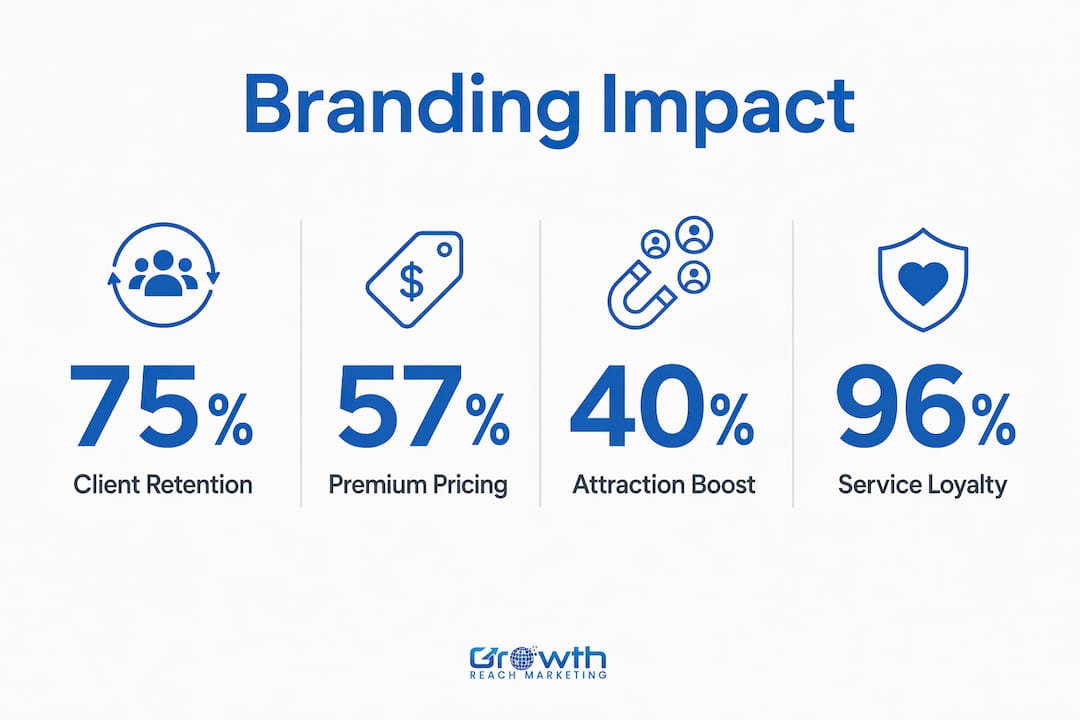
“96% of customers consider customer service a critical factor in brand loyalty, making consistent brand promise delivery the key driver of repeat bookings. Repeat clients require less marketing spend and spend more per visit on average.”
The data above points to one conclusion: your brand promise must be delivered every single time, not just on a good day. A client who experiences a mismatch between your brand’s promise and the actual service will not return. One who experiences alignment becomes a referral source.
The table below shows how branding affects key business outcomes for salons.
| Business outcome | Impact of strong branding |
|---|---|
| Client retention | Repeat bookings increase when brand promise is delivered consistently |
| Pricing power | Clear brand identity supports premium rates without heavy discounting |
| Referral rate | Emotionally connected clients refer friends at a higher rate |
| Marketing efficiency | Loyal clients cost less to retain than new clients cost to acquire |
| Online visibility | Consistent digital branding improves Google and social media trust signals |
Salon marketing and branding work together here. A well-branded salon gives its social media strategy something real to communicate. Without a defined brand, social media posts feel random and fail to build recognition.
Common misconceptions about salon branding
The most damaging misconception is that branding is a one-time design project. Salon owners invest in a logo, pick some fonts, and consider the job done. Branding involves every interaction from discovery through post-appointment follow-up, not just visible design assets.
The second misconception is that branding is a marketing expense rather than a business investment. Marketing spends money to get attention. Branding builds the asset that makes that attention convert into bookings. A salon with weak branding can run ads and still see poor results because nothing about the business compels a stranger to trust it.
The third misconception is that visual consistency is optional. Inconsistent branding across touchpoints confuses clients and reduces conversion opportunities. A client who sees a luxury brand on Instagram and walks into a dated, disorganized salon feels deceived. That gap destroys trust faster than any bad review.
- Branding is not a logo. It is the full client experience from first click to final follow-up.
- Branding is not a cost. It is the foundation that makes every marketing dollar work harder.
- Branding is not static. It requires regular review as your salon grows and your client base evolves.
- Visual inconsistency is not a minor detail. It actively deters ideal clients who expect a premium experience.
Pro Tip: Write a one-paragraph brand description that captures your salon’s personality, values, and client promise. Share it with every team member and use it as the filter for every design, post, and client communication decision.
How to develop and implement a salon branding strategy
Building a salon branding strategy starts with clarity about who you serve and what you stand for. Vague positioning attracts no one in particular. Specific positioning attracts exactly the right clients.
- Define your target client. Identify the specific person your salon is built for. Age, lifestyle, values, and what they want to feel after a visit. Growthreachmarketing’s client segmentation guide walks through this process in detail for beauty businesses.
- Craft your unique value proposition. State in one sentence what your salon delivers that no one else in your area does. This becomes the foundation of all messaging.
- Design consistent visual and verbal assets. Commission a logo, select a color palette with psychological intent, and write brand guidelines that cover tone of voice, image style, and typography. Apply these across your website, social media, signage, and printed materials.
- Build digital authority. Google reviews and Instagram presence significantly influence new client bookings. A consistent, professional digital presence reinforces your brand’s credibility before a client ever walks through the door.
- Train your team. Every staff member is a brand representative. Their language, behavior, and service delivery must reflect the brand promise. Brand guidelines are not just for designers; they are for everyone who interacts with clients.
The comparison below shows the difference between a reactive approach to branding and a deliberate one.
| Reactive branding | Deliberate branding |
|---|---|
| Logo designed without a brand strategy | Logo created from defined values and client profile |
| Social media posts based on what feels good | Content guided by brand voice and client aspirations |
| Pricing set by local competition | Pricing anchored to perceived brand value |
| Staff hired for technical skill only | Staff hired and trained to deliver the brand experience |
| No brand guidelines | Written brand guidelines shared with the full team |
Salon content marketing is one of the most effective ways to reinforce brand authority over time. Educational posts, before-and-after results, and client stories all build the emotional connection that turns a first-time visitor into a loyal regular.
Salon before-and-after photos are a specific visual branding tool that deserves its own attention. Consistent photo style, lighting, and framing across your portfolio signals professionalism and builds trust before a client books.
Key Takeaways
Salon branding is the single most powerful lever for attracting premium clients, commanding higher prices, and building a business that grows through loyalty rather than constant discounting.
| Point | Details |
|---|---|
| Branding is not a logo | The real brand lives in your story, values, and every client interaction from discovery to follow-up. |
| Trust drives retention | Well-crafted branding increases customer trust by up to 82%, directly supporting repeat bookings. |
| Consistency is non-negotiable | Visual and experiential inconsistency across touchpoints confuses clients and reduces conversions. |
| Branding enables premium pricing | A clear brand identity reduces reliance on discounting and attracts higher-value clients. |
| Strategy beats instinct | Deliberate brand guidelines, staff training, and digital consistency outperform reactive design choices. |
Why salon branding is a leadership decision, not a design decision
The salons I see struggle most with branding are not struggling because they lack a good logo. They are struggling because the owner has not made the mental shift from technician to brand leader. Salon owners must adopt a brand leadership mindset, sharing expertise to position the salon as a premium destination rather than just a place to get a haircut.
That shift changes everything. When you see yourself as a brand leader, you stop making decisions based on what you personally like and start making decisions based on what your ideal client needs to feel. You stop posting on Instagram when you feel like it and start building a content presence that communicates authority. You stop hiring based on technical skill alone and start hiring for cultural fit.
Branding is also not a project with an end date. It is an ongoing relationship with your market. The salons that grow reliably are the ones that treat their brand as a living asset, reviewing it regularly, updating it as their client base evolves, and investing in it the same way they invest in education and equipment. That is the mindset that separates a salon that survives from one that leads its market.
— Gerard
How Growthreachmarketing helps salons build brands that get found
A strong salon identity means nothing if the right clients never find you. Growthreachmarketing works with salons and beauty brands to connect their branding with the digital visibility that fills appointment books. That means local SEO for beauty brands built around your specific market, content that reinforces your brand authority on Google, and marketing systems designed to convert online attention into confirmed bookings.
The salons that grow fastest are the ones that treat branding and search visibility as one connected system, not two separate projects. Growthreachmarketing builds that system for you, from brand-aligned content to local search rankings that put your salon in front of clients who are ready to book.
FAQ
What does salon branding mean in simple terms?
Salon branding is the creation of a consistent identity that communicates your salon’s personality, values, and client promise across every touchpoint. It includes visual design, messaging, and the experience clients have every time they interact with your business.
Is a logo the same as a salon brand?
A logo is not a brand. The brand encompasses your salon’s story, culture, values, and the emotional connection built through every client interaction, from your Instagram presence to your post-appointment follow-up.
Why does salon branding matter for pricing?
Strong branding reduces reliance on discounting by attracting clients who value the experience your salon delivers. Salons with a clear brand identity can charge premium rates because clients perceive higher value before they even book.
How does branding affect client loyalty?
96% of customers cite customer service as a critical factor in brand loyalty. Delivering your brand promise consistently at every visit is the most direct path to repeat bookings and referrals.
How do I start building a salon brand?
Start by defining your ideal client and your unique value proposition. Then design consistent visual assets, write brand guidelines, train your team, and build a digital presence that reflects the same identity across every platform.
Recommended
- What Is Salon Content Marketing? 2026 Guide – Growth Reach Marketing
- Types of Salon Marketing Strategies That Fill Chairs – Growth Reach Marketing
- Salon Before After Photos Marketing: 2026 Guide – Growth Reach Marketing
- Why Salons Need a Keyword Strategy to Book More Clients – Growth Reach Marketing