
A differentiation strategy is defined as the deliberate process of creating unique brand qualities that make a business meaningfully distinct from its competitors. For aesthetic brands, clinics, and salons, this is not optional. 46% of consumers cannot distinguish between the digital experiences of competing brands. That statistic means nearly half your potential clients see you as interchangeable with the clinic down the street. A strong differentiation strategy changes that. It builds loyalty, supports premium pricing, and reduces the cost of acquiring new clients. Growthreachmarketing works with aesthetic businesses daily and sees this gap play out in real revenue losses.
Why aesthetic brands need a differentiation strategy to compete
Brand differentiation, the industry term for this practice, is the foundation of any sustainable aesthetic brand marketing strategy. Without it, you compete on price alone. Price competition is a losing game for most aesthetic businesses because it erodes margins without building loyalty.
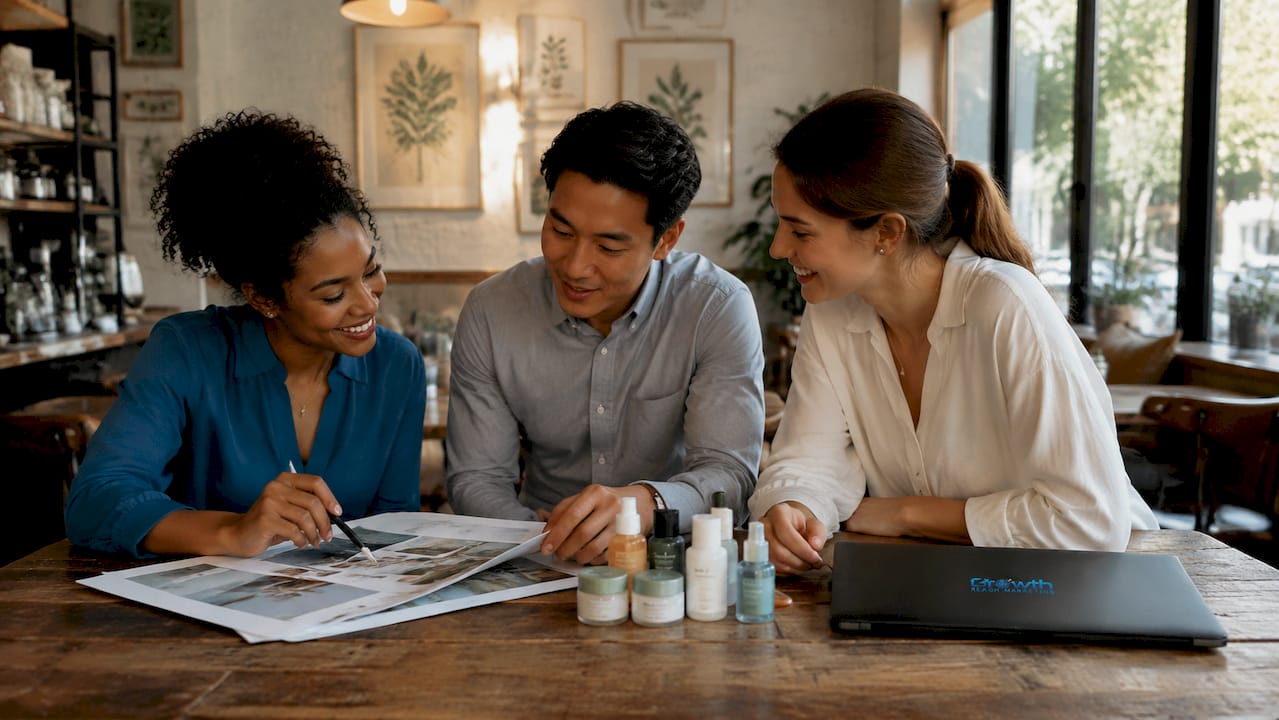
The aesthetic market has a specific problem: most clinics and salons offer nearly identical service menus. Botox, fillers, facials, and laser treatments appear on hundreds of local websites with near-identical copy. Clients searching online cannot tell one provider from another. Differentiation supports lower client acquisition costs, higher retention rates, and stronger brand recognition. Each of those outcomes compounds over time, making your business harder to displace.
The brands that win in aesthetics do not just offer better products. They offer a clearer identity, a more consistent experience, and a stronger reason to choose them over anyone else. That clarity is the core benefit of brand differentiation, and it starts with a deliberate strategy, not an accident.
How differentiation creates pricing power for aesthetic brands
Aesthetic brand competitive advantage comes from owning a position that competitors cannot easily copy. Aesop is the clearest proof of this principle. The brand maintains 87% profit margins by positioning its products as cultural statements rather than functional skincare. Clients are not buying hand wash. They are buying a worldview. That positioning removes price sensitivity almost entirely.
Most aesthetic businesses compete on two levels: operational and marketing. Operational differentiation means your systems, speed, sustainability practices, or client experience are genuinely better. Marketing differentiation means your brand story, visual identity, and messaging communicate a distinct value that resonates emotionally. The strongest brands do both.
When you differentiate effectively, you stop competing on price. Clients who connect with your brand identity pay full rates without negotiating. They refer friends. They return without needing a discount to come back. That cycle is the real financial argument for investing in differentiation.
Pro Tip: Build a one-sentence brand position statement before you touch your website, social media, or ad copy. It should answer: who you serve, what you do differently, and why that matters to them. Every piece of content you create should pass that filter.
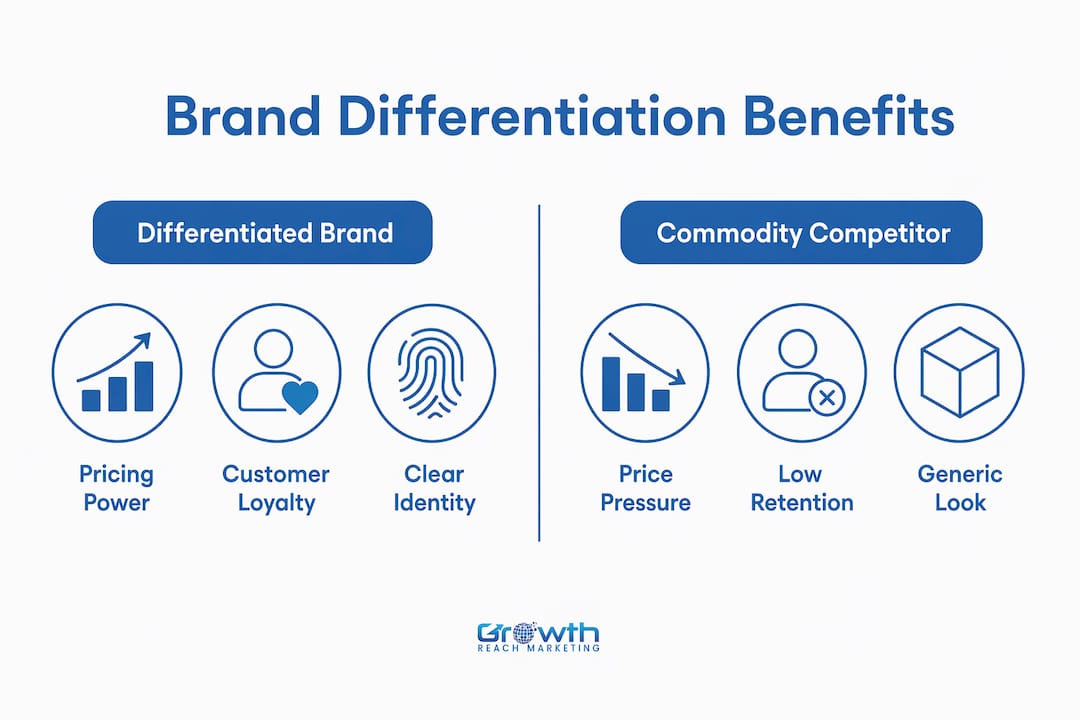
Differentiation benefits vs. commodity competition
| Factor | Differentiated brand | Commodity competitor |
|---|---|---|
| Pricing power | Commands full rates without discounting | Competes on lowest price |
| Client loyalty | High repeat bookings and referrals | Low retention, high churn |
| Acquisition cost | Lower due to word-of-mouth and recognition | High, relies on constant paid ads |
| Market position | Defensible and hard to replicate | Easily displaced by a cheaper option |
| Revenue stability | Consistent, less seasonal volatility | Highly sensitive to promotions and deals |
How visual identity drives aesthetic brand recognition and retention
Visual identity is not decoration. For aesthetic brands, it is a competitive asset. Brightland, the premium olive oil brand, built over $40 million in annual revenue with more than 60% of its clients returning. The engine behind that number was a consistent, art-directed visual identity applied across every touchpoint. The lesson transfers directly to aesthetic clinics and beauty brands.
Most aesthetic businesses treat photography and design as afterthoughts. They use stock images, inconsistent fonts, and whatever filter is trending on Instagram that week. That approach produces a brand that looks like everyone else. Visual consistency, applied with discipline, creates recognition. Recognition creates trust. Trust converts browsers into booked appointments.
The concept of a “rejection vocabulary” is one of the most underused tools in aesthetic brand management. A rejection vocabulary is a documented list of visual and creative choices your brand will never make. It defines what you are not, which makes it easier to say no to off-brand content before it dilutes your identity. Think of it as a creative guardrail, not a limitation.
Here is what a strong visual identity system includes for aesthetic brands:
- A defined color palette with no more than three to four primary colors applied consistently across all platforms
- A typography system with one heading font and one body font, used without exception
- A photography style guide specifying lighting, model direction, background, and mood
- A rejection vocabulary listing visual styles, filters, and content types the brand will never use
- Brand templates for social media, email, and print that require no creative decisions at the point of execution
Pro Tip: Hire a brand photographer once per quarter rather than relying on phone photos. A single day of professional photography produces enough consistent content to maintain your visual identity for three months across all channels.
Building differentiation beyond product: operational and market strategies
The aesthetic industry has a commoditization problem at the formulation level. When every brand sells the same actives, hyaluronic acid, retinol, vitamin C, and peptides, the product itself cannot be your differentiator. Strategy becomes the only real differentiator. This is the insight that separates growing aesthetic businesses from stagnant ones.
Operational differentiation means building advantages into how you run your business, not just how you market it. Sustainability practices, faster appointment turnaround, superior aftercare systems, and transparent ingredient sourcing all create real differences that clients notice and remember. These advantages are also harder for competitors to copy than a rebrand or a new ad campaign.
Serving an underserved segment is one of the fastest paths to differentiation in aesthetics. Clients with darker skin tones, male clients, clients over 60, or clients with specific medical conditions are frequently underserved by mainstream aesthetic brands. Choosing to specialize in one of these groups creates an immediate and defensible market position. You become the obvious choice rather than one of many options.
Operational differentiation tactics that work for aesthetic businesses include:
- Developing a documented aftercare system that clients receive at every appointment, creating a consistent and memorable experience
- Offering transparent pricing with no hidden fees, which builds trust in markets where clients feel uncertain about costs
- Building a sustainability narrative around product sourcing, packaging, or clinic operations that resonates with environmentally conscious clients
- Creating a client experience framework that standardizes every touchpoint from booking to follow-up
- Partnering with complementary local businesses to create referral networks that competitors have not built
Understanding how aesthetic brands build early awareness is also part of this operational picture. Awareness built through genuine differentiation lasts longer and costs less to maintain than awareness built through discounting.
How to measure and maintain effective brand differentiation
The clearest signal that your differentiation is working is pricing power. Identify the client segments where clients pay your full rate without asking for a discount. Those segments are where your differentiation is real and recognized. Focus your growth efforts there.
The race to the bottom is the most common trap in aesthetic marketing. A clinic drops prices to fill appointment slots. Competitors match the discount. Both businesses attract price-sensitive clients who leave the moment a cheaper option appears. Neither builds loyalty. Neither builds a brand. The exit from this trap is not a better promotion. It is a clearer differentiation that makes price comparison irrelevant.
Here are four steps to measure and strengthen your differentiation:
- Audit your client base by segment. Identify which service types and client profiles generate full-rate bookings with no discount requests. These are your differentiation proof points.
- Survey your best clients. Ask them directly why they chose you and why they return. Their language will reveal your real differentiation, which is often different from what you think it is.
- Raise rates in your strongest segments. If clients in a specific service category never push back on price, test a rate increase. Resistance tells you where differentiation is weak. Acceptance tells you where it is strong.
- Release low-margin clients deliberately. Clients who only book during promotions or who consistently negotiate rates are not your target market. Freeing that capacity allows you to serve clients who value your brand. Social proof from loyal clients then reinforces your differentiation to new prospects.
Key Takeaways
Aesthetic brands that build differentiation beyond product formulation command premium pricing, retain more clients, and create competitive positions that are genuinely hard to displace.
| Point | Details |
|---|---|
| Differentiation prevents price competition | Brands with a clear identity attract clients who pay full rates without negotiating. |
| Visual identity is a revenue asset | Brightland’s consistent visual system drove $40 million in revenue and 60% client return rates. |
| Rejection vocabulary protects brand consistency | Documenting what your brand will never do prevents style drift and off-brand content. |
| Operational advantages outlast marketing tactics | Supply chain, aftercare systems, and sustainability create differentiation competitors cannot copy quickly. |
| Pricing power reveals true differentiation | Segments where clients pay full rates without discounts show where your brand strategy is working. |
Why most aesthetic brands get differentiation wrong
Aesthetic brands almost always make the same mistake. They focus entirely on product features and treatment outcomes, then wonder why clients still shop on price. I have seen this pattern repeatedly. A clinic invests in the latest laser technology, updates its treatment menu, and writes detailed clinical copy. Nothing changes. Clients still ask for discounts. Competitors still feel interchangeable.
The problem is that product messaging addresses the rational mind. Differentiation works on identity. Clients do not choose an aesthetic clinic because it has the most advanced equipment. They choose it because it feels like the right place for them. That feeling comes from visual identity, brand voice, client experience, and the story the brand tells consistently over time.
Creative conviction is the discipline of saying no. No to the trending content format that does not fit your brand. No to the discount that fills a slot but trains clients to wait for the next sale. No to the partnership that looks good on paper but muddies your positioning. Aesthetic brands that integrate creative conviction with operational strategy outperform those that rely on product messaging alone. That is not a theory. It is what the data from brands like Brightland and Aesop shows.
Build your differentiation narrative before you build your next campaign. Know what you stand for, who you serve, and what you will never compromise on. Then apply that clarity to every channel, every piece of content, and every client interaction. That is how enduring aesthetic brands are built.
— Gerard
How Growthreachmarketing helps aesthetic brands stand out
Aesthetic businesses that invest in differentiation still need the right digital infrastructure to make that positioning visible. A clear brand identity means nothing if the right clients cannot find you online.
Growthreachmarketing specializes in SEO, content marketing, and lead generation for aesthetic clinics, salons, and beauty brands. The team builds digital systems that translate your differentiation into search visibility, booked appointments, and measurable growth. If you are ready to stop competing on price and start owning a clear market position, the aesthetic clinic SEO strategy page is the right starting point. You can also explore beauty industry content marketing to see how content builds differentiation at scale.
FAQ
What is brand differentiation for aesthetic businesses?
Brand differentiation is the process of creating unique qualities, experiences, or positioning that make an aesthetic business meaningfully distinct from competitors. It goes beyond services offered to include visual identity, client experience, and brand story.
Why do aesthetic brands struggle to differentiate?
Most aesthetic brands focus on product features and treatment menus, which are nearly identical across competitors. 46% of consumers cannot distinguish between competing brands digitally, which shows how common this failure is.
How does visual identity support brand differentiation?
A consistent visual identity builds recognition and trust across every client touchpoint. Brightland’s disciplined visual system produced over $40 million in revenue and a 60% client return rate, proving that creative consistency drives real business results.
What is a rejection vocabulary and why does it matter?
A rejection vocabulary is a documented list of visual and creative choices a brand will never make. It prevents style drift and keeps every piece of content aligned with the brand’s established identity.
How do I know if my differentiation strategy is working?
The clearest signal is pricing power. Identify client segments where clients pay your full rate without requesting a discount. Those segments confirm that your differentiation is recognized and valued.
Recommended
- Why Aesthetic Clinics Need Omnichannel Marketing – Growth Reach Marketing
- 1780189187633_Marketing-team-discussing-aesthetic-agency-strategies-1 – Growth Reach Marketing
- 1780189187633_Marketing-team-discussing-aesthetic-agency-strategies – Growth Reach Marketing
- Top 5 AestheticConversion.com Alternatives Agencies 2026 – Growth Reach Marketing