
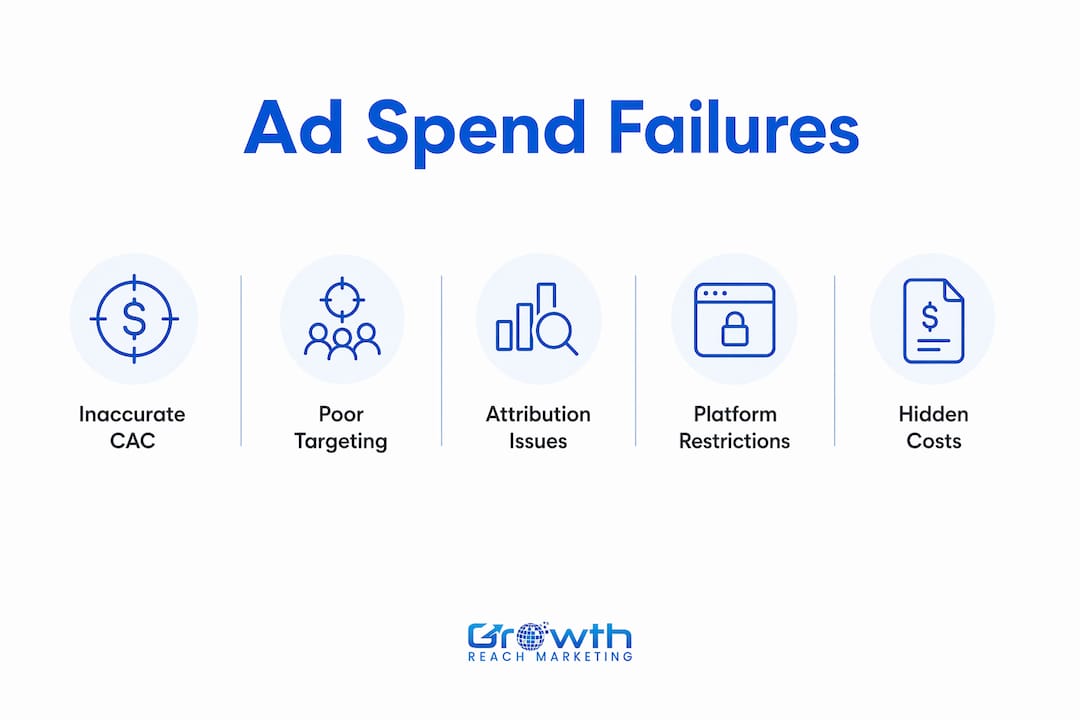
Aesthetic clinics lose paid ad spend because of three compounding failures: inaccurate customer acquisition cost (CAC) calculations, low-intent audience targeting, and platform-level tracking restrictions that silently degrade campaign data. Over 30% of digital ad budgets are wasted on mistargeted audiences and preventable configuration errors. That number is higher in aesthetics, where Meta’s Health and Wellness domain restrictions, coordinator labor costs, and last-click attribution errors all work against you simultaneously. Understanding each failure point is the first step toward fixing your numbers.
Why aesthetic clinics lose paid ad spend on inaccurate CAC
Customer acquisition cost is the single most misunderstood metric in aesthetic clinic marketing. Most clinics calculate CAC as total marketing spend divided by total leads. That formula underestimates your true acquisition cost by 5 to 15 times once you factor in coordinator labor and technology subscriptions. The practical consequence is that you believe a channel is profitable when it is actively losing you money.
Here is what a complete CAC calculation must include:
- Ad spend across all paid channels for the period
- Agency or freelancer fees tied to campaign management
- Coordinator labor for following up on leads, booking calls, and handling no-shows
- CRM and booking software costs allocated per patient acquired
- Creative production costs for photography, video, and copywriting
Hidden coordinator labor adds roughly $52.50 to your true CAC per booked patient. That figure alone can turn a campaign that looks profitable on paper into one that destroys margin. Leads that never convert still consume coordinator time, so every unqualified lead has a real dollar cost attached to it.
The benchmark you need to maintain is a lifetime value to CAC ratio above 3:1. If a patient is worth $1,800 in lifetime revenue and your true CAC is $700, you are operating below that threshold. Clinics that implement proper CAC tracking consistently report 30 to 40% lower acquisition costs than those using the simple formula, because accurate data forces better budget decisions.

Pro Tip: Build a CAC dashboard inside HubSpot or a Google Sheets model that pulls booking data from your CRM, coordinator hours from your scheduling tool, and ad spend from Google Ads and Meta Ads Manager. Segment by channel and by procedure type. You will identify your worst-performing channel within the first 30 days.
How poor targeting wastes budget on the wrong patients
The structural problem with Meta Ads is that the platform optimizes for the cheapest form completion, not the highest-intent patient. Facebook lead ads favor low-intent submissions, producing conversion rates as low as 1 to 2% from lead to booked appointment. Leads that look cheap at $8 to $15 per form fill often convert at 10 to 25 times the reported cost per lead once you track them through to actual bookings.
The targeting mistakes that accelerate this problem include:
- Broad interest-based audiences that include people casually browsing aesthetics content with no purchase intent
- No exclusion lists to filter out existing patients, competitors, and job seekers
- Single-stage funnels that send cold traffic directly to a booking page without warming them first
- No retargeting layers for website visitors, video viewers, or Instagram engagers who have already shown real interest
- Creative fatigue ignored until ROAS collapses, rather than monitored proactively
Audience saturation and creative fatigue cause rising CPMs and declining click-through rates over time. When ad frequency climbs above 2.5, CTR drops and cost per result rises. Most clinic campaigns run the same creative for 60 to 90 days without rotation, which is the primary driver of ROAS decline outside of attribution changes.
The fix is a structured funnel. Cold audiences receive awareness content: before-and-after results, educational videos, and social proof. Warm audiences, meaning people who have visited your site or engaged with your content, receive direct response ads with specific offers. Understanding the types of retargeting ads available for aesthetic clinics helps you build that warm layer correctly. Clinics that add omnichannel marketing alongside paid ads consistently reduce their reliance on cold traffic and lower blended CAC.
Pro Tip: Rotate creative every 21 days on Meta. Set a frequency cap alert at 2.0 inside Meta Ads Manager. When you hit that threshold, pause the ad set and launch a new creative variant before performance drops.
How platform attribution restrictions silently raise your CPA
Meta’s tracking environment in 2026 creates two distinct problems for aesthetic clinics that most marketers do not catch until significant budget has already been wasted.
The first problem is domain classification. Meta restricts conversion event tracking on domains classified under its Health and Wellness restricted category without sending any ad disapproval notice. Your ads keep running. Your spend keeps flowing. But the conversion signals that tell Meta’s algorithm who to target next are being suppressed. The algorithm shifts from optimizing for booked appointments to optimizing for clicks, which fills your pipeline with low-quality traffic at rising cost per acquisition.
The second problem is attribution modeling. Meta’s Andromeda attribution system reports lower ROAS than previous systems because it uses conservative conversion crediting. Reported ROAS can drop 15 to 40% while your actual revenue stays flat. Clinics that do not cross-reference Meta’s reported numbers against GA4 and their booking system revenue interpret this as campaign failure and cut budgets that were actually performing.
Here is a direct comparison of the two tracking failure modes:
| Failure type | What you see | What is actually happening |
|---|---|---|
| Health and Wellness domain restriction | Normal ad delivery, rising CPA | Conversion events blocked, algorithm optimizing for clicks |
| Andromeda attribution change | ROAS drop of 15 to 40% | Conservative crediting model, real revenue unchanged |
| Pixel plus CAPI deduplication error | Inflated or missing conversion counts | Double-counted or lost events distort audience signals |
Last-click attribution compounds all three problems by crediting conversions to direct visits instead of the paid channel that initiated the patient journey. A patient sees your Meta ad, visits your site three days later via Google search, and books. Meta gets no credit. You cut the Meta campaign. Bookings drop and you do not understand why.
The technical fix for domain restrictions is routing traffic through a clean intermediary domain with server-side event routing to restore conversion signal quality. For attribution, triangulating Meta ROAS with GA4 data and total business revenue prevents premature budget cuts during system rollouts.
Pro Tip: Audit your Meta Events Manager monthly. Check that your Conversions API is firing server-side events and that deduplication is configured correctly. A mismatch between browser pixel events and CAPI events is the most common cause of inflated or missing conversion data.
Which ad channels actually deliver the lowest CAC for clinics
The channel comparison most clinics never run is true CAC by source, not cost per lead by source. Those are completely different numbers, and confusing them is a primary reason for wasting budget on ads.
Meta Ads typically produce a lower reported cost per lead than Google Ads. Google search campaigns for terms like “botox near me” or “lip filler city]” cost more per click. But [proper CAC dashboards that segment by channel and procedure type reveal that Facebook CAC is often three to four times higher than Google Ads CAC once lead quality and booking conversion rates are factored in. Clinics that reallocate budget based on this data acquire 40% more patients on the same total spend within 90 days.
| Channel | Typical reported CPL | Typical true CAC | Lead-to-booking rate |
|---|---|---|---|
| Meta lead ads | $8 to $20 | $280 to $600 | 1 to 5% |
| Google search ads | $35 to $80 | $120 to $250 | 15 to 30% |
| Organic SEO | Near zero marginal cost | $60 to $150 | 20 to 40% |
Blended CAC, meaning total spend divided by total patients across all channels, masks this reality entirely. A clinic spending 70% of its budget on Meta and 30% on Google will see a blended CAC that looks acceptable, while Google is carrying the performance and Meta is dragging it down. Separating CAC by channel exposes that imbalance immediately. Resources like the programmatic advertising guide for clinics outline how to structure budget allocation once you have clean channel-level data.
The practical recommendation is to run a 90-day CAC audit across every active channel. Build a simple model that connects ad spend, coordinator time, and booked appointments by source. The data will tell you where to cut and where to scale without guesswork.
Key takeaways
Aesthetic clinics lose paid ad spend because surface metrics like cost per lead hide the true cost of patient acquisition, and platform restrictions degrade the data needed to optimize campaigns.
| Point | Details |
|---|---|
| True CAC is 5 to 15x higher than reported | Include coordinator labor, tech costs, and agency fees to get an accurate acquisition cost. |
| Meta optimizes for volume, not intent | Facebook lead ads produce 1 to 5% booking rates; true CAC often exceeds $400 per patient. |
| Domain restrictions block conversion signals | Meta’s Health and Wellness classification suppresses event data without notifying you. |
| Andromeda attribution drops reported ROAS | A 15 to 40% ROAS drop may reflect a modeling change, not actual campaign failure. |
| Channel-level CAC reveals real performance | Google Ads and SEO typically deliver 2 to 4x lower true CAC than Meta lead ads. |
What I have learned diagnosing wasted ad spend for aesthetic clinics
The most damaging mistake I see clinic owners make is cutting budgets based on reported platform metrics without triangulating against real business revenue. Meta’s Andromeda rollout in 2026 caused dozens of clinics to pause campaigns that were generating real bookings, because the reported ROAS dropped and no one checked the booking system to verify. That is an expensive lesson.
My honest view is that the paid advertising challenges for clinics are less about creative quality and more about measurement infrastructure. You can have the best before-and-after ads in your market and still lose money if your CAC calculation is wrong, your pixel is misfiring, or your coordinator is spending two hours per day chasing leads that were never going to book. Fix the measurement layer first. Then optimize the creative.
The clinics I have seen recover the most wasted spend share one habit: they review channel-level CAC monthly, not quarterly. Monthly reviews catch creative fatigue before it destroys ROAS, catch domain restriction issues before they inflate CPA for a full quarter, and catch attribution drift before it triggers a bad budget decision. That cadence is not complicated. It just requires building the dashboard and committing to the review.
If you are running paid ads and relying solely on Meta Ads Manager or Google Ads reports for performance decisions, you are working with incomplete data. Pull your booking system revenue, your coordinator hours, and your GA4 data into the same view. The picture that emerges will be uncomfortable. It will also be accurate.
— Gerard
How Growthreachmarketing helps clinics stop losing ad budget
Growthreachmarketing works with aesthetic clinics to build the measurement infrastructure that makes paid advertising actually profitable. That means CAC dashboards segmented by channel and procedure, Meta pixel audits that identify Health and Wellness domain restrictions, and server-side Conversions API setup that restores conversion signal quality. The goal is not more leads. It is more booked patients at a lower verified cost. If your Google Ads conversion tracking is misconfigured or your Meta campaigns are optimizing for the wrong events, every pound of ad spend you add makes the problem worse. Growthreachmarketing audits the full system and rebuilds it around data that reflects real patient acquisition. You can also learn how data collection directly improves advertising ROI at every stage of the funnel.
FAQ
Why do aesthetic clinics waste so much on paid ads?
Aesthetic clinics waste paid ad spend primarily because they measure cost per lead instead of true CAC, which underestimates real acquisition costs by 5 to 15 times. Platform restrictions and attribution errors compound the problem by degrading the data used to optimize campaigns.
What is a good CAC for an aesthetic clinic?
A healthy CAC depends on procedure lifetime value, but clinics should maintain a lifetime value to CAC ratio above 3:1. For most aesthetic treatments, a true CAC below $200 via Google Ads or SEO is achievable with accurate tracking and audience segmentation.
How does Meta’s Health and Wellness restriction affect ad performance?
Meta silently suppresses conversion event data on domains it classifies as Health and Wellness, causing the algorithm to optimize for clicks rather than bookings. This raises CPA without triggering any ad disapproval notice, making it one of the hardest restrictions to detect.
Is Google Ads or Meta Ads better for aesthetic clinics?
Google search ads typically deliver a lower true CAC for aesthetic clinics because they capture high-intent patients actively searching for treatments. Meta Ads produce cheaper leads but convert at 1 to 5%, making the true cost per booked patient three to four times higher in most clinic case studies.
How can I tell if my ad tracking is broken?
Compare your Meta Ads Manager reported conversions against your booking system records for the same period. A gap of more than 20% indicates pixel misfiring, CAPI deduplication errors, or domain-level conversion suppression that needs immediate technical correction.