
Most marketers assume ad copy is just “the text in the ad.” That’s technically true and practically useless as a working definition. Understanding what does ad copy mean in Google Ads requires a different frame: it’s a precisely constrained, intent-matching message designed to convert someone who is already searching for what you offer. You’re not creating desire. You’re meeting it. This article covers the definition of ad copy in Google Ads, how its structure works, how to write ad copy that actually performs, real examples, and the most common mistakes that waste your budget.
Table of Contents
- Key takeaways
- What ad copy means in Google Ads
- Google Ads ad copy structure and formats
- Best practices for writing effective ad copy
- Ad copy examples that work
- Common mistakes to avoid in ad copy
- My honest take on Google Ads copywriting
- How Growthreachmarketing can help your Google Ads perform
- FAQ
Key takeaways
| Point | Details |
|---|---|
| Ad copy responds to existing intent | Google Ads copy doesn’t create demand. It meets searchers where they already are. |
| Character limits demand precision | Headlines cap at 30 characters and descriptions at 90, so every word must earn its place. |
| Message match drives conversions | Your ad copy and landing page must say the same thing, or you’ll lose the click you paid for. |
| Testing is built into the format | Responsive search ads let you run multiple headlines and descriptions simultaneously. |
| Quality Score depends on your copy | Ad relevance and expected CTR are Quality Score factors directly shaped by your copy quality. |
What ad copy means in Google Ads
The definition of ad copy in Google Ads is the written text that appears in your paid search advertisements. It includes your headlines, description lines, and display URL paths. But the definition matters less than the function.
Google Ads copywriting differs fundamentally from other marketing writing because it responds to an active search query rather than interrupting someone mid-scroll. When someone types “laser facial near me” or “best accountant for freelancers,” they’ve already told you what they want. Your ad copy’s job is to confirm, in two seconds or less, that you have exactly that.
This is what separates PPC copy from social media ads, banner ads, or even website copy. Social ads generate awareness. Website copy explains and converts. Google Ads copy does one specific thing: it qualifies the click. Every word you write should answer the searcher’s implied question: “Is this for me?”
“Ad copy in Google Ads isn’t about being clever or creative. It’s about being the most relevant answer in the room.”
Because searchers already want something, your copy must fit that need precisely or be ignored. A salon owner running ads for “balayage highlights” can’t write generic copy about “hair services.” Specificity wins every time.
Key principles that define effective Google Ads ad copy:
- It speaks directly to the search query, not around it
- It communicates a clear benefit or solution in minimal words
- It uses the character limits as a discipline, not a limitation
- It filters out the wrong clicks while attracting the right ones
- It sets up the landing page by matching the message the user expects
Google Ads ad copy structure and formats
To write strong ad copy, you need to know what you’re actually building. Google Ads uses a format called responsive search ads (RSAs), which is now the primary format for search campaigns.
Here’s how the structure breaks down:
| Component | Character limit | Purpose |
|---|---|---|
| Headline | 30 characters each (up to 15) | Grabs attention; mirrors the search query |
| Description | 90 characters each (up to 4) | Expands on the benefit; includes call to action |
| Display URL path fields | 15 characters each (2 fields) | Adds keyword context to the URL shown |
Headlines are capped at 30 characters and descriptions at 90, which means every syllable counts. Google displays a combination of your submitted headlines and descriptions, choosing the mix it predicts will perform best for each query. This is why responsive search ads recommend filling all available headline and description slots. The more combinations you provide, the more Google’s algorithm can test and optimize.

Dynamic keyword insertion (DKI) is a feature worth understanding here. It automatically replaces a placeholder in your ad with the user’s search term. For example, a headline written as “Buy {KeyWord:Running Shoes}” would display as “Buy Trail Running Shoes” if someone searched that phrase. This increases relevance, but DKI can appear spammy if overused or applied to headlines where the inserted phrase reads awkwardly.
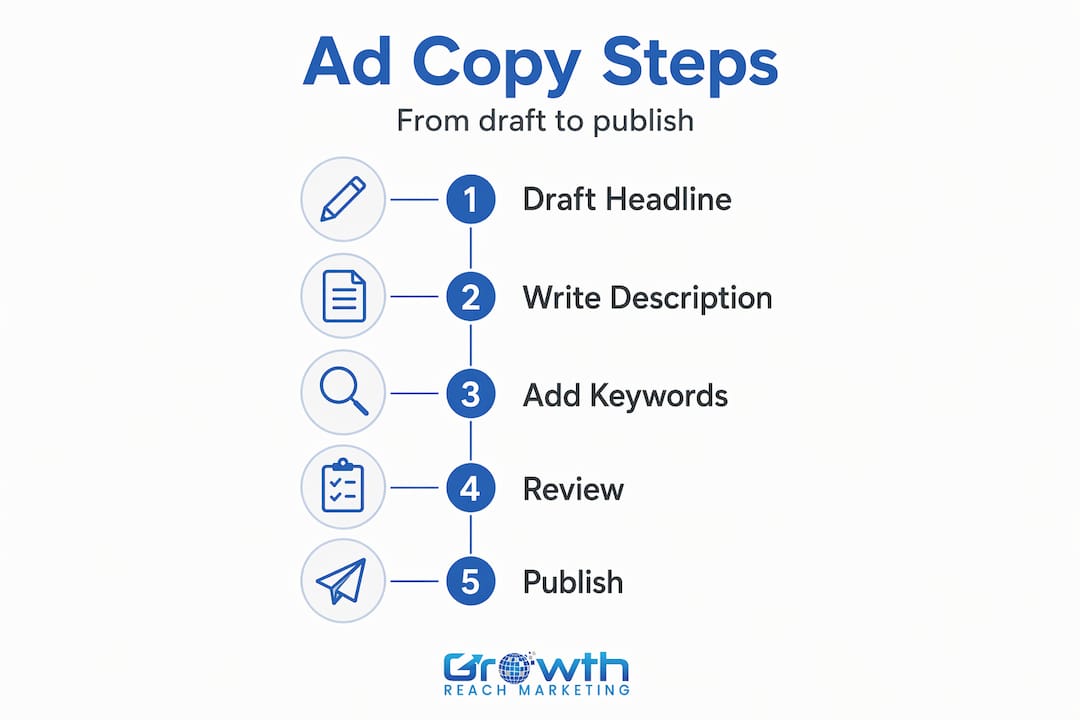
Pro Tip: Pin your strongest headline to position one in a responsive search ad. This locks that headline into the first slot every time, giving you control over the most visible part of your ad while still letting Google test the rest.
Best practices for writing effective ad copy
Writing ad copy that converts is a craft. Here’s a practical approach that works across industries.
-
Mirror the search query in at least one headline. If someone searches “emergency plumber London,” your headline should say “Emergency Plumber” or close to it. This isn’t keyword stuffing. It’s confirmation that you’re the right result.
-
Lead with the benefit, not the feature. “Book in 60 Seconds” beats “Online Booking Available.” The first tells the searcher what they get; the second describes what you have.
-
Use a specific call to action. “Book Your Free Consultation” outperforms “Contact Us” in almost every test. Specificity reduces friction. The user knows exactly what happens next.
-
Match the funnel stage. Someone searching “what is laser hair removal” is early in their decision. Someone searching “laser hair removal price Edinburgh” is close to booking. Write different copy for each.
-
Align your ad copy with your landing page. Message match between ad and landing page directly affects whether someone bounces or converts. If your ad says “50% Off First Facial,” your landing page needs to say that immediately.
-
Use ad extensions. Sitelinks, callouts, and structured snippets add information without touching your character limits. Ad extensions increase ad size and informational value, which positively impacts your expected click-through rate and Quality Score.
-
Test systematically. Run at least three headline variations per theme. Use RSAs to test combinations. Give campaigns two to four weeks before drawing conclusions.
Pro Tip: Write your descriptions as if the headline isn’t there. Descriptions should complete a thought, not repeat the headline. If your headline says “Award-Winning Skin Clinic,” your description should explain why or what that means for the customer.
Ad copy examples that work
The best way to understand good Google Ads copy is to see it in action. Here are several examples across different business types, with notes on why each one works.
Local service business:
- Headline: “Salon Balayage From $120”
- Description: “Book your colour appointment online today. Same-week slots available at our Glasgow studio.”
This works because it answers price (a top concern for searchers), includes a location signal, and reduces hesitation with “same-week slots.”
Aesthetic clinic running a lead generation campaign:
- Headline: “Free Skin Consultation”
- Description: “Not sure which treatment is right for you? Our specialists guide you to the best result. Book today.”
The question in the description mirrors what the searcher is feeling. It builds trust before asking for anything.
E-commerce product ad:
- Headline: “Waterproof Running Shoes”
- Description: “Designed for all-weather trails. Free shipping over $50. Over 4,000 five-star reviews.”
This packs social proof, a practical feature, and a purchase incentive into 90 characters.
Here’s a comparison showing weak versus strong copy for the same search intent:
| Version | Headline | Description | Why it works or fails |
|---|---|---|---|
| Weak | “Hair Services Available” | “We offer a range of treatments for all hair types. Call us today.” | Vague, no specifics, generic CTA |
| Strong | “Balayage Specialist Near You” | “Natural, lived-in colour by accredited stylists. Book online in 2 minutes.” | Specific, benefit-led, frictionless CTA |
The difference is specificity. Ads stuffed with generic promises often fail because they don’t address the specific need of the user. Strong copy sounds like a real person answering a real question.
Common mistakes to avoid in ad copy
Even experienced marketers fall into these traps. Knowing them in advance saves real money.
-
Treating every keyword the same. A campaign with 50 keywords doesn’t need 50 different ads, but it does need ad groups organized by intent. Writing one ad for “cheap dentist” and “emergency dental care” will underperform both.
-
Ignoring character limits until it’s too late. Copy that exceeds limits gets truncated on display. Write within limits from the start, not as an afterthought.
-
Overusing dynamic keyword insertion. DKI is useful for large catalogs, but applying it everywhere creates headlines that read awkwardly or even incorrectly. Always preview what the inserted phrase will look like.
-
Skipping the call to action. An ad with no clear next step leaves the user deciding whether to click. Make it obvious. “Book Now,” “Get a Free Quote,” “See Today’s Prices” all give direction.
-
Mismatching ad copy and landing page. This is the single most expensive mistake. Low ad relevance and landing page experience both drag down your Quality Score, which raises your cost per click while lowering your ad rank.
-
Writing for yourself instead of the searcher. Your tagline and brand voice matter less in ad copy than the user’s specific need. Lead with what they want, not with who you are.
Pro Tip: Before publishing any ad, read it from the perspective of someone who has never heard of your brand. Does it answer their question? Does it tell them exactly what to do? If not, rewrite it.
My honest take on Google Ads copywriting
In my experience working with local service businesses and clinics on Google Ads, the biggest problem I see isn’t poor writing. It’s misplaced priorities. Business owners spend hours perfecting their logo and zero time on their headlines.
I’ve watched ads with mediocre copy outperform “creative” ads consistently, and the reason is always the same: the mediocre ad was specific and relevant. The creative ad was memorable but vague. Google’s system rewards relevance above almost everything else, and ad relevance directly influences Quality Score and what you pay per click.
What I’ve learned is that the best ad copy comes from listening. Read your customer reviews. Look at the phrases people use when they describe their problem. Those phrases belong in your headlines, not in the notes app on your phone. People click ads that sound like they were written for them, not at them.
Testing is where most of the gains come from. The first version of your ad copy is a hypothesis. The version you’re running six months later, shaped by real data, is what actually works. Treat copywriting as an ongoing process, not a one-time task.
— Gerard
How Growthreachmarketing can help your Google Ads perform
If you’ve made it this far, you understand that ad copy isn’t just text. It’s the difference between a campaign that breaks even and one that books appointments. At Growthreachmarketing, we specialize in Google Ads for salons, clinics, and local service businesses. That means we write copy built around how your customers search, not how brands typically advertise. Our team aligns your ad copy with conversion actions so every click has a clear path to a booked appointment or inquiry. If you want to see what that looks like in practice, explore our full range of marketing services built for businesses that need results, not impressions.
FAQ
What does ad copy mean in Google Ads?
Ad copy in Google Ads refers to the written text in your paid search advertisements, including headlines, descriptions, and display URL paths. Its purpose is to match searcher intent and convert clicks into customers.
How long can Google Ads ad copy be?
Google Ads headlines are limited to 30 characters each and descriptions to 90 characters each. Responsive search ads allow up to 15 headlines and 4 descriptions for algorithmic testing.
What makes ad copy effective in Google Ads?
Effective ad copy mirrors the user’s search query, leads with a specific benefit, includes a clear call to action, and matches the message on the landing page. Specificity consistently outperforms generic messaging.
How does ad copy affect Quality Score?
Quality Score components include expected CTR, ad relevance, and landing page experience. All three are directly influenced by how well your ad copy aligns with the user’s search intent.
What is the difference between ad copy and website copy?
Website copy explains, builds trust, and converts over time. Ad copy does one thing: convince a searcher in two seconds that clicking your ad is the right move. The constraints and goals are completely different.